
So the project is finally in full swing! After a couple of weeks of practice sampling and getting used to different protocols for extracting, purifying and amplifying the DNA, we have now moved on to working with our real samples. We have extracted DNA from 18 samples (includes replicates of 3) from the tropical tank and the cold water tank. Funnily, the hardest part of the project so far has been running gels. We initially hit a couple of problems such as thickness of the gel, a loose wire in a gel box and differences in loading buffers and dyes. However, now that Akshay is going to be coming in, hopefully he can give us a couple of hints from his experience from IGEM, cause god knows how many gels he had to make this summer 😛
Category: Misc.

Aquarium Blog Post 1 (#longoverdue)
So after a long and intense summer and first half of fall quarter, the iGEM international competition came and concluded. So now I get the chance to walk down the lab (towards the gel room!) a few more feet and start work on the aquarium project I am helping with in the Eisen Lab. I can now devote more time to the processes of the project, and not just be involved with going to retrive samples from the aquarium, and trying to figure out where we keep our Taq Polymerase. I will try and come in the lab in the next few days, and figure out the workflow and how to get this project going. I am very excited for the project as well as hoping for some actual success in our process. This is the first of many blog posts as well, so stay tuned for the next segment of our project!
Share this:
Thank you interwebs: help proving fungi are cool
Well, am teaching three lectures this week on Fungal Diversity for BIS002C at UC Davis. And I decided tonight to ask the internet for help finding cool new stories on fungi. And boy did the internet come through in the clutch. Thanks internet. See Storification of Twitter and Facebook discussions below:
http://storify.com/phylogenomics/fungi-are-cool.js[View the story “Fungi are cool” on Storify]
Fungi are cool
Storified by Jonathan Eisen · Sun, Nov 04 2012 23:13:14
Twitter Discussion after I asked for suggestions …
Prepping 3 lectures on Fungal Diversity for Intro Bio class at #UCDavis – looking for suggestions for coolest recent fungal stories/studiesJonathan Eisen
@phylogenomics Saccharomyces eubayanus & the new world origin of lager yeast…jashapiro
@phylogenomics well, in the news, jump in fungi in metagenome studies in gulf post BP spill.Kenneth Bruno
@phylogenomics the obvious 1 is the fungal meningitis outbreakKitt Klaiss
@jashapiro reference?Jonathan Eisen
@phylogenomics This looks cool. I’m concerned that intro bio doesn’t have more micro, earlier. Is your syllabus available?Mark O. Martin
@KSBruno9 reference?Jonathan Eisen
@phylogenomics you can discuss Aspergillus around those iatrogenic fungal meningidites…Doctor_Strange
@phylogenomics And I love the whole story on fungi developing ability to degrade lignin leading to end of coal deposits.Kenneth Bruno
@phylogenomics I posted on FB, will get.Kenneth Bruno
@StrangeSource already on the listJonathan Eisen
@phylogenomics http://www.pnas.org/content/early/2011/08/17/1105430108.abstract Nice images here: http://www.news.wisc.edu/newsphotos/lagerYeast11.htmljashapiro
Microbe domestication and the identification of the wild genetic stock of lager-brewing yeastAbstract Domestication of plants and animals promoted humanity’s transition from nomadic to sedentary lifestyles, demographic expansion, …
UW-Madison: University Communications: News PhotosPhotographs are available to media organizations and University of Wisconsin-Madison departments for news, editorial and public relations…
@phylogenomics Think you may have heard of this journal, lol. http://www.plosone.org/article/info%3Adoi%2F10.1371%2Fjournal.pone.0038550Kenneth Bruno
PLOS ONE: Dramatic Shifts in Benthic Microbial Eukaryote Communities following the Deepwater Horizon Oil SpillPLOS ONE: an inclusive, peer-reviewed, open-access resource from the PUBLIC LIBRARY OF SCIENCE. Reports of well-performed scientific stud…
@phylogenomics I’m fond of Scott Strobel’s endophyte course and the discoveries they’re making w undergrads: http://news.yale.edu/2012/10/25/science-magazine-lauds-yale-science-discovery-courseJeramia Ory
Science Magazine lauds Yale science discovery courseAn innovative Yale science course that encourages undergraduates to discover and study plant-associated organisms has been recognized by …
@markowenmartin https://phylogenomics.me/wp-content/uploads/2012/11/lectures.pdfJonathan Eisen
@KSBruno9 heh – that is by @dr_bik … post doc in my lab …Jonathan Eisen
@phylogenomics @Dr_Bik cool, thought it was a great story. I’m from Louisiana so it was all close to home for me.Kenneth Bruno
@phylogenomics Hey, thank you! My students get taught (not by me) that bacteria are simple, don’t have cytoskeletons, no compartments, etc.Mark O. Martin
@phylogenomics @Dr_Bik Not to say that such a huge shift is necessarily a good thing…Kenneth Bruno
@phylogenomics I’ve always enjoyed the predatory Fungi that trap nematodes and rotifers. http://books.google.com/books?id=Du2bi4tgcVcC&pg=PA441&dq=predatory+fungi+bdelloid&hl=en&sa=X&ei=OguXUOGAJoKc9gTn4oC4BQ&ved=0CCwQ6AEwAA#v=onepage&q=predatory%20fungi%20bdelloid&f=falseMike Robeson
Biodiversity of FungiBiodiversity of Fungi is essential for anyone collecting and/or monitoring any fungi. Fascinating and beautiful, fungi are vital componen…
@phylogenomics Other thing that comes to mind is huge trend toward genome mining for secondary metabolites. Chemistry and genetics.Kenneth Bruno
@msrobeson @phylogenomics vids of it in action:http://www.youtube.com/watch?v=8NPa68QCI-0andhttp://www.youtube.com/watch?v=v8Y8i5DDsHsTommy Leung
World’s unique battle -Powerful Arthobortrys fungal adhesive employed to capture soil nematodenandkamat
World’s First video on soil nematode trapped by Drechslerella anchonia mycoadhesivenandkamat
@phylogenomics the responses u r getting is why twitter is cool now will spend part of today reading bout cool fungal researchSponch
May show this video by Louie Schwartzberg on fungi for #UCDavis class this week http://www.youtube.com/watch?v=EDkR2HIlEbc&feature=plcp (although will probably use w/o sound)Jonathan Eisen
Fantastic Fungi: The Forbidden Fruitlouieschwartzberg
@Sponch2 ain’t that the truthJonathan Eisen
Bavarian #brew due to Patagonian yeast #Microbiology “@jashapiro @phylogenomics http://www.pnas.org/content/early/2011/08/17/1105430108.abstract images: http://www.news.wisc.edu/newsphotos/lagerYeast11.html”Sponch
@phylogenomics Here is a paleontological fungal/liverwort controversy! http://rlebling.blogspot.com/2012/06/when-funguses-ruled-earth.htmlMark O. Martin
A Strange Manuscript: When Giant Funguses Ruled the EarthAbout 400 million years ago, during the Devonian period, the world was a very strange place. Green plant life had begun to cover the land…
@phylogenomics Not totally fungal, but horizontal transfer of carotenoid production from fungi to aphids is cool. http://www.ncbi.nlm.nih.gov/pubmed/20431015jashapiro
Lateral transfer of genes from fungi underlies carot… [Science. 2010] – PubMed – NCBIPubMed comprises more than 22 million citations for biomedical literature from MEDLINE, life science journals, and online books. Citation…
@jashapiro already on my list to cover .. I taught about this last few years …Jonathan Eisen
@phylogenomics Great story for a diversity course…jashapiro
@phylogenomics http://www.nytimes.com/2012/09/19/dining/fermentation-guru-helps-chefs-find-new-flavors.html?pagewanted=allDoctor_Strange
Fermentation Guru Seeks Out New (and Old) Flavors”Oh, this is nice kimchi,” he said on a summer afternoon at Momofuku Noodle Bar, using chopsticks to pull crimson-coated knuckles of Napa…
@DrLabRatOry @phylogenomics I know the TAs of the class. Could get you in touch for skyping them in or send you pics from the field tripsDenina Hospodsky
@KSBruno9 @phylogenomics …and ecology and synthetic biology ! 🙂 http://pubs.acs.org/doi/abs/10.1021/ja909118a http://www.nature.com/nrmicro/journal/v9/n2/abs/nrmicro2478.htmlMarnix Medema
Natural Products Version 2.0: Connecting Genes to Molecules – Journal of the American Chemical Society (ACS Publications)Abstract Natural products have played a prominent role in the history of organic chemistry, and they continue to be important as drugs, b…
Exploiting plug-and-play synthetic biology for drug discovery and production in microorganisms : Abstract : Nature Reviews MicrobiologyOne of the most promising applications of synthetic biology is the biosynthesis of new drugs from secondary metabolites. Here, we survey …
Fasebook Discussion after I asked for suggestions …
Prepping 3 lectures… | FacebookJonathan Eisen wrote: Prepping 3 lectures on Fungal Diversity… Join Facebook to connect with Jonathan Eisen and others you may know.
I would go for toe jam–that’s always popular.Amy Propps
well, I already talked about fecal transplants a few weeks ago … I think I am going to avoid the gross/semi gross this timeJonathan Eisen
Other than the contaminated steroids?Joanne Manaster
Ooo, that’s a good one!Amy Propps
Ancient fungi story? http://www.sciencedaily.com/releases/2009/10/091001181051.htmMark O. Martin
New Ancient Fungus Finding Suggests World’s Forests Were Wiped Out In Global CatastropheTiny organisms that covered the planet more than 250 million years ago appear to be a species of ancient fungus that thrived in dead wood…
Joanne – will cover the steroids w/o a doubt .. but I want MORE …Jonathan Eisen
How about King Tut fungus–http://www.scientificamerican.com/podcast/episode.cfm?id=tut-shares-tomb-with-former-fungi-11-06-10Amy Propps
Tut Shares Tomb with Former Fungi: Scientific American PodcastBrown stains on the walls of Tut’s tomb are fungal mats, indicating a hurried burial. Cynthia Graber reports The tomb of King Tutenkhamen…
A lot of news coming out of the UK just now about threat to ash trees from Chalara: http://www.bbc.co.uk/news/science-environment-20128172.Neil Saunders
ooh – King Tut fungus ..Jonathan Eisen
Chalara ash dieback outbreak: Q&AThe recent confirmed cases of Chalara ash dieback means it has become the latest threat to UK trees. Within the UK’s woodlands, ash is th…
That article looks like a stub, don’t know if there’s more to it.Amy Propps
Insight into trade-off between wood decay and parasitism from the genome of a fungal forest pathogen – Olson – 2012 – New Phytologist – Wiley Online Library
It’s hard to go past the Cordyceps “zombie fungus” 🙂 Video – http://www.youtube.com/watch?v=XuKjBIBBAL8 and article – http://www.wired.com/wiredscience/2011/03/zombifying-ant-fungus/.Neil Saunders
4 New Species of Zombifying Ant Fungus Found | Wired Science | Wired.comSee Also: Citation: “Hidden diversity behind the Zombie-Ant fungus Ophiocordyceps unilateralis: Four new species described from Carpenter…
Cordyceps: attack of the killer fungi – Planet Earth Attenborough BBC wildlifebbcworldwide
http://mmbr.asm.org/content/75/4/583.abstractFelipe Gainza Cortes
Bacterial-Fungal Interactions: Hyphens between Agricultural, Clinical, Environmental, and Food MicrobiologistsSummary: Bacteria and fungi can form a range of physical associations that depend on various modes of molecular communication for their d…
I think mimicry examples are cool – fungus making a pheremone http://www.pnas.org/content/104/20/8374; Gibberellin, a plant hormone, is also produced by fusarium http://www.plant-hormones.info/gibberellins.htm; Carrion smelling fungi attract flies to spread spores http://www.mapoflife.org/topics/topic_422_Mimicry-in-fungi/;Jason Stajich
Multitrophic interaction facilitates parasite-host relationship between an invasive beetle and the honey beeInternational Centre of Insect Physiology and Ecology, P.O. Box 30772-00100, Nairobi, Kenya; ‡Institute of Food and Agricultural Sciences…
Plant Hormones GibberellinsGibberellins are diterpenes synthesized from acetyl CoA via the mevalonic acid pathway. They all have either 19 or 20 carbon units groupe…
“Mimicry in fungi” : Map of LifeMost of us are familiar with fungi in the form of mushrooms, some of which are brightly coloured and not likely to be mistaken for anythi…
Fungus + Virus = heat tolerance for thermophilic grasses http://www.ncbi.nlm.nih.gov/pubmed/12446900 and http://www.sciencemag.org/content/315/5811/513Jason Stajich
Thermotolerance generated by plant/fungal symbiosis. [Science. 2002] – PubMed – NCBIPubMed comprises more than 22 million citations for biomedical literature from MEDLINE, life science journals, and online books. Citation…
A Virus in a Fungus in a Plant: Three-Way Symbiosis Required for Thermal ToleranceA mutualistic association between a fungal endophyte and a tropical panic grass allows both organisms to grow at high soil temperatures. …
It’s not new, but there’s a lot of good population biology/epidemiology on sudden oak death (Phytophthera ramorum)–especially the function of landscaping plants as vectors.If you want to use human health as a hook, you can’t go wrong with fungal sec…See MoreKen Callicott
Ken – phytophtera is not a fungus though …Jonathan Eisen
That’s right! I keep forgetting that work that showed them completely unrelated (well, you know what I mean) to the actual fungi–the curse of spending too much time around people who refer to them as water molds.Ken Callicott
look this video Jonathan Eisen….it’s amazing.. http://www.youtube.com/watch?v=Pq1x5V2-3w0Felipe Gainza Cortes
BBC Planet Earth Cordyceps Fungus Finding of the holy mushroom – Diknek lorrie’sdnlscratcher
Death to the frogs/amphibians http://www.annualreviews.org/doi/abs/10.1146/annurev.micro.091208.073435 and http://www.ncbi.nlm.nih.gov/pubmed/20126439Jason Stajich
The deadly chytrid fungus: a story of an emergin… [PLoS Pathog. 2010] – PubMed – NCBIPubMed comprises more than 22 million citations for biomedical literature from MEDLINE, life science journals, and online books. Citation…
underwater fruiting Psathyrella in Oregon discoved 3 years ago: http://2pat.files.wordpress.com/2011/05/underwater-mushroom-oregon.jpgDamon Tighe
WordPress
From a business side of things: 1) Using Oyster mushrooms to treat terrestial oil spills 2) BTTR in Emeryville that uses the left over coffee grounds to produce oyster mushrooms from whole foods etc 3) Eben Bayer’s TED talk on using mycellium to make packaging materials 4) Staments TED talk…fungus as pesticide replacement. 5) Cordyceps sinensis – Asia’s viagra, easily one of the most expensive mushrooms in the world and the hunt for them is causing major environmental problems in India the past summers.Damon Tighe
Eben Bayer: Are mushrooms the new plastic? | Video on TED.comTED Talks Product designer Eben Bayer reveals his recipe for a new, fungus- based packaging material that protects fragile stuff like fu…
Paul Stamets: 6 ways mushrooms can save the world | Video on TED.comTED
John Taylor’s recent reverse ecology study of NeurosporaMatthew Kane
Cambridge librarian finds forgotten fungus Charles Darwin brought back on the Beagle (and it was still wrapped in his newspaper)Fungi and seaweed collected by Charles Darwin on the Beagle Voyage has been uncovered wrapped in newspaper in a Cambridge University libr…
Also James Scott’s work on the angel’s share fungus http://www.wired.com/magazine/2011/05/ff_angelsshare/ and for the future lawyers in the room, what happens when fungal growth can be attributed to the distillers and thus they can be sued for this as …See MoreJason Stajich
The Mystery of the Canadian Whiskey Fungus | Wired Magazine | Wired.comThe air outside a distillery warehouse smells like witch hazel and spices, with notes of candied fruit and vanilla-warm and tangy- mellow…
Share this:
Quick post: nice microbial genomes database: MGBD (hat tip to Google Scholar Updates)
Just discovered this paper: MBGD update 2013: the microbial genome database for exploring the diversity of microbial world. Seems to be a useful microbial genomes database with some nice associated tools. Among the potentially useful features:
General Ortholog Table
Select your own organisms for a Custom Ortholog Table
Add your own genome in My MBGD Mode
And more. Anyway – worth checking out.
I note – I found out about this via Google Scholar Updates:
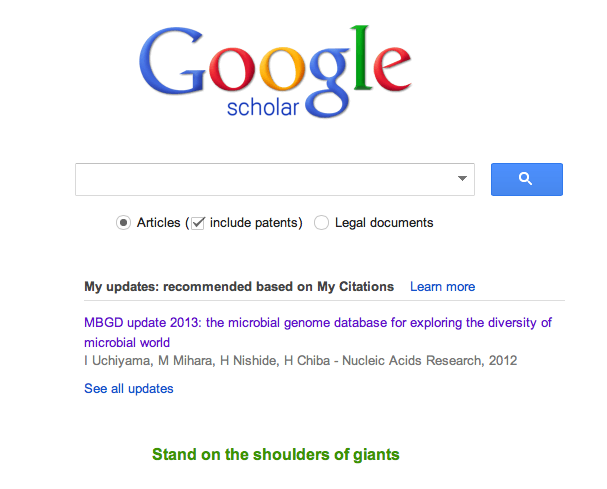
For more on Scholar Updates see here.
Share this:

You win some, you lose some
Our project is starting to pick up! After our initial sampling/sequencing period, we realized that there is actual DNA we can work with from the tanks. This past week, we started our actual sample collecting from the tropical tank. We collected 3 sets of samples from the sediment, walls, and water. Throughout the week, we extracted the DNA and ran PCR on all 9 samples (plus one negative control). Today, we completed the gel electrophoresis and got some unpleasant results. Unfortunately, we couldn’t see the primer bands and the DNA bands didn’t show up like we thought they would. This means something went wrong in our PCR, but we don’t know if it was during PCR16SA or PCR16SB. Well, it’s back to the drawing board! Starting next week, we will be re-running the PCR on the 9 samples and possible collecting more samples from other tanks.
Although this week’s results were a bust, we know that there is definitely some DNA present that we can work with. I’m sure we’ll be finding some pretty cool things as we continue sampling and sequencing. 🙂
Share this:
PhD Comics @phdcomics animated cartoon on #OpenAccess interview of me & Nick Shockey
I assume if you pay any attention to science satire/humor you are familiar with PhD Comics by Jorge Cham. If not, you must check it out. It is simply brilliant stuff. And thus I was completely floored when I was contacted about whether I wanted to be interviewed by Jorge for a video he was commissioned to make as part of Open Access week activities. I mean – I figging say no to almost everything these days but I said yes to this almost immediately. And so I did a phone interview with him and Nick Shockey from SPARC. And then Jorge worked his magic — and here it is.
Share this:
Today’s "Overselling the microbiome award" Crohn’s Disease and Bacteria
Uggh. Just read this: Specific bacterial species may initiate, maintain Crohn’s. Basically it reports on a paper that showed a correlation between bacterial taxa and early Crohn’s disease. The paper makes a big deal out of showing a correlation in the severity of pediatric Crohn’s and the types of microbes found. Good. That is useful. But here is the thing. It is a $&*#($@(& correlation. They have NO IDEA if this is the result of the CD or the cause (or both). To go around pushing the idea that this is about bacteria initiating CD is misleading.
The news release says “The work may ultimately lead to treatment involving manipulation of the intestinal bacteria.” True. The work may ultimately also lead to my screaming. Oh wait. It did already.
For more on Overselling the Microbiome see some of my other posts
- Overselling the microbiome award: MedicalDaily on Effects of Sugary Drink
- The microbiome in the news: risk of overselling but not always bad coverage
- Overselling the microbiome award: Scientists look to mummies for obesity cure
- Probiotics are the new viagra & the risks of overselling of probiotics
- Probiotic use spreading, lots of money being made, known benefits still murky
- Overselling the microbiome award #2: The Marshall Protocol
- Overselling the microbiome award: Stephen Barrie on pre and probiotics at the Huffington Post
- Dubious Press Release from Cedars-Sinai linking Irritable Bowel Syndrome (IBS) and Bacteria in Gut
As I have said many time. I believe the human microbiome is VERY important. I believe it probably plays a role in all sorts of human issues – health and disease. But we need to be careful not to be misleading about what we know and don’t know …
Share this:
iTalk bug – help needed with partial / unclosed aiff file
Well, too long of a saga to post directly to Twitter so posting here.
Yesterday I recorded a review session for a class with iTalk https://itunes.apple.com/us/app/italk-recorder/id293673304?mt=8. I recorded it on my iPhone 4S.
When I got home to upload the file and to convert it to an MP3 to share with the class I discovered that it seemed to not be there in the iTalk file list.

I thought – maybe I never formally “saved” the file but maybe iTalk kept the recording somewhere.
So I opened up iTunes connected to my phone and there it was in the Apps file area

I then copied the file to my desktop and no matter what I do I cannot seem to open it and /or extract audio out of it. I have tried to open it a million ways with all sorts of desktop and online programs and nothing works. My guess is somehow the file was not closed out correctly and thus even though it is 430 Mb it is viewed as empty by all the programs I have tried.
Anyone know a solution for this?
I have posted the file to Dropbox here.
Share this:

Important read: Biotechniques discussion of DNA extraction in microbial studies
Very quick post here. This is worth a read: BioTechniques – DNA Extraction: Overcoming Obstacles in Microbial Studies. From their summary:
“What are the most efficient methods to extract microbial DNA that accurately represents the community it is isolated from? Janelle Weaver reports on efforts to identify the best methods for DNA extraction from unknown frontiers in the human body and across the globe.”
It discusses among many things this fascinating paper: Flores GE, Henley JB, Fierer N (2012) A Direct PCR Approach to Accelerate Analyses of Human-Associated Microbial Communities. PLoS ONE 7(9): e44563. doi:10.1371/journal.pone.0044563
Note – I found out about this on the Twitter
@dr_bik @noahfierer Great paper. We wrote about this paper and similar efforts in a #metagenomics feature this month: bit.ly/RJytjr
— BioTechniques (@MyBioTechniques) October 18, 2012
//platform.twitter.com/widgets.js
On a related note see the paper from my lab on a metagenomic simulation we did a few years ago …
PLOS ONE: Metagenomic Sequencing of an In Vitro-Simulated …
Share this:
Sampling, DNA extraction, and PCR, OH MY!
For the past week, we’ve been doing preliminary sampling, as well as some DNA extractions and PCR on samples from the saltwater and freshwater flasks of water that we filtered and the wall and protein skimmer from the saltwater tank. Those four samples have now been through PCR. Although we found DNA, but the gel prepared after the PCR failed. We also went back to the tanks to gather samples from a saltwater tank that is soon to be broken up to create two coral ponds.
 Jonathan Eisen's Lab