
Quick post here pointing people to an interesting blog post by Rob Dunn: The Sieve Hypothesis: Clever Study Suggests an Alternate Explanation for the Function of the Human Stomach | Guest Blog, Scientific American Blog Network. Definitely worth checking out.
Eisen Lab Blog

Save the Date* IOM public workshop on “Microbial Ecology in Health and Disease ” 3/18-19 in DC

INSTITUTE OF MEDICINE
*SAVE THE DATE*
The Forum on Microbial Threats is pleased to announce a public workshop on:
Microbial Ecology in States of Health and Disease
March 18-19, 2013
Keck Building, Room 100
500 Fifth St., NW
Washington, DC 20001
Investigations of microbial ecology in a variety of organisms and contexts have begun to illuminate the properties of host-associated microorganisms. These observations have revealed a complex and dynamic network of interactions across the spectrum of “host”, “microbe”, and “environmental” niches that may influence states of health and disease. Alterations in the composition and dynamics of the human microbiota have been associated with a variety of complex diseases –including such chronic conditions as cardiovascular disease, obesity, and the inflammatory bowel diseases. This ‘ecologically’ informed view is a paradigm shift away from the conventional “one-microbe, one-disease” perspective of infection and may lead to new insights for health maintenance, disease prevention, and treatment approaches in humans, animals, and plants.
On March 18 and 19, 2013 the Institute of Medicine’s Forum on Microbial Threats will host a public workshop, in Washington, D.C., to explore the scientific and therapeutic implications of microbial ecology in states of health and disease. Topics to be explored may include: host-microbe interactions in humans, animals, and plants; emerging insights into how microbes may influence the development and maintenance of states of health and disease; the impacts of environmental change(s) on the formation, function, and stability of microbial communities; and research challenges and opportunities for this emerging field of inquiry. This meeting is an update of topics discussed at a 2002 Forum workshop: The infectious etiology of chronic diseases.
The workshop is free and open to the public, but registration is required. A DRAFT Agenda for this meeting is attached for your information.
Click here to register.
Click here for the Meeting Website.
Rediscover the IOM at our new website, www.iom.edu.
DRAFT AGENDA-March 2013 Microbial Ecology Workshop-012913.pdf
Share this:

Finally back in the lab
After spending the majority of our time collecting samples and doing water chemistry on site, we are all back in our lab ready to do DNA extractions and PCR galore. Unfortunately, the kim wipes we used to scrub microbes off the walls of the tanks are too large to fit into our tubes with the extraction beads. After about an hour of stressing and improvising, we were able to get a usable amount of supernatant…or so we hope. We will find out after we do our PCR.
Share this:
My progress with the Aquarium Project
Hello everybody,
Thought I’d do a quick log/blog entry of what I have been doing in the lab for the past couple of days. I just got a brief introduction to sampling the first few times I was in the lab. I didn’t do too much of hands on sampling, but developed a fair idea of how it was done before it all ended.
And now we are moving on to do PCR’s and DNA extractions. This is what I consider to be the core of the project and I truly hope to learn a great deal from it. I’ve never been exposed to all these techniques in this particular way and that makes it really exciting to learn all these things! I was really happy to see magnetic beads, cytometers and micro pipettes the first time I entered the Genome Center.
The last time I was in the lab, I was introduced to the basics of analysis, and I learnt how to handle the micro-pipettes. I look forward to performing PCR this week.
Another important update: Currently, I am looking for people in the lab to work with me on the Undergraduate Research Conference. It is something I am really interested in because I love making posters and talking about research and also learning about research. If anyone is interested in doing this, I am willing to help out in any way possible.
The link to the conference page is here: http://undergraduateresearch.ucdavis.edu/urcConf/
I think it’s a good opportunity for the Eisen lab to talk about its achievements!
If anyone is interested, please let David Coil know, and if you need help, please do ask me. I’d love to do my bit! I hope to hear back on this.
Share this:
Water Chemistry Sampling: Our kit list
A couple of people have requested that I post information on the various kits and probes being used to assay water chemistry for our aquarium study. Here’s the list, divided by type with a link to each item on Amazon. Also various user complaints.
Probes:
pH (worked fine, held calibration well)
Salinity (worked fine, held calibration well)
Temperature (annoying, a bit fiddly, I wouldn’t do this one again)
Titration-based kits:
Hardness, Alkalinity, Chloride, and Sulfide were all measured using this combo package It also includes an iron assay that we didn’t use. All of these kits are prone to error since they’re titration based. But used very carefully (takes time!) they seemed to produce okay results. I recommend using glass flasks instead of the plastic beakers supplied.
Colorimetric scanners:
Dissolved oxygen (this kit requires that you have a glass container capable of holding exactly 60 mls of water.. they don’t tell you this until you read the instructions. Otherwise worked fine. A bit hard to use but conversely you’ll learn new vocabulary from reading the instructions)
Ammonia (worked fine, but you have to be very careful to follow the instructions and mix between adding reagents or you’ll get a false high reading)
Nitrate (worked fine)
Nitrite (this one is pretty annoying; it’s hard to get the reagents into the tiny vial and these handheld meters turn themselves off after only 2 minute so if you get distracted you have to start over)
Phosphorus (see nitrite, but even worse. As far as we can tell it’s not even possible to follow the instructions for this since it turns itself off before you finish mixing the reagents)
Share this:
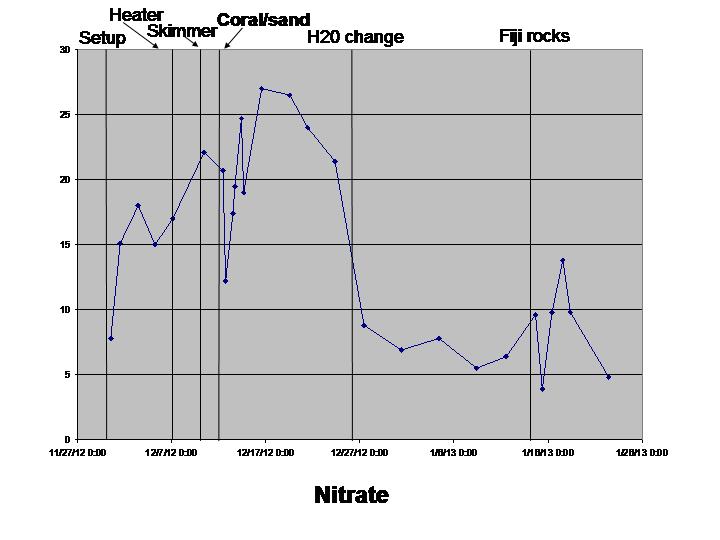
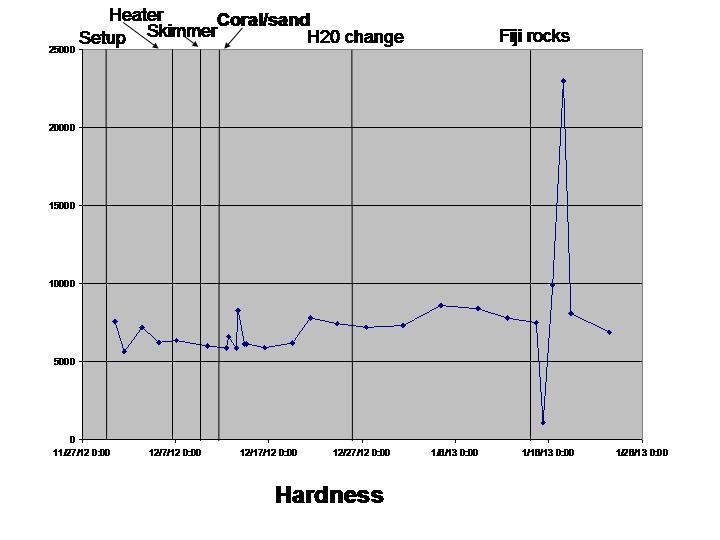
Preliminary chemistry data from Coral Pond #1
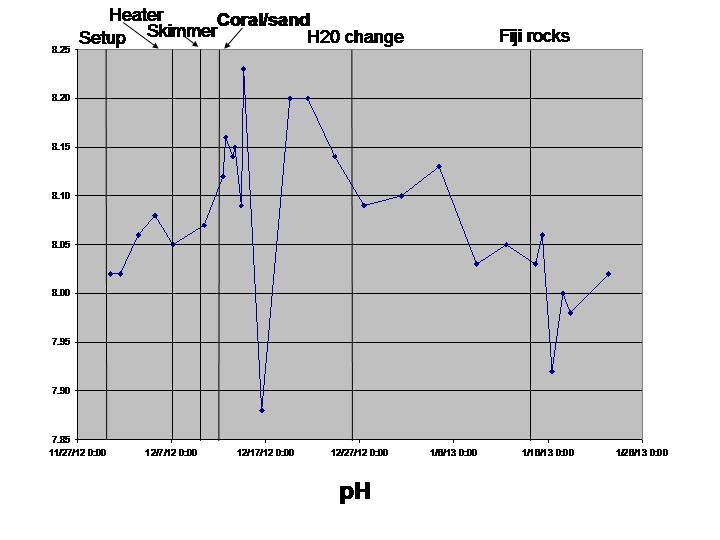
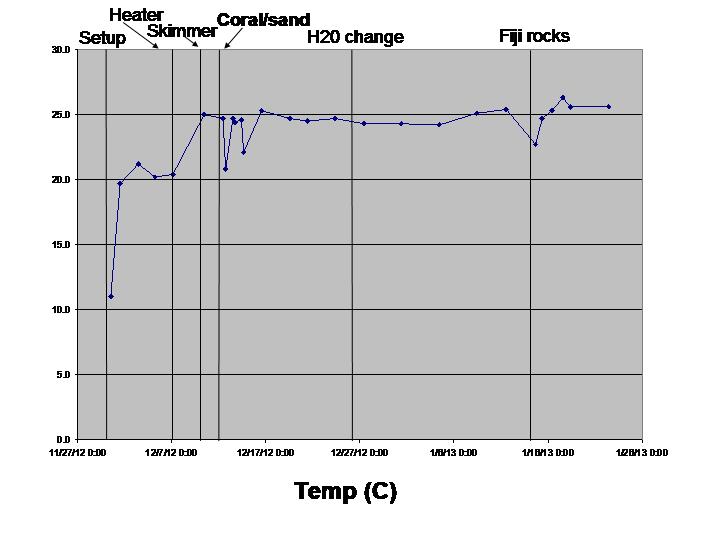
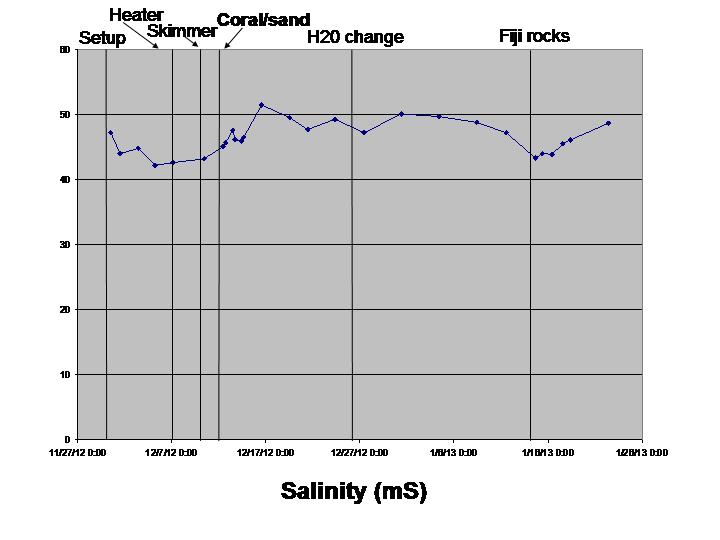
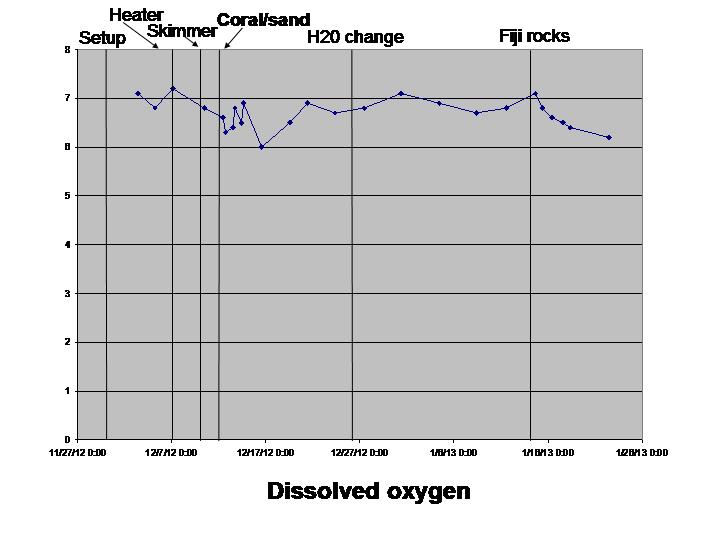
Since we’ve stopped sampling I went ahead and graphed out all the water chemistry data from Coral Pond #1. Feeback, thoughts, comments etc. are welcome!




Share this:

Lab meeting Jan 29th 2013
Dongying Wu will present for this week’s lab meeting.
We will be meeting from 1:30 to 3:00pm at the Genome Center in room 4202.
Share this:
IBM will save the planet with this magical hydrogel – NOT
Well, press releases can drive me crazy. And this one is one of the worst I have seen in a while: IBM News room – 2013-01-24 IBM and The Institute of Bioengineering and Nanotechnology Develop New Antimicrobial Hydrogel to Fight Superbugs and Drug-Resistant Biofilms – United States
This new fangled gel they have made they are very proud of. That is good. Pride in ones work is a good thing. But getting the science wrong and making misleading statements is not. Some statements I have issues with include
- Able to colonize on almost any tissue or surface, microbial biofilms – which are adhesive groupings of diseased cells present in 80% of all infections – persist at various sites in the human body, especially in association with medical equipment and devices.
- Huh? Diseased cells? What does this even mean?
- When applied to contaminated surfaces, the hydrogel’s positive charge attracts all negatively charged microbial membranes, like powerful gravitation into a blackhole.
- Again – huh? How is this like gravitation in a black hole?
- However, unlike most antibiotics and hydrogels, which target the internal machinery of bacteria to prevent replication, this hydrogel kills bacteria by membrane disruption, precluding the emergence of any resistance.
- This is the killer statement. They have apparently invented a treatment that no organism can resist. It is therefore perfect. Sort of like, well, penicillin? Oh no, wait. Sort of like chloroquine. Oh no, wait. I mean, sort of like streptomycin right? Sorry – I meant tetracycline. No no – I meant …. aaaaaaaaaaarrg.
I could go on. Sounds like a possibly interesting new development. But when you make absurd claims about it, and get the science all messed up, it does not give me that warm fuzzy feeling. Annoyingly some news sources are basically just quoting from the PR with no skepticism. For example, see this Daily Mail article. And this blip in The Star. At least this in “The Conversation” has some comments on this being possibly overblown. Anyway, shame on IBM for being more about hype than science.
Share this:
Lecture at #UCDavis by Sir Andrew McMichael, 2013 Nelson Scientific Lecturer 2/6
Forwarding this
Oxford immunologist to discuss the potential of HIV vaccines
Lectures scheduled Feb. 6 at noon in Davis and 5 p.m. in Sacramento
Professor Sir Andrew McMichael of the Weatherall Institute of Molecular Medicine at the University of Oxford in the United Kingdom will be the UC Davis School of Medicine’s 2013
There are two opportunities to hear McMichael’s address, which is titled “T-cell immune responses against HIV-1: Can they be harnessed by vaccines?” He will speak on Wednesday, Feb. 6, at noon in the auditorium of the Genome and Biomedical Sciences Facility, 451 Health Sciences Drive, at UC Davis, and at 5 p.m. in the Matsui Lecture Hall of the Education Building, 4610 X St., in Sacramento.
Both lectures are free and open to the public. To reserve a seat, e-mail specialevents or call 916-734-9101.
Continue reading “Lecture at #UCDavis by Sir Andrew McMichael, 2013 Nelson Scientific Lecturer 2/6”
Share this:
One way to keep up with new genome sequence publications – SIGS compilation
This is a very very helpful thing to keep up with new genome sequence releases/publications: Genome sequences published outside of Standards in Genomic Sciences, October-mid November 2012 | Nelson | Standards in Genomic Sciences. From Oranmlyan Nelson and George Garrity in the SIGS Journal. It is a bit mind boggling how many genome sequences are being determined and published. Fun. But mind boggling. Anyway – good to have someone trying to keep track. Also see GOLD: Genomes OnLine Database.

