Eisen Lab Blog

Rosacea – What Causes It? News story overplays suggested connection to skin mites

Just got done reading this: Could Bacteria in Skin Mites Help Cause Rosacea? – US News and World Report.  The article leads off with a bold statement that caught my eye

“Bacteria carried by tiny mites on the skin might be responsible for the common dermatological condition known as rosacea, researchers say.”

This caught my attention because I have been reading up on skin microbes recently and though many have suggested connections between microbes and rosacea as far as I know nobody has shown any causal relationship.  And causation vs. correlation has been on my mind a lot recently.

So I read further and found some suggestive but inconclusive statements that were linked together

  • there are more of these mites on the skin of patients with rosacea than on those without
  • a bacterium (Bacillus oleronius) has been found in the mites and in people w/ rosacea
  • this bacterium can be killed with the same antibiotics that seem to have some success in treating rosacea
  • people with rosacea have an immune reaction to compounds from this bacterium 
  • another bacterium Staphylococcus epidermis also appears in patients w/ rosacea but not patients free of rosacea

And that apparently was it … not very convincing.  Sounds like just a lot of random correlations to me.  So I decided to dig deeper.  And I went to see fi I could find the paper which alas was not linked from the news story.

I googled the journal name “Journal of Medical Microbiology” and got to the web site.  The news article had said the “review paper” had come out August 30th so I clicked on the Papers In Press link and got to the paper.  I browsed the abstract, which seemed somewhat different from the gist of the news story

Rosacea is a common dermatological condition that predominantly affects the central regions of the face. Rosacea affects up to 3% of the world’s population and a number of subtypes are recognized. Rosacea can be treated with a variety of antibiotics (e.g. tetracycline or metronidazole) yet no role for bacteria or microbes in its aetiology has been conclusively established. The density of Demodex mites in the skin of rosacea patients is higher than in controls, suggesting a possible role for these mites in the induction of this condition. In addition, Bacillus oleronius, known to be sensitive to the antibiotics used to treat rosacea, has been isolated from a Demodex mite from a patient with papulopustular rosacea and a potential role for this bacterium in the induction of rosacea has been proposed. Staphylococcus epidermidis has been isolated predominantly from the pustules of rosacea patients but not from unaffected skin and may be transported around the face by Demodex mites. These findings raise the possibility that rosacea is fundamentally a bacterial disease resulting from the over proliferation of Demodex mites living in skin damaged as a result of adverse weathering, age or the production of sebum with an altered fatty acid content. This review surveys the literature relating to the role of Demodex mites and their associated bacteria in the induction and persistence of rosacea and highlights possible therapeutic options.

And then I did what usually causes me much anguish when I am at home – I clicked on the link for the full text, thinking that I would get a paywall.  And low and behold, I got the preprint of the paper.  The paper is quite interesting in many ways with lots of details about these mites I knew nothing about.  It also has a lot of detail on these two bacterial species and why the authors think they are of interest in rosacea etiology.  But no convincing evidence of any kind is presented that there is a causal connection to these bacteria or to these mites.  I leave everyone with the last paragraph of the paper

The pathogenic role of Demodex mites, as well as B. oleronius and S. epidermidis, in the induction and persistence of rosacea remains an unresolved issue. The lack of an immunological response to Demodex mites in healthy skin raises the possibility of localized immunosuppression, facilitating the survival of the mite. Hopefully, the results of further research will bring us closer to understanding the role of microbes in the pathogenesis of rosacea and assist in the development of new and more effective therapies for the treatment of this disfiguring disease.

I agree. Unresolved.

Almost like getting an email from Santa Claus

My wife just shared this with me – an email she got back from the Lego company

Thank you for getting in touch with us about your replacement LEGO® pieces.

I’m sorry to hear your LEGO pieces need replacing. We get to play with LEGO sets all day long (the best job in the world?), so I know that sometimes a piece wears out or gets lost.

That’s why I’ve asked for a replacement piece to be sent out to you. We always try to match the color you want, but sometimes stocks run low, so we might have to send you a different one. Unfortunately part# 4498712 is licensed and was not included with this request.

Although we usually ask people to pay for replacement pieces, I’m sending this one for free – so now you can get building and have fun!

Your replacement parts will be shipped from our facility in Denmark. Please allow 7-10 business days for delivery.

Thanks again for contacting us. We are always pleased to receive feedback from LEGO fans! If you could take a moment to complete a four question survey by going to the link below, it will help us make sure we are providing the best customer service to you.

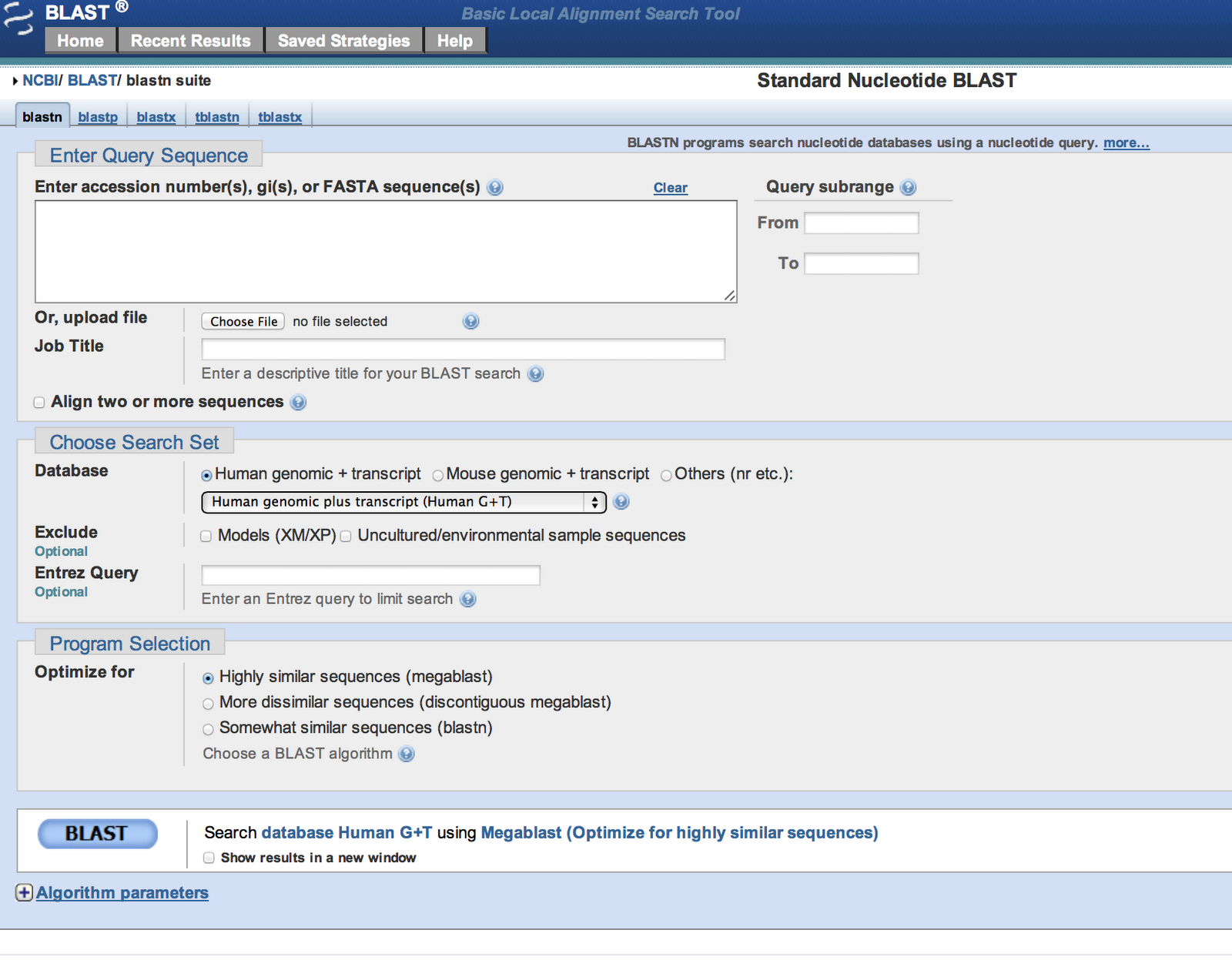
NCBI. Why? Why? Why is the default database for blasting "human G+T"

It is the little things.  The little things that can sometimes eat at you.  And here is one of my little pet peeves.  At some point – not sure how recently – NCBI changed the default database for Blastn searching to the “human G+T” database.  This Db contains human genomic and transcriptomic data.

Now – I am extremely grateful for many – if not most – of the things NCBI does.  Pubmed is great.  Pubmed Central rocks.  Sequence databases galore.  And all sorts of widgets and tools associated with sequence analysis.  Including a free blast server.  Which I use a lot.  But why? why is human G+T the default database for blastn searches?  Why?  I never only want to search this Db.  Why not have the non redundant Db of everything be the default?  Are there really that many people who only want to search human G+T?  Or is this some ploy to force people to do such searches?  This tiny little thing.  This setting.  This glitch.  Whatever it is.  It drives me batty …

Winner of the "genome conference speakers should be male" award …

Presenters at the World Genome Data Analysis Summit.  Women highlighted in yellow.

  1. Richard LeDuc, Manager, National Center for Genome Analysis Support, Indiana University
  2. Gholson Lyon, Assistant Professor, Cold Spring Harbour Laboratory
  3. Christopher Mason, Assistant Professor, Cornell University
  4. Liz Worthey, Assistant Professor, Medical College of Wisconsin
  5. Garry Nolan, Professor of Genetics, Stanford University
  6. David Dooling, Assistant Director, Genome Institute, Washington University
  7. Peter Robinson, Senior Technical Marketing Manager, DataDirect Networks
  8. Thomas Keane, Senior Scientific Manager, Sequencing Informatics, Wellcome Trust Sanger Institute
  9. Eric Fauman, Associate Research Fellow, Pfizer
  10. Geetha Vasudevan, Assistant Director and Bioinformatics Scientist, Bristol-Myers Squibb
  11. Shanrong Zhao, Senior Scientist, Johnson & Johnson
  12. Bill Barnett, Director, National Center for Genome Analysis Support, Indiana University
  13. Zemin Zhang, Senior Scientist, Bioinformatics, Computational Biology, Genentech
  14. Christopher Mason, Assistant Professor, Cornell University
  15. James Cai, Head, Disease & Translational Informatics, Roche
  16. Eric Zheng, Fellow of Bioinformatics Science, Regeneron
  17. Monica Wang, Associate Director, Knowledge Engineering, Millennium
  18. Joachim Theilhaber, Lead Bioinformatics Research Investigator, Sanofi
  19. Francisco De La Vega, Visiting Scholar, Stanford University
  20. Don Jennings, Manager of Data Integration, Enterprise Information Management, Eli Lilly
  21. Deepak Rajpal, Senior Scientific Investigator, Computational Biology, GSK
  22. Mark Schreiber, Associate Director, Knowledge Engineering, Novartis

So that is a ratio of 19:3 for a whopping 13.6% women.  Please – I beg of you – if you are organizing a conference give some thought to the diversity of speakers.  In my experience the best conferences have always ended up being ones with highly diverse speakers.  These conferences were good probably because the organizers put a lot of thought into who to invite to speak, rather than just inviting either big names or people that one knew in some way.

UPDATE: It has been pointed out that I listed one person (Chris Mason) twice — so it is only an 18:3 ratio.  Phew.  Much better.

For other posts on this topic see

Bad words: Nebraska declares many words and names to be off limits when spelled/written

For immediate release
From the Nebraska State Government Headquarters

——————————————
In response to criticisms of our handling of the sign language based signing of a child’s name we have decided that it would only be rationale to also apply the same standard to written and spoken words.  Therefore, be it declared that any words or names that are one letter substitution away from anything bad should be banned.

For example, due to the danger associated with the word G-U-N (which we note – we are just spelling here but not actually writing the word) the following names have been banned: GUS, GUY and the following words are not allowed either GUM, GUY, BUN, RUN, SUN, FUN, GIN, PUN, GUT

For similar reasons it has been deemed that the following names and words to be banned:

  • Names: Ash, Bart, Buck, Butch, Cam, Coco, Dick, Dirk, Fitch, Huck, Luck, Mitch, Nick, Santorum, Tito
  • Words: abs, ads, ash, ask, asp, batch, bits, buck, bum, bunt, butch, can’t, cart, cent, chit, cub, cud, cup, cut, dart, deck, dice, dink, disk, diss, ditch, dock, dock, duck, fare, farm, fits, fort, funk, hiss, hitch, hits, hum, hunt, itch, jock, kick, kiss, kits, lick, lock, luck, miss, mock, muck, mum, nits, part, pick, pitch, pits, puck, punt, rock, rum, runt, santorum, shin, ship, shot, sick, sits, skit, slit, snit, sock, spit, such, sum, tart, tats, tick, tins, tips, tots, tuck, wart, witch, wits, yuck, yum

To help everyone out we have organized the names into clusters based on the banned word (which we would rather not spell out here).

Group 1:

  • Names: Butch, Fitch, Mitch
  • Words: batch, butch, witch, ditch, hitch, pitch, itch

Group 2:

  • Names: Coco
  • Words: dock, jock, lock, mock, rock, sock

Group 3:

  • Names: Tito
  • Words: tots, tats, bits, fits, hits, kits, nits, pits, sits, wits, tins, tips,

Group 4:

  • Names: Ash
  • Words: ash, abs, ads, ask, asp,

Group 5:

  • Names: Bart
  • Words: farm, fare, fort, cart, dart, part, tart, wart

Group 6:

  • Names: Santorum
  • Words: santorum

Group 7:

  • Names:
  • Words: spit, slit, skit, snit, chit, shot, shin, ship

Group 8:

  • Names: Huck, Luck, Buck
  • Words: funk, buck, duck, luck, muck, puck, tuck, yuck, such

Group 9:

  • Names:
  • Words: can’t, cent, bunt, hunt, punt, runt

Group 11:

  • Names: 
  • Words:  miss, diss, hiss, kiss, 

Group 12:

  • Names: Nick, Dirk,
  • Words: kick, lick, pick, sick, tick, deck, dock, disk, dink, dice

Group 13:

  • Names: Cam
  • Words: gum, bum, rum, hum, mum, sum, yum, cut, cud, cub, cup, cut

More groups / banned words coming

Germs germs germs. They are everywhere. Get rid of them w/ hexochlorophene.

Now that many people consider germs to be a blessing, not a curse, it is useful to remind ourselves where we were a few years ago.  Today’s episode of “bad germs” is brought to you by Tact soap.  Hat top to Liza Gross.

Or see this newspaper ad:

So what if Tact soap from that era had hexachlorophene (the active ingredient in phisohex and something that probably is not so good for you). It killed microbes. And that has to be a good thing right? Right?

Lab meeting Wednesday, August 29th

Holly Ganz will be presenting for this week’s lab meeting. We will be meeting in room 5206 of the Genome Center from 1:30pm to 3:30pm.

Velasquez-Manoff opinion piece in the NY Times on autism, parasites & inflammation; nice ideas; not enough caveats

There is a very interesting “Opinion” piece in the New York Times today: Immune Disorders and Autism – NYTimes.com.  By Moises Velasquez-Manoff is details some recent work that the author believes relates to autism and a variety of other human ailments with an autoimmune connection.

The general logic/key points seem to be as follows:

  • Some autism cases look like a form of inflammatory diseases with the immune system overactive (inflammation on high, anti-inflammation on low, or some combination thereof)
  • Infection of a mother during pregnancy increases the risk of having a child with autism.
  • In animal models, inducing inflammation in the mother (even without an infection) leads to an increased risk of behavioral “problems” in her offspring
  • Inflammatory and/or autoimmune diseases (e.g., asthma) have increased in incidence along with autism.
  • If a mother has automimmune or inflammatory diseases such as rheumatoid arthritis celiac disease she has a higher risk of having a child with autism.  Similarly if a mother has allergies or asthma during the second trimester, there is a higher risk of having children with autism.  
  • Many automimmune and inflammatory disorders and autism are all more prevalent is the developed world.
  • The developed world is generally cleaner that the developing world.  
  • There are many fewer parasites in people in the developed world.
  • Parasites are known to suppress inflammation.
  • Therefore, we may be able to stop/limit autism, asthma, and other inflammatory diseases by purposefully infecting people with parasites from our evolutionary past. 

Now, personally, I like the general hypothesis here.  It makes complete sense.  But alas, it is suffers from this issue that is spreading almost as fast as these diseases – a lack of a discussion of the distinction between correlation and causation.  I have been obsessing about this a bit recently with studies of the microbiome.   Overall, I do like this current article.  It mixes human epidemiological studies with controlled animal studies with discussion of conceptual models.  But alas there is really no discussion of the challenges if disentangling correlations vs. causation. And I think it is a bit dangerous in the latter parts with the jump to potentially curing these various ailments by purposeful infection with parasites.  Again, I like the idea.  But a few caveats would have been nice.  I am glad it was marked as an opinion piece but even when one states an opinion about a medical issue, one can still say “there are reasons why this might not be true .. such as …”.  Too bad that wasn’t done here.

UPDATE – Emily Willingham has written a VERY detailed critique of the article that I think everyone interested in anything related to this topic should read: Emily Willingham: Autism, immunity, inflammation, and the New York Timeswww.emilywillinghamphd.com.

Spammy journal of the day: Journal of Proteomics and Genomics …

Just got this email posted below.  Certain aspects of it make me a little skeptical of the editorial quality of the journals from this publisher … (highlighting a few parts done by me).

——————————–
Dear Dr.jonathan a. eisen,

Call for papers – to be published in the month of September and there on

Journal of Proteomics and Genomics

The scientific research is on its wheels now a day more than it has ever been. All the research and results are being accumulated enormously and in this race, you can come into lime light, only if you are noticeable enough. Are you sure the resource you have chosen provides you with such a benefit?
If you are not sure go through this list and make sure if you are at the right place, learn few facts to choose wisely when publishing your valuable research work:

  1. Is it an open access online journal: Being online enhances the reachability of the journal worldwide and being open access means removing barriers for all the researchers, without any discrimination of dissipating the knowledge. (Subscription based is available only for who can afford.)
  2. Does it provide xml files: Xml files are important for deposition into the repositories. Generally high prices are obtained for providing these files by publishing companies. (We provide free of cost.)
  3. Proper communication and support during publication: The most important and the actual tyranny lies in publishing the research paper which is the sweat and time of your hardship. But it would be more hardship if you have to publish with a poorly communicating and non-supportive journal. (Our advanced online system enhances communication effectively.)
  4. Through peer review of original and revised manuscripts: Value of your research paper is enhanced only if it is peer reviewed. (Peer review is one of the main quality element provided by us.)
  5. Revision made easy: And the revision part out there is so terrific. (But with us it is easy due to the detailed comments of our reviewers.)
  6. High profile experts with lot of experience: Editors with specialized expertize are an asset when dealing with scientific manuscripts. They can provide very accurate suggestions with experience and help improving the quality of the paper in-depth. (We are rich with them.)
  7. Support for enhanced citations even after publishing : Paper has been published, everything is done, now what? Have you ever wondered what is happening with your paper? Is it reaching the required?  Not only social media but there are hundred other ways to get you to the right place. (The secret is only with us.)
  8. Appropriate Fee : Open Access journals now a days cost nothing less than $1000. (We charge only $ 540)
Now if you wish to submit your manuscript and publish with us, please follow the below link, the call for papers is open and up 
—————————–

Note – I have not included the link so as to not in any way contribute to their Google Ranking.  But wow – journal spam is pooping up so often it is hard to keep up with it.

Notes from some recent meetings about microbiology of the built environment

Quick post here.  At the microBEnet site that I run we have posted some notes, slides, videos and other information from a few recent meetings on the topic of “microbiology of the built environment” that may be of interest so I am posting links here