Eisen Lab Blog

Worst new omics word award #5: fermentome

I do not have access to the article but the abstract is all I need to give out my fifth “Worst New Omics Word Award

Fermentation of undigested foods in the colon by its resident bacteria affects not only colonic health (protection against inflammation and tumour formation) but also influences metabolic health. Studying fermentation directly is difficult for lack of access. We hypothesise that the anatomical structure of the colon is suited to act as a fermenting chamber with the gaseous molecules (VOCs) emitted having direct effects on the colonocytes as well as gut neural and metabolic effects. We refer to this complex system as the ‘fermentome’, and further hypothesise that alteration in the ‘fermentome’ through dietary modification will have a direct impact on colonic as well as metabolic health and disease. The VOCs emitted may play a role in bacterial chemical signalling within the colon but importantly could also function as a ‘gas’ biomarker. Measurement of such VOCs through non-invasive methods would have important application as a hypothesis-generating tool with subsequent clinical application.

From an article titled “Colonic fermentation – More than meets the nose” in Medical Hypotheses, Volume 73, Issue 5, Pages 753-756 by R.P. Arasaradnama, M.W. Pharaoh, G.J. Williams, C.U. Nwokolo, K.D. Bardhana, S. Kumar

Not really much to say other than, this one is a stinker.
Hat tip to @steinsky for tweeting to me about this.

Help save viral ecology (or, when a corporate takeover can kill a field of science)

Just got this an interesting email below from a friend and colleague, Eric Wommack at U. Delaware. In the email, Eric discusses how the recent purchase of Whatman by GE Helathcare has apparently wreaked havoc on the field of viral ecology. You see, a key tool in many studies of viruses in the field turns out to be filters with really small pore sizes to collect the viruses. And, alas, apparently, GE Healthcare has decided to end sales of the filters that a lot of viral ecology researchers use and cannot replace.

So a seemingly small decision by GE Healthcare could severely harm viral ecology work. Eric (and others) are encouraging researchers to write to GE Healthcare to ask them to reconsider the discontinuation of these filters. I encourage you to do so. A person to wrote to at GE is listed in the email below

I’m writing in hopes that you can help the viral ecology research field build a grass roots campaign to convince GE Healthcare to reverse its decision to discontinue manufacture of all 0.02 µm Anodisc filters. GE Healthcare recently acquired Whatman the sole manufacturer of these filters. Presently, 0.02 µm Anodiscs are the only means of collecting direct counts of free virus particles by epifluorescence microscopy. All other types of filter membranes with suitably small pore sizes (sub 30 nm) simply do no work. Viral direct counts are a baseline inventory measurement throughout the field and the loss of these filters will effectively shut down all cutting-edge viral ecology research productivity.

The official word from GE Healthcare is that the company will fill existing orders and then discontinue the entire product line as of December. According to an openly honest Whatman tech support worker, who was entirely sympathetic with our plight, this decision is entirely financial. The irony is that the company has an effective monopoly in this niche so those labs who absolutely rely on these filters would find a way to pay whatever is necessary to make the product financially viable. The tech support guy said that Whatman actually manufactures Anodisks, so unless another company steps forward to adopt the technology viral ecology research will grind to a crawl over the next couple of years. I know this scenario sounds dramatic, but I’ve seen a nearly complete work stoppage on three projects since the Anodisc supply dried up in July.

Please mail the letters to:

Navin.Pathirana@ge.com
Navin Pathirana, Ph.D., CChem
Regional Product Manager
Whatman, Inc.
GE Healthcare Bio-Sciences Corp.*
800 Centennial Avenue***
Building 1*
Piscataway**, NJ 08855 USA***

Here are some PLOS Open Access papers using these filters

Here are some links to papers found in Google Scholar that have used these things:

Bay Area Biosystematists: 10/15 w/ undergrads. on their research

Gotta love this – education, evolution, science, all rolled into one …

Bay Area Biosystematists Meeting: Thursday, 15 October, 2009

at UC Berkeley, 2063 Valley Life Sciences Bldg.

Undergraduate Research in Evolutionary Biology

This will be a first-time-ever-for-BABS panel discussion led by undergraduates, focused on the research experience for undergraduates in evolutionary biology in the Bay Area. Several undergraduate researchers will speak informally about their research, the path they took to get into research, where they hope to go with it in the future, and what their hopes/fears are. Suggestions on how professors and departments could enhance the process will be featured; this should lead to a productive exchange between undergrads and professional researchers, and a chance for us all to examine this vitally important educational process.

Panel discussants include:
Elaine Fok, UCB (Mishler Lab)
Nairi Hartononi, UCB (Baldwin Lab)
Irene Liao, UCB (Specht Lab)
Brian Mahardja, UCD (May Lab)
Norma Pantoja, UCB (O’Grady Lab)

Schedule and venue:
5:30 – social gathering with beverages and informal pizza dinner:
cost ca. $10, to be collected at door, 2063 Valley Life Sciences Bldg.,
UC Berkeley campus.
7:00 – talk followed by discussion, in same room.

Please email reservations to your host, Gordon Bennett, at gbennett@nature.berkeley.edu by Tuesday, Oct 13th

For a map of campus and view of VLSB, use the link below.
http://www.berkeley.edu/map/maps/ABCD123.html

All are welcome, members or not. If you want to join the Biosystematists, a venerable yet exceptionally lively group that provides the only inter-institutional seminar/discussion forum addressing evolutionary topics in the Bay Area, sign up for our mailing list at: https://calmail.berkeley.edu/manage/list/listinfo/babs-l@lists.berkeley.edu

Open Access Week October 19-23, 2009

To broaden awareness and understanding of Open Access — Open Access Week – October 19-23, 2009

Hope everyone is going to do something ….

Adopt a GEBA genome program for education – from the DOE/JGI

The DOE Joint Genome Institute’s Education Program is providing opportunities for colleges and universities across the country to “adopt” bacterial genomes, such as those sequenced as part of the “Genomic Encyclopedia of Bacteria and Archaea” (GEBA project), for analysis. This “Adopt a GEBA Genome” Education Program makes available a selection of recently sequenced genomes for use in undergraduate courses. The organisms ideally provide a unifying thread for concepts across the life sciences curriculum. For example, students can analyze the six open reading frames for a given fragment of DNA, compare the results of various gene calling algorithms, assign function by sequence homology, and use gene ortholog neighborhoods for comparative genomics and annotate biochemical pathways, while learning the underlying biological concepts in a variety of science courses.

For more information, and to apply for the November 2, 2009 deadline, see:
http://www.jgi.doe.gov/education/genomeannotation.html

For more on the GEBA project, which I am coordinating, see a video of a talk I gave about it at the JGI User meeting. Slides from that talk are on slideshare here.

Data fro the GEBA project is available at a dedicated IMG site here.

http://www.scivee.tv/flash/embedCast.swf

A much much much older talk, from when we just started the project is here:

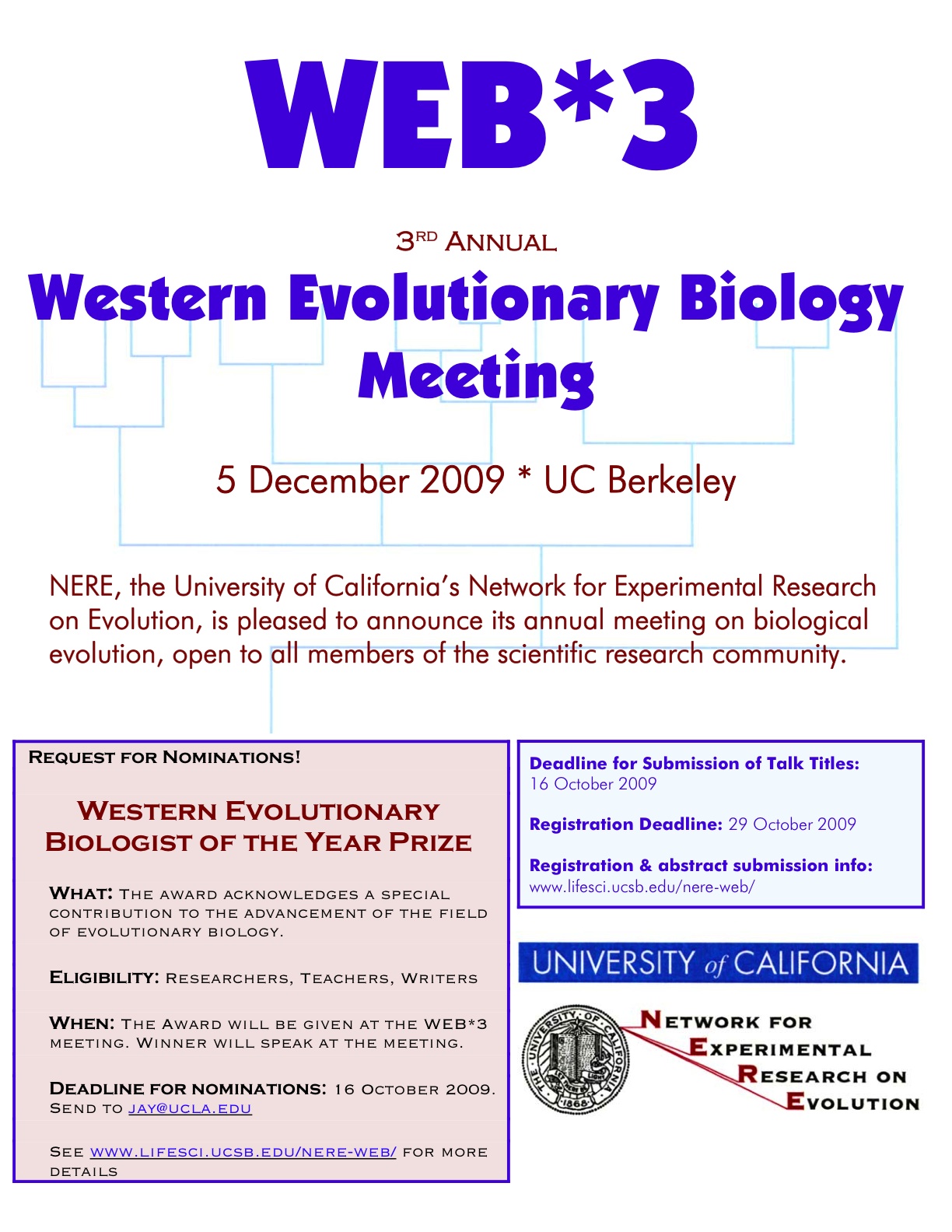
3rd Annual Western Evolutionary Biology Meeting 12/5/09 at Berkeley

The 3rd Annual Western Evolutionary Biology Meeting will be at UC Berkeley. This is a meeting of the UC Network for Experimental Research on Evolution (NERE), attendees from the UC campuses will be present, other evolutionary biologists, researchers, teachers and writers are encouraged to participate as well.

When: Sat. 5 December FREE registration – deadline, 29 October 2009 Submit Abstracts – deadline 16 October 2009 – or present a poster

Where: On the UCB Campus in VLSB, see website for details NOMINATE: Western Evolutionary Biologist of the Year by 9 Oct. 2009

See website for details. Open to Researchers, Teachers, Writers.
REGISTER at http://www.lifesci.ucsb.edu/nere-web/

Some tweets of mine with links about #PLoS papers by #Nobel winners

  1. #Nobel winner Blackburn’s 2004 #PLoS Biology essay: Reason as Our Guide –http://shar.es/140kQ

  2. #Nobel winner Greider’s re #PLoS Genetics pub on telomeres in Primary and Tumor Cells –http://shar.es/140wf

  3. #Nobel winner Szostak has many #PLoSOne pubshttp://tinyurl.com/yeel5sthttp://tinyurl.com/ycb34c5http://tinyurl.com/yegusbc

  4. Yippe – another Nobel Prize for work in Tetrahymena – see my #PLoS Biology paper on the genome here –http://shar.es/140hE

  5. The Greider Lab | Johns Hopkins Medicine –http://shar.es/1406w #Nobel

  6. Blackburn Lab Research – http://shar.es/140G9#Nobel

  7. Szostak Lab: Home Page http://shar.es/140G3#Nobel

Worst new omics word award: Omnigenomics by (surprisingly) @Genomicron

Well, been taking a break from this award, as I am in over my head with teaching right now. But could not resist this one. Based on a tip from Marcio Pie in Brazil I checked out T. Ryan Gregory’s recent posting (Genomicron: Omnigenomics) on his normally excellent Genomicron Blog. And he has clearly been overcome with H1N1 fever or something like that, as he discusses in this new posting, his desire to coin a catchy new omics word to describe his work on comparisons of genome size across species.

And he has chosen, get ready

OMNIGENOMICS

Proposed neologism: “Omnigenomics”

Etymology: Latin “omnis” (all or everything) + genomics (study of genomes)

Sample usage: “What do you do?” / “Omnigenomics” / “What’s that?” / “I study the total amount of DNA in different species of animals, which includes genes and all the other sequences, most of which are non-coding and…”

All I can say, as I did in the comments on his blog, is

Nooooooooooooooooooooooooooooooooooooooooooo
oooooooooooooooooooooooooooooooooooooooooooo
ooooooooooooooooooooooooooooooooooooooo.

And for this full slide down the slippery slope of omics words, T. Ryan Gregory is the recipient of my fourth “Worst New Omics Word Award.” Check out previous winners:diseasome, ethomics, and Museomics. (I note if you look through Google results, domain names with omnigenomics in them have been registered previously and then allowed to expire. Those were good deaths. Hope the resurrection is short lived).


New DOE Graduate Fellowships in Science, Math, Engineering

Secretary Chu Announces up to $12.5 Million in Recovery Act Funding for New Graduate Fellowships in Science, Mathematics and Engineering

New Funding Highlights the Administration’s Commitment to Empowering Students to Choose Careers in Science

Washington, DC – U.S. Energy Secretary Steven Chu announced today that up to $12.5 million in funding from the American Recovery and Reinvestment Act will be awarded in early 2010 to support at least 80 graduate fellowships to U.S. students pursuing advanced degrees in science, mathematics, and engineering through the newly created Department of Energy Office of Science Graduate Fellowship program. The goal of the fellowship program is to encourage outstanding students to pursue graduate degrees in physics, chemistry, biology, mathematics, engineering, and environmental and computer sciences – fields that will prepare students for careers that can make significant contributions in discovery driven science and science for national needs in energy and the environment.

“Training the next generation of U.S. scientists and engineers is critical to our future energy security and economic competitiveness,” said Secretary Chu. “This Fellowship is part of the Administration’s effort to encourage students to direct their talents towards careers in science and our nation’s next technology revolution.”

To be eligible for the Fellowship, applicants must be U.S. citizens and currently a first or second year graduate student enrolled at a U.S. academic institution, or an undergraduate senior who will be enrolled as a first year graduate student by the fall of 2010. Applicants must be pursuing graduate study and research in the physical, biological, engineering and computational sciences. Interested students can apply online at: http://www.scied.science.doe.gov/SCGF.html

Each fellowship award will be $50,500 per year for three years to provide support for tuition, living expenses, research materials and travel to research conferences. Fellowships will be awarded on the basis of peer review. Applicants may begin submitting applications on September 30, 2009. Completed applications are due November 30, 2009.

NYTimes advice on probiotics: "go to Pubmed" but ignores #openaccess issues

There was an article on probiotics in the New York Times today. By Tara Parker-Pope it addresses some important issues rarely covered in the press about probiotics (see Well – Probiotics – Looking Underneath the Yogurt Label – NYTimes.com).

On the one hand, the article does a decent job of pointing out that there is great strain to strain variation among microbes labelled as probiotics. In this regard there is a great quote by Gregor Reid:

Lactobacillus is just the bacterium,” said Gregor Reid, director of the Canadian Research and Development Center for Probiotics. “To say a product contains Lactobacillus is like saying you’re bringing George Clooney to a party. It may be the actor, or it may be an 85-year-old guy from Atlanta who just happens to be named George Clooney. With probiotics, there are strain-to-strain differences.”

Personally I think the article did a poor job of discussing one of the real complexities of probiotics (and actually any drug) in that seems to suggest that particular strains are going to be useful for certain ailments or not. In reality, the human gut is a horribly complex place, and the effectiveness of particular strains is no doubt going to depend on health status, history, other microbes being present, gender, age, genetics, and much much more. Thus it would have been good to include some more discussion of just how complex the interaction between probiotics and “health” is likely to be.

Interestingly, the article suggests:

Consumers interested in probiotics should look for products that list the specific strain on the label and offer readers easy access to scientific studies supporting the claims. A good place to find studies on various probiotic strains is the Web site www.PubMed.gov.

On the one hand, I am very happy that the Times is suggesting consumers look up information in Pubmed, a great resource. On the other hand, much of the published work on probiotics is still hidden from consumers being the veil of corporate and society publishing practices. Perhaps the Times author had access to all these articles. But the consumer right now does not. Too bad the Times missed a chance to discuss this important component of getting consumers involved in making their own health decisions.

.