Eisen Lab Blog

If you want to go to a #manel or a #YAMMM check out Cold Spring Harbor Asia meetings – where men get to speak about stuff

I just got an email about this meeting: CSH Asia 2016 Conference on Microbial Communities in the Environment: Emerging Technologies and New Frontiers:

So the first thing I did was to look at the gender ratio of speakers. I dug into each person listed here as much as a I could and attempted to infer what their gender is.  I realize this is fraught with problems and have written about this previously.  So as much as possible I looked for what pronouns were used to describe these people before infer their possible gender.  I was unable to get any clear gendered pronouns for one person but the others I think I got enough evidence to make a hypothesis.  I colored those I inferred to be male in yellow and those I inferred to be female in green. 

Organizers

  • Dusko Ehrlich, INRA, France
  • Jack Gilbert, University of Chicago, USA
  • Nan Qin, Zhejiang University, China
  • Ting Zhu, Tsinghua University, China

Keynote Speakers:

  • Dusko Ehrlich, INRA, France
  • Jack Gilbert, University of Chicago, USA

Invited Speakers:

  • Christopher Carr , Massachusetts Institute of Technology , USA 
  • Yehuda Cohen , Nanyang Technological University , SINGAPORE 
  • Alana Firl , University of California, Davis , USA
  • Andrew Holmes , University of Sydney , AUSTRALIA 
  • George Kowalchuk , Utrecht University , NETHERLANDS 
  • Shuangjiang Liu , Institute of Microbiology, CAS , CHINA
  • Nan Qin , Zhejiang University , CHINA
  • Jacques Ravel , University of Maryland , USA 
  • Peter Turnbaugh , University of California, San Francisco , USA 
  • George Weinstock , Jackson Laboratory for Genomic Medicine , USA 
  • Paul Wilmes , University of Luxembourg , LUXEMBOURG 
  • Gary Wu , University of Pennsylvania, Perelman School of Medicine , USA 
  • Ruifu Yang, Beijing Institute of Microbiology and Epidemiology, CHINA
  • Yunsheng Yang , Chinese PLA General Hospital , CHINA
  • Jun Yu , The Chinese University of Hong Kong , CHINA
  • Yu-Zhong Zhang , Shandong University , CHINA 
  • Liping Zhao, Shanghai Jiao Tong University, CHINA
  • Jizhong Zhou , University of Oklahoma, USA 
  • Ting Zhu , Tsinghua University , CHINA 
Thus of the speakers (keynotes and invited) I infer a ratio of 18 men to 2 women (and one unknown).  So that is 10% women.  Not remotely representative of the gender in the general area of microbial communities.  
And sadly this is not the first time I have seen such skewed ratios in meetings from Cold Spring Harbor.  See for example: Yet another mostly male meeting (YAMMM) from Cold Spring Harbor and 
I note – this whole thing saddens me even more because one of the invited female speakers is Alana Firl, who is a post doc at UC Davis jointly working in my lab and Sundar’s lab.  She is completely awesome and brilliant.  But this meeting?  Well, it is a manel (a panel of mostly men).  A YAMMM (yet another mostly male meeting).  And a disappointment.  
So I decided to see if maybe it was just this meeting in the CSHL Asia series and if others were all OK.  So I went to their list of past meetings and looked at just the keynote speakers. 
Precision Cancer Biology and Medicine: 3 keynotes.  All male. 
Francis Crick Symposium: Advances in Neuroscience. 2 keynotes. One male. One female. 
Tumor Immunology and Immunotherapy. 2 keynotes. Both male. 
And I went to their list of future meetings and looked at a few (in fields I knew a bit about)
Frontiers in Single Cell Genomics: three keynotes – all male
Telomere and Telomerase: one keynote – male 
Synthetic Biology: one keynote – male
DNA Metabolism, Genomic Stability and Diseases: two keynotes – one male and one female
So in these meetings it is 29:3 male to female for the keynote talks.  Less than 10% female. Great.  CSH Asia meetings.  Where men get to speak about all the stuff they know.

CPB Seminar – Tuesday, March 29, 2016 – 4:10pm in 1022 Life Sciences – Meetings with Speaker Dr. Carlon…

***** CPB Seminar Reminder for Tuesday, March 29, 2016, 4:10pm in 1022 Life Sciences *****

Speaker: Dave Carlon
Director of the Bowdoin Coastal Studies Center and Associate Professor of Biology, Bowdoin College Brunswick
Title: “Two marine hybrid zones and their evolutionary applications ”
Host: Andrew Whitehead

The entire CPB Seminar schedule for Spring Quarter 2016 is available here.

Some notes on requesting for 700s for UC Admins …

How to find form 700s for UC officials?

This turns out to be simple yet slow and offline.  Here is what I found from the UC Davis Counsel site.

Accessing UC Davis Records

  • Identifying Records: To help us provide records promptly, please provide specific information about the records you seek including the record name, subject matter, author’s name, date, office, or department that created the record.
  • Time Deadlines: UC Davis has 10 days to determine if it will disclose the requested records. A limited 14-day extension may apply. If records cannot be provided within these deadlines, we will provide an estimated delivery date, and the records will be disclosed in a reasonable period of time.
  • Copying Fees: UC Davis charges 20 cents per page as the direct cost for duplicating records. When the campus must compile or extract electronic data or perform computer programming, it may charge its full costs.
  • Exemptions: UC Davis will provide access to all public records upon request, unless the law provides an exemption from mandatory disclosure. Examples of exempt records may include: personnel records, investigative records, drafts, confidential legal advice, records prepared in connection with litigation, and information that may be kept confidential under other state or federal laws.

Requests for Statements of Economic Interest Forms (Form 700)

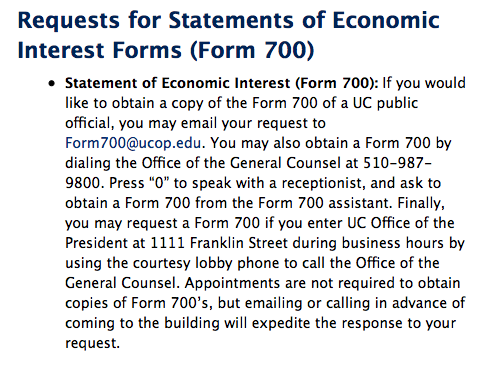
  • Statement of Economic Interest (Form 700): If you would like to obtain a copy of the Form 700 of a UC public official, you may email your request to Form700@ucop.edu. You may also obtain a Form 700 by dialing the Office of the General Counsel at 510-987-9800. Press “0” to speak with a receptionist, and ask to obtain a Form 700 from the Form 700 assistant. Finally, you may request a Form 700 if you enter UC Office of the President at 1111 Franklin Street during business hours by using the courtesy lobby phone to call the Office of the General Counsel. Appointments are not required to obtain copies of Form 700’s, but emailing or calling in advance of coming to the building will expedite the response to your request.

You may submit a request for records by email to publicrecords@ucdavis.edu. Prior to making a request, you may find information in the Frequently Asked Questions section helpful.


So I just wrote to them to see how long this takes (sent 3/24 at 7:28 AM)

Hello
I am writing to request a copy of the form 700 filings for the UC Davis Chancellor Linda Katehi for the last 10 years.  If it is not possible to request the form for this many years I would like to request it for the most recent year.
Sincerely
Jonathan Eisen


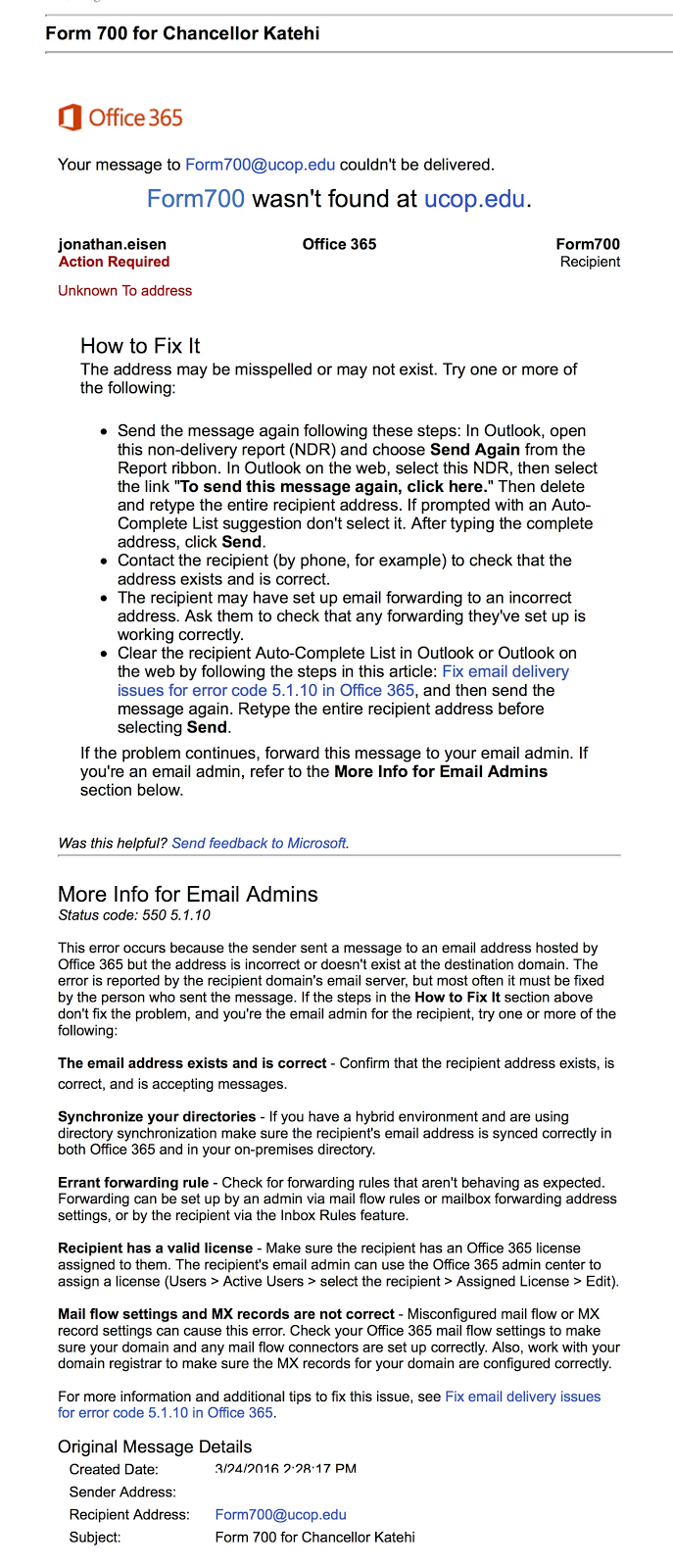
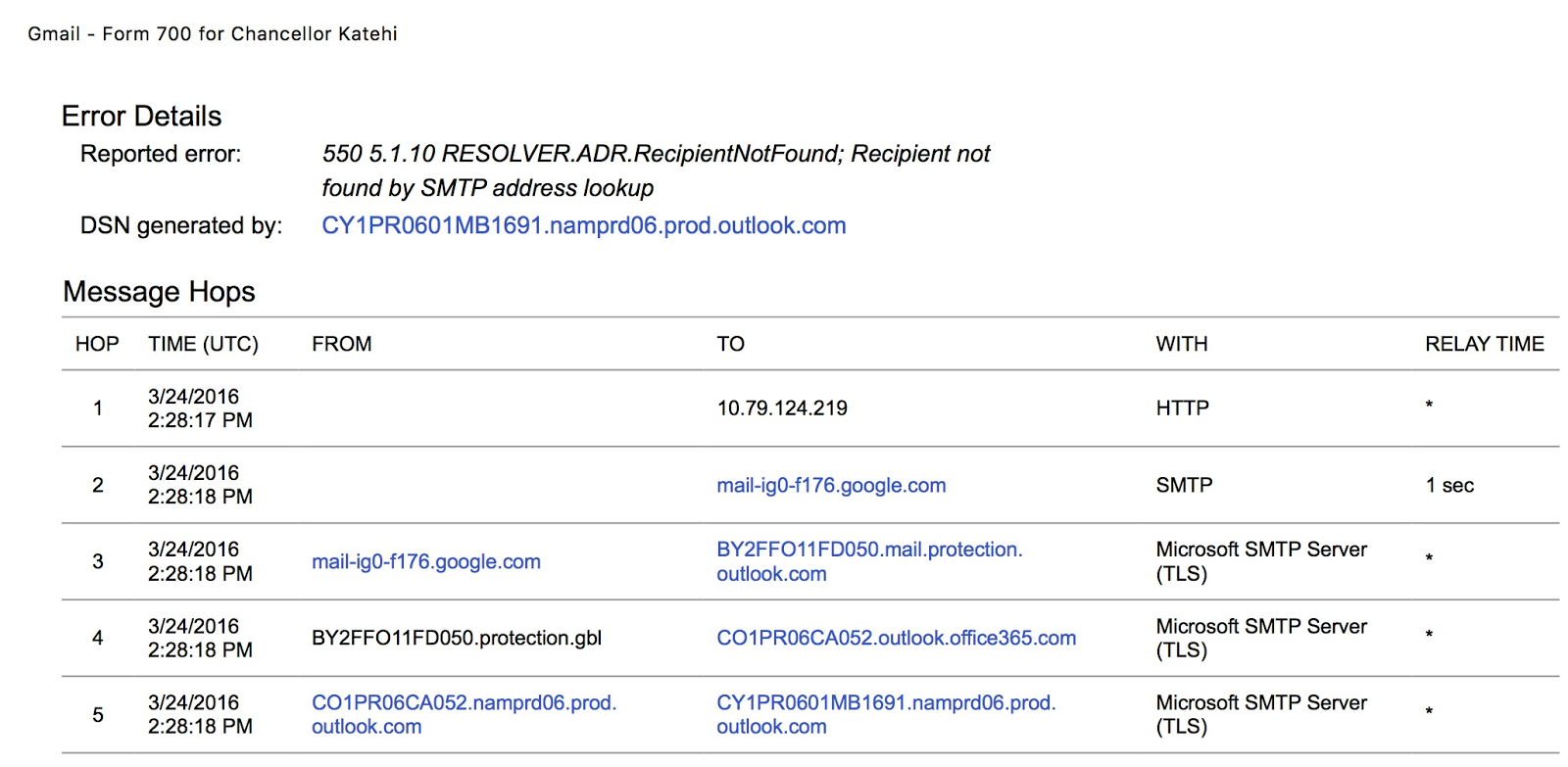
OMG.  And just a minute later I find out the message bounced.  See “simple” returned message below.  WTF am I supposed to do with that?


So – I guess getting form 700s is not so easy.  Shocking.

So now I will try to other address listed here.

You may submit a request for records by email to publicrecords@ucdavis.edu

To whom it may concern 

I submitted a request for form 700s based on instructions at http://campuscounsel.ucdavis.edu/public-records/accessing-records.html
Email to the address listed (Form700@ucop.edu) bounced.  So I am writing now to the other address listed. 

I am writing to request a copy of the form 700 filings for the UC Davis Chancellor Linda Katehi for the last 10 years.  If it is not possible to request the form for this many years I would like to request it for the most recent year. 

Sincerely,
Jonathan Eisen

UPDATE 3/24

Someone from the UC Davis office wrote back to me really quickly which is great

Dear Dr. Eisen, I believe the reason that your email bounced back is because it is incorrect.  The correct email for your request is form700info@ucop.edu  (copied above). The Office of the President is the “office of record” for all Form 700s.  I would have to go through the same process as you do to acquire this information.  Please feel free to contact me later next week if you still have not received a response from OP, but usually requests are responded to within a couple of business days.  (FYI – tomorrow is a University holiday.) Regards,

I wrote back to try and get them to correct their web site mistake

Thanks so much for the quick reply.  I note – I got the address from the Office of the Campus Counsel website 

http://campuscounsel.ucdavis.edu/public-records/accessing-records.html 

It would be good to fix that site with the correct address.  See a screen capture below.
Jonathan


A few minutes later they wrote back saying they were going to fix the incorrect email address.  Yay.  One step forward towards transparency. A very small step. But still …


3/29/16 – Forms Received
Got an email with the forms a few minutes ago (~ 4:15 PM)

Dr. Eisen: Attached please find the response to your request for the Statement of Economic Interests, Form 700s, for Chancellor Katehi. Please note: we are required by law to retain Form 700s for only seven years. At this time, we consider CPRA #16-1590 fulfilled and your file will be closed. Thank you. Sincerely, UCOP Public RecordsOffice of General Counsel1111 Franklin St., 5th FloorOakland, CA 94607pra@ucop.edu

So that is about 5.5 days.  Not terrible.  But it would be better for these to be online somewhere.

Blast from the not so distant past – special issue of JMBE on Scientific Ethics

So _ picked up my new issue of Microbe in the mail today and I saw something in it that seemed very intriguing.

A whole section of JMBE – the Journal of Microbiology and Biology Education dedicated to Scientific Ethics.  Sounded intriguing.  So I looked it up.  Took a bit to find it but there it was from December 2014 – Volume 15 number 2

I don’t know about the specific articles but the whole collection seems definitely worth a look and of potentially many uses.

So I have listed the individual papers below.  Kudos to ASM and JMBE for putting this together.  Now off to read some of the papers.


Robert Edgar at #UCDavis 3/30 “Sequence analysis for marker gene metagenomics”

University of California, Davis

Department of Microbiology & Molecular Genetics

College of Biological Sciences

MIC 291: Selected Topics in Microbiology

Work-in-Progress Seminars

Dr. Robert Edgar

(Independent scientist and consultant in fields of computational biology and bioinformatics)

Sequence analysis for marker gene metagenomics

Wednesday, March 30, 2016

4:10pm

1022 Life Sciences

Abstract: Microbial community studies using marker genes such as 16S and ITS present challenging sequence analysis problems due to sparse coverage in reference databases and the difficulty in distinguishing experimental error from true biological variation. I will show that several popular algorithms for taxonomy prediction and for creating de novo clusters (OTUs) have high error rates, and describe new algorithms with greatly improved accuracy.

Dr. Edgar is best known for developing the widely-used MUSCLE and USEARCH programs, which have been cited by thousands of published papers. He also works as a consultant and looks for opportunities to leverage his unique combination of business and scientific skills by helping start-up companies.

Host: Prof. Mitch Singer (mhsinger)

Department of Microbiology & Molecular Genetics

(note – title uses a definition of metagenomics that I do not endorse …)

Edgar 3-30-16.doc

Postdoctoral Scholar Positions at the Thermal Biology Institute

Dear TBI & Friends,

Please forward this position announcement on to folks you think would be interested. We are accepting applications until both positions are filled.

Postdoctoral Scholar Positions Open

Thermal Biology Institute, Montana State University

Two recently funded Postdoctoral Scholar positions are available immediately in the Thermal Biology Institute (TBI) () at Montana State University (MSU). One position will focus on metagenomics and microbial ecology, and a closely aligned position to focus on proteomics and metabolomics of these same systems. TBI conducts research on the biology and interrelated physical and chemical processes of geothermal environments in the Greater Yellowstone Ecosystem, and was established in 1999 and has a successful history of high quality, interdisciplinary biological research in geothermal environments. https://jobs.montana.edu/postings/4528

Complete details attached.

MSU TBI Postdoc Positions.pdf

At #UCDavis 3/31 – Frontiers in Publishing: Experience w/ open access publishing

Thursday, March 31, 2016

PANEL: 3:00P.M. – 5:00P.M. RECEPTION: 5:00P.M. – 6:00P.M.

UC Davis, Activities & Recreation Center (ARC), Meeting Room 1

Frontiers is a leading Open Access scholarly journal publisher, with 55 journals in many disciplines and growing. In addition to rising journal impact factors, Frontiers is advancing article-level and author metrics as new ways of measuring the impact of research. A growing number of UC Davis faculty members edit Frontiers journals and have gained experience with this new publishing model and its benefits and challenges for publishing research. Join

us for a look at the benefits of Open Access publishing for improving research impact through increased citations, and a cross- disciplinary panel of five UC Davis editors, on how Frontiers has worked in practice.

Participants:

MacKenzie Smith, University Library (moderator)

Neelima Roy Sinha, Plant Biology

Cecilia Giulivi, Molecular Biosciences & Vet Med

Patrice Koehl, Computer Science & Genome Center

Mary M. Christopher, Vet Med Pathology, Microbiology & Immunology

Arne Ekstrom, Psychology

Sandra Hausmann, Frontiers

Frontiers event poster 03-31-2016.pdf

Letter from President Napolitano to UC community about new sexual assault measures

Of possible interest:

UNIVERSITY OF CALIFORNIA COMMUNITY

Dear Colleagues:

Recent developments have roused concerns and questions regarding how incidents of sexual harassment and sexual violence are addressed at UC. I want to take this opportunity to reinforce some important points and share with you additional measures I am instituting to address these issues.

Let me be clear: each and every one of you has the right to come to UC to learn and work in an environment free of sexual harassment and sexual violence, and to be part of an institution that deals with any substantiated reports of sexual harassment or violence firmly, fairly, and promptly.

Ensuring that UC is a safe environment is a top priority both for the University, and to me personally. In 2014, I formed the 29-member President’s Task Force on Preventing and Responding to Sexual Violence and Sexual Assault, which has spent the last two years instituting systemwide improvements to strengthen our processes and increase transparency and consistency across the system. These improvements have included mandatory education and training for students, administrators, faculty, and staff; confidential support for survivors; resources for people reporting sexual violence and those responding to allegations; and standardized procedures for investigating, adjudicating, and imposing sanctions in cases involving students.

In cases involving faculty, I appointed a joint committee of the UC administration and the Academic Senate, with student representation, to review our current procedures and provide recommendations to me by April 4. Once that work is complete, we will then focus on reviewing our process for handling cases involving staff beginning in April.

But recent developments have demonstrated that we must take immediate steps to further shore up our efforts.

Last week, I established a new Systemwide Peer Review Committee that will review and approve all proposed sanctions for any senior University leader found to have violated our UC Policy on Sexual Violence and Sexual Harassment. Senior leaders include, but are not limited to, Chancellors, Associate and Assistant Chancellors, Provosts and Vice Provosts, Deans, Coaches, and Athletic Directors.

After consulting with the Chancellors, I have appointed the following individuals to serve on the Systemwide Peer Review Committee:

• Co-Chair Sheryl Vacca, UC Chief Compliance and Audit Officer and Chair of the President’s Task Force on Preventing and Responding to Sexual Violence (UC Office of the President)

• Co-Chair Allison Woodall, Deputy General Counsel (UC Office of the President)

• Ramona Agrela, Associate Chancellor, Chief Human Resources (UC Irvine)

• Brian Alldredge, Vice Provost of Academic Affairs, Professor of Clinical Pharmacy (UCSF)

• Ken Baerenklau, Associate Provost, Associate Professor of Environmental Economics and Policy (UC Riverside)

• Gregg Camfield, Vice Provost for the Faculty, Professor of Literature and Culture (UC Merced)

• Fiona Doyle, Dean of Graduate Division, Professor of Mineral Engineering (UC Berkeley)

• Julie Freischlag, Vice Chancellor of Human Health Sciences, Dean of School of Medicine (UC Davis)

• Margaret Klawunn, Vice Chancellor of Student Affairs (UC Santa Barbara)

• Sarah Latham, Vice Chancellor of Business and Administrative Services (UC Santa Cruz)

• JoAnn Trejo, Associate Dean of Faculty Affairs in Health Sciences, Professor of Pharmacology (UC San Diego)

• Patricia Turner, Vice Provost of Undergraduate Education, Dean of the Division of Undergraduate Education (UCLA)

In addition, I have directed the Chancellors to ensure that all senior leaders take the University’s mandatory sexual harassment training by March 25 to guarantee full understanding of UC’s policy and procedures.

We must, and we will, do a better job of investigating all claims of sexual harassment or sexual violence thoroughly and fairly. And when claims are substantiated, we must hold people accountable and impose sanctions that appropriately reflect the seriousness of these cases.

Yours very truly,
Janet Napolitano
President

UC_Community_Systemwide_Peer_Review_Committee_3181_0.pdf

The #UCDavis Chancellor’s Board Positions and the Need for a More Public, Open and Early Disclosure System

So, I assume by now many people out there have heard about the controversy going on at UC Davis over the board positions taken by the UC Davis Chancellor Linda Katehi.  If you have not – here is a brief summary.

  • In late February, Chancellor Katehi accepted a board position at the for profit educational company Devry but then steeped down after complaints.  See for example this story by Diana Lambert in the SacBee for details.  Note – she has admitted that her accepting of this position prior to getting approval from the UC President was a violation of UC policy.
  • Chancellor Katehi received $420,000 in compensation for serving on the board of John Wiley and Son’s from 2012-2014.  See this SacBee story by Diana Lambert and Dale Kasler for more detail.  In relation to this report, Chancellor Katehi has apologized and has said she will donate “all the stock proceeds” she made from Wiley to a Scholarship fund for UC Davis students.
  • Chancellor Katehi served on the International Advisory Board of King Abdulaziz University in Saudi Arabia for a year.  This is the same University that has been strongly critiqued for its practice of paying highly cited scholars to become adjunct faculty in order to boost its ratings. It has been reported that she did not attend any of the board meetings in person and did not receive any compensation for this.  See this and this for more detail.  
There have been many responses to these revelations including:

The situation does not appear to be letting up.  I note – in the description above I have tried to be as objective as possible in describing the situation.  And I have been thinking a lot about what I think should happen now.  Do I think the Chancellor should resign?  Should she be fired?  Do we need more faculty to come out in support of her?  What is the best path forward for UC Davis?  I certainly have thoughts on these questions and related topics.  And I assume many people who know me know that I am not exactly shy about expressing my thoughts in public.

But … there is one major thing that gives me pause here.  And it relates to the comment above about trying “tried to be as objective as possible” here.  The reason this gives me pause here is because one of the key issues at play relates to “Conflicts of Interest” – both real and perceived – in the Chancellor’s board positions.  Many critics have argued that each of these board positions comes with major conflicts of interest in the Chancellor’s job as the head of a major public university.  The Chancellor’s supporters have argued that these board positions at worst involved the appearance of a possible conflict and not any real conflict.

Why I am digging into this conflict of interest topic?  Because I think one key way to help people assess whether there are any real or possible conflicts of interest in one’s activities is to fully disclose as much as possible about one’s activities.  And I think the UC in general and the Chancellor of UC Davis could do a much much much better job in terms of disclosures.  And I have a proposal for that.

But before we get into that I think it is necessary for me to make some disclosures.  Here are some:

  • I am a Professor at UC Davis
  • I have worked on a few projects with the UC Davis Chancellor Linda Katehi directly and indirectly and I have always had positive interactions with her).
  • I have worked on the UC Davis ADVANCE Project ( to increase the participation and advancement of women in academic science and engineering careers) for which Chancellor Katehi is the lead. 
  • I don’t always agree with actions taken by Chancellor Katehi but I do believe she is truly committed to improving UC Davis
  • I have worked for many years on “open access” to scholarly literature (and a little bit to textbooks) and have occasionally been at odds with the John Wiley and Son’s company.
  • I was involved in an exposé of what I believe to be unethical behavior of King Abdulaziz University a few years ago in their attempts to buy rankings by trying to have scholars change their institutional affiliations on publications and in citation databases.  See for example this and this and this.  I note – I was threatened by one of the people from KAU who I helped expose.  I am NOT A FAN of KAU.
  • I spent almost two months writing about the pepper spray incident and follow up in 2011 in an effort to help save the image of UC Davis, which I love.  See some of my posts about this here.  The whole incident and the aftermath was very traumatic for the University and many individuals associated with the University, including myself.  There were calls for Chancellor Katehi to resign then.  And there were statements of support by deans and faculty.  I refused to sign either.  I thought she and the UC Davis admins made many mistakes and did not by any means deserve endorsements.  But I also thought it was unclear if their mistakes were enough for them to be pushed out. 
  • Other disclosures of mine are here: https://phylogenomics.wordpress.com/about/disclosures
I have listed these disclosures because I am not sure I can be objective about this story.  And I want everyone reading this to have this information so that you can make your own decision as to whether you think my possible conflicts of interest might cloud my judgement in various ways.  I tried to be objective in outlining what I think the current state of the situation is above, but I understand that not everyone may agree.  And if people think my view of the situation is too biased, well, they probably will not care too much about what I think we should do now.  And I am OK with that.  What I want most is for people to know now just what my positions are, but what might have affected what my positions are.

OK – so that is a way longer introduction than I had imagined in getting to the question of “what should we do now?” 

A reader who thinks I am not completely compromised might ask – what do I think about the situation and what do I think should happen now?  Here are some comments:

  • I personally think that accepting each of these board positions was really not wise.  Yes, the Chancellor may have accepted them with the best of intentions.  And yes, she may not have done anything inappropriate in her time on the two on which she served (Wiley and KAU).  But I think it would not have been that hard to imagine how these board positions might be perceived – especially by UC Davis students.  And that alone I think should have led to turning down these board positions.  She has admitted Devry was a mistake. She has not admitted (as far as I know) that Wiley was a mistake but has hinted that she can see how some people may not like it.  She has not admitted at all that KAU was a mistake as far as I can tell (and has defended it as being in the interest of promoting diversity), but given that it was known in 2011 widely that they were buying ranking in a seemingly unethical manner, this should have raised some red flags.  I do wonder a bit whether my really unpleasant interaction with KAU has made me more judgmental about this board position than maybe I should be (hence why I thought it was important to disclose this above).
  • Despite the above comments, I do not think that the board positions taken by the Chancellor are enough of a problem to call for her firing or resignation.  There are two major reasons for this.  My min reason for this is that I think one has to weigh the board position issue against all she has done as Chancellor and overall I believe she has done many very good things as Chancellor and that she is truly and deeply committed to UC Davis.  I understand that other people do not agree with this.  So I think in a way how people respond to this board position issue may relate largely to how good a job they think she has been doing as Chancellor.
  • I think a key mistake in this whole situation involved a poor job of disclosure.  More on this below.
  • I think another key mistake has been the slow and minimal communication with UC Davis and the public in response to these issues.  I really wish Chancellor Katehi and UC Davis administrators would hold some town halls or the like to discuss these issues and to explain to us why these board positions were taken.
So in summary – I think the Board positions were mistakes but I do not think they rise to the level of calling for the Chancellor to be fired or to resign.  I do think we should use this situation to completely revisit the topic of conflicts of interest, disclosure, and outside activities of the UC Administrators.  There have been calls, for example, to greatly limit if not stop entirely outside activities, especially at for profit entities, by the UC Chancellors and other higher ups.  I am not sure what I think about these calls, but they are definitely worth considering.  However, I think as a first step the UC could tackle one key issue – Disclosure.  

In general I think disclosures of possible conflicts of interest are done really poorly in academia.  So poorly that before this whole issue cropped up at UC Davis I made a proposal that scholars add disclosures to a centralized universal scholarly ID system known as ORCID.  See Improving Ability to Identify Possible Conflicts of Interest of Scholars 1: Adding a Disclosure Field to ORCID.  This would certainly help when on sees a paper by someone (say, Eric Lander) and would allow one to get more information about their possible conflicts of interest (say, billions of dollars in possible royalties for the institute one runs).  I think such a system would be very useful.  But it is not really enough for the issue at hand here.

So in order to at least get the UC started down a better path in terms of conflicts of interest and activities by UC administrators I propose the following simple steps (and I note – this are just some ideas and thoughts, not a well formulated system at this point).

Proposed Public, Open, and Early Disclosure System for UC Administrators.

  • This system should be applied to all top UC Administrators (UC President, Chancellors, Provosts, Deans, and possibly others)
  • Disclosures of outside activities and potential conflicts of interest must be made publicly available in a centralized location. 
    • This would include Form 700s and other declarations.
    • I have been told such forms are available for all UC Admins.  They are certainly not readily available.
    • UC Administrators should be required to update such disclosures quarterly
  • The disclosures need to be referenced and linked readily and widely:
    • The disclosures should be provided at the administrator’s profile pages 
    • Disclosures or links to them should accompany all official communications of these administrators (much in the way disclosures should accompany scholarly publications).
  • Administrators should be required to submit proposed outside activities to the public PRIOR to commencing those activities. 
    • There should be a public commenting period regarding these proposals
    • The specific activities and compensations must be included in all proposals
    • The proposals should include a discussion of the putative benefits to the UC for such activities.
    • There should be a more public, more formal review process for determining if the proposed activities are in the best interest of the UC
  • These disclosures should happen whether or not any other regulations about outside activities happen.
I understand this will not solve all the issues associated with outside activities, conflicts of interest, and such.  But I think one big step would be for the UC to adopt a more open, public, early, easy to find, and widely share disclosure system for outside activities of UC Administrators.  And perhaps, just perhaps, requiring such open, public, and early disclosure system would lead some UC Administrators to think more carefully and clearly about what outside activities they choose to do – or propose to do.


Update 3/23: some other links of relevance


Been attempting to get for 700s for the Chancellor (as an exercise, not to dig into them in any detail). Writing about it in a seagate post.


At #UCDavis: Center for Open Science’s Open Science Framework 5/4/16

Workshop announcement: Open Science Framework

Who: Center for Open Science

When: May 4th, 2016

Times: 9 am – 12 pm (morning session) or 1 pm – 4 pm (afternoon session)

Pizza lunch at noon for both sessions

Where: DSI Space, Shields Library, room 360, UC Davis Campus

There are many actions researchers can take to increase the openness and reproducibility of their work. Please join us for a workshop, hosted by the Center for Open Science, to learn easy, practical steps researchers can take to increase the reproducibility of their work. The workshop will be hands­ on. Using example studies, attendees will actively participate in creating a reproducible project from start to finish.

Topics covered:

* Project documentation

* Version control

* Pre-Analysis plans

* Open source tools, such as the Center for Open Science’s Open Science Framework, which can be thought of as an electronic notebook that easily integrates the aforementioned concepts in a workflow.

This workshop is aimed at faculty, staff, and students across disciplines, who are engaged in quantitative research. The workshop does not require any specialized knowledge of programming. Participants will gain a foundation for incorporating reproducible, transparent practices into their current workflows.

The three hour workshop is offered at two times to facilitate busy schedules. As space is limited, please register here by April 4th if you plan to attend:

https://docs.google.com/forms/d/16HcMmFq0_tl5gg-hhlilkLo_7fQ8Rb-J1DrFg6Te80Y/viewform

If you register and are no longer able to attend, please contact Jessica Mizzi (jessica.mizzi) and let her know.

UCDavisPromotionalFlier