
Who: Susan Holmes (Stanford Univ.)
When: Thursday, Nov 12, 4:10pm,
Where: MSB 1147, UC Davis
What: Analyzing data from perturbation experiments: the case of the human microbiome.
Eisen Lab Blog

At #UCDavis 11/13: Matthew Barber on “Blood and Iron – Evolutionary Conflicts t Host-Microbe Interfaces”

Share this:

YARILKB: Assemblathon to Zykovich: an A-Z that reflects a decade at the UC Davis Genome Center
Posting this email I just got – everyone around #UCDavis should go. YARILKB.
Hi,
After (almost) 11 years working in the Genome Center I am finally moving on and heading back to the UK. Join me for a highly informal ‘Exit seminar’ on my last day (November 20th) where I will reminisce about lessons learned from a decade at the Genome Center (including the challenges of organising foosball tournaments).
There will be cakes!
+ Friday 20th November, 10:00 am. GBSF room 4202.
Regards,
Keith
Share this:
Thanks, no plans to help you get your impact factor on
Got this in the intertubes this morning. Sorry – not planning to submit there.
Dear Jonathan A Eisen,
Hope you are doing well.
We, Bio Accent open access publishers came newly into publishing sector to provide a platform to the researchers, practitioners, students and professionals from both academia as well as industry to meet and share cutting-edge development in the field of Microbiology.
We have found your profile from your institute; it seems you are a very good expert in Microbiology. We don’t want to miss your appreciable work so, we are inviting you for manuscript submission in BAOJ Microbiology.
We request you to let us know if you have any kind of research work to publish with us and please let me know your tentative date of manuscript submission.
We are expecting huge support from your side, so it will help us to get indexed & impact factor soon.
Awaiting your positive response.
Sincerely
Laura
Share this:
BigDat 2016 where men (and only men) will teach you about big data #YAOMM
Just got an email invitation to the following
2nd INTERNATIONAL WINTER SCHOOL ON BIG DATA
BigDat 2016
Bilbao, Spain
February 8–12, 2016
Organized by:
DeustoTech, University of Deusto
Rovira i VirgiliUniversity
I confess, I was intrigued enough to look because it was in Bilbao, and, well, my kids are completely obsessed with soccer and we are thinking of a trip to Barcelona, so why not a trip to Bilbao too. And then, well, I got sick to my stomach. I looked at the list of speakers and instructors and did a bunch of Googling to make inferences about their gender. And, well, everyone associated with the School appears to be male. That is 24 or 24 slots (4 keynote speaker slots and 20 professor slots. See below for the rundown. People I identified as male are highlighted in yellow. Sad and disappointing. Needless to say I will not be going.
—————————–
Keynote Speakers
- Nektarios Benekos (European Organization for Nuclear Research)
- Chih-Jen Lin (National Taiwan University)
- Jeffrey Ullman (Stanford University)
- Alexandre Vaniachine (Argonne National Laboratory)
Professors and Courses
- Nektarios Benekos (European Organization for Nuclear Research)
- Hendrik Blockeel (KU Leuven)
- Edward Y. Chang (HTC Health, Taipei)
- Nello Cristianini (University of Bristol)
- Ernesto Damiani (University of Milan)
- Francisco Herrera (University of Granada),
- Chih-Jen Lin (National Taiwan University),
- George Karypis (University of Minnesota)
- Geoff McLachlan (University of Queensland)
- Wladek Minor (University of Virginia),
- Raymond Ng (University of British Columbia)
- Sankar K. Pal (Indian Statistical Institute)
- Erhard Rahm (University of Leipzig)
- Hanan Samet (University of Maryland)
- Jaideep Srivastava (Qatar ComputingResearch Institute)
- Jeffrey Ullman (Stanford University)
- Alexandre Vaniachine (Argonne National Laboratory)
- Xiaowei Xu (University of Arkansas, Little Rock)
- Fuli Yu (Baylor College of Medicine)
- Mohammed J. Zaki (Rensselaer Polytechnic Institute)
Share this:
Storify of Discussions About Shameless Behavior by #AAAS Relating to #Ebola Papers
//storify.com/phylogenomics/aaas-science-magazine-shamelessly-try-to-get-credi/embed?border=false//storify.com/phylogenomics/aaas-science-magazine-shamelessly-try-to-get-credi.js?border=false[View the story “#AAAS & Science Magazine shamelessly try to get credit for free #Ebola papers; while ignoring HIV, TB, malaria, etc ” on Storify]
Share this:
Improving Ability to Identify Possible Conflicts of Interest of Scholars 1: Adding a Disclosure Field to ORCID
Real and perceived conflicts of interest are a critically important topic in scholarly activities that I believe has not received enough attention from the scientific community. Right now, disclosures of possible conflicts of interest are handled incredibly very unevenly and poorly by academia and industry and government. Even when people do the right thing and make detailed disclosures, such information is hard to find and ephemeral. There are many things that the community could do to improve the ability to find such information.
One simple step that I believe could be useful would be to link disclosures to universal scholar ID systems. Although there are multiple UID systems for scholars, right now the UID of choice appears to be ORCID. ORCID currently allows scholars to compile information about their education, employment, funding and scholarly works.

I therefore propose that ORCID add a new category: DISCLOSURES. What would be included here? Well, I don’t know exactly but would include things like board membership, stock in companies, funding not listed elsewhere, any other significant relationship with a group, and more. Sure this could get messy. But I think we need to do more to make it easier to share and find information that could be a actual or potential conflict of interest.
Something like this:

If anyone knows of other tools for doing this I would love to hear about them.
//storify.com/phylogenomics/system-for-disclosures-for-academics/embed?border=false//storify.com/phylogenomics/system-for-disclosures-for-academics.js?border=false[View the story “System for Disclosures for Academics” on Storify]
Share this:

Does #AAAS care about #Ebola anymore? Nope. And probably never did. #ClosedAccess
In October I wrote a blog post criticizing AAAS (and ASM) for trying to give themselves a pat on the back for making a few papers about Ebola freely available: The Tree of Life: No #AAAS and ASM you do not deserve good PR for freeing up a few papers on Ebola. The whole thing was a publicity stunt. And AAAS in particular tried to play up how they were doing this for the benefit of humanity.
So today I decided to check back and look into whether AAAS was making new papers on Ebola freely available. So I searched for the word Ebola in the title or Abstract
The most recent seemed interesting:

Surely AAAS must still care enough about Ebola to make new papers freely available right? Nope. $20 to rent for a day
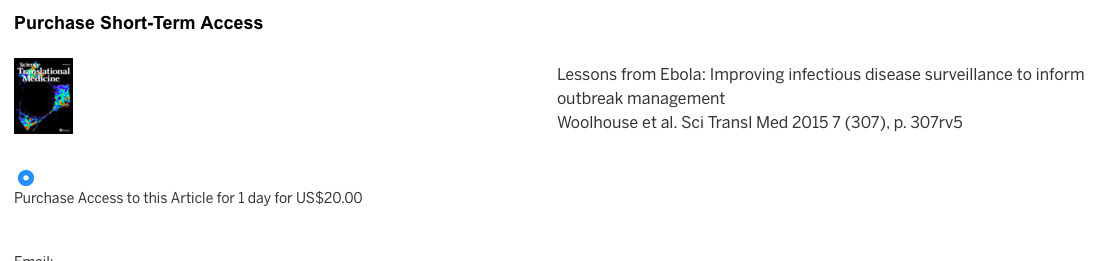
How about #2:

Seems useful and worth reading if one works on Ebola. Free right? Nope: $20/day

How about #3:
Seems peripherally relevant to Ebola but I would not mind if more Ebola workers read this. Free right? Nope. Guess how much? $20/day

And so on. A few in the first 10 were, at least for now freely available. But overall it seems, AAAS and Science have decided Ebola is no longer important. So much for helping the world.
Share this:

YASEBI – Yet another SPAMMY editorial board invitation
Got this SPAMMY invite in the emails. Given that I work neither on Immunology or Immunotherapy this seems, well, SPAMMY.
Dear Dr. Jonathan Eisen,The Journal of Immunology & Immunotherapy welcomes you!Henry Publishing Group introduces you the Journal of Immunology & Immunotherapy. The journal is newly launched with an open access initiative to serve the scientific community globally. We welcome eminent scientific personalities, who are expertise in this field as editors to form the editorial board.Based on your expertise and contributions in this field, we request you to associate with us as an editor. We would be happy if you could serve as an editor and help us for the growth and development of the journal.Kindly go through the URL for journal online,We are awaiting for your response regarding your opinion towards the position. If you are interested, please mail us your acceptance along with an updated CV, summary of research expertise and biography at immunology@henrypublishinggroup.orgPlease let us know if you have any queries regarding this. I look forward to hear from you soon.Hope to associate with you a long lasting and scientific relationship with youWith kind regardsAndy LauerUnit 3,830 Manukau Rd,Rayal Oak,Auckland – 1061,New ZealandTel: +64 98010312
Share this:
Today at #CUDavis: MEGAN DENNIS: The Role of Human Structural Variation in Evolution and Disease
**TODAY**
Integrated Genetics & Genomics Graduate Group
Seminars in Genomics & Epigenetics
“The Role of Human Structural Variation in Evolution and Disease”
Megan Dennis
Assistant Professor, Dept. of Biochemistry and Molecular Medicine
UC Davis
Monday, November 2, 2015
4:00 – 5:00 p.m.
1022 Life Sciences
Host: Alex Nord (asnord)
(If you would like to meet with the speaker, please contact their host)


 Jonathan Eisen's Lab