
Dr. Phillip Romero, UCSF
4:10 p.m. Chemistry in Rm 179
Seminar Title: “Data-Driven Protein Engineering: Learning the Sequence-Function Mapping from Experimental Data”
Eisen Lab Blog

Harvard, hope and hype: the sad reason behind overselling diabetes stem cell work – raising money
Earlier in the week I got all fired up – not in a good way – about a press release and news stories relating to a new paper from Doug Melton on a insulin producing STEM cell study
Exceptionally disappointed in Doug Melton of @HHMI for publishing new important diabetes paper as #closedaccess pic.twitter.com/DefoWwmiBR
— Jonathan Eisen (@phylogenomics) October 10, 2014
//platform.twitter.com/widgets.js With a little more discussion I just got more angry
.@HHMINEWS and publishes the groundbreaking paper behind a paywall so online the elite can see it #closedaccess pic.twitter.com/ZPriyCdHvY
— Jonathan Eisen (@phylogenomics) October 10, 2014
//platform.twitter.com/widgets.js
.@David_Dobbs @Stephen_Curry @rpg7twit massive hype yet paywall is a big f#*$ you to those who care about diabetics pic.twitter.com/MErZi5pzL7
— Jonathan Eisen (@phylogenomics) October 11, 2014
//platform.twitter.com/widgets.js
@cryptogenomicon @phylogenomics @Stephen_Curry @David_Dobbs @rpg7twit the paper is available at http://t.co/Rt2el9b9W5
— HHMI NEWS (@HHMINEWS) October 11, 2014
//platform.twitter.com/widgets.js I was angry both about the overselling of the implications of the paper and the fact that the paper was not published in an open manner. This was despite the stated goals of HHMI which funds some of the Melton Lab work.
.@Stephen_Curry @David_Dobbs @rpg7twit only 1/5 pubs on Melton HHMI page http://t.co/L1p2BEKrQ6 is free #closedaccess pic.twitter.com/KQDY5ZLjuA
— Jonathan Eisen (@phylogenomics) October 11, 2014
//platform.twitter.com/widgets.js
I was especially upset that much of the press coverage was reporting on an imminent cure for type I diabetes when this was clearly not imminent. Although I note – some coverage was OK. Like these:
… has there been too much hype? NHS cautions that talks of a “cure” for type 1 diabetes are premature http://t.co/MUZiRRWq3F
— Judith Taylor (@Endo_Editor) October 11, 2014
//platform.twitter.com/widgets.js
Risks of overhyping science: Telegraph says “Cure for Type 1 diabetes imminent after Harvard stem-cell breakthrough” http://t.co/hwDTHOZgeR
— Jonathan Eisen (@phylogenomics) October 11, 2014
//platform.twitter.com/widgets.js Another good piece of news – HHMI got Doug Melton to post a copy of the paper on a web site
@cryptogenomicon @phylogenomics @Stephen_Curry @David_Dobbs @rpg7twit the paper is available at http://t.co/Rt2el9b9W5
— HHMI NEWS (@HHMINEWS) October 11, 2014
//platform.twitter.com/widgets.js Although this was kind of hidden
@HHMINEWS @cryptogenomicon @Stephen_Curry @David_Dobbs @rpg7twit tx – is that newly added? can you get link posted w/ all PR/news stories?
— Jonathan Eisen (@phylogenomics) October 11, 2014
//platform.twitter.com/widgets.js
@HHMINEWS @cryptogenomicon @Stephen_Curry @David_Dobbs @rpg7twit not linked from http://t.co/PTauxXWosy or http://t.co/8vmUpQVuBf or others
— Jonathan Eisen (@phylogenomics) October 11, 2014
//platform.twitter.com/widgets.js Another good thing – Paul Knoepfler, a colleague of mine at UC Davis wrote a blog post for his excellent STEM cell blog about the Harvard study and the hype.
@phylogenomics @David_Dobbs @Stephen_Curry @rpg7twit If interested, my take on this paper & media hype http://t.co/6glBEGQo1F
— Paul Knoepfler (@pknoepfler) October 11, 2014
//platform.twitter.com/widgets.js
Thank you @pknoepfler for reality check on very important but overhyped Diabetes Stem Cell study http://t.co/w443cDOGgb
— Jonathan Eisen (@phylogenomics) October 11, 2014
//platform.twitter.com/widgets.js But the hype was still spreading …
Risks of overhyping science: Telegraph says “Cure for Type 1 diabetes imminent after Harvard stem-cell breakthrough” http://t.co/hwDTHOZgeR
— Jonathan Eisen (@phylogenomics) October 11, 2014
//platform.twitter.com/widgets.js So I felt like there was a continued need to say something about this
Ultimately @harvard & Doug Melton bear some responsibility for press overhyping their #diabetes stem cell work pic.twitter.com/8hwwmlsWFf
— Jonathan Eisen (@phylogenomics) October 11, 2014
//platform.twitter.com/widgets.js I even changed a talk I was giving on Sunday to include a discussion of this paper and the hype as, well, a bad thing
And I thought, and kind of hoped, that this might just go away. And then, many people forwarded me this email from Harvard sent out as part of a fundraising campaign. Most of the people who sent it to me sent it in happiness with the possibility of a cure for type 1 diabetes. Here is the email:
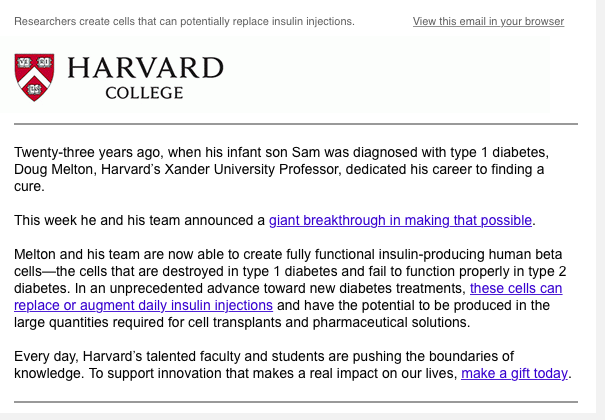
Of for $&*#*# sake. Really. So now Harvard was going to use this as a fundraising tool. And they would oversell it even more:
“A giant breakthrough in making that possible” with “that” referring to “finding a cure”. And then they say “these cells can replace or augment daily insulin injections” without saying that this WAS NOT IN HUMANS. THIS WAS IN MOUSE. $*#($#) DECEPTIVE LYING SCHMUCKS.
And they end this email with “make a gift today.” How about this Harvard. I will make donations to anyone but you until you stop marketing in hope and hype and start being responsible.
UPDATE 10/16/14 8 AM PST
Some of the overhyped statements relating to this story:
Harvard Press Story: “We are now just one preclinical step away from the finish line,” said Melton
Rawstory: Stem-cell cure for Type 1 diabetes ‘on par with discovery of antibiotics’
Telegraph: Cure for Type 1 diabetes iminent
Times of India: Type 1 diabetes cure within reach after breakthrough that could spell end of insulin injections for millions
BBC: Giant Leap to Type 1 Diabetes Cure
Share this:

Seminar at #UCDavis 10/30 – Scott Edmunds on “Open Publishing for the Big-Data Era”
Seminar of possible interest
Thursday, Oct 30th
12:10 PM to 01:30 PM
SS&H 1246
Scott Edmunds
from Gigascience / BGI
"Open Publishing for the Big-Data Era"
For more information see:
http://sts.ucdavis.edu/scott-edmunds-open-publishing-for-the-big-data-era
Additional information below:
Share this:
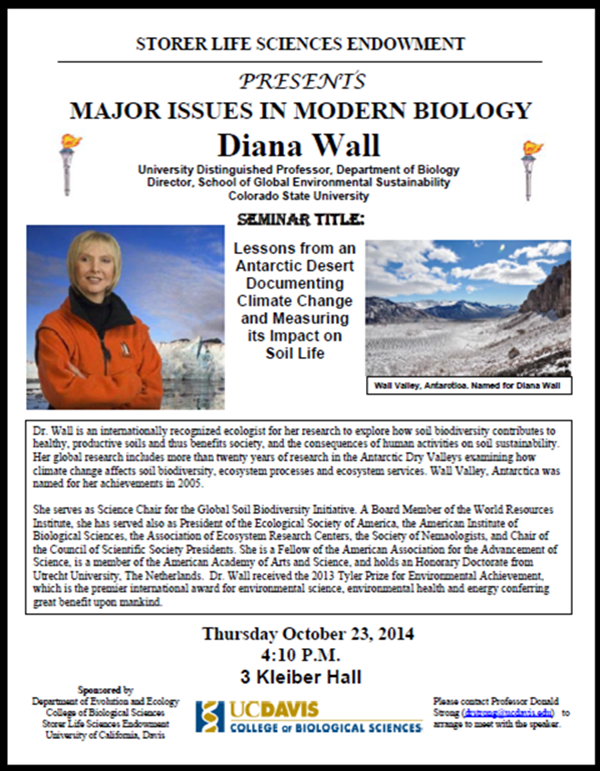
Diana Wall at #UCDavis 10/23 4 PM: Lessons from an antarctic desert …

Talk for UC Davis Pre-Health Meeting (#UCDPHSA): Opening up to Diversity
Sunday I gave a talk at the “12th National UC Davis Pre-Health Student Alliance Pre-Medical and Pre-Health Professions Conference“. I normally try to not give talks on weekends (to spend time with my family) but I made an exception here since this meeting has a strong commitment to issues relating to diversity in health and STEM fields. This mission statement for the meeting reads:
The UC Davis Pre-Health Student Alliance’s objective is to introduce and support academic, admission, and preparatory opportunities for all students interested in health professions with a focus on those underrepresented in healthcare (with regard to gender, economic, social, educational, linguistic, cultural, racial, and ethnic background). We target universities, community colleges and high schools throughout the United States. The UC Davis Pre-Health Student Alliance aims to impact health education, increase diversity amongst the healthcare workforce, and inspire future leaders of healthcare through hosting the largest national pre-health professions conference.
It was that mission statement that got me to ditch my wife and kids Sunday AM (and also much of Saturday PM for a dinner and to work on my talk). I went to a dinner Saturday for some of the speakers with the new Dean of the UC Davis School of Medicine Julie Freischlag. The dinner had about 20 or so people and I met some quite interesting folks there working on various aspects of human and animal health.
And then Sunday AM I got up early, decided to use slides (was not sure) and finished off the slide set I had worked on the night before. I decided that, in the spirit of the meeting, I would talk about two main things – diversity and access. And I planned to tell three stories about my work in this area. I wove in some personal stories since, at the dinner the night before Barbara Ross-Lee (who I sat next to) helped remind me of the importance of making talks personal. So in the end I talked about myself, diabetes, diversity of microbes, antibiotics, diversity in STEM, and open science. I came up with a title I was OK with: Opening up to Diversity.
My talk went well, I think. I am pretty sure it was vbideotaped but not sure where that recording will end up. I did however post my slides to slideshare. See below:
Opening up to Diversity talk by @phylogenomics at #UCDPHSA from Jonathan Eisen
And I also recorded the talk using Camtasia (basically, it allows recording of the screen, the video camera on my computer, and the audio). I posted the recording (without the video feed which shows mostly my neck) to Youtube. See below:
I have scanned in my notes that I made in planning this talk. Figured, why not post them.
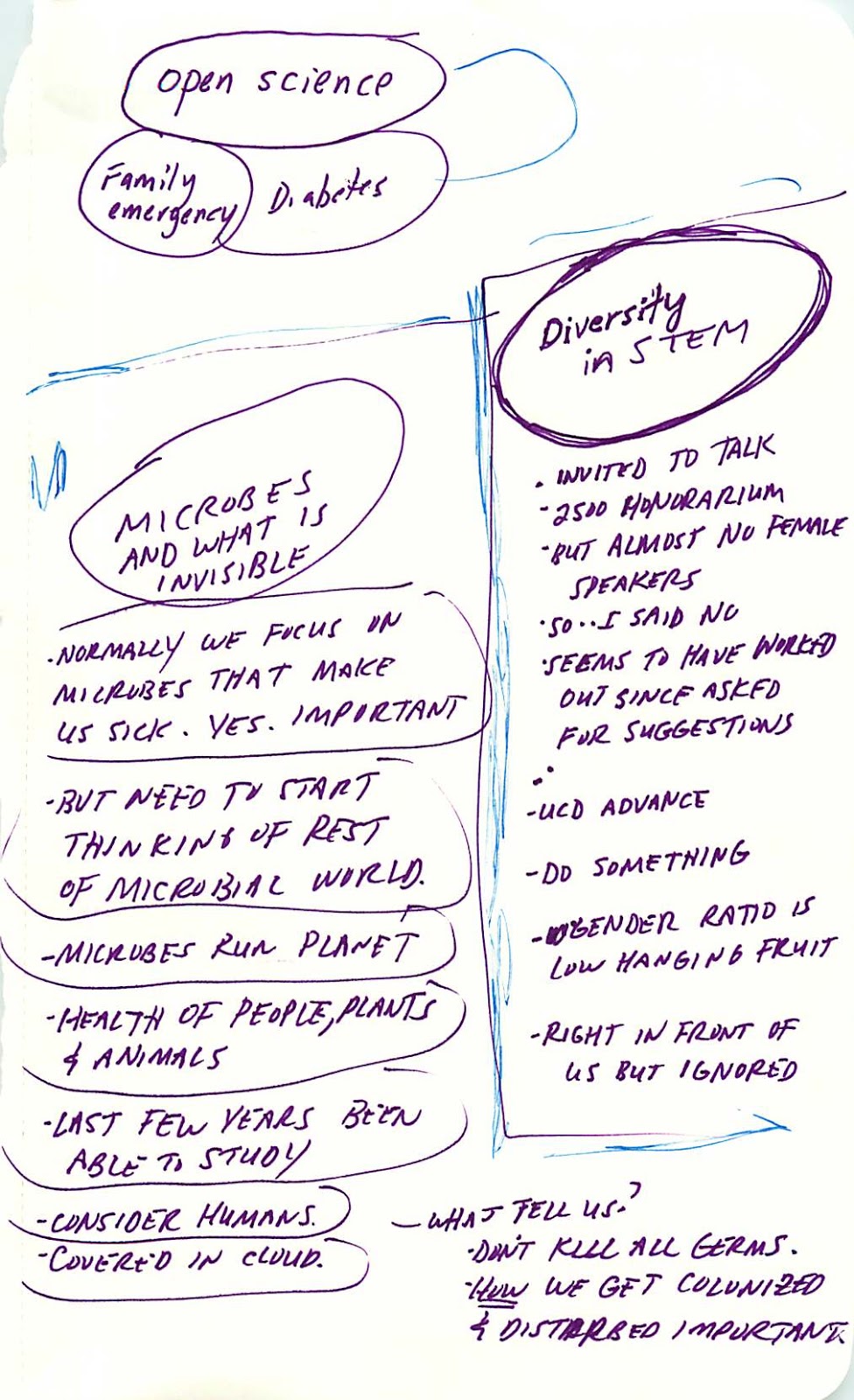

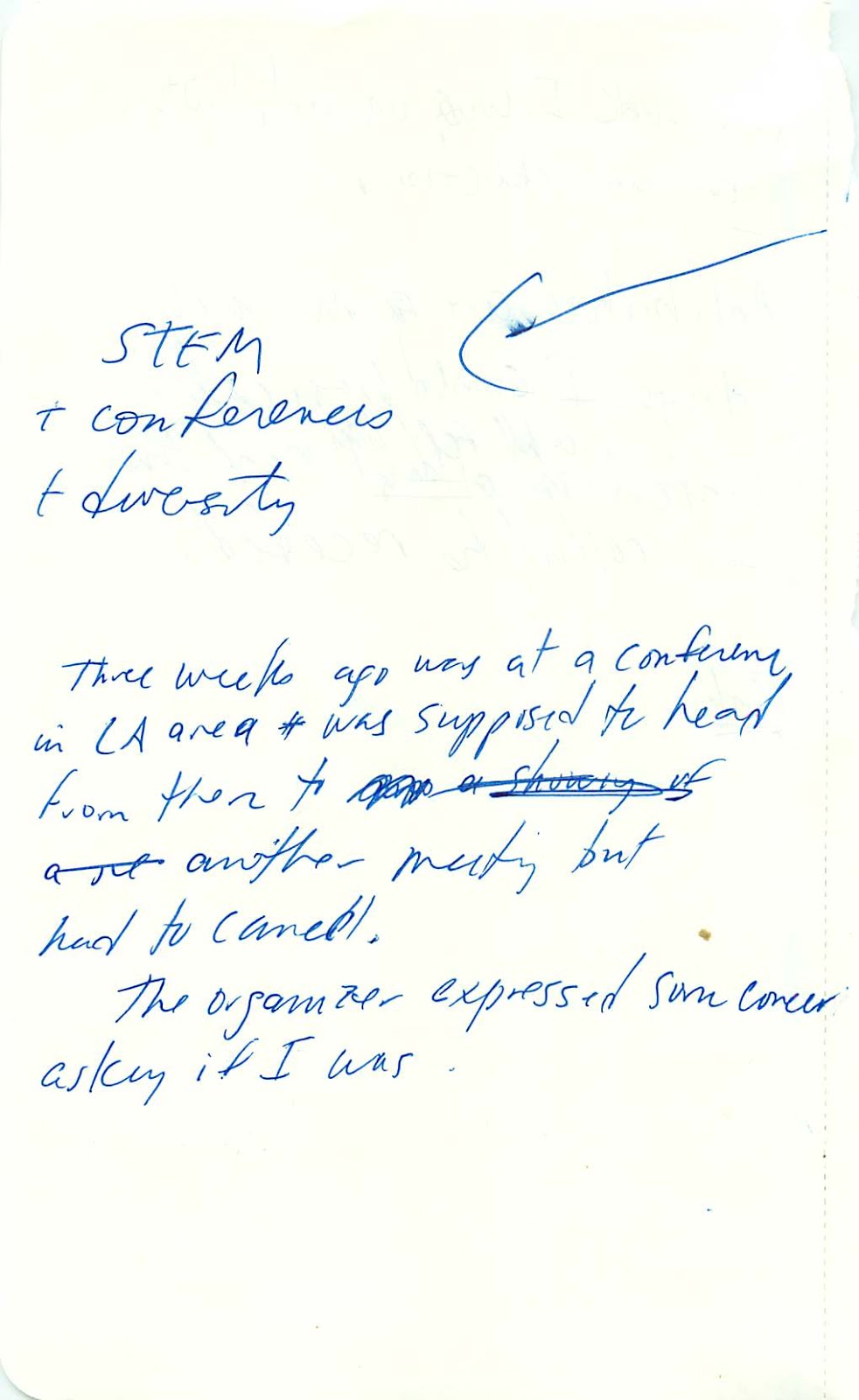

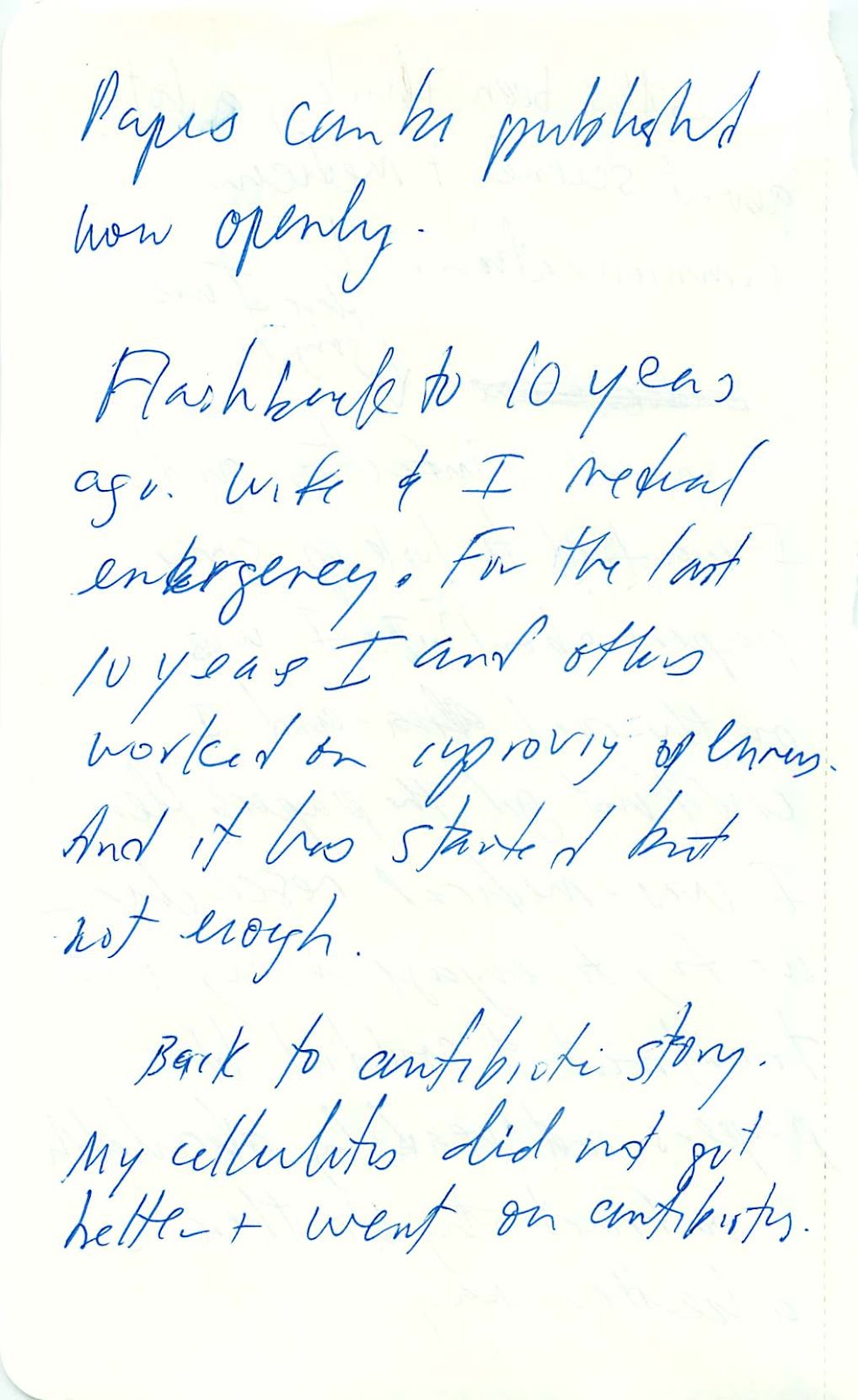


Update: 12/10/2014 – just discovered a video of the talk was posted to Youtube
Share this:

Biomedical Ph.D. Career Development Trends, Wed 10/22 @ 3 pm at #UCDavis
well, this could be intersting :
This announcement is sent on behalf of Associate Dean John Harada
Biomedical Ph.D. Career Development Trends: Implications for Workforce Development & Diversity
· Wednesday, October 22, 2014 at 3:00 – 4:00 PM
· Location: Memorial Union, MUII room (2nd floor)
· Target Audience: STEM faculty, postdocs, and students
· Recent biomedical workforce policy efforts have centered on the twin challenges of enhancing career preparation for graduate students and postdocs, and increasing diversity in the research workforce & professoriate. Dr. Gibbs will discuss results of his work that has focused on the graduate and postdoctoral training experiences and career-decision making of recent Ph.D. graduates, and whether/how these differ across lines of race/ethnicity and gender. Specifically, Dr. Gibbs will share from a focus group study, and national survey of 1500, recent biomedical PhD graduates (including 276 from URM backgrounds).
· Speaker: Kenneth Gibbs, Jr., PhD, is a Cancer Prevention Fellow at the National Cancer Institute (NCI). Dr. Gibbs conducts policy-relevant research aimed at strengthening the research enterprise.
· For more info and to RSVP: http://goo.gl/forms/IScrjZUBrE
flyer – Biomedical PhD Career Pathways.pdf
Share this:
Aspen Center for Biophysics: Workshop on Microscale Ocean Biophysics
Just got this from the Moore Foundation ..
Dear colleague,
The MMI team would like to apprise you of the following meeting on microscale ocean processes. Please share with potentially interested colleagues; the application deadline is quickly approaching — October 15, 2014. Further information can be found at http://www.aspenphys.org/physicists/winter/winterapps.html and tinyurl.com/MicroAspen.
Workshop on Microscale Ocean Biophysics
At Aspen center for physics
11-16 January 2015
Application deadline: 15 October
This highly interdisciplinary meeting will focus on how physical processes affect aquatic organisms at small scales, and thereby the global processes in oceans and lakes that microorganisms overwhelmingly govern. Over the past two decades, there has been a growing realization that the ecology of these organisms depends not only on the bulk environmental conditions, but also crucially on small-scale biophysical interactions and microscale heterogeneity in the physical and chemical conditions. It is becoming clear that physical processes play a fundamental role in shaping the microscale landscapes that form the arena in which these organisms forage, reproduce and encounter each other. A key goal of this meeting is to help advance our understanding of aquatic ecosystems by replacing current statistical and heuristic descriptions with a mechanistic understanding of the component processes. This cannot be achieved without a strong appeal to small-scale fluid physics, mass transport, active suspensions, turbulence, and mechanics in general. The result is a rich landscape of opportunities for physicists, mathematicians, chemists and engineers to be involved in oceanographic and environmental problems, and for oceanographers, biologists and ecologists to inspire and utilize physical concepts and approaches more pervasively. The vision underpinning this meeting is that the interdisciplinary application and advancement of these topics in the context of oceanographic processes will greatly improve our understanding of how organism life is constrained and has evolved to exploit the fundamental laws of physics.
Deadline to apply is October 15, 2014
Apply here:
http://www.aspenphys.org/physicists/winter/winterapps.html
Organizers:
Roman Stocker (MIT)
Stuart Humphries (University of Hull)
Thomas Kiørboe (Technical University of Denmark)
Lee Karp-Boss (University of Maine)
Justin Seymour (University of Technology, Sydney)
Share this:
At #UCDavis Leonid Chindelevitch, 10/09/14 “Probing Networks to Understand Nature”
Department of Computer Science Colloquium Seminar Series
Speaker: Leonid Chindelevitch
Harvard, MIT
Host: Dan Gusfield
WHEN: Thurs. Oct 9, 2014 3:10pm
WHERE: 1131 Kemper Hall
Title: Probing Networks to Understand Nature
Abstract: Networks are a fundamental tool for understanding the intricate interconnections that govern biological systems. This talk will describe two ways in which networks, in combination with mathematical models and algorithmic techniques, can yield valuable biological insights.
Causal regulatory networks help reveal the hidden regulators of gene expression patterns. To facilitate their analysis we established an efficient method for evaluating the significance of the overlap of ternary signals, which generalizes Fisher’s exact test. We used this method to analyze a large-scale causal regulatory network and uncovered new regulators of cardiac hypertrophy.
Metabolic networks help identify novel drug targets. We uncovered structural features of these networks that had been missed by previous researchers, and developed a theoretical framework based on duality for analyzing them in a consistent fashion. We used this theoretical framework to create a new metabolic network for Mycobacterium tuberculosis by algorithmically merging two existing networks, and identified several putative drug targets.
Bio: My research interests lie primarily in the modeling of infectious diseases, both on the molecular level (using approaches from computational and systems biology) as well as on the population level (using approaches from epidemiology and biostatistics). I am particularlly interested in the interactions between science, medicine and policy as they relate to improving patient outcomes, especially in low-income, low-resource settings.
Share this:
Manuscript preprint now online – Phinch data visualization framework
The preprint for the Phinch software paper is now online (one of my Legacy Eisen Lab projects) Please enjoy the PDF on bioRxiv while we patiently wait for the manuscript to go through the peer review process:
Bik, H.M. and Pitch Interactive (2014) Phinch: An interactive, exploratory data visualization framework for –Omic datasets, bioRxiv, doi: http://dx.doi.org/10.1101/009944
If you’re not familiar with this project – Phinch (http://phinch.org) is an open-source framework for visualizing biological data, funded by a grant from the Alfred P. Sloan foundation. This project has been an interdisciplinary collaboration between researchers (driven by myself at UC Davis) and Pitch Interactive, a data visualization studio in Oakland, CA. If you’re interested in loading up some data in this visualization tool, check out our GitHub wiki for full instructions on preparing files and metadata (if you’re already using the QIIME pipeline, you should be ready to go in ~10 minutes…we tried to make it that easy!)
Share this:
Session on microbial interactions at ASLO 2015 in Spain
Email just received:
Dear colleagues,
This is just to remind you that the deadline for abstract submission (October 10) for the ASLO Aquatic Sciences Meeting in Granada, Spain, 22-27 February 2015 is coming closer. We would like to invite you to participate in our session "MICROBIAL INTERACTIONS ACROSS THE DOMAINS OF LIFE" (# 058). We are looking forward to your contributions on microbial interactions, as well as evolutionary studies related to understanding microbial ecology. Please find more details in the flyer attached.
Feel free to pass this on to other colleagues who might be interested.
Thank you,
Susanne, Valeria & Alex
Deadline for Abstract Submissions: October 10, 2014
http://sgmeet.com/aslo/granada2015/
Session058_AquaticSciencesMeeting_Granada_Spain_Feb2015.pdf

