Eisen Lab Blog

A Celebration of Kevin Rice: Plant Ecology, Evolution, and Conservation Symposium: 5 September 2014

Received this by email:

Dear Colleagues

On 5 September 2014 a 1-day research symposium will take place on the UC Davis campus.

This symposium celebrates the career and research themes of Dr. Kevin Rice (retiring in 2014 from UC Davis) by highlighting innovative scientific approaches to answer fundamental questions and solve practical problems in conservation biology, restoration ecology, and invasion biology. Speakers represent diverse study systems to explore the evolutionary ecology of natural plant populations, and will present results that will inform future efforts to study adaptation and conserve native communities.

Please join us.

DATE: 5 September 2014
LOCATION: UC Davis

REGISTRATION: http://ucanr.edu/survey/survey.cfm?surveynumber=3D13084

This symposium is free of charge.

SPEAKERS

Sally Aitken
Spencer Barrett
Nancy Emery
Elizabeth Leger
Richard Mack
John McKay
Kevin Rice
Annie Schmitt
Jason Sexton
Sharon Strauss
Sonia Sultan

MORE INFO: https://sites.google.com/site/bigscience2014/home

No Ovaries? Well this Ovarian Club Conference is For You (YAMMMs for everyone)

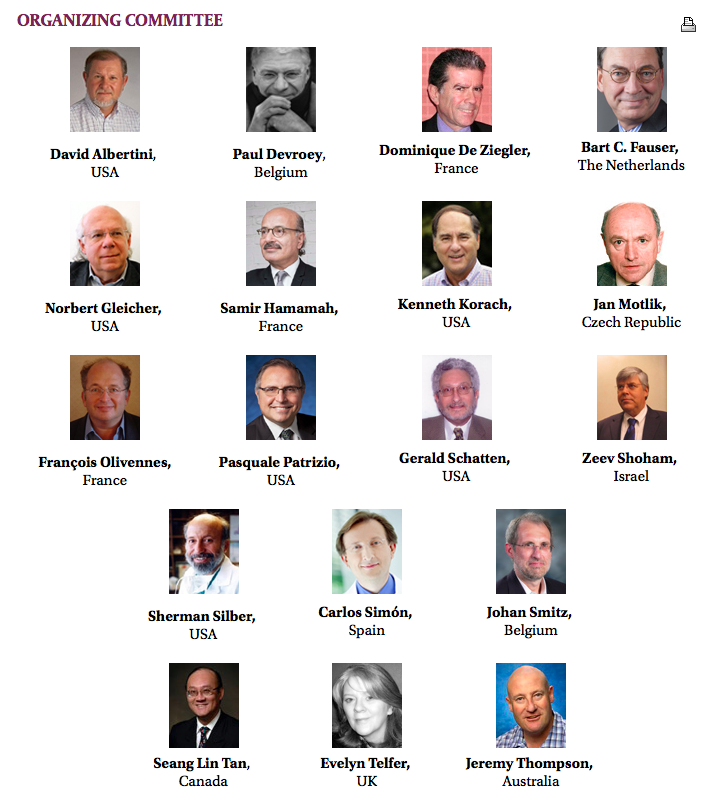
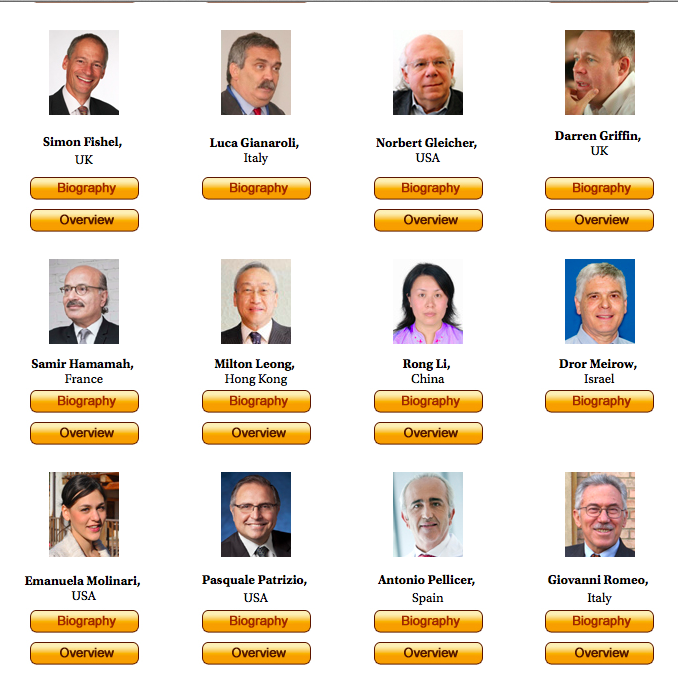
Well, I just got an email invitation to attend CME – OVARIAN CLUB 4.  And alas, rather than just dumping it into SPAM (which I did do) I clicked on one of the links.  I had to know – what was the gender balance at this meeting.  Was there any chance that the organizers would see that it would be ironic to not have a decent number of female speakers?  Alas, nope.

The organizing committee is 17:1 males to females.

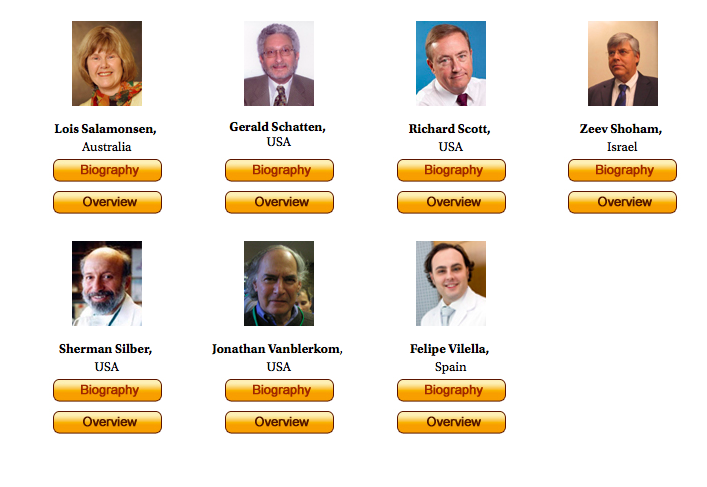
And the speaker balance is not much better something like 25:6.

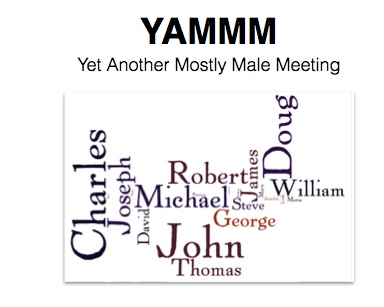
I guess maybe they should rename this “Meeting brought to you by people who mostly do not have ovaries.”  Sad.  Another YAMMM (Yet another mostly male meeting).


Related posts and pages

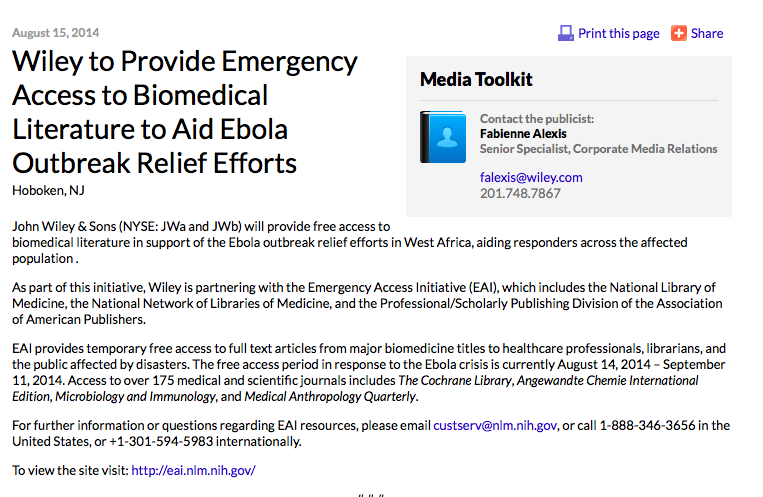
No #AAAS and ASM you do not deserve good PR for freeing up a few papers on Ebola

Saw a PR from AAAS about how they were freeing up all of ~ 20 papers on Ebola

In light of what has become the largest Ebola outbreak on record, Science and Science Translational Medicine have compiled over a decade’s worth of their published news and research. Researchers and the general public can now view this special collection for free.

OK. More access is good. But alas, they did not even free up all papers in #AAAS journals with Ebola in the Title or Abstract.

And then I started thinking. What about HIV? TB? Malaria? And as I started Tweeting about this, I saw that ASM also was hopping on the “free Ebola” bandwagon (actually I do not know who did it first).

And so I got angry and started Tweeting away. The Storify below sums up most of the details.

//storify.com/phylogenomics/aaas-and-asm-free-up-ebola-papers-show-they-don-t/embed?border=false//storify.com/phylogenomics/aaas-and-asm-free-up-ebola-papers-show-they-don-t.js?border=false[View the story “#AAAS and ASM free up Ebola papers show they don’t care about HIV, malaria, TB, etc.” on Storify]
————————–
UPDATE 9 AM 8/21

Great.  And now the Lancet has joined the bandwagon.

They write
“The current outbreak of Ebola in west Africa constitutes the largest and most complex to date. Declared a public health emergency of international concern by WHO, the outbreak of a disease with no known treatment or vaccination is proving difficult to contain given the already fragile and under resourced health systems in the affected areas.
The Lancet wishes to assist health workers and researchers working under difficult and dangerous conditions to bring this outbreak to a close. This Ebola hub contains all related resources from The Lancet family of journals offered with free access to support their vital work.”
Since they do not make papers available on TB, malaria, AIDS, cancer, etc does this mean people working on those are not doing vital work?
UPDATE 2: 8/21 5:45 PM
Wiley also trying to get some PR for making papers available.

UPDATE 3: 9/3
Oh look.  ACS cares about Ebola too.  They are making 18 papers available for free.  How generous. Oh and only until February 2015.  After then, they don’t care about Ebola.  Oh and before then, they apparently don’t care about any other affliction affecting the world.  Ebola is the only thing important enough to make freely available.

UPDATE 10/17

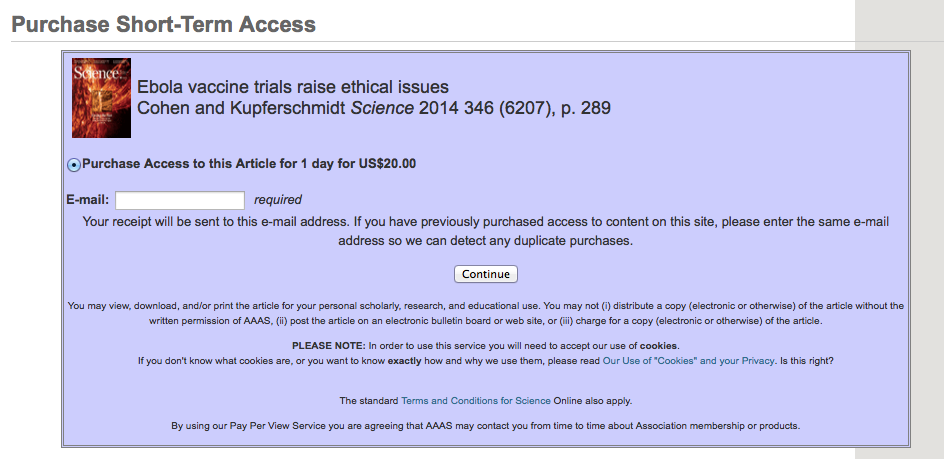
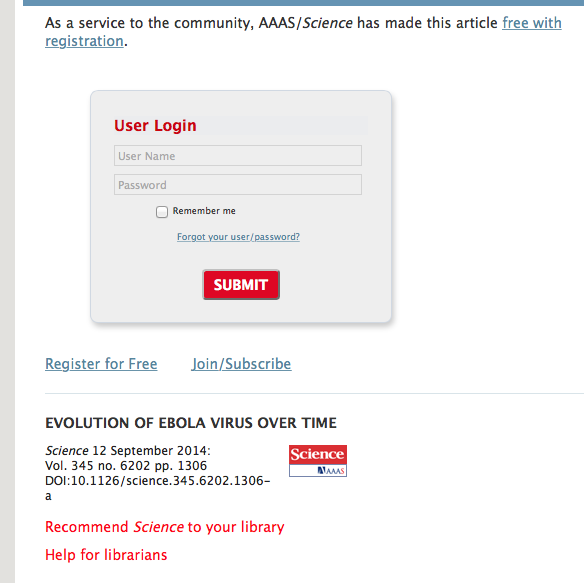
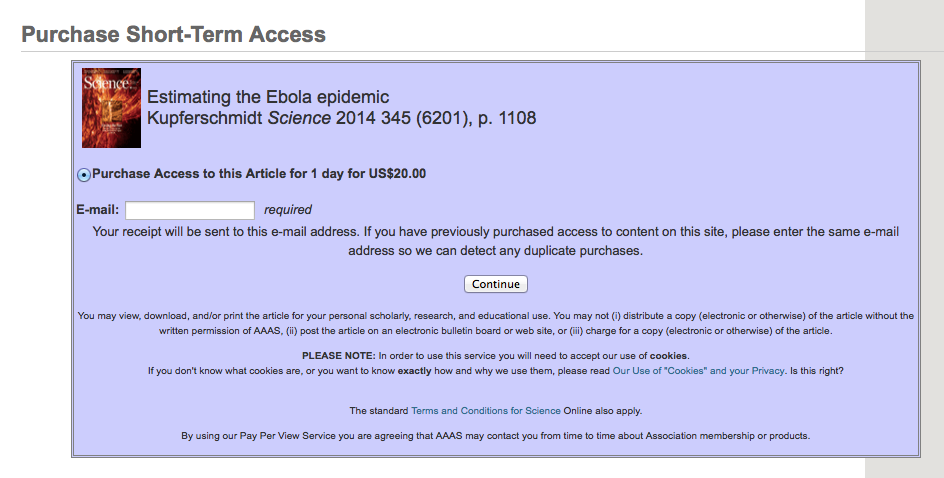
As the Ebola situation worsens, journals and publishers are still trying to get props for making certain papers freely available.  For example, AAAS continues to do this – (see this news story here which ends with a statement about a collection of free ebola papers).  Alas they are being sadly selective in what papers they make available.

Here are some that are not available

What a joke.  If #AAAS really cared about infectious diseases and human health and making papers available, they would stop being one of the most anti-open access publishers out there.

If you want consistently #openaccess papers about Ebola, go to #openAccess journals or do a search in Pubmed Central with a “limit” for Open Access papers: http://www.ncbi.nlm.nih.gov/pmc/?term=ebola%5BAll+Fields%5D+AND+%22open+access%22%5Bfilter%5D&cmd=DetailsSearch

Today’s YAMMM (Yet another mostly male meeting): pharma-nutrition #PN2015

Just got pointed to (by Elisabeth Bik) an announcement for a meeting: Home : Pharma-Nutrition 2015 with a focus on “Linking the Microbiome with Nutrition and Pharma”.  And alas, the list of confirmed speakers is as follows:

  • Keynote Speaker
    • Martin J. Blaser, NY University Medical Center, New York, NY, USA
  • Speakers
    • Gregor Reid, University of Western Ontario, London, ON, Canada 
    • Alain van Gool, Radboud University, Nijmegen, The Netherlands 
    • David Hafler, Yale, New Haven, CT, USA 
    • John F. Cryan, University College Cork, Cork, Ireland 
    • André Marette, Laval University, Montreal, QC, Canada 
    • Charles R. Mackay, Monash University, Clayton, Victoria, Australia
    • Alan L. Landay, Rush University Medical Center, Chicago, IL, USA

Yay.  All men.  How wonderful.  Because, you know, there are no women working on the microbiome and nutrition right?  Ugg.

Seems like they are still working on getting more speakers.  I will send this blog post to the organizers and see what they say.  But suffice it to say I am very disappointed in them.  Oh, and shockingly, the two organizers are men: Johan Garssen and Alan Landay.

These YAMMMs (Yet Another Mostly Male Meeting) really have got to be killed.  People should not got to them.  People should not speak at them.  And the organizers should not be allowed to run other meetings unless they can explain themselves and provide evidence that they will work to not have this happen again.


UPDATE A FEW MINUTES AFTER POSTING.

I found the program committee for the meeting.  Alas the gender ratio there is lame too.

  • John F Cryan, University College Cork, Cork, Ireland
  • Alain van Gool, Radboud University Medical Centre, Nijmegen, The Netherlands
  • David Hafler, Yale School of Medicine, New Haven, CT, USA
  • Charles R Mackay, Monash University, Melbourne, Australia
  • André Marette, Laval University, Sainte-Foy, QC, Canada
  • Gregor Reid, Lawson Health Research Institute, London, ON, Canada

And a bit strangely – all of the people on the program committee are speakers.  No bias there.

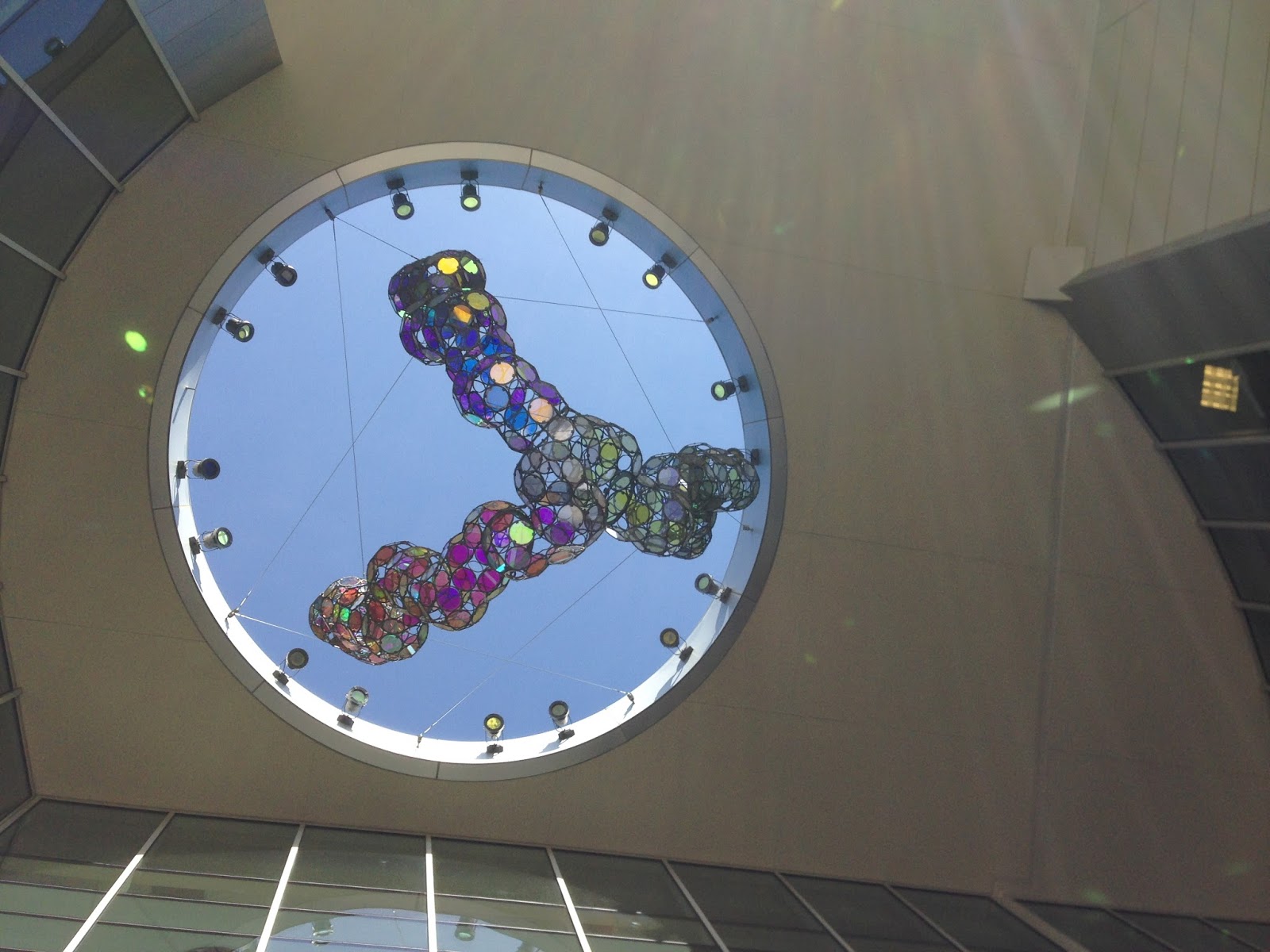
Nice Art and Science example – UC Davis Medical School molecule sculpture

Quikc post here.  A month or so ago I went to the UC Davis Medical School in Sacramento for a meeting and got to see this amazing new sculpture for the first time.

For more about this and the Artist Roger Berry see this article.  It is always inspiring and uplifting to see nice architecture and nice art in a science building. 

AAAS – Blocking Access to the Scientific Literature Even When They Say It Is "Free"

Today, I wanted to show someone a PDF of a paper of mine that I co-authored in 1999.  The paper was, I think, kind of cool.  It reported the sequencing and analysis of the genome of Deinococcus radiodurans, an incredibly radiation resistant bacterium.  Alas, I did not have a copy on me, and the only electornic device I had with me was my phone.  The person I wanted to show the paper to had their computer, a device with a strange little red trackball and running some sort of Windows operating system, so I looked at it and panicked and said “Maybe you should drive” (as in, maybe they should be the one controlling the computer).

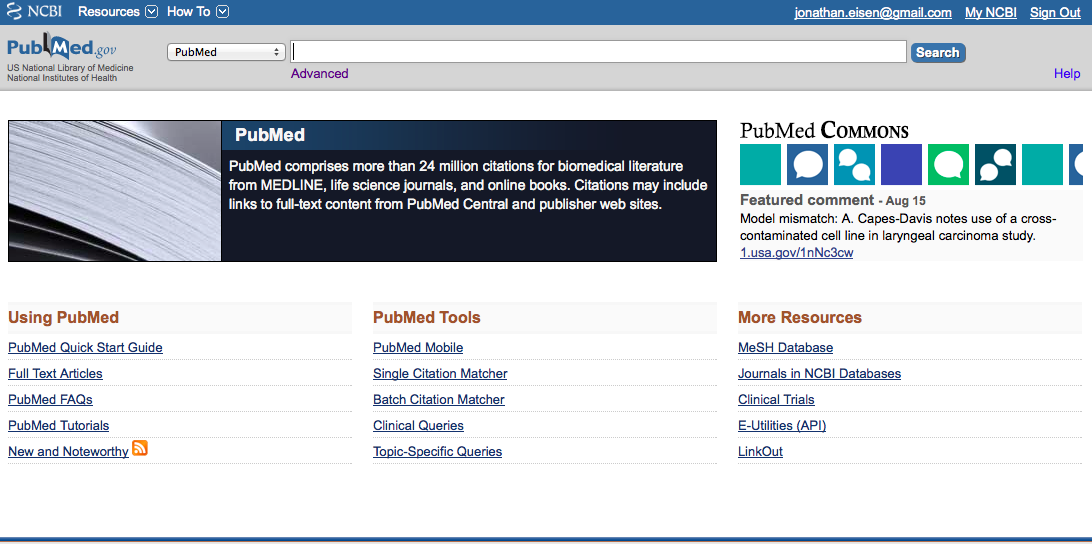
So this person, who shall remain anonymous mostly because of the ancientness of their computer, did the kind of obvious thing, and opened a web browser (don’t even ask which one) and typed in “Pubmed.Com”.  OK – that would work.  I might have preferred going to Google Scholar, but I use Pubmed about as frequently.  And though I do not have a Windows machine or the weird web broswser they used, I have recreated what happened next.

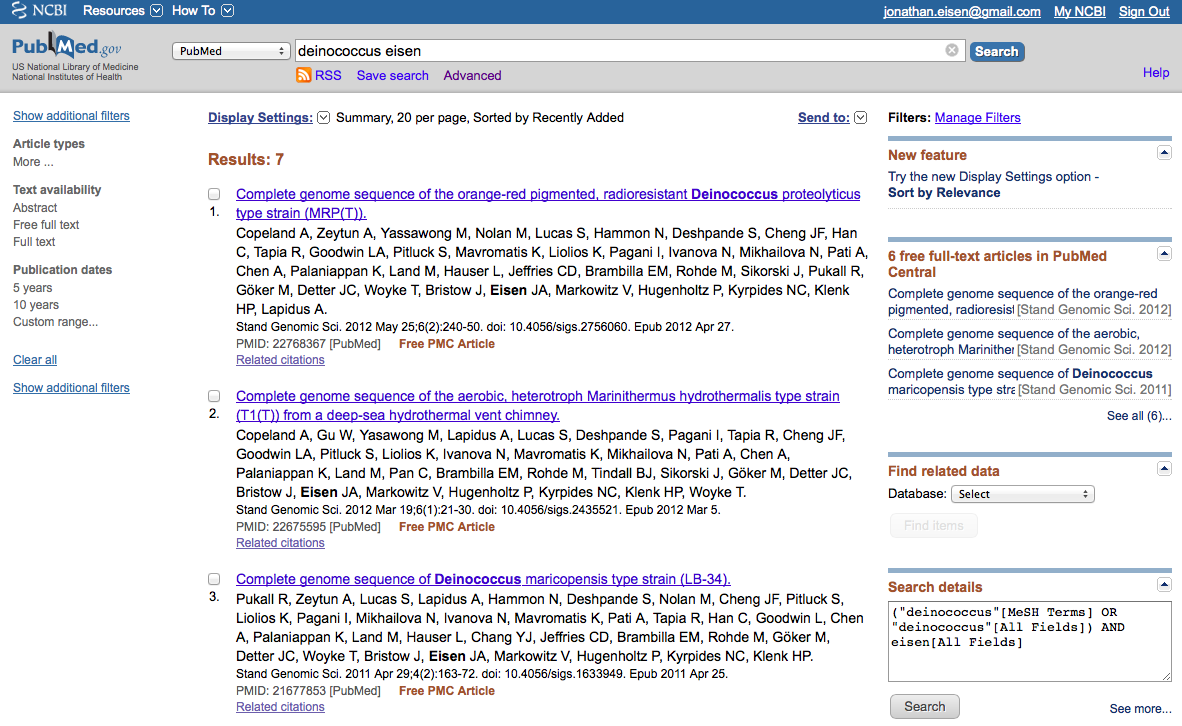
A nice Pubmed window.  And I said, type in “Deinococcus Eisen.” and seven papers showed up.

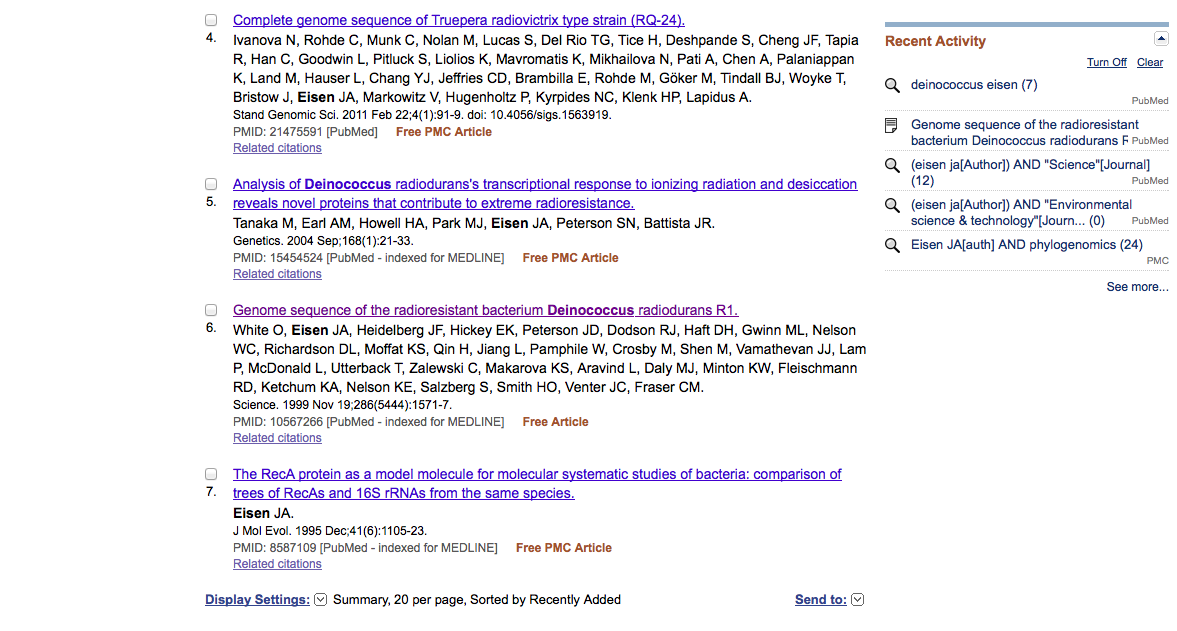
And so I said “Scroll Down” and “Near the Bottom” and there was the paper “White et al” from 1999.   I was happy to see it said “Free Article” since I could not remember if AAAS had made this article available or not. So I said “Click on that one”.

And we looked around for a minute and at the same time we both realized, there in the upper right corner was a link to Science “Full text”.  And I thought – cool – the text is available just at Science not at Pubmed.  And my colleague clicked on this.

And here is where is got annoying.  A new page comes up from this link:

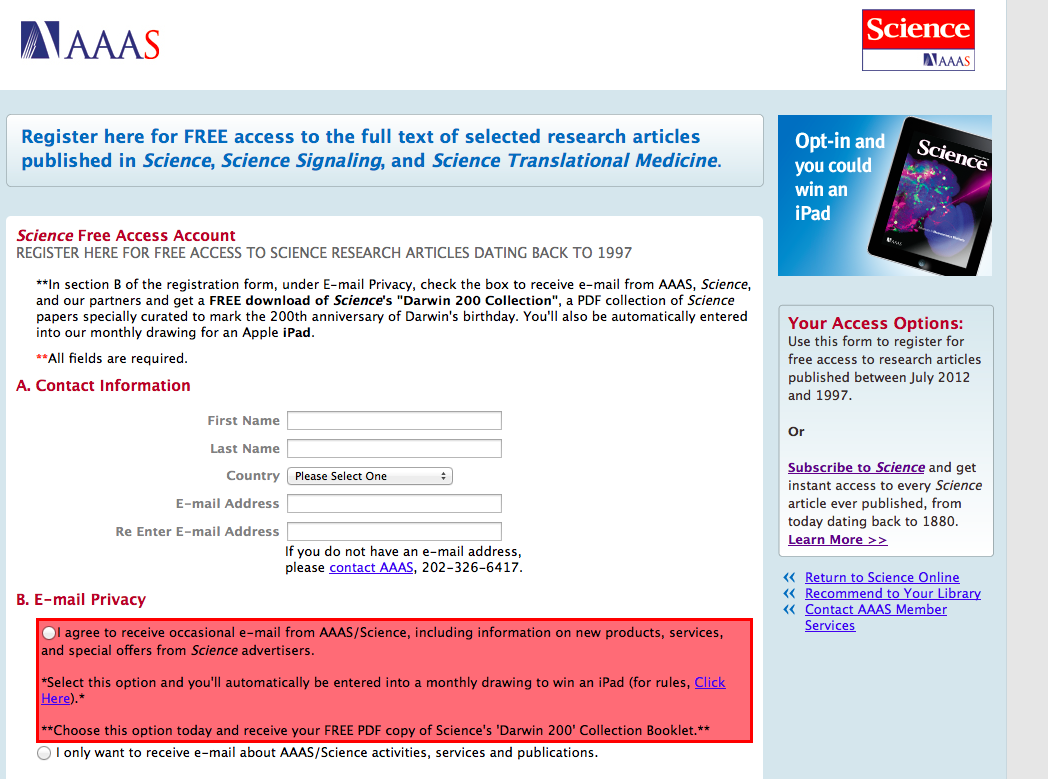
So – the paper is not actually readily available, one has to register in order to see it.  What a pain.  And my colleague just stopped there and said “I do not want to do this right now” and I said “Understood”.  And we stopped and I never showed him the paper (we could have tried other routes but we both had other things to do).  When I got home this evening I decided to look in more detail at the registration and clicked on the link:

Hmm.  So to register it seems I have to sign up for emails from AAAS and all sorts of other crap.  And I have two choices for email neither of which is “I do not want any FU#*(#@ email from AAAS”.  Great.  So I filled out some parts and scrolled to the bottom to see the Privacy Policy option.    And so I clicked on the link.  And the section on Uses of This Information is pretty annoying:

The information collected may be used by AAAS for the purpose of operating and improving the Science Website, fostering a positive user experience, and delivering the products and services that we offer. We may also use the information we gather to inform you of other products or services available from the Science Website or to contact you about your opinion of current products and services or potential new products and services that may be offered. 

We may use your contact information in order to send you e-mail, postal mail, or other communications regarding updates at the Science Website, such as Job Alerts, newsletters, new opportunities, and additional listings which may be of interest to you. We may also use it to send you information about third-party products and services that match your interests and preferences, if you opt in for this communication. We do not release any of your contact information to third parties unless we have your permission. The nature and frequency of these messages will vary depending upon the information we have about you. In addition, at the time of registration for certain services, such as Science Careers Job Alerts, or free partial access to any of the Science websites, you have the option to elect to receive additional communications, information, newsletters, and promotions relating to topics that may be of special interest to you. 

We may share information, such as your IP address, with third parties as might be required for technical purposes, such as facilitating user discovery and access via web search engines.

Well they say they will not share information unless I opt in, but the only way to get access to this paper is to opt in.  Great.   And it gets more explicit under the email policies section:

Users of free online services provided by AAAS±such as free partial access to Science, Science Signaling, or Science Translational Medicine, access to ScienceNOW or SAGE KE, e-mail alerting services or Science Careers services±are agreeing that AAAS may contact them by e-mail in exchange for these free services. Users can also opt in for third-party informational e-mails. Users who do not wish to receive e-mail may cancel their online services by following the unsubscribe instructions at the bottom of any e-mail message from AAAS.

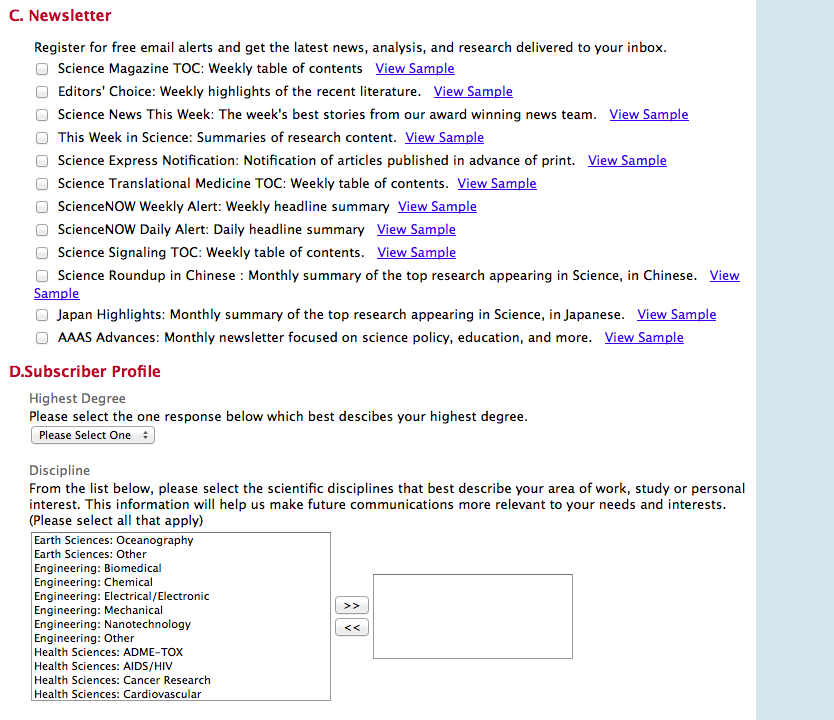
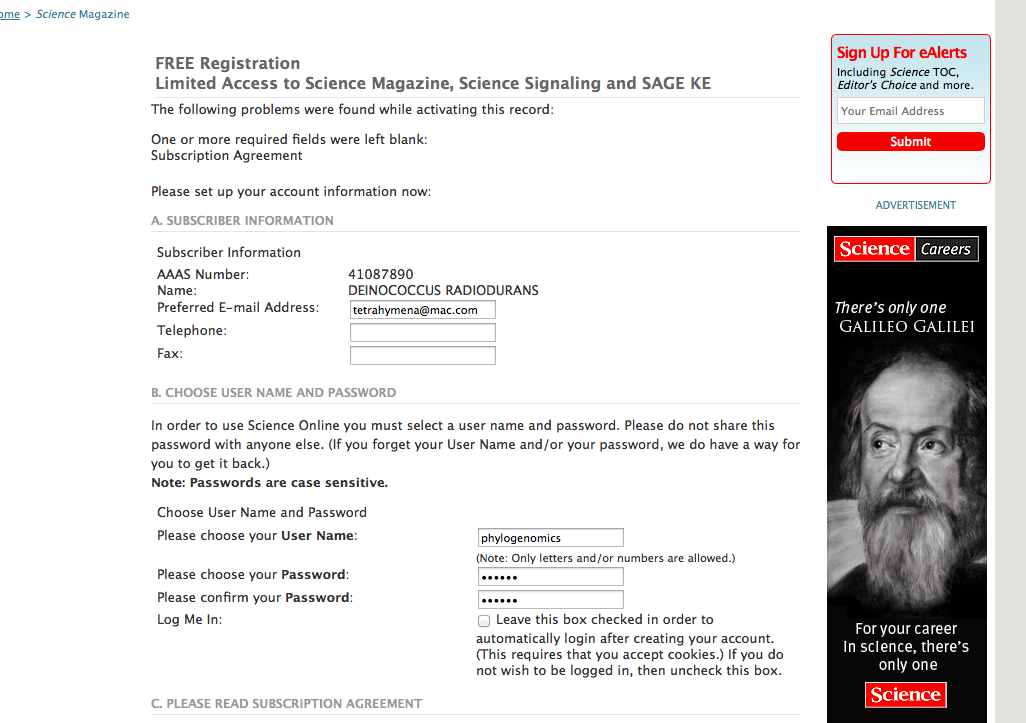
So, actually, there is no opt in policy for those wanting free access to papers.  If you want access, you agree to be contacted.  So – I used a email address I have never used for anything else (so I can track who AAAS sells my name to) and sucked it up and registered.  And I checked the box for agreeing to the Privacy Policy even though I felt icky doing it.  Seemed like I should consult with a lawyer before doing that given how long it was.  Certainly not easy access.  And for the form I had to fill out I tried to not fill out anything under “Discipline” but the site would not let me.  I tried to not fill out anything under Lab Products but the site would not let me either.  And so I filled something out and then amazingly, when I submitted the form, I got sent another page where I had to keep filling out information.
And even though I was not subscribing to the journal I had to agree to some subscription policy.  So I clikced on that and got to another policy.  This including a Copyright warning:

Copyright Notice
Although there is no charge for the use of some portions of the materials contained on the Science websites (“Websites”), all the materials are protected under copyright and other laws of the United States, and, under international conventions, similar laws abroad. Please respect the copyrights and related rights of the authors and publishers of the Websites.

And then many many limitations on use

Limitations on Use by (and to) Registered Users
The contents of the Websites as available through the Free Service, may only be accessed, viewed or otherwise used by a Registered User. A Registered User is permitted to view, browse and/or download for temporary copying purposes only the contents of the Websites, provided these uses are for noncommercial personal purposes, and further provided that the Registered User maintains all copyright and any other notices, on all copies. Registered Users are not, however, permitted to store in electronic or any other form, any significant portion of the Websites. Except as provided by law or by this Agreement, the contents of the Websites may not be further reproduced, distributed, transmitted, modified, adapted, performed, displayed (including adaptations/displays such as by “framing”), published or sold in whole or in part, without the prior written permission from AAAS. 

Any use which is commercial and/or non-personal is strictly prohibited, and may subject the Registered User making such uses to immediate revocation of access to this Free Service, as well as any other applicable civil or criminal penalties. Similarly, sharing a Registered User password with a non-Registered User or otherwise making this Free Service available to third parties is strictly prohibited, and may subject the Registered User participating in such activities to immediate revocation of access to this Free Service; and, the Registered User and any third party, to any other applicable civil or criminal penalties. 

In the case of an authorized site license, a Registered User shall cause any employee, agent or other third party which the Registered User allows to use the Free Service materials to abide by all of the terms and conditions of this Agreement. In all other cases, only the Registered User is permitted to access the Free Service materials.

Well, this is getting pretty complicated and there was a lot of other stuff there.   But I checked the box.  I felt even ickier with this one and thought I really should consult a lawyer.  But I did not.  And I submitted this form.

And finally I had it.  It took about an hour.  This may seem minor to many out there but it seems inappropriate to me.  This paper represented hundreds of thousands if not millions of dollars of work funded by the Department of Energy and was published in 1999.  The goal of the work was to share knowledge.  And this is a major roadblock to sharing that knowledge.  Plus, all the restrictions on use and reuse mean that anyone wanting to share the knowledge with others also is restricted.  The agreements imply that I should not use anything from the paper in a talk or a class or in any way.  There is no mention of Fair Use or any other hint that it would be OK to share the material for educational or scholarly purposes. And who knows what crap I am going to get sent to the email address I used for this registration.

So – why are there all these restrictions?  I presume, to make AAAS money in some way.  Is that a bad thing?  Well, in principle I am all for publishers making money.  I subscribe to many newspapers.  I subscribe to many magazines.  I buy lots and lots of books.  I pay for music and movies and other works.  I don’t download anything illegally.  So why not just accept that people should pay for scientific papers?  Well, because this paper, and 1000s and 1000s of others are different than all the other works I list above.  Owen White and I (with some help from some others) wrote this paper.  AAAS and Science did little except handle the peer review and do some copy editing.  They just simply do not deserve the rights they are claiming to this article and to all the others.  And as a society supposedly for the “advancement of science” it seemed to me that they should make it easier to access the old literature. They could certainly make all papers published more than 12 months ago freely and openly available and deposit them in Pubmed Central.  It would be incredible beneficial to science and to scientists.  But they do not.  Is this in the interest of the “advancement of science”?   Unquestionably no.  But I guess they have decided it is in the interest of the “advancement of Science” where the journal and money for the society is the goal and the advancement of science is lost in the ether.

In the end, I deeply regret having ever published in Science.  15 years after publishing this paper I would definitely say it would have been better to have published in another journal – one that makes papers more openly and freely available.  I cannot change the past.  But I will not support AAAS or its activities in the present or the future unless they change policies and practices.


Some related posts:


UPDATE 1. 8/18 – 5 PM. Been Storifying some of the discussion

AAAS and SnapChat collaborate to develop SnapScience to publish scientific papers transiently

Just got this in an email and thought it should be shared.

Washington, DC. August 15, 2014.

Kent Anderson, the newly appointed Publisher of AAAS (see http://www.aaas.org/news/aaas-names-new-science-publisher) has announced his first action as Publisher – a partnership between AAAS and Snapchat (https://www.snapchat.com).

Anderson said “Although I will not officially assume the role of Science publisher until 3 November, this was too important a task to not carry out immediately. AAAS has always been looking for new ways to reduce the public availability of scientific publications. AAAS approached Snapchat a few months ago and in secret developed a new App “SnapScience” which allows the transient publication of scientific articles. Article longevity can be set to 1 minute, 5 minutes or 15 minutes.”

Anderson followed this with “This kind of thing I had always hoped to do in my role as president of the Society for Scholarly Publishing but the technology was just not available. Snapchat has developed the perfect platform for the future of AAAS and scholarly publishing in general with its ability to allow readers a glimpse of a scientific article but not allow them to keep it or reread it or redisplay it.”

AAAS CEO Phil Lesher said “We have had serious issues recently with the public demanding access to articles in Science and other AAAS published journals. And in addition, we have published a slew of papers that have needed to be retracted shortly after publication. This solves both issues. First, all papers will only be transiently available, so their there is no need for retractions. Second, even scientists will only have short term access to papers so the public cannot possibly demand access for themselves.”

Anderson also said “We think SnapScience is the perfect way for me to step into my new role as Publisher of the Science family of journals. It is cutting edge. It is exactly the type of thing that publishers have been looking for. And it will be fun.”

AAAS hopes to roll out updates to SnapScience that will allow researchers to also publish data and protocols only transiently as well.

Today’s YAMMM (Yet Another Mostly Male Meeting) Brought to You by CIFAR & NAS

Well, just got an invite to this meeting: Symbioses becoming permanent: The origins and evolutionary trajectories of organelles.  The topic seems of direct interest to what I work on.  And, it is relatively close (Irvine is a short hop away).  So this could be a way to go to a meeting without having to travel too far.  And maybe I could see my younger brother Matt who lives in LA and just graduated from UC Irvine’s Masters program in Sound Engineering. Then I looked at the schedule of speakers and organizers.  Many are friends.  Many others are colleagues.  Could be fun to see some people I have not seen in a while.  And then I realized, most – no nearly all of them – are men.  Below I list the people involved in the meeting, highlighting men in yellow and women in blue.

Organizers: W. Ford Doolittle, Patrick Keeling, and John McCutcheon

Distinctive Voices Public Lecture presented by Michael Gray, CIFAR Advisor, Dalhousie University

Session 1: Genomes (evolutionary rates, oddities, and reduction)

  • Introduction and welcome remarks – W. Ford Doolittle, CIFAR Advisor & Patrick Keeling, CIFAR Program Director and Senior Fellow
  • John McCutcheon, CIFAR Associate Fellow, University of Montana
  • John Archibald, CIFAR Senior Fellow, Dalhousie University, Nuclear organelles 
  • Andrew Roger, CIFAR Senior Fellow, Dalhousie University, Organelle reduction 
  • Siv Andersson, Uppsala University, Alphaproteobacterial genome evolution 
  • David Smith, University of Western Ontario, Roots of genomic architecture variation 
  • Daniel Sloan, Colorado State University, Cytonuclear co-evolution under extreme mitochondrial mutation rates
  • John Allen, University College London, Why keep genomes?

Session 2: Integration/Control (trafficking, signaling, transporters)

  • Debash Bhattacharya, Rutgers University, Transporters in organellogenesis 
  • Nancy Moran, University of Texas, Austin, Insect endosymbionts 
  • Geoff McFadden, University of Melbourne, Diversity of protein trafficking
  • Chris Howe, Cambridge University, Why integrate?
  • Steve Perlman, CIFAR Fellow, University of Victoria, Maternal transmission, sex ratio distortion, and mitochondria 
  • William Martin, Düsseldorf University, Endosymbiont and organelle, what’s the difference? 
  • Moriya Okhuma, Riken University, Metabolic integration across endosymbiotic communities

Session 3: Theories and Models

  • Eors Szathmary, Loránd University, A fresh look at cooperation in some major transitions, especially the origin of eukaryotes
  • Marc Ereshefsky, University of Calgary, Evolutionary individuality
  • Peter Godfrey-Smith, City University of New York, Individuality and the egalitarian transitions 
  • Maureen O’Malley, University of Sydney, Philosophical Reflections on Endosymbiosis: Implications for Evolutionary Theory
  • Toby Kiers, University Amsterdam, Bacterial cooperativity

Closing remarks J. McCutcheon


So – that appears to be a ratio of 18 male speakers and 4 female speakers for a whopping 18% female speakers.  No thanks CIFAR and NAS.  I will sign up for a different meeting.  And by the way – WTF?  There are so so many qualified women working on these topics – what let to this 18:4 ratio?  The organizers should really rethink their processes and the sponsors should pull funding from meetings like this.  It is the only way some people will pay attention to diversity.


UPDATE: 8/20

Wrote to the NAS via their Website

To whom it may concern:

I am writing to express my disappointment in the gender ratio of speakers at this meeting (18 males, 4 females).  Due to the skew I am unwilling to participate.  See http://phylogenomics.blogspot.com/2014/08/todays-yammm-yet-another-mostly-male.html for details.

Sincerely,

Jonathan Eisen

Got this response

Dear Dr. Eisen,

The NAS Committee on Scientific Programs, which oversees the Sackler Colloquia most definitely considers gender diversity when approving these programs.  When organizers propose the programs they achieve a good balance on paper. Regrettably, in many fields, women scientists are at a premium and are sometimes overwhelmed with invitations and demands for their participation on programs and committees.  For a variety of reasons, including availability of speakers, the final program is not always as optimally balanced as originally intended.

I have conveyed your message to NAS Vice President and Chair of the Committee on Scientific Programs and will also share your concerns with the colloquium organizers and co-sponsor.

Best regards,

Susan Marty
Program Director
National Academy of Sciences
Sackler Colloquia
http://www.nasonline.org/programs/sackler-colloquia/

So I wrote back

Susan 

Thank you very much for the response.  It is good to hear there is some emphasis on gender diversity when programs and developed.  However, in my experience and based on my readings of the literature on this topic, this is not usually sufficient to produce diverse conferences.  Do you know if the NAS has any additional policies relating to diversity at conferences.  For example, if someone does not accept an invitation, is the organizer of the meeting then free to select whomever they like or are there protocols to help guarantee that the selection of replacements is also diverse?  Also do you know if there are any policies relating to the meetings themselves such as child care that have been shown to impact the attendance of women more than men?   

Any additional information you have would be appreciated.  I think that NAS could and should do more than just review the proposed list of invitees. 

Sincerely
Jonathan Eisen 

If I were applying for post-docs now, I would consider this one w/ Bassler, Stone and Wingreen

Just got this email:

Dear Jonathan,

We are looking for adventurous postdocs to work on bacterial quorum
sensing and biofilms. Our labs combine genetics, biochemistry,
structure, engineering, microfluidics, chemical, computational, and
theoretical approaches. Postdocs that join the group are welcomed into
a nurturing, collaborative, and vibrant atmosphere in which they can
tackle fundamental questions regarding the principles underlying
collective behaviors. They will learn and exploit strategies from a
variety of scientific disciplines. The interdisciplinary training they
receive with us will provide an excellent foundation for a successful
independent career.

Please send this note to your terrific senior graduate students and
encourage them to apply to us. We have attached information on the
position and how to apply.

Yours,

Bonnie Bassler, Howard Stone, and Ned Wingreen
———————


Postdoc ad Molecular Biology Princeton req#1400519.pdf

An important read: Emma Pierson on gender and authorship position in science

This is a fascinating read: In Science, It Matters That Women Come Last | FiveThirtyEight.  By Emma Pierson, who works at 23 and me.  It has all sorts of references of use and details on authorship position in scientific publications and how gender and author position are correlated.  Definitely worth a read.