Eisen Lab Blog

Carin Bondar video on "Organisms do Evolve" based on Miley Cyrus’ Wrecking Ball

I love Carin Bondar.

Compare to the original

A little bit about PhyloSift: phylogenetic analysis of genomes and metagenomes

New paper from people in the Eisen lab: PhyloSift: phylogenetic analysis of genomes and metagenomes [PeerJ].

Basically, the concept behind Phylosift is to provide for high quality, automated, high throughput phylogeny-driven analysis of metagenomic sequence data.  The software was developed openly on github and has been available in some form for more than a year.  Aaron, Holly, Erick and I have discussed it extensively in various talks around the world and thus we assume some are already familiar with it.

This project was coordinated by Aaron Darling, who was a Project Scientist in my lab and is now a Professor at the University of Technology Sydney.  Also involved were Holly Bik (post doc in the lab), Guillaume Jospin (Bioinformatics Engineer in the lab), Eric Lowe (was a UC Davis undergrad working in the lab) and Erick Matsen (from the FHCRC).

Abstract:

Like all organisms on the planet, environmental microbes are subject to the forces of molecular evolution. Metagenomic sequencing provides a means to access the DNA sequence of uncultured microbes. By combining DNA sequencing of microbial communities with evolutionary modeling and phylogenetic analysis we might obtain new insights into microbiology and also provide a basis for practical tools such as forensic pathogen detection.

In this work we present an approach to leverage phylogenetic analysis of metagenomic sequence data to conduct several types of analysis. First, we present a method to conduct phylogeny-driven Bayesian hypothesis tests for the presence of an organism in a sample. Second, we present a means to compare community structure across a collection of many samples and develop direct associations between the abundance of certain organisms and sample metadata. Third, we apply new tools to analyze the phylogenetic diversity of microbial communities and again demonstrate how this can be associated to sample metadata.

These analyses are implemented in an open source software pipeline called PhyloSift. As a pipeline, PhyloSift incorporates several other programs including LAST, HMMER, and pplacer to automate phylogenetic analysis of protein coding and RNA sequences in metagenomic datasets generated by modern sequencing platforms (e.g., Illumina, 454).

Figure 1 shows the general outline of the workflow.
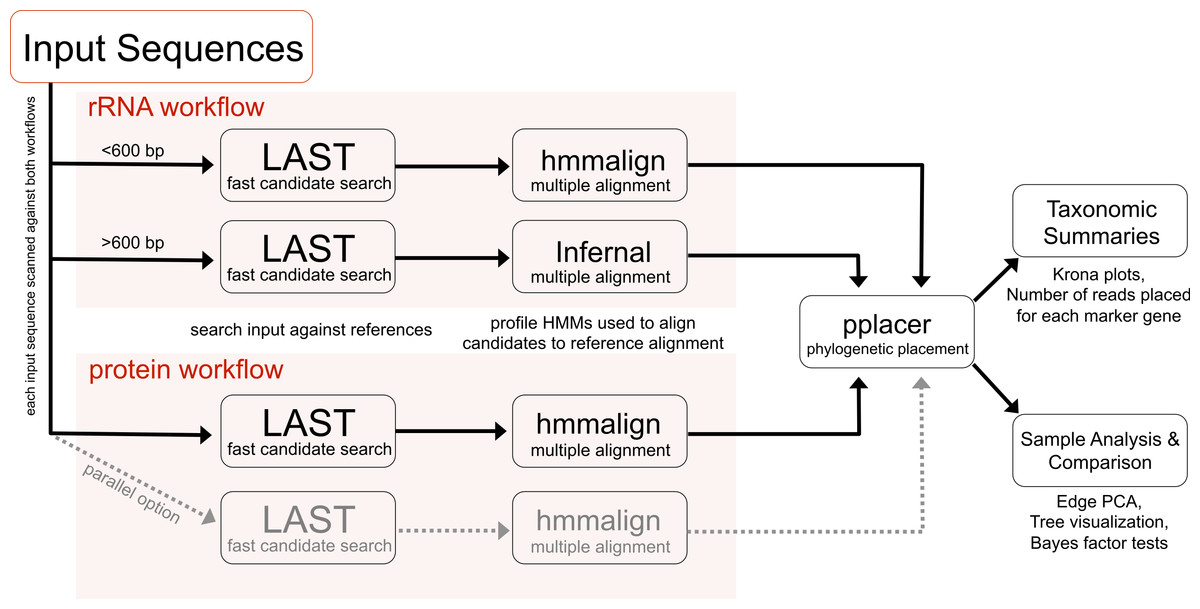
Figure 1 showing the Phylosift workflow.

The workflow follows a series of steps including

  • Sequence identity search 
  • Alignment to reference multiple alignment 
  • Placement on a phylogenetic reference tree 
  • Visual presentation of taxonomic summary 
  • Comparison among samples (e.g., using Edge PCA)
In addition, there is a workflow for updating the database behind Phylosift which includes

  • Acquiring new genome data 
  • Gene family search and alignment workflow on each genome 
  • Phylogenetic inference and pruning 
  • Selection of representatives for similarity search 
  • Taxonomic reconciliation 

The paper shows some of the things you can do with Phylosift and some comparison of Phylosift and other methods.
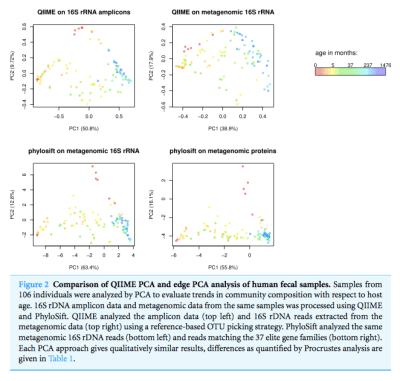
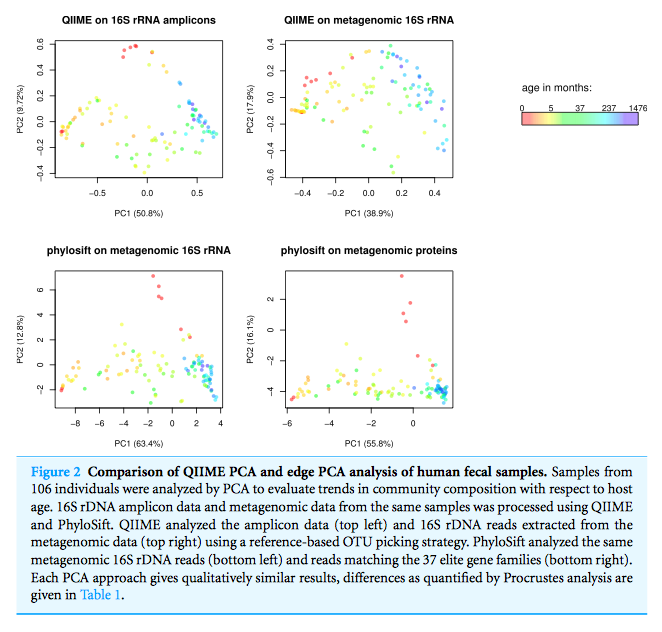
Figure 2. Comparison of QIIME PCA and edge PCA analysis of human fecal samples.

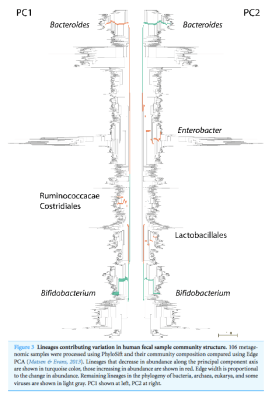
Figure 3: Lineages contributing variation in human fecal sample community structure. (Analyzed using EDGE PCA)

It also provides Krona based output visualization of the taxonomic composition of a sample.

Anyway, more on Phylosift later.  Just thought I would get some out here on the blog.  Thanks to Aaron Darling, Holly Bik, Guillaume Jospin, Eric Lowe and Erick Matsen for all their hard work on this.  And thanks to the Department of Homeland Security for supporting the work.

For more about Phylosift see

Worth a look: American Academy of Microbiology report on the Human Microbiome

Definitely worth checking this out: FAQ: Human Microbiome, January 2014. It is a report from the American Academy of Microbiology and it is really well done.  In addition to the report itself there is also and Infographic and a nice little handout.

The report was based on discussions with a collection of Human Microbiome Gurus:

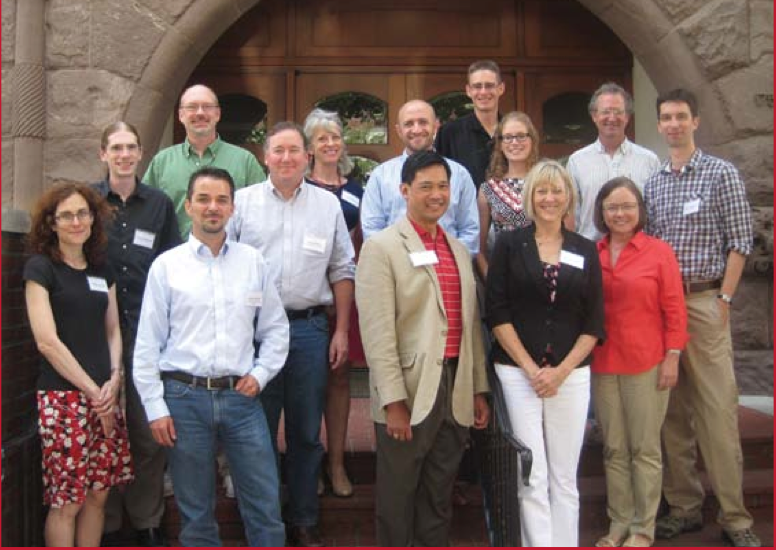
And it was written  by Ann Reid and Shannon Greene. It has a variety of useful tidbits and has a reasonable number of caveats – such as “it should be noted, however, that at this point, most studies, even in mice, are looking at correlations between gut microbiome composition and factors like weight, insulin sensitivity, and other metabolic measures.”

#UCDavis encouraging those with the flu to stay home rest and recover

Good to see this. I note – I have a lab policy that anyone who is sick MUST stay home. That forced my home for most of this week despite actually wanting to be in the lab / office for work.

See forwarded email below:

Dear MSOs/CAOs,

Following up on recent news reports about the major flu virus in the Sacramento area, Human Resources has reminded us to please encourage those are sick to please stay home, rest and recover. This will help prevent colleagues and friends from getting the flu.

While it takes about two weeks for the flu shot to work, it is probably not too late to get one since there are least two more months of flu season.

Please circulate this information us as is appropriate in your department/center.

Thanks.

Donna

Donna Watkins Olsson
Executive Assistant Dean

New EisenLab paper: PhyloSift: phylogenetic analysis of genomes and metagenomes [PeerJ]

New paper from people in the Eisen lab (and some others): PhyloSift: phylogenetic analysis of genomes and metagenomes [PeerJ].  This project was coordinated by Aaron Darling, who was a Project Scientist in my lab and is now a Professor at the University of Technology Sydney.  Also involved were Holly Bik (post doc in the lab), Guillaume Jospin (Bioinformatics Engineer in the lab), Eric Lowe (was a UC Davis undergrad working in the lab) and Erick Matsen (from the FHCRC).  This work was supported by a grant from the Department of Homeland Security.

Abstract:

Like all organisms on the planet, environmental microbes are subject to the forces of molecular evolution. Metagenomic sequencing provides a means to access the DNA sequence of uncultured microbes. By combining DNA sequencing of microbial communities with evolutionary modeling and phylogenetic analysis we might obtain new insights into microbiology and also provide a basis for practical tools such as forensic pathogen detection.

In this work we present an approach to leverage phylogenetic analysis of metagenomic sequence data to conduct several types of analysis. First, we present a method to conduct phylogeny-driven Bayesian hypothesis tests for the presence of an organism in a sample. Second, we present a means to compare community structure across a collection of many samples and develop direct associations between the abundance of certain organisms and sample metadata. Third, we apply new tools to analyze the phylogenetic diversity of microbial communities and again demonstrate how this can be associated to sample metadata.

These analyses are implemented in an open source software pipeline called PhyloSift. As a pipeline, PhyloSift incorporates several other programs including LAST, HMMER, and pplacer to automate phylogenetic analysis of protein coding and RNA sequences in metagenomic datasets generated by modern sequencing platforms (e.g., Illumina, 454).

For more about Phylosift see
#UCDavis EVE Ecologist search candidate Stephanie Yelenik – 1/9

DEPARTMENT OF EVOLUTION AND ECOLOGY

RECRUITMENT SEMINAR

ECOLOGIST

Dr. Stephanie Yelenik

Research Ecologist

U.S. Geological Survey

Pacific Islands Ecosystem Research Center

“Plant-soil interactions, community dynamics and ecosystem management"

Thursday, January 9th, 2014

2:10pm

1022 Life Sciences Building

Faculty Host: Professor Gail Patricelli, Department of Evolution and Ecology

Interesting NSF Funding Opportunity – "Genealogy of Life"

From the web site:

SYNOPSIS
All of comparative biology depends on knowledge of the evolutionary relationships (phylogeny) of living and extinct organisms. In addition, understanding biodiversity and how it changes over time is only possible when Earth’s diversity is organized into a phylogenetic framework. The goals of the Genealogy of Life (GoLife) program are to resolve the phylogenetic history of life and to integrate this genealogical architecture with underlying organismal data. 

The ultimate vision of this program is an open access, universal Genealogy of Life that will provide the comparative framework necessary for testing questions in systematics, evolutionary biology, ecology, and other fields. A further strategic integration of this genealogy of life with data layers from genomic, phenotypic, spatial, ecological and temporal data will produce a grand synthesis of biodiversity and evolutionary sciences. The resulting knowledge infrastructure will enable synthetic research on biological dynamics throughout the history of life on Earth, within current ecosystems, and for predictive modeling of the future evolution of life 

Projects submitted to this program should emphasize increased efficiency in contributing to a complete Genealogy of Life and integration of various types of organismal data with phylogenies. 

This program also seeks to broadly train next generation, integrative phylogenetic biologists, creating the human resource infrastructure and workforce needed to tackle emerging research questions in comparative biology. Projects should train students for diverse careers by exposing them to the multidisciplinary areas of research within the proposal.

Tenure policies not keeping up with the digital revolution

Interesting article in the Chronicle for Higher Education that I was pointed to by Mackenzie Smith:

Digital Humanists: If You Want Tenure, Do Double the Work | Vitae.

The article is by Sydni Dunn – a Staff Reporter at CUE and it discusses a topic of direct relevance the upcoming conference we are hosting here: Publish or perish? The future of academic publishing and careers February 13 – 14, 2013 UC Davis.  The article focuses on some discussions that came up in association with the annual meeting of the MLA – the Modern Language Association.  The discussion was about how to assess scholars in the humanities – especially those who are heavy on the digital side of scholarship.  And the discussion is both scary (to me at least) and fascinating as scholars struggle with how to get their institutions to accept digital scholarship and assess it.

It is definitely worth a read and I note we will have extensive discussions of this general topic at our meeting …


Important new paper on impact of having women as conveners on gender ratio of speakers

There is an important new paper from Arturo Casadevall and  Jo Handelsman: mBiosphere: Scientific meetings: convening committees with at least one woman boost numbers of women speakers. It was published January 7, 2014 in the open access journal mBio. 

Their abstract

We investigated the hypothesis that the gender of conveners at scientific meetings influenced the gender distribution of invited speakers. Analysis of 460 symposia involving 1,845 speakers in two large meetings sponsored by the American Society for Microbiology revealed that having at least one woman member of the convening team correlated with a significantly higher proportion of invited female speakers and reduced the likelihood of an all-male symposium roster. Our results suggest that inclusion of more women as conveners may increase the proportion of women among invited speakers at scientific meetings. 

IMPORTANCE The proportion of women entering scientific careers has increased substantially, but women remain underrepresented in academic ranks. Participation in meetings as a speaker is a factor of great importance for academic advancement. We found that having a woman as a convener greatly increased women’s participation in symposia, suggesting that one mechanism for achieving gender balance at scientific meetings is to involve more women as conveners.

Basically they conclude that having women serve as conveners for sessions and meetings increases the chance that women will be well represented as speakers.

Much of their key findings are shown in Figure 1

From their paper:  FIG 1  Proportion of women speakers as a function of convener gender composition for the years 2011, 2012, and 2013 at the GM and ICAAC meeting. All comparisons were significant at P < 0.05 by Student’s t test

What to do about this? They have some suggestions at the end of the paper

Whatever the mechanism driving the results, practical actions are suggested by the data. The results suggest that an experiment in which at least one woman is included in every team of conveners might increase the proportional representation of women among the speakers at ASM meetings. An alternative might be to explicitly charge conveners with finding speakers who reflect the diversity of microbiologists. These strategies are worth testing. In the process, we might find that our meetings draw on a fuller arc of talent in microbiology and are enriched by increased gender balance. 

This study suggests a simple mechanism for increasing women’s participation in a critical part of a scientific life. Further research should determine whether discriminatory behaviors contribute to the outcomes and whether the outcomes contribute to the loss of women from academic science.

Some press for this article

Some other things I have written about gender ratio in meetings:

Yolo Basin 1-6 – yellowthroat, sora, and more

Another good day at Yolo Basin.  Here are a few pics.