More art & science – hand painted poster at Synthetic Biology #synbio5 – by Karmella Haynes

I posted this to twitter yesterday but am now adding it to my blog since it was so great.  At the Synthetic Biology 5.0 meeting at Stanford I walked into the poster session last night to discover this incredible poster:

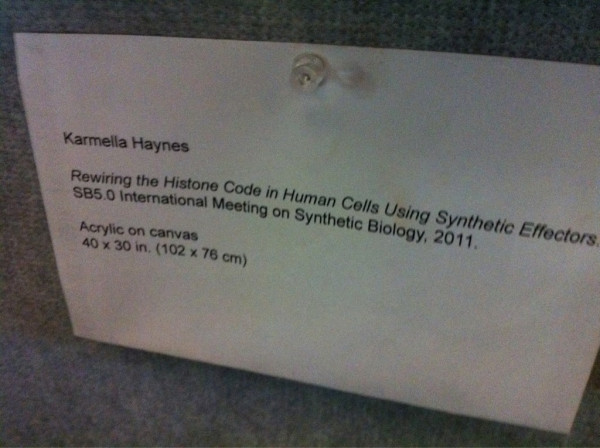
Karmella Haynes, had hand painted her poster on canvas.  Drawn in by the art, I went to talk to her (well, first I said “This is awesome” or something like that.  And then I found out a bit more detail.  She had her paints with her and was continuing to add touches to the painting.  Though I was fascinated by the art side of this, then we got to talking about the science because actually – the figures there were about work she had done on applying some ideas from synthetic biology to animal cells in tissue culture.

I was completely blown away by this.  I am not sure if the same posters will be up tomorrow and if so I will try to get some better shots.  Anyway, I found out she is on her way to a faculty position in Arizona and has recently been a post doctoral fellow at Davidson College.

And then with a little help from Google I discovered her openwetware page: Karmella Haynes.  And from that I found her art page: http://www.karmellahaynes.com/.  I hope she does more hand painted posters for conferences – it certainly brightened up the poster session and made my day.

Absolutely spectacular – glass microbes

Wow. These are truly spectacular: Gallery – Glass Microbiology – Luke Jerram

Thanks to Morgan Jackson for pointing me to them via twitter: here

See also:

Coming up on http://phyloseminar.org Jason Stajich (aka @hyphaltip) #fungi #genomics

Upcoming seminar on Phyloseminar.Org

Jason Stajich speaks Wednesday, June 29th at noon PST on “Fungal phylogenomics: Getting lost in the moldy forest.”
Fungi occupy diverse ecological niches in roles from nutrient cycling in rainforest floors to aggressive plant and animal pathogens. Molecular phylogenetics has helped resolve many of branches on the Fungal tree of life and enabling studies of evolution across this diverse kingdom. The genome sequences from hundreds of fungi now permit the study of change in genes and gene content in this phylogenetic context and to connect molecular evolution with adaptation to ecological niches or changes in lifestyles. I will describe our work in studies contrasting pathogenic and non-pathogenic fungi and efforts to unravel the evolution of multicellularity in fungi comparing unicellular basal fungi with multicellular mushrooms and molds.
The development of tools for data mining and use of fungal genomics is also driving the pace of molecular biology and genetics of fungi. I will highlight new approaches to make this easier and the ways data integration can inform and transform studies of functional biology of fungi.

Japan 04:00 (04:00 AM) on Thursday, June 30
New Zealand 07:00 (07:00 AM) on Thursday, June 30
West Coast USA 12:00 (12:00 PM) on Wednesday, June 29
East Coast USA 15:00 (03:00 PM) on Wednesday, June 29
England 20:00 (08:00 PM) on Wednesday, June 29
France 21:00 (09:00 PM) on Wednesday, June 29

Learn how to connect ahead of time. To hear about upcoming talks, send an email to phyloseminar+subscribe@googlegroups.com or follow @ematsen.
If you can’t make it, don’t fret– you can always watch the recording

Yes, I am a #RedSox & #PLoS fan; & this video sort of is proof #BenFranklinAward #OpenScience

Just saw this posted on Youtube.  Did not know it was coming … but am happy they recorded it

And here are the slides I used.  Will try to synch

For more on this award see

Opening up one’s eyes to other fields (cross-posting from #microBEnet)

Cross-posting this: Opening up one’s eyes to other fields which I posted originally on the microBEnet blog.

I spend most of my time working on biology.  I like to think I cover lots of breadth within biology and I probably do – microbes, evolution, ecology, human health, pathogens, symbioses, forensics, genomics, bioinformatics, and more.  But nothing like really looking at other fields to realize how narrowly focused one is.

And that is what has happened to me since I took on the “microBEnet” project trying to foster communications and collaborations on microbiology of the built environment. I now pay much more attention to anything that might have a connection to “Building Science” in one way or another.  Not only did I just go to an Indoor Air meeting, but I keep discovering more and more stuff right near home that I was not aware of before.  For example – I just got sent this news link from Aaron Darling in my lab: UC Davis News & Information :: History of sciences in architecture subject of Mellon Foundation winner’s study.  Previously, I would definitely not have been paying much attention to architecture and history of science.  But now seeing other people at UC Davis working on the Built Environment just makes me think about how I can build connections with them and talk to them about buildings (and other built environments) and possibly, one day, about the microbes that are in them.

Which brings me to another story.  At the Indoor Air meeting earlier in the week in Austin, Texas, when heading to the conference center I got into a conversation with someone looking for the registration desk.  After showing her where to go she asked where I was from and I said “UC Davis.”  And it turns out – she was too.  Turns out, this was Deborah Bennett, who I had heard mentioned the evening before but had not heard the whole name.  I just knew someone else at the meeting was from Davis.   Deborah is at the UC Davis School of Public Health and works on some really interesting stuff.  And since UC Davis is so big (some 2500 or so faculty I think) – it is not always easy or simple to find people even if you might have a connection to them.

So anyway, just a little commentary on how I find it fascinating to see for the first what was in a way right before my eyes.

Quick update (pics, twitter feed) on #IndoorAir2011 in Austin, TX #microBEnet

Here are some pics from my trip to the Indoor Air 2011 meeting. I am going to post more detail about the meeting later.

https://picasaweb.google.com/s/c/bin/slideshow.swf

If you want some information about what happened at the meeting, best place right now is probably twitter

http://widgets.twimg.com/j/2/widget.js
new TWTR.Widget({ version: 2, type: ‘search’, search: ‘#IndoorAir2011’, interval: 6000, title: ”, subject: ‘Indoor Air 2011’, width: 250, height: 300, theme: { shell: { background: ‘#8ec1da’, color: ‘#ffffff’ }, tweets: { background: ‘#ffffff’, color: ‘#444444’, links: ‘#1985b5’ } }, features: { scrollbar: true, loop: false, live: true, hashtags: true, timestamp: true, avatars: true, toptweets: true, behavior: ‘all’ } }).render().start();

Also see the microBEnet blog which has some recent posts on this.

Worst new omicsword, perhaps ever, the Dispensome #awful #badomics #reallybad #uggh

Well, I do not even have any idea what to say. I got pointed to this paper: PLoS Genetics: Finished Genome of the Fungal Wheat Pathogen Mycosphaerella graminicola Reveals Dispensome Structure, Chromosome Plasticity, and Stealth Pathogenesis by KamounLab on twitter. The authors of the paper include colleagues at the DOE-Joint Genome Institute so it is possible that they are baiting me to get some attention. But YHGTBFKM – the dispensome? Defined by them as “The dispensable chromosomes collectively comprise the dispensome and showed extreme plasticity during sexual reproduction.” Now, I have seen my share of bad omics words (and which I write about often with, for example, my Worst New Omics Word Award and Bad Omics Word of the Day). But this is the first case where the word, and the excessive use of it in the paper is distracting (as suggested by KamounLab) to the science. Is this word really necessary? Could they not just say “dispensable chromosomes” (which I note, I might still have problems with since they would only be known as dispensable under certain conditions)? But “dispensome” is unnecessary, distracting, and, well, not a good word. Thus in this case I have decided to not even give them an award per se but to simply say that I think this is possibly the worst omics word I have ever seen. I note – I am not criticizing the science (nor endorsing it mind you) they did here. But the word, oh the word. It hurts me. It really does.

I like this pic of me so much it gets a whole post – "Apple Love" by Rhonda Roman

Apple Love by Rhonda Roman
 So a few Saturday’s ago I was at the Davis Farmer’s Market and Steve Smit from Mt. Moriah Farm’s showed me this pic that a photographer had given him.  Steve is one of my favorite people anywhere.  I don’t know why really.  But I go to the Farmer’s Market many times just to see him/buy stuff from him.  He is funny, warm, interesting, social, etc.  And apparently a photographer caught one of our interactions from earlier this year.  

Fortunately, she put her name on the back of the picture and a little googling and I found her photo collection on flickr.  Her name is Rhonda Roman and I really like her collections there.  But in particular I love this picture she took of me and Steven and others at the Market.  It captures everything really about my interactions with Steve.  Thanks Rhonda.  A picture is worth way way more than 1000 words.

#UCDavis to partner with the Beijing Genome Institute (BGI)

Well, it is now formal so I guess I can post about it here.  UC Davis is officially developing a genomics partnership with the Beijing Genomics Institute (BGI).

For more on this breaking news see

Not much detail there I know – but in essence the plan is to build a partnership between UC Davis and BGI with BGI provided genomics and informatics expertise and capabilities and Davis providing biological expertise and diversity (of course, Davis has some genomics chops too and BGI does some biology but you probably get the point). 
For those who do not know, BGI is a relative newcomer on the block in terms of large scale genomics research institutes.  But by being new they have had a massive advantage in a way in that they are really the first to be developed as a “Second-generation Genome Center” having been built / developed with the new second generation sequencing systems at its core.  Thus while other large centers around the world have tried to adapt to the new second generation sequencing systems, BGI started from scratch and could build it’s enterprise around the new systems.  
I am excited about the possible connections with BGI though I confess I do not know a whole lot about the plans.  There have been lots of whisperings here at Davis about building a partnership with BGI and people have been a bit nervous about word getting out too early.  So, though I have heard some details I have not been an active part of the discussions.  However, whatever the plans are I am looking forward to interactions with BGI.  They are really pushing the frontiers of genome sequencing in many ways.  And despite the moans and groans from many people, I do not think genome sequencing is on a downward slope in any way.  For example, as a tool in studying microbes, genome sequencing still has many many years of use – after all there are hundreds of millions of microbial species that have yet to be studied and each one has lots of intraspecific diversity (e.g., across geography) to be characterized.  
And as a UC Davis faculty member I think BGI picked a great place to work with.  Davis has an almost unprecedented diversity of faculty working on some area in the life sciences – and these faculty come from across campus from the College of Biological Sciences, School of Medicine, Viticulture and Enology, School of Veterinary Medicine, College of Agriculture and Environmental Sciences, College of Engineering, School of Nursing, and College of Letters and Sciences.  In fact, you could say – in a way – UC Davis is a campus more dedicated to Life Sciences than almost any other place in the world.  
This development is just one of many that make me impressed with the new UC Davis Administration.    Ever since Chancellor Katehi came on board I have been pleased with almost every major initiative and development and administrative hire on campus.  Sure – the budget cuts from the California government hurt.  But in challenging times, you need great leadership.  And we certainly have it at UC Davis these days.  And if you think I am just sucking up, you should read some of the things I wrote about our previous administration.  I really am impressed here.  
I do not know what will happen with the BGI – UC Davis partnership.  Right now it is just a plan.  But I will do what I can to help it succeed and I am looking forward to interactions with BGI and the bright future at UC Davis. 

Off to #IndoorAir 2011 in Austin, TX – to discuss and promote http://microbe.net #microBEnet

Well, off to Austin for a meeting I would not have imagined going to a few years ago. Indoor Air 2011. Why am I going? Because a few years ago I began to discuss studying the microbiology of the built environment with Paula Olsiewski, from the Alfred P. Sloan Foundation. You see, the Sloan Foundation has a new program in this area “The Indoor Environment“. Eventually, after much discussion I applied for a grant in their program. My grant is a bit unusual (for me and for others probably) in that it focuses on communication, coordination, networking, collaboration, etc.
My project is called “microBEnet” – which stands for “microbiology of the Built Environment network”. The BE is purposefully capitalized to emphasize the Built Environment part and we figure, since microbes are small, the m should be lower case. For more on the project see: Microbiology of the Built Environment Network | Site for the microBEnet project. As part of this project, a collaborator (Hal Levin) and I are doing many activities and I will post more about them over time. Among our activities are a new blog, and a diversity of resources.

Which brings me to Indoor Air 2011.  We are also starting to organize or help organize some meetings and workshops to bring together the various folks who might be interested in microbiology of the built environment.  And for Indoor Air we have helped the meeting organizer Rich Corsi plan some sessions on microbiology of the built environment.  The sessions take place Wednesday and Thursday and should be great.   Looking forward to going to Austin, maybe seeing some friends at UT and nearby (hint hint Dr. Hillis, Sheril K, etc) and learning about the built environment.