Tag: Misc.
YAMMGM – yet another mostly male genomics meeting (series): Plant Genomic Congresses by Global Engage
Just got invited to the “Plant Genomics Congress Asia” meeting. As usual, the first thing I look at now is gender ratio. From their web site I got a list of their speakers (so far) and their advisory board. I highlighted in Yellow ones I am inferring are male and in green ones I am inferring are female. For the meeting the ratio so far is 17:4 male to female. Not the worst I have seen but still pretty bad. Though if you look at their advisory board at least the ratio for the speakers is better — it is 17:0 for the Advisory Board.
- John Manners, Chief, CSIRO Plant Industry, Australia
- Dave Edwards, Principal Research Fellow, School of Agriculture and Food Sciences, University of Queensland, Australia
- Nagendra Singh National Professor-BP Pal Chair, National Research Centre on Plant Biotechnology, Indian Council of Agricultural Research, India
- Han Zhao, Professor of Biology and Biotechnology, Institute of Biotechnology Jiangsu, Academy of Agricultural Sciences, China
- Huaan Yang, Department of Agriculture and Food (DAFWA), Australia
- Rajeev K. Varshney, Principal Scientist (Applied Genomics) & Director, Centre of Excellence in Genomics, ICRISAT, India
- Apichart Vanavichit, Professor, The Rice Gene Discovery Unit, Kasetsart University, Thailand
- Norman Warthmann, Senior Post Doc, Borevitz Laboratory, ANU College of Medicine, Biology and Environment, Australian National University, Australia
- Chungui Lu Lecturer in Post-Genomics, Faculty of Science, Nottingham University, UK
- Beng Kah (Bk) Song, Lecturer, Monash University, Sunway Campus, Australia/ Malaysia
- Kenneth Olsen, Associate Professor Department of Biology, Washington St Louis University, USA
- Yue-Ie Hsing, Distinguished Research Fellow, Institute of Plant and Microbial Biology, Academica Sinica, Taiwan
- Meilina Ong Abdullah, Breeding and Tissue Culture Unit, The Advanced Biotechnology and Breeding Centre, Malaysian Palm Oil Board (MPOB) Malaysia
- Yijun Ruan, Professor and Director, Systems Biology Center, HuaZhong Agricultural University, Wuhan, China
- Sachiko Isobe, Head Applied Plant Genomics, Kaduza DNA Research Institute (KDRI), Japan
- Yuan-Ming Zhang, Professor of Statistical Genomics, State Key Lab. of Crop Genetics and Germplasm Enhancement, Nanjing Agricultural University, China
- Parveen Chhuneja, Geneticist, Bioinformatics Centre School of Agricultural Biotechnology, Punjab Agricultural University, India
- Shengyi Liu, Professor and Head, The Key Lab of Oil Crops Biology, the Ministry of Agriculture, PRC Department of Genomics, Oil Crops Research Institute, Chinese Academy of Agricultural Sciences, China
- Wen-Hsiung Li, Director and Distinguished Research Fellow, Biodiversity Research Center, Institute of Plant and Microbial Biology, Academica Sinica, Taiwan
- Graham King, Director, Southern Cross Plant Science Professor of Plant Genomics and Epigenetics, Southern Cross University, Australia
- Ryan Lister, Professor/ARC Future Fellow, Plant Energy Biology ARC CoE, School of Chemistry and Biochemistry, The University of Western Australia
- Amitabh Mohanty, Lead Trait Discovery, E.I. DuPont India Pvt Ltd.
- Robin G Allaby, Associate Professor, School of Life Sciences, University of Warwick, UK
- Todd Blevins, Senior Postdoctoral Associate, Pikaard Lab, Indiana University
- Roger Bossé, Global Product Line Leader, PerkinElmer
- James Coomer, Senior Technical Advisor for Europe. Data Direct Networks
- Tamas Dalmay, Professor of RNA Biology, School of Biological Sciences, University of East Anglia, Norwich
- Massimo Delledonne, Professor, Department of Biotechnology & Director, Functional Genomics Center, University of Verona, Italy
- Joe Duran, Director – HPC Systems, Technology Solutions Division, Fujitsu
- Alberto Ferrarini , Biotechnology Professional, University of Verona
- Keywan Hassani-Pak, Group Leader Applied Bioinformatics, Computational and Systems Biology, Rothamsted Research
- Julin Maloof, Professor, Department of Plant Biology, University of California, Davis
- Piotr Mieczkowski, Director of NGS Facility, Research Assistant Professor, University of North Carolina
- Stephen P. Moose, Associate Professor, Maize Genomics, Department of Crop Sciences,, Program Leader, Feedstock Genomics, Energy Biosciences Institute, University of Illinois at Urbana Champaign
- Lukas Mueller, Professor, Plant Breeding and Genetics, Boyce Thompson Institute, Cornell University
- Odd-Arne Olsen, Professor at Department of Plant and Environmental Sciences (IPM), Norwegian University of Life Sciences (UMB) , Faculty of Education & Natural Sciences, Hamar University College (HUC), Norway
- Chris Pires, Associate Professor Division of Biological Sciences, University of Missouri-Columbia
- Uwe Scholz, Group Leader, Research Group Bioinformatics and Information Technology, IPK
- Alan Schulman, MTT Agrifood Research and Institute of Biotechnology, University of Helsinki
Institutional repository success story: Master’s on "War Eagles" contributes to amazing ring recovery story
![]() |
| Image from NPR. |
So I just heard this amazing story on NPR. “Journey Of The Ring: Lost In WWII, Now Back With POW’s Son.” In summary – a US Military member David Cox was taken as a POW in World War II in Germany. While a captive he ended up trading a treasured ring for some chocolate. He returned home and made a replica of the ring but always felt bad about having had to trade the ring for food. He passed away a few years ago. Three or so weeks ago, two Americans – Mark and Mindy Turner – were invited to a dinner at the house of Martin and Regina Kiss and it turns out the Kiss’s had the ring. But they did not know who the original owner was. So the Turners did some searching based on the inscription on the ring and the figured out who the original owner was and it has now been returned to David Cox’s son.
So – how on earth is this a story connected to institutional archives. Well, it turns out that the Turners figured out who the original owner of the ring was because their Google searches based on the ring’s inscriptions took them within a few minutes to this Master’s Thesis posted in 2006 at the NC State Digital Repository: War Eagles: A Bird’s Eye View of 305th Bomb Group and the Eighth Air Force from the experiences of David C. Cox and Joseph B. Boyle – NCSU Digital Repository. The thesis was written by Norwood McDowell, who happens to be the younger Cox’s son in law. And his thesis was about the elder Cox and had a brief discussion of the ring.
Kudos to all involved, including NC State and Norwood McDowell for making his Masters thesis available.
Strange emails about microbes: probiotic water
I get some strange emails about microbes. Here is one I got today:
Dear Prof. Jonathan,
I am nothing, but I write my wish because of duty for the great future of Probiotics, which shall be big fortune of earth people.
I, by G-d’s grace, made Probiotics Multiplication “Water” at my kitchen to help my sister’s intestine problem.
And I soon found out how many many applications of the Probiotics Multiplication Water shall be opened for most peoples in the earth.
Please invite me at your cost and let me introduce the Probiotics Water and the vary applications in front of your team, then, I will show 100ml spray and mist of Probiotics Water to them. It would be great great opportunity of your meeting if you will do.
You said in Video of TED website that we have to surround ourselves by good bacteria.
How? I convince the Probiotics Water Mist and Spray is the answer. Easy and economic valuable answer!– Probiotics Water’s color is plain, light pale yellow and near transparency white.
Smell is some sour, and disappeared immediately after spray. –If you have questions, please send me your reply asap.
My smart phone number : XX-XX-XXXX-XXXX /Phone: XX-XX-XXXX-XXXX
Please send me your message before calling. Thanks very much,
XXXXXX, XX
Pohang City, South Korea
Closed access irony of the day: Who Will Pay for Access to Research Data? You Will …
Though I would share this with people who read this blog but don’t follow me on Twitter.
F#$*#ing brilliant – article by Cerf & Berman “Who Will Pay for Public Access to Research Data?” costs $20 to read pic.twitter.com/UOZwGuiXr4
— Jonathan Eisen (@phylogenomics) August 13, 2013
Great use of metagenomic data: community wide adaptation signatures
OK I have been dreaming about doing something like this for many years. One of the potentially most useful aspects of shotgun metagenomic data is that you get a sample of many/all members of a microbial community at once. And then in theory one could look across different species and taxa and ask – do they all have similar adaptations in response to some sort of environmental pressure. There have been a few papers on this over the last few years (e.g. check out this one from Muegge et al on Diet Driving Convergence in Gut Microbes). But this new paper is really the type of thing I have been hoping to see: Environmental shaping of codon usage and functional adaptation across microbial communities. Basically they looked at codon usage in organisms in different metagenomic samples and found major metagenome specific signatures, suggesting that different taxa were in essence converging on common codon usage.
The paper is definitely worth a look.
Perhaps this meeting should be renamed "Of Microbiomes and Men" ….
Well, just got an email inviting me to participate in a meeting on microbiomes. The full invite is at the bottom of this posting. Alas, at first glances it seems this meeting, has, well, some gender issues.
Confirmed Keynote Speakers: both male.
- Mark Adams, Ph.D., Scientific Director, J. Craig Venter Institute, San Diego
- Sarkis K. Mazmanian, Professor of Biology, California Institute of Technology
Confirmed other speakers: all seven male
- Pierre Belichard, Co-founder and CEO, Enterome
- Adam Godzik, Ph.D., Bioinformatics and Systems Biology, Professor & Program Director, Sanford-Burnham Research Institute
- JunHua Li, Team Leader of Reference Metagenomics, BGI Research
- Victor Nizet, MD, Professor & Division Chief, Department of Pediatrics, UCSD School of Medicine, San Diego
- Steve Orndorff, NuMe Health
- Andrei Osterman, Ph.D., Professor, Bioinformatics & Systems Biology, Infectious and Inflammatory Disease Center, Sanford-Burnham Medical Research Institute
- Bernd Schnabl, MD, Assistant Professor, Division of Gastroenterology, UCSD School of Medicine, TSRI California Campus
I suppose one could say “Well, they are still working on their agenda … maybe they will have some female speakers.” So I decided to dig around a little bit more. They provide a link to the outline agenda here. Alas that is even worse. There we find out who some invited speakers are who have not yet accepted
- David Odelson, R&D Program Director, Life Technologies
- Peter B. DiLaura, President & CEO, Second Genome
- Chris Christofferson, Morganthaler Ventures
- Lou Tartaglia, Third Rock Ventures
- Mike Grey, Pappas Ventures
- Justin L. Sonnenburg, Assistant Professor, Microbiology & Immunology, Stanford School of Medicine, Palo Alto, CA
So that is 9 confirmed speakers and six invited speakers – all of whom are male. Great. Here is a suggestion. DO NOT GO TO THIS MEETING.
![]() |
||
|
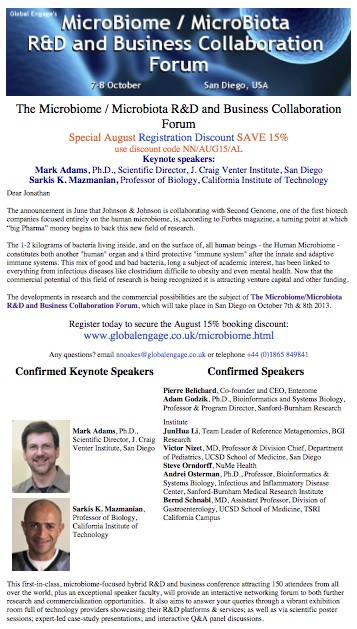
The Microbiome / Microbiota R&D and Business Collaboration Forum
Special August Registration Discount SAVE 15%
use discount code NN/AUG15/AL
Keynote speakers: Mark Adams, Ph.D., Scientific Director, J. Craig Venter Institute, San Diego Sarkis K. Mazmanian, Professor of Biology, California Institute of Technology |
||
| Dear Jonathan
The announcement in June that Johnson & Johnson is collaborating with Second Genome, one of the first biotech companies focused entirely on the human microbiome, is, according to Forbes magazine, a turning point at which “big Pharma” money begins to back this new field of research. The 1-2 kilograms of bacteria living inside, and on the surface of, all human beings – the Human Microbiome – constitutes both another “human” organ and a third protective “immune system” after the innate and adaptive immune systems. This mix of good and bad bacteria, long a subject of academic interest, has been linked to everything from infectious diseases like clostridium difficile to obesity and even mental health. Now that the commercial potential of this field of research is being recognized it is attracting venture capital and other funding. The developments in research and the commercial possibilities are the subject of The Microbiome/Microbiota R&D and Business Collaboration Forum, which will take place in San Diego onOctober 7th & 8th 2013. Register today to secure the August 15% booking discount:
www.globalengage.co.uk/microbiome.html Any questions? email nnoakes@globalengage.co.uk or telephone +44 (0)1865 849841 |
||
|
||
| This first-in-class, microbiome-focused hybrid R&D and business conference attracting 150 attendees from all over the world, plus an exceptional speaker faculty, will provide an interactive networking forum to both further research and commercialization opportunities. It also aims to answer your queries through a vibrant exhibition room full of technology providers showcasing their R&D platforms & services; as well as via scientific poster sessions; expert-led case-study presentations; and interactive Q&A panel discussions. | ||
|
The Outline Agenda
Venture Capital + Technology Transfer
The microbiome of the GI tract
Clinical Applications
Connections to the Food World
|
||
| www.globalengage.co.uk/microbiome.html | ||
| Not interested in the Microbiome/Microbiota? Unsubscribe here Nick Noakes: nnoakes@globalengage.co.uk Tel +44 (0) 1865 849841 |
You might think that at some point some of the people organizing meetings
Graduate Student Opportunity in Marine Biology /Environmental Sequencing of micro eukaryotes
Posting a grad student opportunity for a new project I’m involved in – The project will be using high-throughput sequencing techniques to study microbial eukaryotes in Arctic sediments.
Graduate Student Opportunity in Marine Biology / Biological Oceanography
UAF School of Fisheries and Ocean Sciences, Fairbanks, Alaska USA
We are seeking a graduate student research assistant for a project applying high-throughput DNA sequencing techniques in the study of meiofaunal communities in the Arctic. The student will take a lead role in sample processing and data analysis, including both standard microscopic analysis and morphological taxonomy and high-throughput sequencing approaches. Data will be used to assess meiofaunal community structure and diversity in the US Arctic, and identify possible environmental drivers of community structure. Skills developed will include DNA extraction, purification, and next-generation sequencing methods, and analysis of sequence data. Prior experience in molecular methods is desirable, but not essential. The student may also have the opportunity to participate in research cruises in the Arctic.
Prospective students are encouraged to apply at either the MS or PhD level (PhD candidates would be expected to develop additional research objectives that complement the project, and to work with the advisor in pursuing additional funding sources). The position will be based at the University of Alaska, Fairbanks, but the student will be expected to travel for extended periods to University of California, Davis to receive training in sequencing methods and data analysis. Funding is available for 2.5 years, including tuition, stipend (starting at ~$21,000 / year for MS students), and basic health insurance. The successful candidate will be expected to enroll in the graduate program in Spring 2014, but may be hired as a staff research technician as early as Oct. 1, 2013 if available.
To apply:
Application materials and general information about the graduate program are available at http://www.sfos.uaf.edu/prospective/graduate/. Application deadline for spring enrollment is October 15, 2013. Required materials include three letters of recommendation, general GRE scores, and transcripts from all institutions attended. If interested, or for additional information about the project or the position, contact Sarah Hardy (smhardy@alaska.edu) or Holly Bik (hbik@ucdavis.edu).
Another genomics meeting featuring men men men and men: International Forum on "Genomics, Innovation and economic growth"
Well this is just peachy. Saw this tweet
The International Forum on Genomics, Innovation & Economic Growth will be held on 25 – 27 Nov 2013 in Mexico City. http://t.co/0M54BLg1IU.
— Human Genome Org (@humangenomeorg) July 29, 2013
And my first thought was – please – please – please let this meeting have a decent gender ratio. I am so so sick of genome meetings that have gender ratio issues. Alas, then I went to their site: International Forum “Genomics, Innovation and economic growth”
11 plenary speakers. All of them men. See here.
Forum president: 1 man
Advisory Board: 5 men
Crap crap crap. What is WRONG WITH PEOPLE?
Nothing else to say really. But I will not be going I guess I can say that.