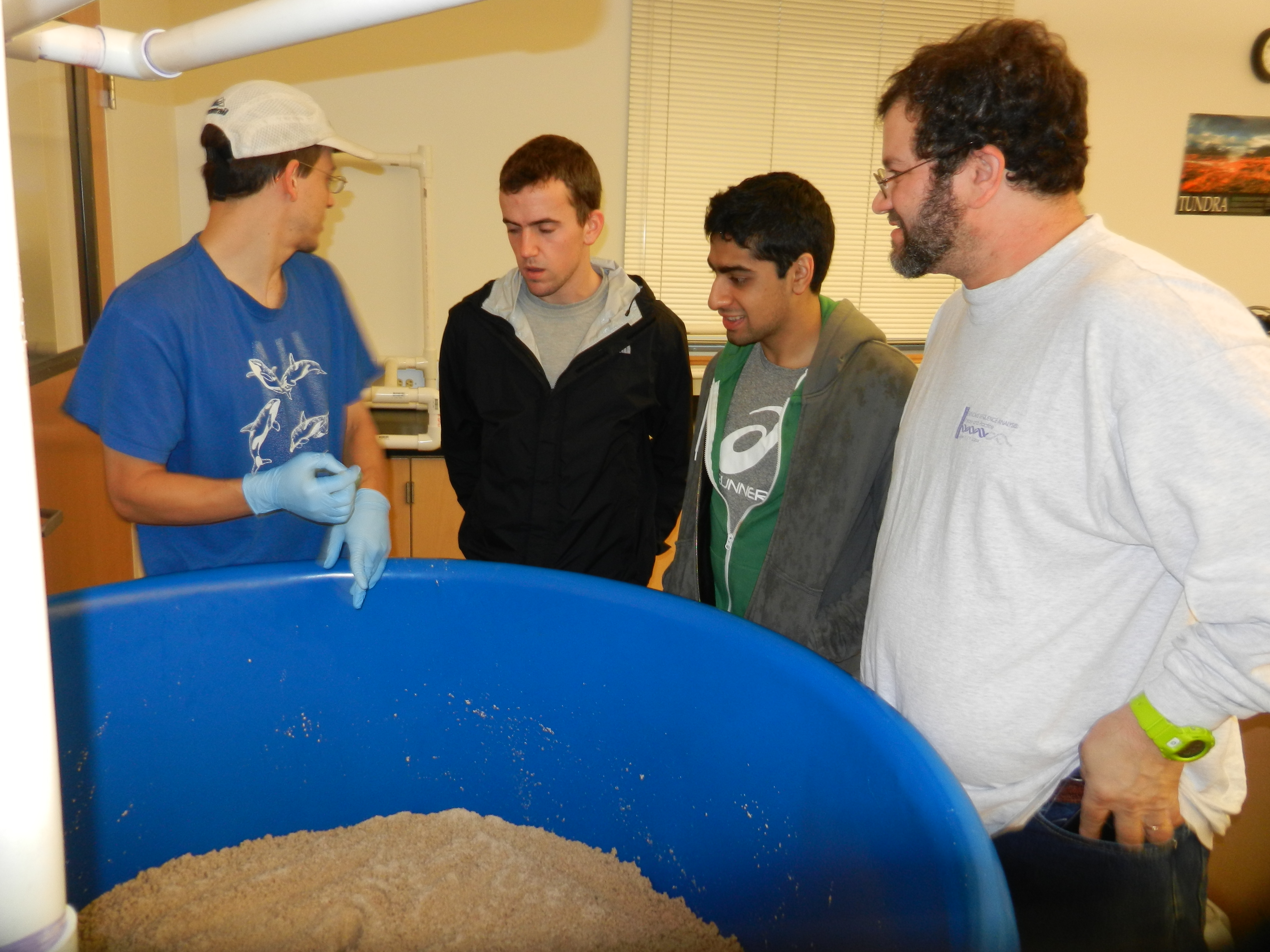
Can’t think of a better way to spend my Saturday afternoon!

Unlike most Saturdays, today I woke up and my first thought was, “I get to go to the SciLab building and sample!”  Jennifer and I took samples of the wall, water, and sand in the Coral Pond. We also did all of our water chemistry tests. Everything went well!


My only concern is with the nitrite test that I did. My value was extremely higher than the first two times (before the water was added to the pond and time zero). Those values were around 20 while I measured nitrite at 125 today. Because of this significant difference I ran the test twice, but got the exact same number the second time. I’ve been trying to find anything online that would give me a hint to whether my value makes sense or not.


We are going to have a lot to do this week. DNA extractions here we come!

Drexel Executive Leadership in Academic Technology and Engineering program fellowships

Just a quick post here.  I just got an email about the ICELA | International Center for Executive Leadership in Academics program in “Leadership Development for Senior Academic Women”.

The full email I received about this program is below:

Dear Colleague

As a recent recipient of an NSF institutional- level grant and a leader in your field, I would like to alert you to our (NSF-supported) leadership development program for mid-career women faculty in science and engineering.

The Executive Leadership in Academic Technology and Engineering program (ELATE at Drexel(r)) is a program for the enhancement of the professional and leadership skills of women faculty in mid-career (associate or full professor) in science and engineering fields. It is designed for faculty who are in a developmental phase of their institutional leadership, or who are already holding such positions.

We are now accepting applications for its 2013-2014 class through our online application<https://www.icela.net/apply/>.

The ELATE at Drexel program launched in 2012, and is currently hosting its inaugural class of Fellows from some of the nation’s leading universities in science and engineering. Over the past year, the program has been recognized with awards from the National Science Foundation, the Sloan Foundation, and the Henry Luce Foundation.  Our greatest honor has been to work with the accomplished Fellows and faculty in the program. More information about the current fellows and faculty is available at http://www.drexel.edu/engineering/programs/special_opp/ELATE/

ELATE advances knowledge and skills in strategic finance and management, personal and professional leadership effectiveness, and academic organizational dynamics. Upon graduation, each ELATE fellow becomes part of a community of leaders in higher education that provides continuing support for each member and her organization while serving as role models for the next generation of men and women scientists and engineers.

We would appreciate it if you could distribute this information to your colleagues, and encourage women in current or potential leadership roles to apply. Information provided in the attached brochure.

Applications are due by January 3, 2013.

Questions? Please contact us at ELATE@Drexel.edu or 215-991-8240.

New Coral Ponds

Hi all,

I have been looking forward to adding some blog posts on this great student outreach project but keep holding back because I wanted to include some pictures. I have recently joined Eisen’s lab and will be at Davis for the year before returning to San Diego State University to continue working on my Phd looking at microbial communities across Southern California kelp forests. I was excited about the opportunity to join in on this project and am impressed by the level of student participation.

This week has been busy with everyone getting acquainted with all the new water chemistry kits David has ordered for us. With Russell’s new tweeting pH meter, I was afraid the machines were taking over but it turns out undergrads and grads are still needed for bench work.

ImageImage

Today we got to see the newest coral pond setup and everyone in action as we collect our baseline data. Despite the rain we had a lot of participation and everything went smoothly.

ImageImage

Convoluted title, cool paper in #PLoSGenetics on relative of insect mutualists causing a human infection

Saw this tweet a few minutes ago:

//platform.twitter.com/widgets.js
The title of the paper took me a reread or two to understand.  But once I got what they were trying to say I was intrigued.  And so I went to the paper:  PLOS Genetics: A Novel Human-Infection-Derived Bacterium Provides Insights into the Evolutionary Origins of Mutualistic Insect–Bacterial Symbioses.  And it is loaded with interesting tidbits.  First, the first section of the results details the history of the infection in a 71 year old male and his recovery and the isolation and characterization of a new bacterial strain.  Phylogenetic analysis revealed this was a close relative of the Sodalis endosymbionts of insects.

And then comparative genomics revealed a bit more detail about the history of this strain, it’s relatives, and some of the insect endosymbionts.  And plus, it allowed the authors to make some jazzy figures such as

And this and other comparative analyses revealed some interesting findings.  As summarize by the authors

Our results indicate that ancestral relatives of strain HS have served as progenitors for the independent descent of Sodalis-allied endosymbionts found in several insect hosts. Comparative analyses indicate that the gene inventories of the insect endosymbionts were independently derived from a common ancestral template through a combination of irreversible degenerative changes. Our results provide compelling support for the notion that mutualists evolve from pathogenic progenitors. They also elucidate the role of degenerative evolutionary processes in shaping the gene inventories of symbiotic bacteria at a very early stage in these mutualistic associations.

The paper is definitely worth a look.

Follow the pH meter on Twitter

As part of the environmental monitoring of the coral ponds that we’re going to undertake Russell has agreed to loan us his famous tweeting pH meter.   Right now it’s just practicing in a freshwater tank at the facility but soon it will go into the first coral pond and we’ll get a continuous record of pH over the course of the project.   Follow along on Twitter @RussellspHMeter


Day 1 of sampling tomorrow! #OccupyBioLab

We have received word that they’re loading the first container with water tomorrow, which means we will have sampling and testing to do! They’re graciously lettings us keep our water chemistry equipment in the labs so we don’t have to bring it back and forth from the Genome Center. Also they’re giving us some freezer space. How nice! 🙂

Water Chemistry

So I meant to post this yesterday, but I couldn’t figure out why it wouldn’t let me blog. Apparently my computer signs me off wordpress every so often so I have to sign back in.. So this information is from my time in the lab yesterday.

Dissolved oxygen, nitrate, and ammonia tests came with no reagents… really? It’s almost as if they expect us to have an abundance of reagents for nitrate test before we have the tools to run the test. Oops, our bad! So that’s a bit frustrating, but we ordered more reagents for everything which should come by tomorrow hopefully.


The Phosphorous and Nitrite kits came with a couple reagents (still annoying), but this allowed us to run a couple trial runs with them on salt water from one of the tanks. Alex did a few tests in the morning (check out her blog entry) and I did a few in the afternoon.
I’m glad I familiarized myself with the tests because I had to make a few modifications to the procedure, because it was just… not good. For example in these tests, you have to blank the meter (makes sense, right?) but then you have to add the reagents from a small packet into a small cuvette (harder than it sounds) and mix for at least two minutes according to the instructions. However, the meter turns off after two minutes. I solved this by having two cuvettes: one to blank the meter and one with the reagent in it.


Phosphorous gave a reading of 200 ppb, which leads me into our next problem. The meter maxes out at 200, so we can assume phosphorous is at a level higher than 200. We need to get another kit with a meter that measures a higher concentration of phosphorous. I measured Nitrite at 70 ppb, which was similar to what Alex measured.


I also measured pH at 7.46 and salinity at 48.3 mS


David and I hoped that the hardness and alkalinity tests would give similar results since they both test for CaCO3. If we had gotten the same result, we could eliminate one of the tests and save time. I measured alkalinity at 114ppm CaCO3. When I ran the hardness test, it didn’t work. I attempted twice and had the same result: failure. We’re thinking the test just doesn’t work with salt water? We’re going to look into it.


It was really good to familiarize myself with all the equipment because now when we begin our intensive sampling and testing of the succession of the coral ponds, I’ll be ready to go with those water chemistry tests!


And now we wait! We wait for an email telling us they’re going to load the water into the containers for the coral ponds. At this point we have a lot of sampling to do! I’ve decided to call it Occupy Bio Labs since we’ll be spending quite a bit of time in there 🙂

Water Chemistry!

Most of our new gadgets and gizmos for water chemistry have finally come in, so we have started testing them out. Some of the kits we ordered include tests for nitrate, nitrite, phosphorus, chlorine, hardness, sulfate, and iron. At first, we were testing the kits out on tap water to get comfortable with all the tests, and then Matt collected sea water samples from one of the tanks so we started using those.

Today I tried the nitrate kit, which has never been used before. It was a surprisingly simple and quick test, and I found 79.5 ppm (mg/L) nitrate in the sea water. Unfortunately, I do not know the significance of this value, so David suggested that I try the test on tap water for comparison. The amount of nitrate in the tap water sample was 23.2 ppm (mg/L). According to Wikipedia, marine aquariums are only supposed to have trace amounts of nitrate in order to be healthy, so I do not know what our values mean.

A few of the kits we ordered do not have the range to collect values from sea water, so we are thinking of diluting our sea water samples with DI water. We will then use that mixture to conduct the tests that did not work (i.e. the phosphorus and hardness tests). In order for this plan to work, however, there must be small amounts of chemicals in the DI water or our data will be skewed. I checked the level of phosphorus in the DI water and the value came out to be 34 ppb. I am not sure if this means that our dilutions will work, but I am sure we will be able to figure out how to analyze our data after doing some more research.

Water Chemistry Testing Acclimation

The water chemistry kits seem to be pretty straightforward, with a few nuances here and there. I conducted the titration-based tests as well as the tests to detect phosphorous and hardness. For the tests I used DI water to compare values, and so far the values I have been getting are comparable to values other people are getting, as well as make sense, which is good. 

So a few tips. The phosphorous meter turns off after a few minutes, and it will forget the blank sample. So it is a good idea to make the reagent+sample tube before you begin. 

Also, it is good to choose the low range of testings, because the high range is too much for our samples. 

Sample testing using new equipment

We finally got all our equipment for gathering metadata on the water, and decided to do some sample testing using tap water and saltwater from the tank. We ended up with the following:


Tap water –

NO2-N levels: 65 ppm

NO2 levels: 154.63 ppm

Phosphorus: 105 ppb


Saltwater –

NO2-N levels: [TRIAL ONE] 65 ppm, [TRIAL TWO] 57 ppm

NO2 levels: [TRIAL ONE] 213.85 ppm, [TRIAL TWO] 187.53 ppm

Phosphorus: [TRIAL ONE] 48 ppb, [TRIAL TWO] 200 ppb


Some problems we encountered: When I did the trial one on the saltwater phosphorus test, I used the wrong reagent (phosphate reagent is used for the nitrite scanner, while phosphorus reagent is used for the phosphorus scanner). In addition, the phosphorus scanner maxes out at 200 (Andrew later confirmed this by doing additional scans on the saltwater), which means we’ll need a broader range scanner.