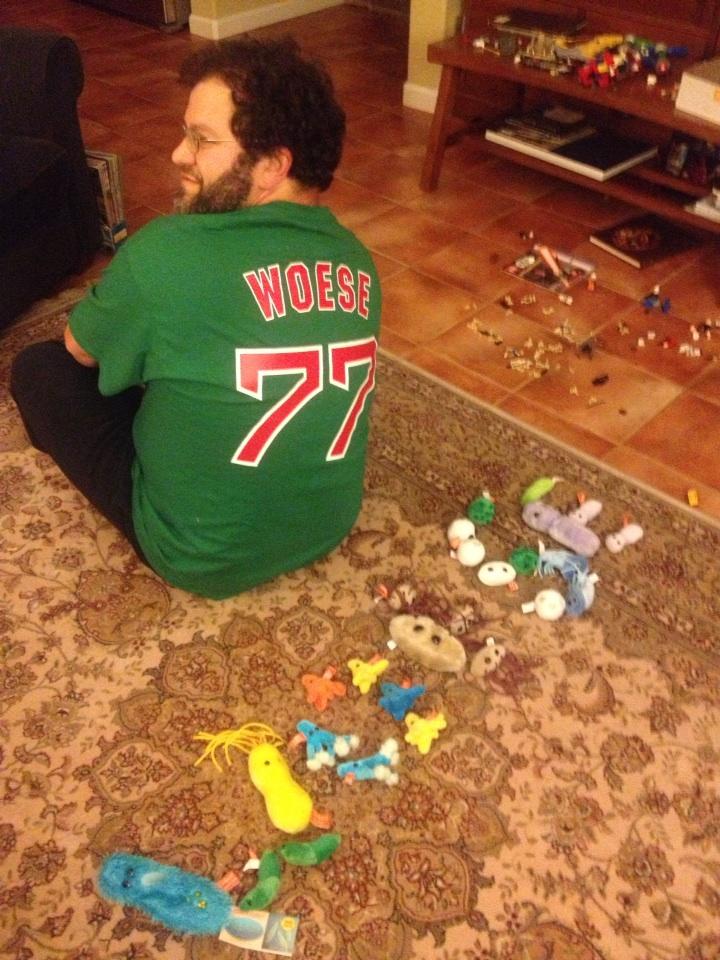
RIP Carl Woese: Collecting posts / notes / other information about my main science hero here

My tribute to Carl Woese 12/30/12

Sadly, Carl Woese has passed away.  I am collecting some links and posts about him here in his memory.  He was without a doubt the person who most influenced my career as a scientist.

News stories about Woese’s passing

Some of my posts about Woese

Woese Tree of Life pumpkin (by J. Eisen)

Storification of Tweets and other posts about his passing //storify.com/phylogenomics/rip-carl-woese.js?template=slideshow[View the story “RIP Carl Woese” on Storify]

Other posts worth reading about Woese’s passing

Some videos with Woese 


Miscellaneous

My graduate student Russell Neches used a laser to etch a picture of Carl Woese on a piece of toast.

http://www.mendeley.com/groups/2940711/papers-by-carl-woese/widget/21/3/

2003 email from Carl Woese to Mitch Sogin after winning Crafoord Prize

I had posted an email here from Carl Woese to Mitch Sogin (with Mitch’s permission).  However, in retrospect I feel uncomfortable posting private emails of Carl Woese’s here as he is not around to give permission.  So I have removed them.  Apologies to all who may have felt uncomfortable about the posting and to those who wish it would remain public.  But I just do not feel comfortable with this anymore.

Best email I have ever received – from Carl Woese 10/29/2011

I had posted an email exchange here between Carl Woese and myself.  However, in retrospect I feel uncomfortable posting private emails of Carl Woese’s here as he is not around to give permission.  So I have removed them.  Apologies to all who may have felt uncomfortable about the posting and to those who wish it would remain public.  But I just do not feel comfortable with this anymore.

Email exchanges between Robin Gutell and Carl Woese

I had posted emails here between Carl Woese and Robin Gutell (with Robin’s permission).  However, in retrospect I feel uncomfortable posting private emails of Carl Woese’s here as he is not around to give permission.  So I have removed them.  Apologies to all who may have felt uncomfortable about the posting and to those who wish it would remain public.  But I just do not feel comfortable with this anymore.

Microbial art for the holidays from the J. Craig Venter Institute

Saw this Tweet on Christmas Day

//platform.twitter.com/widgets.js It was from Russell Neches, a PhD student in my lab.

Went to the site “La boite verte” and checked out their post “Des champignons de Noël.”

Discovered it was based on a post from none other than the J. Craig Venter Institute’s blog: Holiday Art” JCVI Blog. The post is by Stephanie Mounaud from December 2010 and it has three wonderful fungal art forms. I am embedding the images of them below:

Fungal Christmas Tree

Fungal Snowman

Fungal Christmas Tree2

Enjoy.

Great ideas in this #PLoSOne paper; except we published same idea 12 fu$*# years ago

Figure 1 from Pollock et al. 2000

Wow. I mean, imitation is a form of flattery. But this paper … Grrrrrrr PLOS ONE: Conveniently Pre-Tagged and Pre-Packaged: Extended Molecular Identification and Metagenomics Using Complete Metazoan Mitochondrial Genomes In the paper the authors basically argue that for many purposes, including phylogenetic studies in particular, one could obtain many mitochondrial genomes at once by just pooling together samples from different organisms, shotgun sequencing the samples, and assembling the separate mitochondrial genomes out.  All one would need to do is to make sure the organisms pooled were distantly related enough such that their mitochondrial sequences would not cross assemble with each other.  They say things like:

We propose a novel approach for the isolation and sequencing of a universal, useful and popular marker across distant, non-model metazoans: the complete mitochondrial genome. It relies on the properties of metazoan mitogenomes for enrichment, on careful choice of the organisms to multiplex, as well as on the wide collection of accumulated mitochondrial reference datasets for post-sequencing sorting and identification instead of individual tagging. Multiple divergent organisms can be sequenced simultaneously, and their complete mitogenome obtained at a very low cost. We provide in silico testing of dataset assembly for a selected set of example datasets.

AND

We describe here the approach, the type of sequence data it generates, the procedure to recover mitochondrial genomes without external tagging, and some potential uses. We perform an in-silico validation test based on the analysis of a simulated dataset with read lengths of two different sizes to represent average read length of three 2nd generation desktop sequencing platforms, Illumina Mi-Seq, 454 GS junior and Ion Torrent PGM. Thus we can contrast their relative efficiencies for the experimental protocol proposed here.

Sounds great. Except I wrote a paper with David Pollock, Norman Doggett, and Michael Cummings published in 2000 proposing the same thing. Our paper:  Pollock DD, Eisen JA, Doggett NA, Cummings MP. Mol Biol Evol. 2000 Dec;17(12):1776-88. A case for evolutionary genomics and the comprehensive examination of sequence biodiversity.

 Our abstract:

Comparative analysis is one of the most powerful methods available for understanding the diverse and complex systems found in biology, but it is often limited by a lack of comprehensive taxonomic sampling. Despite the recent development of powerful genome technologies capable of producing sequence data in large quantities (witness the recently completed first draft of the human genome), there has been relatively little change in how evolutionary studies are conducted. The application of genomic methods to evolutionary biology is a challenge, in part because gene segments from different organisms are manipulated separately, requiring individual purification, cloning, and sequencing. We suggest that a feasible approach to collecting genome-scale data sets for evolutionary biology (i.e., evolutionary genomics) may consist of combination of DNA samples prior to cloning and sequencing, followed by computational reconstruction of the original sequences. This approach will allow the full benefit of automated protocols developed by genome projects to be realized; taxon sampling levels can easily increase to thousands for targeted genomes and genomic regions. Sequence diversity at this level will dramatically improve the quality and accuracy of phylogenetic inference, as well as the accuracy and resolution of comparative evolutionary studies. In particular, it will be possible to make accurate estimates of normal evolution in the context of constant structural and functional constraints (i.e., site-specific substitution probabilities), along with accurate estimates of changes in evolutionary patterns, including pairwise coevolution between sites, adaptive bursts, and changes in selective constraints. These estimates can then be used to understand and predict the effects of protein structure and function on sequence evolution and to predict unknown details of protein structure, function, and functional divergence. In order to demonstrate the practicality of these ideas and the potential benefit for functional genomic analysis, we describe a pilot project we are conducting to simultaneously sequence large numbers of vertebrate mitochondrial genomes.

And not any mention of our paper in this new one.  I could do a detailed side by side comparison but I am too angry right now.  It’s either stealing on purpose or just shoddy work.  I think stealing is unlikely so I will conclude just poor work.  Shoddy job by the authors (Dettai A, Gallut C, Brouillet S, Pothier J, Lecointre G et al).  Shoddy job by the editor Dirk Steinke from Guelph.  Annoying as all heck.

UPDATE 11 AM 12/22: I got carried away with anger when I wrote the last few sentences crossed out above.  Upon further, more rational consideration, I do not think the authors or editors did anything really wrong here.  Yes, they missed some prior literature on the topic and our prior paper is indeed quite similar to theirs.  But our prior paper is pretty hard to find by literature searches (see comments/discussion) and they clearly came up with their ideas independently.  I truly regret the aggressive, obnoxious tone of my post and sincerely apologize to the authors of the new paper.

PS.  I wish to thank @DrShmoo on Twitter for knocking some sense into me

//platform.twitter.com/widgets.js

//platform.twitter.com/widgets.js

Sampling the Wild Microbial Life of My Home

Just finally got around to doing the sampling of my house for the Wild Life of Our Homes microbial sampling project.

I signed up online, got a kit, got a registration code, and did the sampling today.  I swabbed the exterior door frame, an interior door frame, the kitchen counter and my pillow case.  Plus as a bonus, my 7 year old daughter helped – learning a bit about microbial sampling and also taking pictures of me at work (and a few of herself).

https://picasaweb.google.com/s/c/bin/slideshow.swf

So many cool Citizen Microbiology projects going on now. Some information about them is here but I need to update the links there.

Preliminary phosphate data too

Thought this one was interesting (though not surprising) as well.   Phosphorus levels are low in the in initial system (seawater and sand) and go up quite a bit once corals and established sediment are added.

chemistryfigures

New "microbiology blog of the day" series at microBEnet

I am starting a new “microbiology blog of the day” series at the “microbiology of the built environment network (microBEnet)” site I co-run.  This is a culmination of something I started at the ASM Meeting in June.  When I went to the Communications Committee meeting, I suggested that there were lots of interesting microbiology blogs that ASM could do a better job of featuring.  I was asked “how many are there?”  And I said “there are dozens, and probably over 100”.  A certain person on the committee who works on the current ASM blog expressed doubt that there were “more than five that are any good.” I said I could compile a list easily.  And so I did this while at the ASM meeting.  And, well, I have been compiling ever since.  And the list grows and grows.

There are so many good microbiology – themed blogs out there that we created a compilation at microBEnet with the latest posts from each.  And at the suggestion of Nick Loman we pointed people to the OMPL file of the entire list which people can use to add the whole list to ones RSS reader.

So far I have written three simple summaries of blogs and will continue as long as I can ….  The first three are:

If you want to keep up with the posts, you need to subscribe to the microBEnet blog feed.  
There are so many great microbiology bloggers out there.  If you know of others not on our list, please let me know.

UPDATE 12/26 More Blogs Added to the Series

Preliminary Nitrite/Nitrate data just for fun

Since we’ve been collecting all this water chemistry data I thought it’d be nice to share a bit of it.   Here you can see the nitrate and nitrate levels in Coral Pond #1 over a couple of weeks.  Levels start out low, then rise in the newly established system right up until inoculation with an stable microbial community.  At that point the nitrites head back down quickly and the nitrates continue to rise.  So question for the undergrads on the project:  Is this what we expect or not?   Why would we see this pattern?

nitrate-nitratefigure