Guest post: Kevin Carpenter on his new microbial photo exhibit at the Exploratorium in SF #SoCool

Special guest post from Kevin Carpenter who has microbe photos featured at the Exploratorium.


One of my colleagues who does research on the microbes that live in the hindguts of lower termites once remarked that interesting organisms can be found in the most unusual of places. And the lower termite hindgut, by almost anyone’s estimation, is certainly an unusual place. It is also a fascinating place for anyone interested in biology, ecology, evolution, biochemistry, or beautiful natural forms and patterns.

Since my undergraduate days in the early 90s, I have had a deep interest in the tree of life, especially eukaryote phylogeny. After a Ph.D. in Plant Biology at U.C. Davis, I headed off to the University of British Columbia to work in Patrick Keeling’s lab to pursue these interests. Anyone who has this peculiar obsession (actually, I think it’s peculiar not to have this obsession!) knows that the eukaryote tree comprises mostly protists, and they arguably encompass greater structural, cell biological, biochemical, (and certainly evolutionary!) diversity than all plants, animals, and fungi combined.

In Patrick’s lab I developed methods for SEM and TEM imaging of these microbes to investigate their phenotypic character evolution, functional morphology, and symbioses with bacteria in the light of molecular phylogenetic data. In addition to a number of publications (with more to come) and talks in Russia, Germany, Norway, etc. my electron micrographs have been featured on numerous journal covers, textbooks, and invited artistic presentations in Canada and Germany.

On 17 April 2013, a collection of 11 of my scanning electron micrographs of lower termite hindgut protists and their bacterial symbionts will go on permanent exhibit at the Exploratorium museum as they open their new $300 million dollar location on Pier 15 in San Francisco. This is a large (12′ x 4′) installation in the East Gallery (overlooking the bay):

The waterfront location, the architecture, the exhibits, and sustainable technology (rooftop solar panels, etc) are all amazing, and I encourage anyone with any interest in science/biology, art, experimentation, tinkering, and beautiful views to come out for a visit. For more information on the exhibit, the organisms, additional images and other resources (including a blog!), please visit my website at: KevinJCarpenter.com

As for the organisms…

The hindgut of wood-feeding lower termites–comprising approximately 1000 species (out of a total of several thousand species of termites)–is densely packed with symbiotic protozoa (protists), many of which engulf and enzymatically degrade wood fragments making their way to the termite hindgut. Far from being parasites, numerous studies have shown this to be a mutualsitic symbiosis, by demonstrating that the termites will starve and die if deprived of their protist symbionts. The symbiosis between lower termites and their hindgut protists is one of the longest-studied and best-known examples of microbial symbiosis, dating back nearly a century and a half to the work by Joseph Leidy and others.

The protists are anaerobic flagellates belonging to Parabasalia or Oxymonadida–members of the Excavate eukaryotic supergroup (also including euglenids, trypanosomes, Giardia, and heterolobosean amoebas). There are numerous odd, interesting, beautiful, and instructive things about these protists.

First, they are endemic to termite hindguts and are found nowhere else. Most of the protist species are found only in association with a single species of termite. The termites pass their hindgut biota from adult to newly hatched nymphs and moulting adult termites (which lose their hindgut contents) via specialized feeding behaviors. It is thought that termites evolved social behavior and caste differentiation from their cockroach ancestors partly to pass hindgut protists between individuals.

Second, many of the protist species and lineages have attained large size (up to 300 microns in length), and enormous structural complexity. Some of the protists are estimated to bear up to 50,000 flagella, each associated with specialized proteinaceous structures (kinetosomes, parabasal fibers) inside the cell. Hence, these are likely among the most structurally complex cells known to science. This is in marked contrast to other symbiotic protist lineages such as microsporidia, apicomplexans, and the coral reef symbiont Cyanidioschyzon, all of which have undergone extreme structural reduction. When looking at these termite gut protists in all of their great structural complexity, dwarfing their numerous bacterial surface symbionts, it is is kind of mind-boggling in a sense to realize that this is a unicellular organism!

Third, the cell biology of these organisms is so different from what is taught in undergraduate cell biology (which is really mammalian, or at best, metazoan cell biology), that it may (hopefully) cause one to reflect on how truly diverse and unknown our biosphere really is. As one example of this, in parabasalid protists, mitochondria have become drastically reduced structurally (loss of cristae), functionally (loss of oxidative metabolism/Krebs cycle), and genomically, and their only known function is the conversion of pyruvate to acetate, with the production of hydrogen gas as a waste product. Hence, these relict mitochondria are called hydrogensomes. The oxymonads are among the least understood group of eukaryotes, and for many species it is unknown what they eat (some of the smaller species apparently do not eat wood), how they reproduce, or how they metabolize their food. Some even have a non-canonical genetic code.

The sitution becomes even more complex when we consider the bacteria in lower termite hindgut systems. In light of their importance in the human and other gut microbiomes, it is no surprise that the termite gut is swarming with innumerable bacteria, many of which are likely found only in one species of termite. What is surprising is that an estimated 90% of all bacterial cells in these systems live either on the surface of, or inside of a protist, and are not free-swimming. One study estimates that the large protist Pseudotrichonympha harbors about 100,000 bacterial cells. Microscopy reveals specialized attachment structures that help the bacteria anchor to the protist surface. Our research shows that the large protist Barbulanympha has not only vast numbers of rod-shaped bacteria on its cell surface and interior, but also bacteria surrounding extruded strands of cytoplasm. This is possibly a mechanism to increase the area available for exchange of nutrients.

Recent research on bacteria symbiotic with termite gut protists suggests that they are important in nitrogen metabolism–both in nitrogen fixation and synthesis of vitamins and amino acids. They are thought to transfer these compounds to their host protist (and to the termite) in return for sugars derived from breakdown of wood.

Just as the protists are generally endemic to a single species of termite, in many cases, bacteria found in symbiotic association with the protists are endemic to a single species of protist. Given this close, three-way association between termite, protist, and bacteria, it is perhaps not surprising that evidence of triplex speciation has been found in these organisms: both the bacteria and their protist hosts speciate in tandem in response to termite speciation events. This is one of only a handful of putative cases of triplex speciation.

The symbiosis between termites and protists is actually also present in a species of wood-feeding cockroach–Cryptocercus punctulatus. C. punctulatus is actually more closely related to termites than to other cockroaches (cockroaches are paraphyletic). It is believed that symbiotic protists were present in the hindgut of the ancestor of C. punctulatus and modern termites, which likely lived over 100 million years ago.

Thus, I consider these termite hindgut systems to be among the most unusual, beautiful, and instructive natural laboratories in evolution and ecology known to science. Nature indeed seems to enjoy tinkering, and in that spirit, I think this is well suited to representation in a place like the Exploratorium!

A few references (copied straight out of one of my manuscripts!) for those interested:


Brune, A. & Ohkuma, M. (2011). Role of the termite gut microbiota in symbiotic digestion. In Biology of Termites: A Modern Synthesis, Bignell, D. E., Roisin, Y. and Lo, N. (Eds.), pp. 439-475. London: Springer.

Carpenter, K.J., Chow, L. & Keeling, P.J. (2009). Morphology, phylogeny, and diversity of Trichonympha (Parabasalia: Hypermastigida) of the wood-feeding cockroach Cryptocercus punctulatus. J Eukaryot Microbiol 56(4), 305-313.

Carpenter, K.J., Horak, A., Chow, L. & Keeling, P.J. (2011). Symbiosis, Morphology, and Phylogeny of Hoplonymphidae (Parabasalia) of the Wood-Feeding Roach Cryptocercus punctulatus. Journal of Eukaryotic Microbiology 58(5), 426-436.

Carpenter, K.J., Horak, A. & Keeling, P.J. (2010). Phylogenetic position and morphology of spirotrichosomidae (parabasalia): new evidence from Leptospironympha of Cryptocercus punctulatus. Protist 161(1), 122-132.

Carpenter, K.J. & Keeling, P.J. (2007). Morphology and phylogenetic position of Eucomonympha imla (Parabasalia: Hypermastigida). J Eukaryot Microbiol 54(4), 325-332.

Carpenter, K.J., Waller, R.F. & Keeling, P.J. (2008). Surface morphology of Saccinobaculus (Oxymonadida): implications for character evolution and function in oxymonads. Protist 159(2), 209-221.

Hongoh, Y., Sharma, V.K., Prakash, T., Noda, S., Taylor, T.D., Kudo, T., Sakaki, Y., Toyoda, A., Hattori, M. & Ohkuma, M. (2008a). Complete genome of the uncultured Termite Group 1 bacteria in a single host protist cell. Proc Natl Acad Sci U S A 105(14), 5555-5560.

Hongoh, Y., Sharma, V.K., Prakash, T., Noda, S., Toh, H., Taylor, T.D., Kudo, T., Sakaki, Y., Toyoda, A., Hattori, M. & Ohkuma, M. (2008b). Genome of an endosymbiont coupling N2 fixation to cellulolysis within protist cells in termite gut. Science 322(5904), 1108-1109.

Ohkuma, M. & Brune, A. (2011). Diversity, structure, and evolution of the termite gut microbial community. In Biology of Termites: A Modern Synthesis, Bignell, D. E., Roisin, Y. and Lo, N. (Eds.), pp. 413-438. London: Springer.

YAMMGM: Yet another mostly male genomics meeting

Just got an email from Illumina – key parts are below:

2013 Illumina Scientific Summit

Dear Jonathan,

Illumina’s third annual Scientific Summit will be held June 3rd through 7th in charming New Orleans, Louisiana, at the Loews Hotel. Described by a past attendee as, “an upscale Gordon Conference”, the Scientific Summit is an invitation-only meeting of 120 leading scientists and thought leaders plus the Illumina executive and R&D leadership teams. 

Plenary sessions will be focused on the Genetic Etiology of Cancer and Genetic Diseases, The Changing Landscape of Medical Genetics, Microbial Detection, and Epigenetics. The formal presentations will be complemented by attendee-driven discussion sessions on a variety of topics ranging from workflow bottlenecks to future applications of Next Generation Sequencing in single cells and diagnostics.

The following distinguished scientists are scheduled to speak:

Dr. Mark Adams, Scientific Director, J. Craig Venter Institute

Dr. Kenneth J. Bloom, Chief Medical Officer, Clarient

Dr. David Craig, Deputy Director of Bioinformatics, Associate Professor and Director, Neurogenomics Division, Head Neurobehavioral Research Unit, TGen

Dr. Richard Gibbs, Wofford Cain Chair in Molecular and Human Genetics, Professor, Department of Molecular and Human Genetics, Professor, Programs in Translational Biology & Molecular Medicine, Baylor College of Medicine

Dr. David Goldstein, Director, Duke Medical Center for Human Genome Variation, Duke University

Dr. Steven Jones, Head of Bioinformatics and Associate Director, Michael Smith Genome Sciences Centre, BC Cancer Agency 

Dr. Michael Katze, Professor, Microbiology, University of Washington

Dr. Jim Knowles, Professor and Associate Chair for Research and Psychiatry and the Behavioral Sciences, USC

Dr. Peter Laird, Director, USC Epigenome Center, Professor of Surgery,Biochemistry and Molecular Biology, Keck School of Medicine, USC

Neil Miller,  Director of Informatics and Software Development, Center for Pediatric Genomic Medicine, Children’s Mercy Hospital, Kansas City

Dr. Steven Musser, Director, Office of Regulatory Science, FDA Center for Food Safety and Applied Nutrition

Dr. Charles Perou, Distinguished Professor of Genetics, Professor, Pathology & Lab Medicine, Lineberger Comprehensive Cancer Center, University of North Carolina School of Medicine

Dr. Jonathan Sebat, Chief, Beyster Center for Genomics of Neuropsychiatric Diseases, Associate Professor, Department of Psychiatry & Cellular and Molecular Medicine, University of California, San Diego

Dr. George Weinstock, Professor of Genetics and Molecular Microbiology, Washington University

Dr. Liz Worthey, Director of Genomic Informatics, Medical College of Wisconsin

I love Illumina sequencing toys.  I really do.  No so impressed with the gender ratio of this meeting however.  Would not have gone anyway … but if I COULD have attended I would not have.  I wonder -did they even think about whether there might be some bias here?  There certainly are plenty of female candidates they could have invited. Maybe they did not invite women? Maybe all the women said no?

GGG seminar today: Dan Rokhsar

Genetics Spring 2013 Seminar

1022 Life Sciences Mondays at 4:10PM

April 22, 2013

“In the Beginning: Genomics of Animal Origins and Diversity”

Dan Rokhsar
Lawrence Berkeley National Laboratory

Do we need naming regulations for computer software?

Well, just saw this new paper: BMC Bioinformatics | Full text | Bellerophon: a hybrid method for detecting interchromo-somal rearrangements at base pair resolution using next-generation sequencing data.  Seems potentially interesting.  But one part of it struck me as very awkward.  You see, there already is a Bellerophon software program used by many in my field: Bellerophon: a program to detect chimeric sequences in multiple sequence alignments.  Seems like a very bad idea to have a new program with the same name as an existing (and still used) one in a similar general field (DNA sequence analysis).

This leads me to the following question – do we need some sort of naming guidelines or regulations for computer software?  We have all sorts of naming regulations and conventions for genes, for species, for other groups of taxa, and more.  Why not software tools?  But seriously, I don’t think we need such a thing – we just need people to use Google and to do a little searching before they invent / publish a software package in case it’s name is, well, already used.

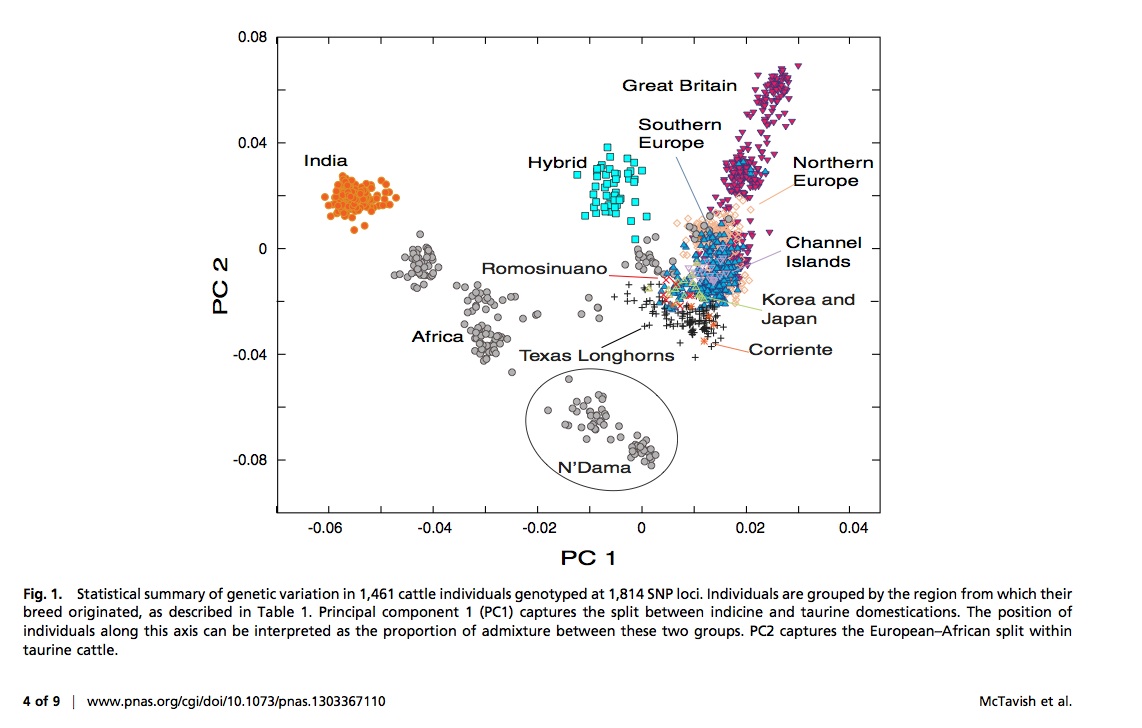
Cool #OpenAccess paper from McTavish et al. on Domestication of New World Cattle

Sort of randomly bumped into this one via Google Scholar Alerts I have set up and being from UC Davis the title caught my eye: New World cattle show ancestry from multiple independent domestication events.  Yes, we think about cows a lot here OK.  And then the second thing that caught my eye were the authors – including David Hillis – who I did not know was working on cattle.  I mean – I knew he lived in Texas – so maybe I should have guessed this was coming at some point.

And then I noticed the first author is someone I follow on Twitter.  Ok – enough.  I got the message.  So I looked over the paper.

From the Abstract:

Previous archeological and genetic research has shown that modern cattle breeds are descended from multiple independent domestication events of the wild aurochs (Bos primigenius) ∼10,000 y ago. Two primary areas of domestication in the Middle East/Europe and the Indian subcontinent resulted in taurine and indicine lines of cattle, respectively. American descendants of cattle brought by European explorers to the New World beginning in 1493 generally have been considered to belong to the taurine lineage. Our analyses of 47,506 single nucleotide polymorphisms show that these New World cattle breeds, as well as many related breeds of cattle in southern Europe, actually exhibit ancestry from both the taurine and indicine lineages. In this study, we show that, although European cattle are largely descended from the taurine lineage, gene flow from African cattle (partially of indicine origin) contributed substantial genomic components to both southern European cattle breeds and their New World descendants. New World cattle breeds, such as Texas Longhorns, provide an opportunity to study global population structure and domestication in cattle. Following their introduction into the Americas in the late 1400s, semiferal herds of cattle underwent between 80 and 200 generations of predominantly natural selection, as opposed to the human-mediated artificial selection of Old World breeding programs. Our analyses of global cattle breed population history show that the hybrid ancestry of New World breeds contributed genetic variation that likely facilitated the adaptation of these breeds to a novel environment.

There is some really fascinating stuff in here.  And some great figures.

Definitely worth a look if you are interested in cattle, domestication, population genetics, and more …

WWWD – What would Wolbachia do? Not always male destruction. Not always mutualism. Sometimes they disappear.

Interesting paper in Nature Genetics: Genomics of Loa loa, a Wolbachia-free filarial parasite of humans : Nature Genetics : Nature Publishing Group.  It is “Open” due to the NPG policy for papers reporting genome data.

Anyway – the paper deals in parts with the biology of the interaction between Wolbachia and filiarial nematodes.  Wolbachia are these fascinating intracellular bacteria that are found to infect a diversity of invertebrate species.  In 2004 we published the genome sequence of the first Wolbachia genome – a strain that infects Drosophila melanogaster and causes male specific detrimental effects (see summary here and our paper here and a general review here).  Many of the Wolbacia that are well studied have male specific effects leading us to jokingly call them “WMDs” the Wolbachia of male destruction.

Interestingly, Wolbachia also infect filarial nematodes, such as the ones that cause various nasty diseases.  And these Wolbachia not only do not have any obvious male specific detrimental effects, they appear to be mutualistic symbionts of the nematodes.  That is where this paper comes in.  The authors sequenced the genome of a filarial nematode that does not have any Wolbachia.  The premise here is – if Wolbachia are needed for other nematodes maybe one can figure out what Wolbachia do by identifying features in the Wolbachia-free nematode that are not in the ones with Wolbachia. 

They write

Loa loa, the African eyeworm, is a major filarial pathogen of humans. Unlike most filariae, L. loa does not contain the obligate intracellular Wolbachia endosymbiont. We describe the 91.4-Mb genome of L. loa and that of the related filarial parasite Wuchereria bancrofti and predict 14,907 L. loa genes on the basis of microfilarial RNA sequencing. By comparing these genomes to that of another filarial parasite, Brugia malayi, and to those of several other nematodes, we demonstrate synteny among filariae but not with nonparasitic nematodes. The L. loa genome encodes many immunologically relevant genes, as well as protein kinases targeted by drugs currently approved for use in humans. Despite lacking Wolbachia, L. loa shows no new metabolic synthesis or transport capabilities compared to other filariae. These results suggest that the role of Wolbachia in filarial biology is more subtle than previously thought and reveal marked differences between parasitic and nonparasitic nematodes.

Anyway – the paper is worth checking out.

Figure 3: Phylogenomic analysis of nematodes.. Maximum likelihood, parsimony and Bayesian methods all estimated an identical phylogeny using the concatenated protein sequences of 921 single-copy orthologs. To the left of each node are likelihood bootstrap support values/parsimony bootstrap support values/Bayesian posterior probabilities. The distributions of genes in the ortholog clusters are shown to the right of the phylogeny. Core genes are encoded by all genomes, shared genes are encoded by at least two but fewer than all genomes, and unique genes are found only in one genome. Orthologs specific to the nonparasitic (C. elegans, C. briggsae and P. pacificus) and filarial nematodes are also highlighted. Of the 6,280 L. loa genes with no functional assignment, 3,665 are unique to L. loa and 1,158 are filarial specific. From http://www.nature.com/ng/journal/vaop/ncurrent/full/ng.2585.html

Microbes and obesity – more connections

A couple of recent papers on weight-loss surgery and microbes have gotten a lot of attention to the idea that obesity and microbes have a more than just coincidental connection.

Some of the news stories on the topic are below. A few of them are a bit over the top but the new work seems pretty sound so this is definitely worth a look.

Who are the microbes on your fruits and veggies?

Nice paper from Jonathan Leff and Noah Fierer in PLOS One: Bacterial Communities Associated with the Surfaces of Fresh Fruits and Vegetables

Abstract: Fresh fruits and vegetables can harbor large and diverse populations of bacteria. However, most of the work on produce-associated bacteria has focused on a relatively small number of pathogenic bacteria and, as a result, we know far less about the overall diversity and composition of those bacterial communities found on produce and how the structure of these communities varies across produce types. Moreover, we lack a comprehensive view of the potential effects of differing farming practices on the bacterial communities to which consumers are exposed. We addressed these knowledge gaps by assessing bacterial community structure on conventional and organic analogs of eleven store-bought produce types using a culture-independent approach, 16 S rRNA gene pyrosequencing. Our results demonstrated that the fruits and vegetables harbored diverse bacterial communities, and the communities on each produce type were significantly distinct from one another. However, certain produce types (i.e., sprouts, spinach, lettuce, tomatoes, peppers, and strawberries) tended to share more similar communities as they all had high relative abundances of taxa belonging to the family Enterobacteriaceae when compared to the other produce types (i.e., apples, peaches, grapes, and mushrooms) which were dominated by taxa belonging to the Actinobacteria, Bacteroidetes, Firmicutes, and Proteobacteria phyla. Although potentially driven by factors other than farming practice, we also observed significant differences in community composition between conventional and organic analogs within produce types. These differences were often attributable to distinctions in the relative abundances of Enterobacteriaceae taxa, which were generally less abundant in organically-grown produce. Taken together, our results suggest that humans are exposed to substantially different bacteria depending on the types of fresh produce they consume with differences between conventionally and organically farmed varieties contributing to this variation.

Getting press attention.  Examples include:

Definitely worth a look.

Human microbiome all over the news (well, the topic that is)

Just a quick post here.  In the last week or so the human microbiome has been all over the news.  Here are some links to check out

And many more …

Question – anyone having issues w/ delays/difficulty in the process of getting genomes / metagenomes into Genbank?

DNA sequencing continues to go crazy in terms of lower cost, higher speed, and spread of technology. Alas, some aspects of doing a genome project are not necessarily keeping up. So I am posting here to ask a simple question about one of these steps. What do people out there think about the steps of getting genome / metagenome data into Genbank. Without wanting to bias answers too much – we are having some challenges in this area. Storify of Twitter responses below the fold


//storify.com/phylogenomics/a-work-around-for-genbank-bottleneck.js[View the story “A work around for Genbank bottleneck” on Storify]