Author: Jonathan Eisen
Playing w/ Google Scholar’s "Citations" system – some nice features but in need of a little fine tuning
Been playing around with Google Scholar‘s Citations system that allows anyone to create a mini page with their publications. Here is a link to mine: Jonathan Eisen. I recommend that everyone out there who has any publications create a Scholar Citations page for themselves. Instructions can be found here.
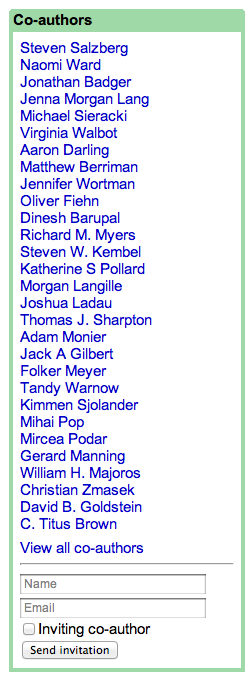
I quite like the simplicity yet informativeness of the Scholar Citations front page:
Yet there are many other things I wish were there. For example, I really wish the “Institution” part was an active link and led to other people at UC Davis. Alas, not so. So I had to use the search function to pull out other people from UC Davis (searching for UC Davis in the search for Authors in the box in the upper right from my home page).
The list comes out in order of numbers of citations, which is good and bad. Here are some of the top people from the list:
- John Terning
- Steven Luck
- Alan Hastings
- Luca Comai
- Oliver Fiehn
- Dean Keith Simonton
- Donald R. Strong
- Pamela Ronald
- Roger Wets
- Patricia Lyon Mokhtarian
- Bertram Ludäscher
- John Owens
- Peter C Wainwright
- David Fyhrie
- Mark W. Schwartz
- Anna Scaglione
- Katherine Ferrara
- Craig A. Tracy
- Richard McElreath
- Kwan-Liu Ma
- Prasant Mohapatra
- Truman P. Young
- Patrice Koehl
- Peter Cranston
- N. Sukumar
- Marcel Holyoak
- MA Matthews
- Kali H. Trzesniewski
- Shyhtsun Felix Wu
- Stacey Harmer
- Julin N Maloof
- R Ford Denison
- Zhendong Su
- Dorothy Gietzen
- David A. Mills
- Danh Nguyen
- H. Michael Zhang, HM Zhang
- Louise Kellogg
- Aaron Darling
Genome Center Network Focus Group – Reminder
The Genome Center
Network Focus
Group Presents
Dana Pe`er
Assistant Professor, Department of Biology
Columbia University
"On the road to personalized therapy, a systems approach“
Abstract: Systematic characterization of cancer genomes has revealed a staggering complexity of aberrations among individuals, such that the functional importance and physiological impact of most tumor genetic alterations remains poorly defined. A major challenge involves the development of analysis methods to integrate the flood of genome-wide data on tumors towards patient-specific tumor network models. We will elaborate on two computational approaches: (1) Integration of genetic and genomic data to identify genetic determinants of cancer and model how these alter the regulatory network, as well as drug response. (2) Single cell models of cancer signaling based on mass cytometry, a novel technology that can accurately measure more than forty signaling molecules simultaneously single cells. We will demonstrate the utility of these applications of these approaches across a broad range of different cancers.
Monday, March 5, 2012
10:00 a.m., 1005 GBSF Auditorium
And now Spam from Elsevier – thanks – but no thanks
Just got an email from Elsevier for something called “Reviewers’ Update” which starts off:
Dear Dr Eisen,
As a valued contributor to Elsevier’s journals we thought you may be interested in receiving the Reviewers’ Update – our free quarterly e-update for reviewers – which contains advice for reviewers, updates on how Elsevier supports the peer review process as well as information which we hope proves useful to you when reviewing manuscripts.
Click on the headings below for access to a selection of articles in Issues 8 and 9, or browse through the full archive on the Reviewers’ Update homepage.
Would you like to receive the next issue of Reviewers’ Update as well as future reviewer updates?
If so, please register here.
Kind regards,
Andrea Hoogenkamp-O’Brien, PhD
Communications Manager, Elsevier
That leads me to wonder – just what did I do to become a valued contributor? I cannot for the life of me remember the last time I reviewed for any Elsevier journal. And the last time I was an author on a paper in an Elsevier journal was 2006 and that was only because I did not really realize that is where collaborators were submitting a paper. Thanks Elsevier, but I will skip registering for this service.
Misha Angrist Seminars Speaker-March 7,8
From Angus Chandler:
Next week’s Evolution and Ecology seminar speaker is Dr. Misha Angrist from Duke University. Misha is invited as part of the "Big Read: Open Access Science" partnership. In addition to his academic talk during the usual EVE seminar spot (Thursday, March 8th at 4:10 in 2 Wellman), he will also be speaking at the Davis public library on Wednesday March 7th at 7:30 pm. More information can be found here: http://sciencenovels.wordpress.com/
Misha’s EVE talk is entitled:
"To Put Away Childish Things: The Burgeoning Rebellion of Human Research Participants”
We continue to argue about who should have access to our biological samples and data and the degree to which openness with them will lead to all sorts of bad things. I would like to re-frame the discussion and ask a different set of questions: What are the opportunity costs to research participants, the research enterprise, and society of an insistence upon biological anonymity and business as usual? What do we lose by holding fast to genomic exceptionalism in an age of cheap sequencing and social media? What can we learn from the experiences of those who have opted to eat from the tree of knowledge?
Some answers to "Wanted-good simple guide to the statistics of sampling design for field ecology studies"
I asked a question on twitter “Wanted – good simple guide to the statistics of sampling design for field ecology studies” and got some useful answers, which I have “storified” below. Any additional suggestions welcome. http://storify.com/phylogenomics/suggestions-for-simple-guides-to-statistics-of-sam.js[<a href=”http://storify.com/phylogenomics/suggestions-for-simple-guides-to-statistics-of-sam” target=”_blank”>View the story “Suggestions for simple guides to statistics of sampling design” on Storify</a>]
Full list of 2012 American Academy of Microbiology Fellows Announced
Just got this email and well, I thought I would share. I would share even if I was not on the list since, well, I love microbes and microbiology. Note the list is also available on the AAM Web site here.
- James B. Anderson, Ph.D., University of Toronto, Mississauga, ON, Canada
- Dan I. Andersson, Ph.D., Uppsala University, Sweden
- Raul Andino, Ph.D., University of California, San Francisco
- Brenda J. Andrews, Ph.D., University of Toronto, BC, Canada
- Charles Barlowe, Ph.D., Dartmouth Medical School, Hanover, NH
- Joel B. Baseman, Ph.D., University of Texas Health Science Center, San Antonio
- Ruth L. Berkelman, M.D., Emory University, Atlanta, GA
- Robert E. Blankenship, Ph.D., Washington University, St. Louis
- James B. Bliska, Ph.D., Stony Brook University, NY
- Kerry S. Bloom, Ph.D., University of North Carolina, Chapel Hill
- Jef D. Boeke, Ph.D., D. Sc., Johns Hopkins School of Medicine, Baltimore, MD
- Charles M. Boone, Ph.D., University of Toronto, BC, Canada
- Stephen Buratowski, Ph.D., Harvard Medical School, Boston, MA
- George Church, Ph.D., Harvard Medical School, Boston, MA
- Daniel G. Colley, Ph.D., University of Georgia, Athens
- Patricia A. Conrad, Ph.D., D.V.M., University of California, Davis
- Ross E. Dalbey, Ph.D., Ohio State University, Columbus
- Roger J. Davis, Ph.D., Howard Hughes Medical Institute and University of Massachusetts Medical School, Worester
- Piet A.J. de Boer, Ph.D., Case Western Reserve University School of Medicine, Cleveland, OH
- Mark R. Denison, M.D., Vanderbilt University Medical Center, Nashville, TN
- Shou-Wei Ding, Ph.D., University of California, Riverside
- Jonathan Eisen, Ph.D., University of California, Davis
- Luis Enjuanes, Ph.D., National Center of Biotechnology-Spanish National Research Council (CNB-CSIC), Campus Universidad Autonoma, Madrid, Spain
- Tom Fenchel, Ph.D., D. Sc., University of Copenhagen, Denmark
- Robert L. Garcea, M.D., University of Colorado, Boulder
- Reid Gilmore, Ph.D., University of Massachusetts Medical School, Worcester
- Douglas T. Golenbock, M.D., University of Massachusetts Medical School, Worcester
- Robert M. Goodman, Ph.D., School of Environmental and Biological Sciences, Rutgers University, New Brunswick, NJ
- Daniel E. Gottschling, Ph.D., Fred Hutchinson Cancer Research Center, Seattle, WA
- Glenda Gray, M.B. B.Ch., F.C. Paeds., Perinatal HIV Research Unit, Baragwanath Academic Hospital, Soweto and University of the Witwatersrand, Johannesburg, South Africa
- F. Ulrich Hartl, M.D., Dr. Med., Dr. Med. Habil, Max Planck Institute of Biochemistry, Martinsried, Germany
- Regine Hengge, Ph.D., Freie Universität Berlin, Germany
- John E. Heuser, M.D., Washington University, St. Louis and Kyoto University, Japan
- Wolf-Dietrich Heyer, Ph.D., University of California, Davis
- Edward A. Hoover, D.V.M., Ph.D., Colorado State University, Fort Collins
- Barbara J. Howlett, Ph.D., The University of Melbourne, Australia
- Philip Hugenholtz, Ph.D., University of Queensland, St. Lucia, Australia
- James M. Hughes, M.D., Emory University School of Medicine, Atlanta, GA
- Eric Hunter, Ph.D., Emory University, Atlanta, GA
- Regine Kahmann, Ph.D., Max Planck Institute for Terrestrial Microbiology, Marburg, Germany
- Albert Z. Kapikian, M.D., NIAID, NIH, Bethesda, MD
- Patrick Keeling, Ph.D., University of British Columbia, Vancouver, Canada
- Karla Kirkegaard, Ph.D., Stanford University, CA
- Eugene V. Koonin, Ph.D., NCBI, NLM, NIH, Bethesda, MD
- Thomas M. Kristie, Ph.D., National Institutes of Health, Bethesda, MD
- Nirbhay Kumar, Ph.D., Tulane University, New Orleans, LA
- Ching Kung, Ph.D., University of Wisconsin, Madison
- Jean-Paul Latge, Ph.D., Institut Pasteur, Paris, France
- Jeffrey G. Lawrence, Ph.D., University of Pittsburgh, PA
- Jared R. Leadbetter, Ph.D., California Institute of Technology, Pasadena, CA
- Maxine L. Linial, Ph.D., Fred Hutchinson Cancer Research Center, Seattle, WA
- Alison McBride, Ph.D., NIH, Bethesda, MD
- Xiang-Jin Meng, M.D., Ph.D, Virginia Polytechnic Institute and State University, Blacksburg, VA
- Hiroaki Mitsuya, M.D., Ph.D., National Cancer Institute, NIH, Bethesda, MD
- Edward Mocarski, Jr., Ph.D., Stanford University School of Medicine, CA
- Jens Nielsen, Ph.D., Dr. Technology, Chalmers University of Technology, Gothenburg, Sweden
- Victor Nizet, M.D., University of California, San Diego
- Paul A. Offit, M.D., Children’s Hospital of Philadelphia, PA
- Joseph S. Pagano, M.D., University of North Carolina, Chapel Hill
- Julian Parkhill, Ph.D., The Sanger Institute, Cambridge, United Kingdom
- Robin Patel, M.D., Mayo Clinic, Rochester, MN
- John T. Patton, Ph.D., NIAID, NIH, Bethesda, MD
- Martin Polz, Ph.D., Massachusetts Institute of Technology, Cambridge
- Markus Ribbe, Ph.D., University of California, Irvine
- Naomi Rosenberg, Ph.D., Tufts University, Boston, MA
- Eric J. Rubin, M.D., Ph.D., Harvard School of Public Health, Boston, MA
- Peter Sarnow, Ph.D., Stanford University School of Medicine, CA
- Christa M. Schleper, Ph.D., University of Vienna, Austria
- Olaf Schneewind, M.D., Ph.D., University of Chicago, IL
- David M. Serwadda, M.B.ChB., M. Med., M.P.H., Makerere University School of Public Health, Kampala, Uganda
- Eric J. Snijder, Ph.D., Leiden University Medical Center, Netherlands
- Roger E. Summons, Ph.D., Massachusetts Institute of Technology, Cambridge
- Michele S. Swanson, Ph.D., University of Michigan Medical School, Ann Arbor, MI
- Rudolf K. Thauer, Dr. rer. nat., Max Planck Institute for Terrestrial Microbiology, Marburg, Germany
- Kenneth L. Tyler, M.D., University of Colorado School of Medicine, Denver
- Rytas Vilgalys, Ph.D., Duke University, Durham, NC
- Peter R. Williamson, M.D., Ph.D., NIAID, NIH, Bethesda, MD
- Thomas A. Wynn, Ph.D., NIAID, Bethesda, MD
- X. Sunney Xie, Ph.D., Harvard University, Cambridge, MA
- Arturo Zychlinsky, Ph.D., Max Planck Institute for Infection Biology, Berlin, Germany
My obsession with a Field Guide for Microbes
Recently I gave a talk at the AAAS Meeting in Vancouver on my dream of having “A Field Guide to the Microbes”. The talk was part of a session on the “Earth Microbiome Project” organized by Jack Gilbert and others.
You can see a slideshow with audio of my talk below:
It seems that my talk has sparked a lot of interest as I have been interviewed by various people and publications about this concept.
For example, Holly Menninger recently interviewed me for a blog post for the “Your Wild Life” blog:
Is a Field Guide for Microbes in Our Future? Q & A with Microbiologist Jonathan Eisen.
And today a wonderfully illustrated piece came out at Wired.Com by Daniela Hernandez titled “Book of Germs: A Quest for a Field Guide to Microbes.”
If you are interested in some more background on what I have been thinking about a Field Guide to the Microbes here are some previous things I have written or said or commented on relating to this topic:
- Editorial I wrote in 2009 w/ Catrionna MacCallum for a collection of articles in PLoS Journals on the Genomics of Emerging Infectious Diseases: PLoS Biology: Genomics of Emerging Infectious Disease: A PLoS . It has a box on a Field Guide to the Microbes.
- Microbe Magazine Article interviewing me: Genomic Analyses Could Lead to “Field Guide to Microbes”
- Press release from project in 2005: Poison + water = hydrogen. New microbial genome shows how
- Talk I gave in November 2011 at the Compass Summit on ‘The Dark Matter of Biology.”
Task force investigating #UCDavis Pepper Spray Incident report to be released 3/6
Just got an email from UC Communications
“Former California Supreme Court Associate Justice Cruz Reynoso, chair of the task force investigating the pepper-spray incident on November 18, 2011, said today the task force is working toward public release of findings and recommendations on Tuesday, March 6, at a time and location on the UC Davis campus to be determined.
Additional information will be provided as soon as it is available.”
Last call for applications (due March 4): Phylotastic! hackathon at NESCent (June 4 to 8)
Email I just got from Ariln Stoltzfus
Dear Colleague,
Hello. I’m writing to make sure you are aware of the opportunity provided by the Phylotastic! hackathon planned at NESCent in June, a week-long event that will bring together scientist-programmers to develop an open system that will democratize research access to the Tree of Life.
Below is the open call for participation– anyone can apply, and funding is available.
I would appreciate if you could forward this to anyone who might be interested in applying. We especially encourage women and members of traditionally under-represented minorities to apply. The online application takes about 15 minutes (deadline: March 4 at midnight EST).
Thanks for your time. With regards,
Arlin Stoltzfus