Next Omics Office Hour @ SOM this Friday March 2 at 9:00am Rm 3209 Edu Bldg

The UC Davis Genome Center holds an Omics Office Hour from 9:00-10:00am each month in Room 3209 of the Medical Education building in Sacramento. These drop-in sessions are open to anyone in the SOM community with questions regarding Genomics, Epigenomics and Gene Expression, Proteomics, Metabolomics, Network Biology and Bioinformatics.

The mission of the Genome Center is to facilitate your “omics” research at UC Davis. Genome Center staff and faculty will be on hand for consultation in a friendly, informal setting. If you have ideas that you would like to explore, we would be happy to discuss it as well as the possibility of pilot grants.

The next session will be Friday, March 2, 9:00 am in Room 3209 of Med Edu Bldg.

For more details, please link to:
http://www.genomecenter.ucdavis.edu/outreach-and-giving/omics-office-hour-2012

The schedule is also available as a Google Calendar called “‘Omics Office Hours”. For anyone who wants to subscribe to the calendar, here are instructions:

For Google Calendars:
1- go to Google Calendar
2 – under “Other calendars” click Add/Add by URL
3 – past the iCal link shown below into the box.
4 – click Add Calendar
5 – DONE

For iCal:
1- just click on the link below (might require some advanced Mac skills)
– or –
1- open iCAL
2- in the menu select Calendar/Subscribe
3 – past the iCal link shown below into the box.
4 – click Subscribe
5 – DONE

https://www.google.com/calendar/ical/o6rt68uree1205hictul75m614%40group.calendar.google.com/public/basic.ics

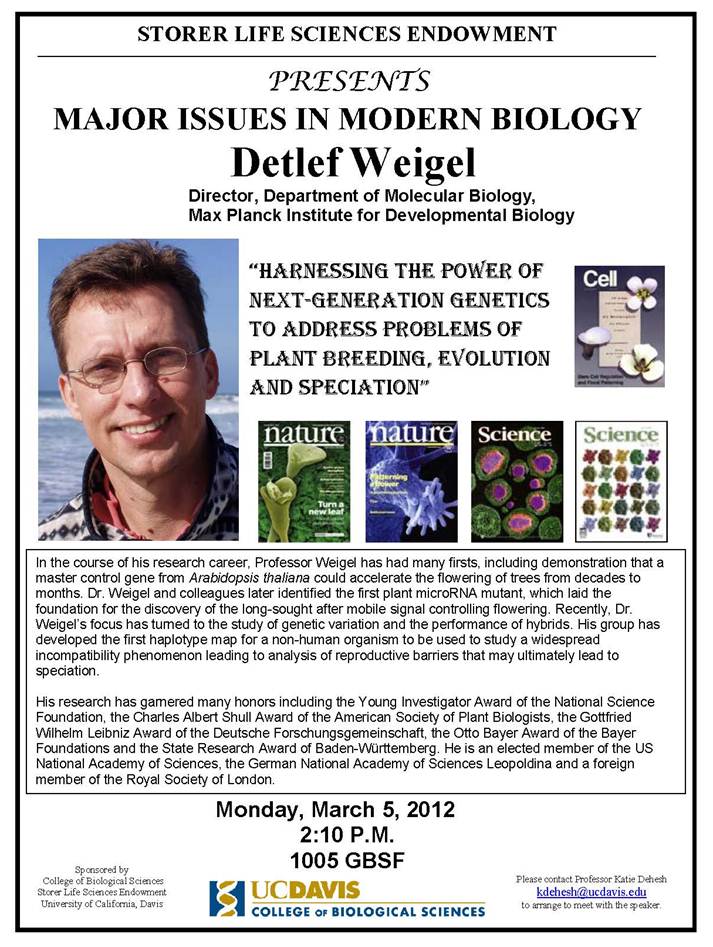
Major Issues in Modern Biology – Dr. Detlef Weigel-Monday, March 5, 2012

Detlef Weigel flyer II.PDF

Nice #openaccess review on the ecology of chemosynthetic symbioses from @chicaScientific & Guus Roeselers

Figure 1 from 10.1007/s00253-011-3819-9. Sediment cross section 
exposing the characteristic Y-shaped burrow dug by S. velum. 
Positioning itself at the triple junction of the Y, the bivalve alternates
 between actively pumping oxygenated water from the upper arms of
 the burrow through the mantle cavity and across the gills and 
accessing reduced sulfur compounds diffusing up from the anoxic 
zones below and pumped through a ventral incurrent opening in the 
mantle. Scale bar equals 2.5 cm

For those who do not know, I got my first taste of microbiology research when I was an undergrad at Harvard and I did my senior/honors research project in the lab of Colleen Cavanaugh. Colleen studied (and in fact still studies) symbioses between invertebrates and chemosynthetic bacteria. The bacteria basically allow these invertebrates to function like plants in many ways. Some of these invertebrates (like the giant tube worms in hydrothermal vents) have lost their mouths and digestive systems and basically live by bringing in high energy chemicals for their symbionts which then make sugars, vitamins, amino acids and other goodies for the host.
Anyway – I am still very interested in these symbioses and have published a few papers on the topic here and there. All that lead in is to simply point everyone out there to a nice new Open Access review paper by Guus Roeselers and Irene Newton: On the evolutionary ecology of symbioses between chemosynthetic bacteria and bivalves. When I first saw the reference in the “Applied Microbiology and Biotechnology” journal I was worried I would not have access to it, but I clicked on the link and discovered it was published using Springer’s version of Open Access. Yippee.  The article is worth a look.

ResearchBlogging.org Roeselers, G., & Newton, I. (2012). On the evolutionary ecology of symbioses between chemosynthetic bacteria and bivalves Applied Microbiology and Biotechnology, 94 (1), 1-10 DOI: 10.1007/s00253-011-3819-9

My favorite new thing/site on the web: Download The Universe

I am completely fascinated by this new site: Download The Universe. It is a group effort from (so far) some 16 science writers. The main goal of the site is summarized in a post from Carl Zimmer who appears to be the instigator in chief of this effort:
“… It is still tough for readers to discover new science ebooks. Traditional book reviews limit themselves to works on paper. Some ebooks may appear in computer magazines, but buried in reviews of laptops and printers. In between, we need a community.
Download the Universe is a step towards that community. It is the work of a group of writers and scientists who are deeply intrigued by the future of science books. (You can find our names and links to our web sites on the right.) Here we review science ebooks–broadly defined, except for ebooks that are just spin-offs of print books. We hope to build up a library of titles that curious readers can browse. Some reviews will be positive, others negative. We welcome your own judgments, and we look forward to vibrant (but civilized) discussions in the comment threads. We will also write essays from time to time about the changes that publishing is undergoing.
As we continue to build Download the Universe, we may change our minds about the scope of its mission. We can’t say what those changes will be. We can only be sure they will be here before too long.”
I confess – I have never read an ebook of any kind – science or not. And I really really love “real” books – I have collected them for years and years. But I think I am going to start on the ebooks thing. And this site is giving me some ideas for what to start with … This site is definitely worth checking out, and keeping an eye on …

In case you didn’t hear – #openness WON – Research Works Act shelved

See this story from infojustice.org: Research Works Act Shelved by Sponsors
This is just awesome news. The act was completely inane.
Hooray for Open Access and Open Science and Openness in general.

John Stewart takes on H1N1 on hypochondriac update

The Daily Show with Jon Stewart Mon – Thurs 11p / 10c
Hypochondriac Update
www.thedailyshow.com
http://media.mtvnservices.com/mgid:cms:item:comedycentral.com:408965
Daily Show Full Episodes Political Humor & Satire Blog The Daily Show on Facebook

Seminar, Thursday March 1: Bruce Rannala – Species Delimination

You are invited to:

Department of Statistics

Graduate Group in Biostatistics

University of California, Davis

STATISTICS COLLOQUIUM

Thursday, March 1st, 2012 at 4.10pm, MSB 1147 (Colloquium Room)

Refreshments: 3.30pm, MSB 1147 (Colloquium Room)

Speaker: Bruce Rannala (Genome Center, UC Davis)

Title: A Bayesian Approach to Species Delimitation

Abstract: Taxonomy is an ancient subject aimed at classifying organisms according to species or higher level groupings. Morphological (physical) features have been used to identify species for centuries. However, some taxonomic groups show great morphological similarities despite their ancient relatedness. This has led to the notion of a "cryptic" species. Recently, there has been much interest in the identification of cryptic species using only genomic sequences. I will provide an overview of a recently developed method that uses a combination of population genetic modeling, phylogenetic inference theory and Bayesian reversible jump Markov chain Monte Carlo to assign posterior probabilities to particular species delimitations. Examples will be presented analyzing sequence data for primates and lizards.

http://www.stat.ucdavis.edu/seminar-030112-rannala

(Data driven life)^10 featuring Larry Smarr @lsmarr

Caution: Brain Dump ahead.

I saw (briefly) Larry Smarr today at a TTI Vanguard Conference on Hacking Life. I missed his talk yesterday unfortunately but after my talk today on microbes he sent me this article: The Patient of the Future – Technology Review.

For those of you who do not know Larry, well, you should get to know him as he is a pioneer in getting to know himself. As background – I have known Smarr for about 7 years now as I have interacted with him over metagenomic analysis.

If you want to know more about Smarr’s background, well, it is amazingly impressive as all heck (see his Wikipedia entry for example). He has been a pioneer in computing, supercomputing, and engineering – and is a member of the National Academy of Engineering as well as the head of CaLIT2.

Anywho, a few years ago Smarr had an epiphany of sorts – he became – well – a bit obsessed with his own personal phenotype. This came in part from medical issues that cropped up in his life but I am sure it also came in part from his nature.  So rather than sit back and let the winds of general indifference from MDs knock him around, he decided to take control. And now he has gather more information about himself than virtually anyone on the planet.

Over the years Larry has told me about some of his explorations of his own personal information.  But I confess I was not really getting the point.  But slowly I have come around to the notion.  One thing that helped move me in this direction was when I went to a party for the release of Thomas Goetz’s book “The Decision Tree.”  (I note – I also ended up losing a dollar bill to Jason Bobe – but that is another story). I got a copy of the book and read it – and this made me realize that technological advances – which are a big part of my work on microbes – are also making it easier for people to gather data about themselves.  Goetz in the book discusses in part how technology can help enable people to engage more in decisions about their health by providing them with more information.

And though I read Goetz’s book it all still seemed a bit abstract to me.  Certainly – more and more people were engaging in what has been called “The Data Driven Life” or the Quantified Self or the Measured Life. And on some topics I know people were recording information quite obsessively (e.g., about sleep wake cycles, or food consumed, or whatever). But what really opened my eyes to the whole notion was a meeting I had with Smarr about a year ago.

I was in San Diego to give a few talks and participate in some meetings about “Beyond the PDF.”  And for my talk at UCSD I told my host(s) that I really did not want too many meetings – I just wanted to meet with a couple of people.  And Larry Smarr was one of them.  I had lunch with Larry and then went to his office where he showed me his data about himself.  Holy crap.  It was completely mind blowing.  In a fascinating way.  And a strange way.  But more fascinating than strange. He had been ordering blood tests, and microbe tests and genetic tests and reading all the literature and then ordering more tests and recording his health status regarding all sorts of things.

And this is when I think it hit me – this is real – this is about specific individual people.  The data is not just a bunch of numbers that a scientist will use to do an in depth study of a person.  This is a person doing an in depth study of themselves.

Going back to the new article about Smarr – it discusses his continuing efforts to learn about his own medical ailments as well as predict and monitor his health condition.  He will dig and dig and dig as much as he can – even more so than the last time I saw him.  For more about Smarr and his self-data question see for example: How one quantified-self patient is working to transform health care and his website which has links to talks, videos, papers, etc.

Here is a recent video of a talk of his: It is clear in this that Smarr is a pioneer.  But he is not alone.  Much more is coming.  With electronic medical records, with cheaper and cheaper sensors, with better data storage and processing tools – many more people will do this.

Of course, data is not knowledge.  I see this issue every day in “metagenomic” studies and in the general and continued overhyping of genomics.  But massive amounts of data gathered smartly and used smartly could really revolutionize medicine. Imagine if we all did this.  Even better – imagine if we all did this AND shared the data.  This notion is in part what the “personal genome” project from George Church is about.  In that project people are releasing their genome data as well as personal medical data openly.  But as far as I know the Personal Genome Project (PGP) is not driving the massive continuous collection of information about the participants in the way of Smarr. I note – after I saw Smarr in San Diego I began to move more towards sharing my own personal data and now, for example, have posted data to the PGP.

Certainly there are challenges ahead.  Privacy for example is a big issue.  Target may be able to infer a lot about ones medical conditions from their shopping patterns, but using that information has risks.  And of course, even if one is not worried about one’s own privacy there are risks.  Information about you can reveal information about others.  This is obvious in terms of genetics – releasing information about yourself does reveal at least probabilities for your relatives.  But it also is true for all sorts of other data.  Your microbes for example, could say a lot about other people you interact with (consider the extreme – finding gonorrhea on ones skin …).

Anyway – just thought it would be good to post about this issue.  Sorry if it rambled a bit – been a bit of a long day.  Now if only I had been recording all my personal health stats all day I could now if, while I was writing this, I was all here or not …


PCR amplification and pyrosequencing of rpoB as complement to rRNA

Figure 1. Number of OTUs as
 a function of fractional sequence difference
 (OTU cut-off) for the 16S rRNA marker
 gene (A) and the rpoB marker gene (B).

Interesting new paper in PLoS One: PLoS ONE: A Comparison of rpoB and 16S rRNA as Markers in Pyrosequencing Studies of Bacterial Diversity

In the paper they test and use PCR amplification and pyrosequencing of the rpoB gene for studies of the diversity of bacteria. Due to the lower level of conservation of rpoB than rRNA genes at the DNA level they focused on proteobacteria. It seems that with a little perseverance once can get PCR for protein coding genes to work reasonably well for even reasonably broad taxonomic groups (not totally new here but I am not aware of too many papers doing this with pyrosequencing). Anyway, the paper is worth a look.

Citation:
 Vos M, Quince C, Pijl AS, de Hollander M, Kowalchuk GA (2012) A Comparison of rpoB and 16S rRNA as Markers in Pyrosequencing Studies of Bacterial Diversity. PLoS ONE 7(2): e30600. doi:10.1371/journal.pone.0030600 ResearchBlogging.org Vos, M., Quince, C., Pijl, A., de Hollander, M., & Kowalchuk, G. (2012). A Comparison of rpoB and 16S rRNA as Markers in Pyrosequencing Studies of Bacterial Diversity PLoS ONE, 7 (2) DOI: 10.1371/journal.pone.0030600

Bay Area Microbiology themed events

Posting this email I received from Chuck Bevins:

Hi everyone. There are two special events coming up that may be of interest. They are both outstanding opportunities, and they are FREE! Don’t miss out.

BAMPS (Bay Area Microbial Pathogenesis Symposium)
The 15th annual Bay Area Microbial Pathogenesis Symposium (BAMPS XV) will take place on Saturday March 24, 2014 at Genentech Hall on the Mission Bay Campus of UCSF from 8:30 a.m. to 5:00 p.m. The keynote speaker this year will be Scott Hultgren, PhD. from Washington University (St Louis). As always, the conference is FREE. Breakfast, lunch, and a wine and hors d’ oeuvres reception will be provided free of charge. This symposium will feature a series of 15 to 30-minute talks by students, postdocs, and PI’s and a poster session at lunchtime by Bay Area researchers in microbial pathogenesis. The conference is FREE, but you "must" register. http://bamps.ucsf.edu<http://bamps.ucsf.edu/> Registration closes March 1, 2012.

If you wish to be considered for a short talk, please upload a one-paragraph abstract and provide a tentative title. The deadline for submitting an abstract is February 24, 2011 (TOMORROW!). If your abstract is not selected for an oral presentation, we will automatically schedule you for a poster presentation. If you wish to present a poster only, please enter the tentative title. The deadline for submission of a poster title is March 1, 2012. If necessary, the title of your poster can be changed.

The Annual Microbiology Student Symposium at UC Berkeley
Please mark your calendars. The 13th annual MSG symposium is scheduled for Saturday April 14th, 2011 from 9am to 4pm (http://pmb.berkeley.edu/news/microbiology-student-symposium). The program will include talks by students, poster presentations, and two keynote addresses: Dr. Eduardo Groisman and Dr. Diane Newfield. Registration will be FREE and location has not been finalized. The symposium registration includes a catered lunch and coffee breaks.

The XIII MSG symposium is an excellent opportunity to interact with microbiology researchers from the entire region. Last year, attendees included 150 students, postdoctoral fellows, and faculty from UC Davis, UC Merced, UC San Francisco, Stanford, twelve departments at UC Berkeley, The Joint Genome Institute, the US Department of Agriculture, and the Lawrence Livermore and Lawrence Berkeley National Labs.

Again, you won’t want to miss these great opportunities!

BAMPS2012.pdf