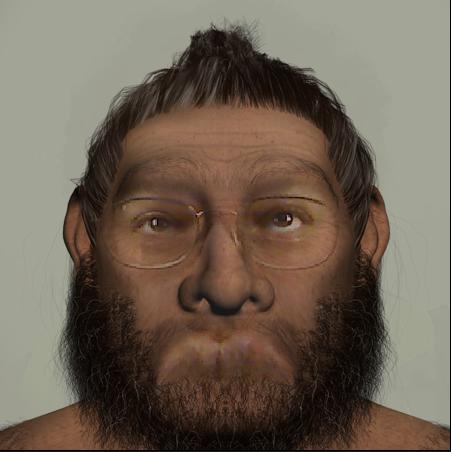
Me, as a Neanderthal

Went to the Smithsonian Museum of Natural History.  Did something there.  And got this email regarding it with a picture attached.  Explanation is below.  Though I think I probably should have taken off my glasses …

Dear Visitor,

Congratulations! You have been transformed into a Homo neanderthalensis, one of the closest relatives of modern humans. Your picture is attached.

As a Homo neanderthalensis, you live between 200,000 and 28,000 years ago in what is now Europe and Asia. You have a very big nose, which helps you survive in cold climates by warming and humidifying cold, dry air. You bury your dead, use simple symbols, and may even speak a language.

Thanks for visiting the David H. Koch Hall of Human Origins at the Smithsonian National Museum of Natural History.

About the exhibit: The David H. Koch Hall of Human Origins offers visitors an immersive, interactive journey through the origins of human beings and the dramatic stories of survival and extinction in the midst of earth’s history of climate change. Learn more at: http://humanorigins.si.edu/

Buy cool stuff: Shop on-line and discover What Does It Mean to be Human? Check back often for more exciting products. http://tinyurl.com/smithsonianstore

Support us! Your contribution will help us meet the challenge of making the latest discoveries in human origins available for all to see. https://support.si.edu/site/Donation2?idb=914659333&df_id=3064&3064.donation=form1

Fun with microbial diversity studies: SitePainter

Nice new tool out there: SitePainter: A tool for exploring biogeographical patterns by Antonio Gonzalez, Jesse Stombaugh, Christian L. Lauber, Noah Fierer and Rob Knight.

I saw the paper and figured I would see if I could get it up and running.

First I downloaded the software from source forge.

Then I uncompressed it and tried to run it.  When I opened the index.html file in Chrom I got a message saying it only worked in Firefox.  So then I opened it in Firefox and I got an error saying it only worked in newer versions of Firefox.  So I downloaded the latest version of Firefox and then finally the tool opened.  I then followed the simple tutorial they have provided and Voila I was up and running in a few minutes

Completely cool.  Going to definitely have to try this out with our own site-variable microbial data.

Art Meets Science at the Keck Center in DC

Some nice science-art on display at the Keck Center where I was for a NAS/IOM meeting today.  Here are some pics.
https://picasaweb.google.com/s/c/bin/slideshow.swf

My kids learn about the center of mass

Movie_on_12-12-11_at_7.46_PM_#2.mov Watch on Posterous

Pluses and minuses if Wikipediafying your database

There is a really interesting article that just came out from Robert Finn, Paul Gardner and Alex Bateman: Making your database available through Wikipedia: the pros and cons.  The article is part of the Nucleic Acids Research Database Issue.

The abstract does a good job of summing up the article

Wikipedia, the online encyclopedia, is the most famous wiki in use today. It contains over 3.7 million pages of content; with many pages written on scientific subject matters that include peer-reviewed citations, yet are written in an accessible manner and generally reflect the consensus opinion of the community. In this, the 19th Annual Database Issue of Nucleic Acids Research, there are 11 articles that describe the use of a wiki in relation to a biological database. In this commentary, we discuss how biological databases can be integrated with Wikipedia, thereby utilising the pre-existing infrastructure, tools and above all, large community of authors (or Wikipedians). The limitations to the content that can be included in Wikipedia are highlighted, with examples drawn from articles found in this issue and other wiki-based resources, indicating why other wiki solutions are necessary. We discuss the merits of using open wikis, like Wikipedia, versus other models, with particular reference to potential vandalism. Finally, we raise the question about the future role of dedicated database biocurators in context of the thousands of crowdsourced, community annotations that are now being stored in wikis.

They discuss many of the worries people have with integrating their database with Wikipedia and go through a few examples including the 11 databases that are part of the NAR Database Issue that are Wikipediafied.

Regarding “vandalism” where inappropriate edits are made by someone the authors here report

” Overall, inappropriate editing is rare for pages related to biology and occurs at very low rates. Since Rfam started to use Wikipedia to manage the textual annotation of RNA families in 2007, ∼1% of all edits have been reverted, by the Rfam curators or the greater Wikipedia community, suggesting that they may be vandalism (2). Similar numbers are presented for the GeneWiki project (3), with these authors estimating that vandalism is observed less than one page view in every 3000, a rate much lower than other articles in Wikipedia.”

They go on to discuss other issues associated with Wikipediafication of a Database including how to best do the integration, how to track changes, and how to leverage the Wikipedia community.  They also discuss how to deal with the fact that Wikipedia does not allow “Original Research” and thus for example a conjecture by a user about some protein function.  They also discuss issues like whether the use of Wikipedia will lead to decreased funding for full time curators (they do not think so).

They conclude

Wikis are undoubtedly changing the way some biological databases operate, providing an established solution to community annotation. Adopting a wiki means that a particular resource is no longer a closed, static resource (between public data releases) that cannot be improved by its users. The challenge is now to get scientists en masse to generate and edit articles. How editors receive credit for their work on the article is unclear. Assuming they work on the subject area, wiki articles provide them an opportunity to showcase their work in context of the field at the very least. Curation of biological data must be crowdsourced if there is any chance to comprehensively annotate the vast datasets that are being generated and the scientific community should feel responsible. Hopefully this article has provoked thoughts as to how a wiki, especially Wikipedia, may work for a resource that you are responsible for or use. The growing number of databases using wikis suggests that they are here to stay, we now face the issue of how to overcome the social engineering required to get everyone involved.

I personally agree with many of their conclusions (e..g,  the issue of credit does not to be worked out better).  There is no doubt that for me this article had the desired effect of provoking me to think a bit more about how Wikis could be used for various projects in which I am involved.

This paper is definitely worth a read.

Other related things worth reading on this topic:

Crosspost from http://microbe.net – fun stuff from Rob Dunn

I am cross-posting this from the microBEnet blog I co-write:
I am enjoying the posts to the Scientific American Blogs by Rob Dunn on his and other Citizen Science project(s) and I thought I would share here.
If you do not know about Rob Dunn’s projects, well, you should.  I am particularly fascinated by “The Wild Life of Your Homes” which relate to the above posts.  He does some other fascinating projects too like “School of Ants” and “Wild Life of Your Body“.  Completely brilliant stuff worth checking out.


Fact Sheet from #UCDavis Administration annotated by some skeptical faculty #OccupyUCDavis

Just got a pointer to this by email and thought some would be interested (not endorsing everything that is there but it is definitely worth a look – the Fact Sheet they are annotating rubbed me the wrong way too).

5 UCD faculty members prepared an annotated version of the “fact sheet” sent by the Chancellor’s office last week: https://sites.google.com/site/realfactsheet/realfactsheet.pdf

This is designed not only to give more of the relevant facts, but also to analyze the quality of communications coming out of the Chancellor’s office. The list of endorsers is at https://sites.google.com/site/realfactsheet/endorsers.pdf

Carl Zimmer on "Who Owns Your Microbes"?

There was an interesting piece by Carl Zimmer in the New York Times a few days ago: Our Microbiomes, Ourselves – NYTimes.com
In the piece Zimmer discusses the issue of who owns your microbiome. This can be considered an extension of the concept of “Who owns your cells?” such as has been discussed in the context of Rebecca Skloot’s HELA book.
My favorite line(s):

Monitoring the bacteria flushed into the sewer system of a town, for instance, might reveal a lot about the entire town’s health. But a regulation requiring permission from every resident of the town would stop the study dead in its tracks

Personally I think none of us own our microbes – since we get them from the world around us and likely share them with millions of others. It would be akin to saying we own genes found in all humans. But there very well may be some person specific alleles in microbes that could in a way be akin to person specific cell lines. Not sure.

Anyway – I think I am going to name all my microbes as a first step in protecting my rights to them …

Kids book of interest: Antarctic Adventure

Just found out about this new kids book about Antarctica: Antarctic Adventure. Hat tip to Jeff Hoffman, a friend who has been on many many scientific field adventures.
From the book web site:

Antarctic Adventure is the story of author/scientist Mak Saito’s research expedition to the Southern Continent. The book is targeted at children age 3 – 7. Simple text and stunning photographs highlight the adventure elements of fieldwork in the Antarctic (helicopters, snow storms, wildlife). Children learn where Antarctica is, what algae are, what glaciers look like, and the names of several different whales and penguins. More generally, they get a sense of what it means to do scientific fieldwork. A “Dear Reader” section at the end of the book goes into more detail about the expedition’s research goals, which involve the importance of algae in global biogeochemical cycles.

I have just bought a copy … will let people know more when I get it but I am guessing it is going to be good …

Me and my girl Annapurna