All microbes, all the time. May the microbes be ever in your favor.
Author: Jonathan Eisen
I am an evolutionary biologist and a Professor at U. C. Davis. (see my lab site here). My research focuses on the origin of novelty (how new processes and functions originate). To study this I focus on sequencing and analyzing genomes of organisms, especially microbes and using phylogenomic analysis
Was at the end of a bike ride to work yesterday and was biking by the UC Davis Vet School when I heard a screeching bird. I was not sure what it was but I knew I had heard something like it before and also that it was not common.
So (1) got off my bike (2) got out my iPhone (3) opened the Merlin App and (4) starting the “Start New Recording” option and very quickly it IDd the bird as a Cooper’s hawk.
So then I got out my camera (I had brought a relatively new travel camera – a Nikon CoolPix) with me on my ride and had been taking pics along the way but put it in my backpack when I got near the Vet School – assuming incoorectly I would not want to take any more pics now that I was close to my office).
And I tried to figure out where the call was coming from. It took a bit but I found the bird and first made a video with my phoen and then took some pics. They are below.
So I got up really early on July 12th to get out and go to Yolo Bypass to go for a hike before it got too hot. The weather prediction was for it to get to above 110 °F so I really wanted to get out early. And I was really looking forward to see what creatures were out early in the AM
I left my house jsut before 6 and the sun had already risen but was quite orange still.
Possibly A Blue Grosbeak Seen on the Way to Yolo Bypass
And then when I got there, alas, the gate was closed, even though it is supposed to be opened at sunrise.
Gate at Yolo Bypass Closed
There was also a woman there in her car waiting to get in. We chatted a bit. She was an artist, from Canada, and was hoping to get in early because the lighting would be nice. She told me about her dogs (that were not with her) and her family. We say a few interesting critters from the levee road outside the gate including a mink. I did not get a picture of the mink alas. But I did get a pic of a hawk.
We saw some pickup trucks driving by that we hoped would be someone to open the gate but after 20 or so minutes I decided I wanted to go SOMEWHERE to go for a hike and was not going to wait for the key person. So I headed off to the Davis Wetlands. Not as much shade there and not really where I wanted to go. But I felt like it was the next best option.
On the drive in to the Wetlands I saw an otter family cross the road (no pics of them). But it seemed to be a good omen. I parked, got my stuff together and headed out for a walk. It was not about 7 AM. And it was already getting pretty warm. And lo and behold, just five minutes into the walk I got a nice sighting of a muskrat, swimming towards me.
And got a little video
And then continued on my walk and got to see some nice birds and got a few good pics of some including these:
My apple watch kept getting annoyed when I stopped to look at birds.
I took a few selfies too …
And on the way back I stopped by the spot where I had seen the muskrat and before I could get my camera ready I startled a beaver (no pics alas). And a few minutes later the muskrat came out.
And then I was off to my car to head home. But on the way out of the wetlands I also saw some deer.
Overall I would say that this was a pretty nice outing. More mammals than I was used to seeing in a day. Mink, otter, muskrat, beaver, and deer. Cool.
And then I headed home. But this was not the end of the story. Because just around sunset my wife said our daugther was a bit bored and had not gotten out all day and I asked if I might be able to take her out to do a quick shopping run. I said sure, espeically since I knew that my daughter was likely willing to do a little drive to look for wildlife afterwards. So we headed out, made a stop to do some quick shopping, and then I asked my daughter if she wanted to drive by the entrance of Yolo Bypass to see if we could catch the bats coming up form under the causeway. See a post I wrote about these bats from 2014 here: https://phylogenomics.me/2014/07/26/bat-tour-at-yolo-basin-wetlands/.
So we headed over to Yolo Bypass, with some trpidation because of the earlier locked gate. But now the gate was not locked although it was likely to be locked shortly since they close up at sunset. And it was just getting to be sunset. So we parked on the little levee road where I had parked in the morning, got out, and lo and behold got to see the bats flying out from the causeway. I made a short video and then my phone battery died so alas I did not make others. Here is that video. My phone makes it look lighter than it was out — it was actually quite dark.
And then when we had enough of the bats we decided to do a little drive around rural areas to see if we could see any wildlife. We do this often, although never before had we done this after sunset. And we did what we always do on drives. We guess what mammal species we might see. I chose opoosum. She chose coyote. And then changed her mind thinking that was too unlikely so she chose skunk. We drove around slowly on some rural roads and saw a lot of bunnies but no other mammals (we see so many bunnies and their relatives around here that we no longer allow them as one of the guesses).
And then on a rural road between Davis and Woodland we hit the jackpot. Juveniles coyotes. OMG. OMG. OMG.. They were so cutre. Got some videos and a few pics (with my cell phone – my real camera does not do well in low light). Actually fumbled quite a bit and missed a lot of the scene but at least caputred some of it. Here are some pics and videos.
We were SO excited about this. Just amazing to see these juvenile coyotes. And even though my daughter had originally picked coyote but then changed her pick to skunk, we both agreed she deserved credit for the original pick. And though we wanted to stay and see if the coyotes came back, we decided to head back home. And then a few minutes later we struck gold.
A mother and juvenile fox. I have never seen a fox around here. And these two were not exceptionally shy so we got good looks.
Made a few movies – the juvenile headed into the brush.
After the juvenile headed into the shrubs the adult stayed around and just sat there. So amazing.
What a day. It went from a possible disaster with Yolo Bypass being closed to a day where I saw a slew of mammals – a mink, two otters, a muskrat, a beaver, two deer, many bats, two juvenile coyotes and a juvenile and adult fox. Just amazing. And my daughter was beyond thrillled.
New data report paper out from my lab and others. Basically this is a report of genome sequences and some other measures such as MLADIMALDI-TOF) of bacteria isolated by NASA from some of their spacecraft (before they were sent to space).
Tran MT, Seuylemezian A, Wright A, Coil D, Eisen J, Guan L. Draft Genome Sequences of Spacecraft-Associated Microbes Isolated from Six NASA Missions. Microbiol Resour Announc. 2023 Feb 22:e0101122. doi: 10.1128/mra.01011-22. Epub ahead of print. PMID: 36840549.
This paper was from a collaboration between my lab (Alonna Wright – who was a PhD student in my lab and who just got her doctorate recently, David Coil – who was my lab manager and is now the Public Health Coordinator at UC Davis- and me) and researchers at the Jet Propulsion Lab (Michelle Tran, Arman Seuylemezian and Lisa Guan).
Abstract: Whole-genome sequencing can be used to better understand and assess the functional abilities of microorganisms isolated from spacecraft hardware and associated surfaces for planetary protection (PP) purposes. We sequenced 191 isolates from 6 spaceflight missions with PP requirements and identified them using Illumina-based sequencing methods and matrix-assisted laser desorption ionization–time of flight (MALDI-TOF) mass spectrometry.
New preprint out on from the Eisen Lab and others. This is from a collaboration between David Coil, Heather Bischel, Karen Shapiro, Randi Pechacek, Roque G. Guerrero, Minji Kim, and Rogelio Zuniga-Montanez (first author) at University of California, Davis.
It is about environmental monitoring for SARS-CoV-2 in schools and, well, in part about how difficult this is.
The challenge of SARS-CoV-2 environmental monitoring in schools using floors and portable HEPA filtration units: Fresh or relic RNA?
Abstract:
Testing surfaces in school classrooms for the presence of SARS-CoV-2, the virus that causes COVID-19, can provide public-health information that complements clinical testing. We monitored the presence of SARS-CoV-2 RNA in five schools (96 classrooms) in Davis, California (USA) by collecting weekly surface-swab samples from classroom floors and/or portable high-efficiency particulate air (HEPA) units. Twenty-two surfaces tested positive, with qPCR cycle threshold (Ct) values ranging from 36.07–38.01. Intermittent repeated positives in a single room were observed for both floor and HEPA filter samples for up to 52 days, even following regular cleaning and HEPA filter replacement after a positive result. We compared the two environmental sampling strategies by testing one floor and two HEPA filter samples in 57 classrooms at Schools D and E. HEPA filter sampling yielded 3.02% and 0.41% positivity rates per filter sample collected for Schools D and E, respectively, while floor sampling yielded 0.48% and 0% positivity rates. Our results indicate that HEPA filter swabs are more sensitive than floor swabs at detecting SARS-CoV-2 RNA in interior spaces. During the study, all schools were offered weekly free COVID-19 clinical testing. On-site clinical testing was offered in Schools D and E, and upticks in testing participation were observed following a confirmed positive environmental sample. However, no confirmed COVID-19 cases were identified among students associated with classrooms yielding positive environmental samples. The positive samples detected in this study appeared to reflect relic viral RNA from individuals infected before the monitoring program started and/or RNA transported into classrooms via fomites. The high-Ct positive results from environmental swabs further suggest the absence of active infections. Additional research is needed to differentiate between fresh and relic SARS-CoV-2 RNA in environmental samples and to determine what types of results should trigger interventions
And then she isolated bacteria from the soy milk and from some blue tofu in her fridge, identified them, did experiments to see if these isolated bacteria could cause soy milk to turn blue, found some that did, sequenced their genomes, and analyzed them to show that these ones had similar properties to other bacteria known to cause blue discoloration of food products. A truly remarkable piece of work.
And thanks to Guillaume Jospin and Harriet Wilson who helped with the work and all the people in my lab and via social media that encouraged and supported Marina along the way.
Post-Doc Position available in Ecology of Emerging Infectious Disease
The Epicenter for Disease Dynamics at the One Health Institute in the School of Veterinary Medicine at UC Davis is seeking a post-doctoral researcher interested in the impacts of environmental change on the epidemiology, ecology and evolution of zoonotic diseases. Activities will focus on a new National Science Foundation Ecology and Evolution of Infectious Diseases project “Impacts of Rapid Landscape Change and Biodiversity on Virus Host Specificity”.
Primary responsibilities relate to both theoretical and data-informed modeling of virus evolution and transmission across landscape changes in Southeast Asia. This is a 3-year post-doctoral position, expected to begin January 2022 based at UC Davis with opportunities for collaboration and co-mentorship across the PIs on this project including Christine Kreuder Johnson (UCD), Tierra Smiley Evans (UCD), Lark Coffey (UCD), Michael Boots (UC Berkeley), and Rebekah Kading (CSU).
Project Overview:
This study investigates the impacts of deforestation, landscape change, and biodiversity on virus characteristics that determine zoonotic potential, including virus “host plasticity”, which is the diversity of host species a virus can infect in nature. Findings from this research will contribute to ecological theory on the impact of environmental changes on microbial adaptation, with practical implications for management of ecosystems at high risk for pathogen spillover. Investigations will evaluate host range of bat-borne coronaviruses and mosquito- borne arboviruses (flaviviruses, alphaviruses and bunyaviruses) in the biodiverse tropical forests of Southeast Asia. Activities will include theoretical and computational modeling, underpinned by field investigations and in vitro experiments, to develop data and model driven insights into the role that mosquito vectors play in constraining or expanding virus host plasticity and genetic diversity. Characterization of bat-borne coronaviruses and host affinities in an ecosystem with SARS-CoV-related viruses will further inform on coronavirus evolution and emergence of zoonotic potential. This position will conduct research in a team science setting that is especially relevant to development of an evidence-base on the relationship between environmental change, biodiversity, disease outbreaks, and pandemics to underpin public policy.
65% SCIENTIFIC RESEARCH
Contribute to designing field studies to investigate virus host plasticity, evolution and transmission across forest gradients in Southeast Asia;
Develop methods and analyses to evaluate surveillance strategies to detect zoonotic pathogens at high-risk interfaces for disease emergence;
Analyze metadata on emerging zoonotic diseases, high-risk human-animal contact, and ecological risk and conduct data analyses needed to train models for emerging disease prediction;
Develop advanced analytical techniques and associated programming capabilities for infectious disease modeling, predictive frameworks, and social network analyses;
Conduct independent research and produce high quality scientific manuscripts related to biosurveillance and the ecology of emerging infectious disease.
35% PROJECT IMPLEMENTATION
Provide disease expertise, technical support, data analyses, and data-sharing tools for zoonotic disease prediction and biosurveillance projects;
Provide epidemiologic expertise to field staff in other countries on study design, data collection, data management, data analysis and interpretation, and publication preparation;
Contribute to regular summaries of surveillance data, assist in development of data collection and data management tools; and ensure open communication and coordination with international partners in project implementation;
Travel to international field sites to work with field staff, participate in field activities, and attend scientific meetings as needed.
Skills needed:
Background in infectious disease epidemiology or disease ecology and strong quantitative skills in biostatistics, epidemiology, and mathematical modeling with knowledge of animal health and wildlife disease. Experience with statistical software including R and STATA, as well as ability to write code for programming, including Python. Experience conducting independent, applied scientific research on infectious diseases with a promising publication track record.
Education:
PhD in biology, ecology, epidemiology, or related life-science (required)
Application:
Please email cover letter and CV by September 30th to:
Tierra Smiley Evans, DVM, PhD and Christine Kreuder Johnson, VMD, PhD EpiCenter for Disease Dynamics | One Health Institute
School of Veterinary Medicine
University of California
Davis, CA 95616
530-752-1238
Posted video of a recording I made of a talk for BIATA2021 meeting. Phylogenomic Case Studies: The Benefits (and Occasional Drawbacks) of Integrating Evolutionary and Genomic Studies
Co-First Authors: Jay T. Osvatic and Laetitia G. E. Wilkins
Co-Last Authors: Jillian M. Petersen and Benedict Yuen
Other authors: Lukas Leibrecht, Matthieu Leray, Sarah Zauner, Julia Polzin, Yolanda Camacho, Olivier Gros, Jan A. van Gils, Jonathan A. Eisen
Significance (from the paper)
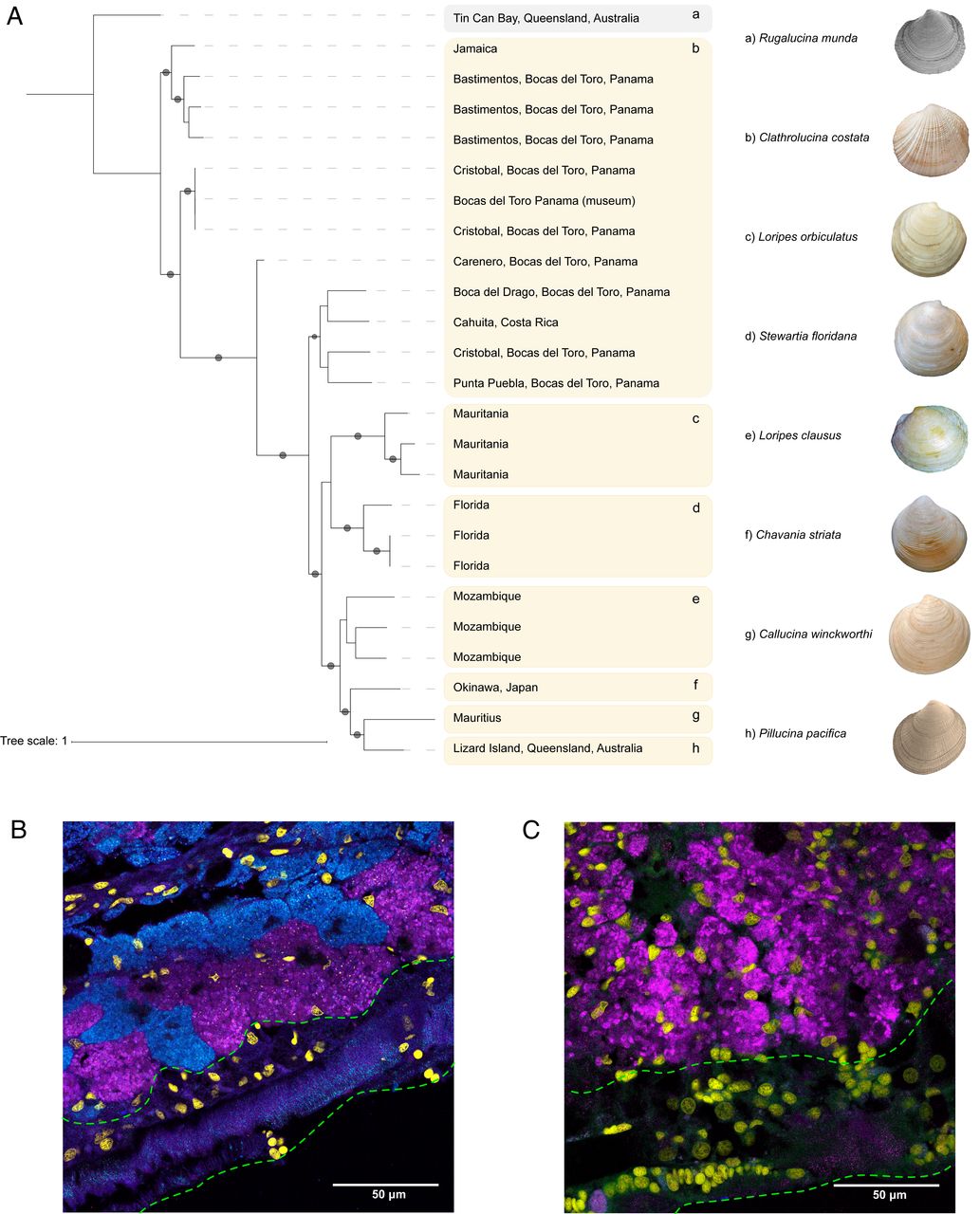
Knowledge of host–symbiont biogeography is critical to understanding fundamental aspects of symbiosis such as host–symbiont specificity. Marine animals typically acquire their symbionts from the environment, a strategy that enables the host to associate with symbionts that are well-suited to local conditions. In contrast, we discovered that in the chemosymbiotic bivalve family Lucinidae several host species distributed across the globe are all associated with a single cosmopolitan bacterial symbiont. The genetic cohesiveness of this global symbiont species is maintained through homologous recombination across its extensive geographical range. The remarkable flexibility in the lucinid association is advantageous to both host and symbiont as it increases the likelihood of locating a compatible partner across diverse habitats spanning the globe.
Abstract (from the paper)
In the ocean, most hosts acquire their symbionts from the environment. Due to the immense spatial scales involved, our understanding of the biogeography of hosts and symbionts in marine systems is patchy, although this knowledge is essential for understanding fundamental aspects of symbiosis such as host–symbiont specificity and evolution. Lucinidae is the most species-rich and widely distributed family of marine bivalves hosting autotrophic bacterial endosymbionts. Previous molecular surveys identified location-specific symbiont types that “promiscuously” form associations with multiple divergent cooccurring host species. This flexibility of host–microbe pairings is thought to underpin their global success, as it allows hosts to form associations with locally adapted symbionts. We used metagenomics to investigate the biodiversity, functional variability, and genetic exchange among the endosymbionts of 12 lucinid host species from across the globe. We report a cosmopolitan symbiont species, Candidatus Thiodiazotropha taylori, associated with multiple lucinid host species. Ca. T. taylori has achieved more success at dispersal and establishing symbioses with lucinids than any other symbiont described thus far. This discovery challenges our understanding of symbiont dispersal and location-specific colonization and suggests both symbiont and host flexibility underpin the ecological and evolutionary success of the lucinid symbiosis.
Acknowledgements (from the paper)
We thank Gustav Paulay (FLMNH, Gainesville, FL), Amanda Bemis, and John Taylor (NHM, London) for providing preserved samples. John Taylor also provided high-resolution images of lucinid clams for Fig. 2. We thank Liz Hambleton (University of Vienna), Miriam Weber, Christian Lott, Boris Unger, Dorothée Makarow, Natalie Elisabeth (University of California, Berkeley), Diana Chin, Tim Oortwijn, and Arthur Curry for providing fresh samples. We also thank Thalassa for 300 million y of sheltering lucinids. We are grateful to Stephanie Markert for providing access to the proteomics data, Ipek Yamin Meric and Nora Grossschmidt for helping with DNA extractions, Marina DeLeón for help with fieldwork and travels in Costa Rica, Cassandra Ettinger for early discussions of the study, and Guillaume Jospin for support with the bioinformatic analyses. We thank Xavier Didelot for discussions on the recombination analysis. L.G.E.W. was supported by Grant GMBF5603 from the Gordon and Betty Moore Foundation (J.A.E. was Principal Investigator on the same grant). The work was also supported by the European Research Council Starting Grant EvoLucin and a Vienna Research Grant for Young Investigators from the Vienna Science and Technology Fund (WWTF, VRG14–021) and the Austrian Academy of Sciences. Sequencing was carried out at the DNA Technologies and Expression Analysis Cores at the University of California, Davis Genome Center (supported by NIH Shared Instrumentation Grant 1S10OD010786-01), the Biomedical Sequencing Facility at CeMM (https://www.biomedical-sequencing.org/) in Vienna, Austria, and at the Joint Microbiome Facility (JMF) of the Medical University of Vienna and the University of Vienna (project ID 1911-1). Thanks to Petra Pjevac and Gudrun Kohl for sample processing at JMF. The gill embedding was performed by the Histopathology Facility at Vienna BioCenter Core Facilities, a member of the Vienna BioCenter, Austria.
Funding: Gordon and Betty Moore Foundation (for the part from my lab at least). Part of a collaboration with STRI.





 Jonathan Eisen's Lab