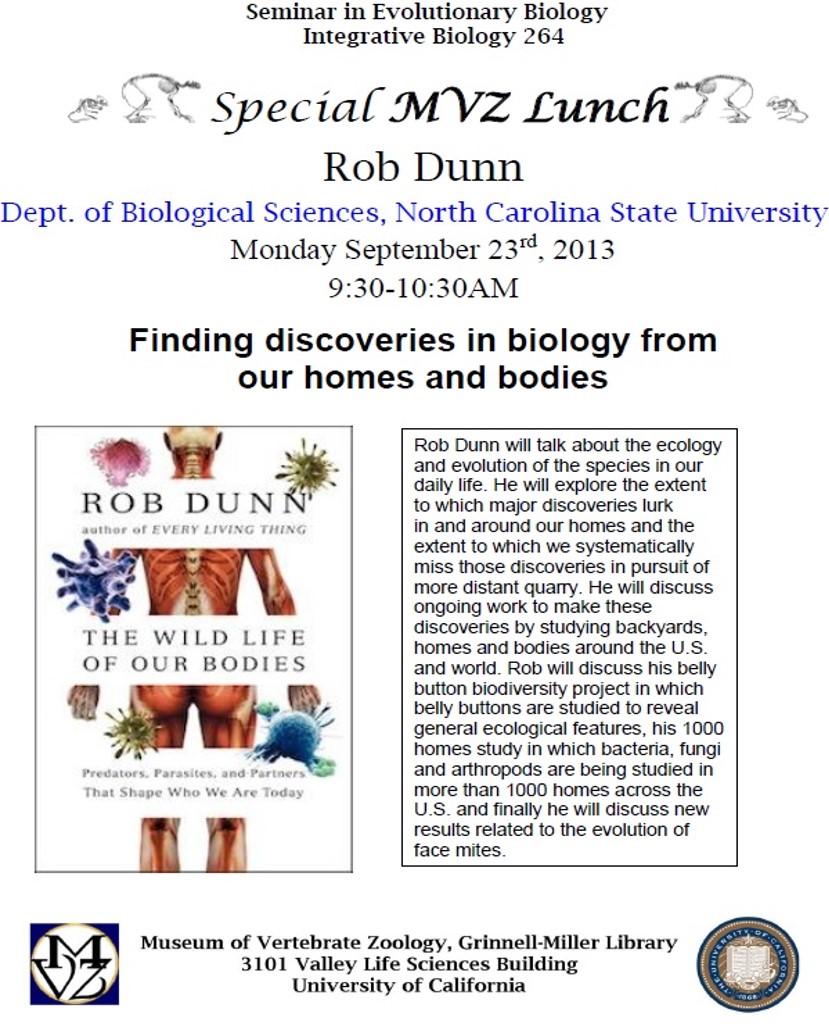
At UC Berkeley 9-23 9:30 AM: Rob Dunn “Finding Discoveries in Biology from Our Homes and Bodies”

Got this by email and thought it would be of interest:
Tenure Track Faculty
Microbiology
The Department of Biology at California State University San Bernardino invites applications for a tenure track position at the rank of assistant professor in the area of microbiology. The successful applicant will develop an independent research program and is expected to excel in teaching courses related to microbiology, medical microbiology, microbial ecology, or immunology at the undergraduate and M.S. levels. Candidates must have a record of published research and show potential for developing and sustaining independent, externally funded research involving both undergraduate and M.S. students. Candidates must have a Ph.D., preferably in the biological sciences; postdoctoral experience is desirable. Application deadline is 1 November 2013, but applications will be accepted until the position is filled. Submit curriculum vitae, statement of research accomplishments and goals, statement of teaching philosophy, and three letters of reference to:
Dr. David Polcyn, Chair
Department of Biology
Attn: Microbiology Faculty Search
California State University
5500 University Parkway
San Bernardino, CA 92407
(909) 537-5305
Email: dreynold@csusb.edu
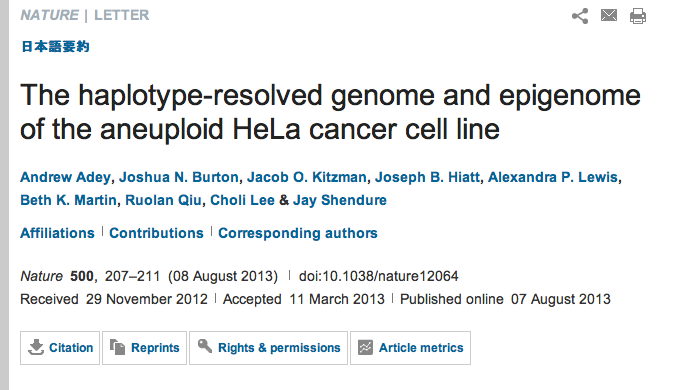
This is just fucking ridiculous. As I have written about many many times – Nature Publishing Group many years ago promised to make papers reporting genome sequence data freely available. They do not generally live up to this promise well. See for example

Forwarding this:
Dear Colleagues,
Please find attached an announcement regarding an exciting career opportunity on the Microbiota at the Global Health Institute, EPFL, Switzerland.
I would be grateful if you would forward it to the members of your Institution.
With best regards,
Stewart Cole
Global Health Institute
EPFL, Switzerland
Faculty Position in Microbiota of the Gut.pdf
Heard an interesting story on copyright termination on NPR last night: Taking Back ‘Funkytown’: Songwriters Prepare For A Custody Battle By Joel Rose. This in turn led me to a New York Times article on the same general topic: A Copyright Victory, 35 Years Later – NYTimes.com.
The gist of these stories is that it turns out UC Copyright law has a “termination” provision which allows artists / writers / etc to terminate copyright agreements that they made for work they produced. This is allowed 35 years after the copyright was assigned. And many musicians are using this provision of copyright law to reacquire some works they made three and a half decades ago.
So – I am asking the world out there – could this same provision be applied to scientific or academic works? Would this be a way to move a lot of material that is behind a wall back into the hands of authors and/or into the public domain? I am looking into doing this with work published by my father as a test case (as part of my long struggle of Freeing My Father’s Publications (since termination rights apparently transfer to family members if the holder passes away as my dad did in 1987).
So – anyone out there know if this termination has been used for scientific or academic works?
UPDATE: Other reading
In this guest post (thank you Jonathan!) I wanted to tell the story behind a paper that my colleagues and I published two weeks ago in PLoS ONE. The story also offers an opportunity to talk about what role, if any, a middle author can play in a scientific study.
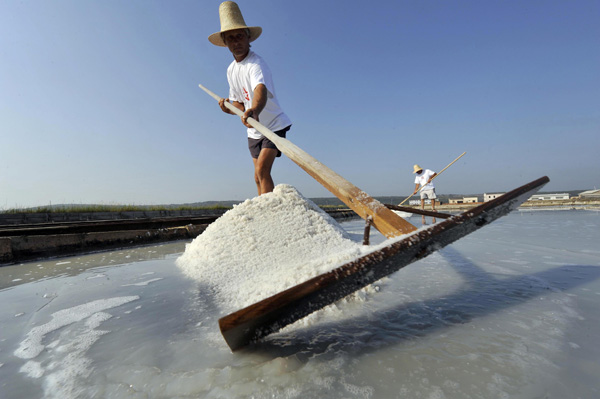 |
| A worker harvests sea salt in the Secovlje salterns, July 17, 2010. Some 2600 tons of salt is expected to be produced during the two and a half month season at the salterns.(Xinhua/Reuters Photo) |
I hadn’t heard of Hortaea until I started googling around looking for a yeast extremophile that I can grow in the lab to dissect out its nucleosomes to ask questions regarding nucleosome occupancy and transcription in the face of extreme environments. Turns out it was not a crazy idea–
13 years ago a peculiar black yeast Hortaea werneckii was isolated from its natural habitat: waters containing so much salt, it would kill most living organisms instantly. Since then, two small (but enthusiastic) Slovenian groups have tried to understand its halotolerance. This demanded field trips to the beautiful Slovenian coast, but also a lot of hard work and inventiveness to optimizing protocols used for other organisms – and to do it on a low budget. The first important obstacle was actually cultural – to persuade the scientific community that such extreme yeast even exists in nature! You can see it below. We now have ample evidence as Hortaea has been isolated from many seawater-related environments, saline lakes, but also from surface layers of tropical microbial mats in salterns and even from spider webs in Atacama Desert caves. All these different Hortaea strains are now waiting in their freezer (the Ex culture collection) to be analyzed.
 |
| Hortaea werneckii growing happily on 2M salt. |
The figure below summarizes what was known about halotolerance of Hortaea before the genome sequence was decoded. In brief, high salinity is detected by sensors of the HOG signaling pathway (green arrows), which modulate the expression of salt-responsive genes (underlined green). The expression of other genes also varies; genes with higher expression at high salinity are written in red, repressed genes in blue). The impact of a hyperosmolar environment is countered by increasing the energy supply to drive energy-demanding processes such as export of Na+ and H+, import of glycerol andthe synthesis of compatible solutes. Melanization of the cell wall reduces the leaking of solutes from the cells and restructuring of membrane lipids helps preserve the integrity of the cells. Read this paper if you want to know more: Gostinčar et al, Adv Appl Microbiol. 2011;77:71-96 .
 |
| Gostinčar et al, Adv Appl Microbiol. 2011;77:71-96 |
This critter, as our recent paper reports, is as interesting genotypically as it is phenotypically. The full genome sequence reported in the PLoS ONE paper shows that genome size is 51mB quite a bit larger than its closest relatives, and given the number of gene models detected (20,000!), for all intents and purposes it looks like Hortaea underwent whole genome duplication last weekend!
Piquing my interest, I immediately started searching for the the genome sequence to have a reference to map nucleosome sequencing reads. Turns out, I had requested the strain from Metka years ago, only to find that one of our lab mates, Uros, with whom I was collaborating at the University of Toronto, had performed some of the groundwork on Hortaea for his PhD. But the network connections don’t stop here, I moved to the University of British Columbia last year, and as it happened Hortaea is popular in Vancouver too! Our new colleagues at UBC were working together with the Slovenian team on sequencing and analyzing the Hortaea genome. In fact, the collaboration started in 2005, catalyzed by a poster at the Budapest FEBS conference were Metka, at that time still a PhD student, and Ivan Sadowski started a discussion about the interesting phenotypic switch that Hortaea undergoes between yeast and filamentous forms. So, by virtue of a convergence of curiosity, good luck and generous collaborators I had the good fortune of being an active participant in the study.
So how does this have anything to do with what a middle author does or doesn’t do on a manuscript? And why do I care?
The genome sequence offers an exciting new start in studies of Hortaea werneckii. Going forward, the Slovenians want to study its transcriptome and proteome in response to increasing salinity. Preparing knock-out mutants is also a must, to find key genes important for halotolerance. We definitely want to take a closer look at all those cation transporters and their functions. It would also be fun to find its mating partner in one of those frozen Hortaea samples. And now that the genome sequence is available to everybody, the research on this extremely interesting species may start to gain more appeal even to researchers beyond the two stubborn Slovenian groups.
Although I might not get to Slovenia in the foreseeable future, I wouldn’t be surprised if one of my graduate students will meet up with the group at an upcoming yeast meeting. This particular student is dragging our lab into evolutionary genomics by trying to see if he can’t get Hortaea to lose some of its genome in long-term culture (I can’t help but think of “Amadeus” where Salieri is telling Mozart that the composition is fine but it has too many notes….). I’m sure the results will be surprising, and am also encouraged to see what our future collaboration will bring.
Listened to a nice show on KQED this AM on my bike ride in to work (note – I listen with one earplug in, and one ear free to hear the world around me, and I listed on relatively low volume …). We still need to do so much to make STEM fields and related fields more diverse …
Inspiring Girls and Women to Code:
http://www.kqed.org/assets/flash/kqedplayer.swf

Bay Area Malaria Meeting (BAMM)
RSVP by phone: monroe
Come join the ‘updated’ local Malaria Meeting to share your research, policy work, ideas on eliminating malaria, etc. Make your voice heard, network, collaborate and have fun!
Date: Tuesday, September 17th, 2013
Location: Amyris Inc, 5885 Hollis St., Emeryville
Street parking available, accessible by Emery-Go-Round & Amtrak
Time: 6 – 8pm
Format :1- (30 min) Keynote, 2- (15 min) presenters, 30min network
The Key to Malaria Control and Elimination,
Roly Gosling,UCSF- GHG
The Effects of Deforestation and Climate Change on Avian Malaria, Ravinder Seghal, SFSU
Light Refreshments will be served
Sponsored by:

http://berkeley-oakland.mosquitosquad.com/
I guess today is fecal transplant day. So why not a little news story from Health2Fit about families that share everything …
Interesting discussion of Fecal Transplants is this letter from the American Hospital Association to HHS about Medicaid / Medicare: Marilyn Tavenner September 6, 2013 Page 1 of 33 September 6 …
Key text is below:
The CPT manual instructions require that the actual instillation or fecal microbiota transplant be coded separately using CPT 44799 for either oro-nasogastric tube or enema. Additional instruction in the CPT manual identifies that all laboratory testing provided for the patient is to be reported separately. Based on this instruction and the intent of the CPT code 44705, this is an add-on or “list separately in addition to the primary procedure,” which would be the instillation procedure, e.g., the oro-nasogastric tube or enema.
By contrast, effective Jan. 1, 2013, CMS created HCPCS code G0455, Preparation with instillation of fecal microbiota by any method, including assessment of donor recipient, and assigned it to APC 00340, with a payment of $49.64. The payment for code G0455 appears only to cover the work related to the preparation of the donor fecal microbiota specimen, which may also include the review of the donor lab results for presence of pathogenic microbes. However, the payment does not appear to recognize the work to prepare the patient for the implantation or the instillation of the donor microbes, or the work performed and supplies consumed during the instillation procedure. The additional cost to perform this portion of the procedure would include the supplies, e.g., nasogastric tubes (approximately $5 each), enema tubes (approximately $25 each), other disposables including drapes, gloves, gowns (approximate cost of $20); the overhead expenses are not considered in these additional costs. In addition, if the microbiota instillation is performed via colonoscopy or EGD, the payment does not recognize the cost of the endoscopic procedure. This is demonstrated by the CPT codes and corresponding APC payments as follows:


