Mesquite "A modular system for evolutionary analysis" v3.0 released from Team Maddison

Just found out about this on Facebook via Rod Page: Mesquite V3.0  has been released.  Mesquite is from Team Maddison (Wayne and David).  I have been using their software since 1987 when I took Stephen Jay Gould’s course at Harvard and they were TAs for the course demoing an early version of MacClade.   Lots of nice features and it is available in Mac, Unix/Linux, and Windows versions.   They describe “What Mesquite Does” on their Wikispaces site in the following way:

Mesquite is software for evolutionary biology, designed to help biologists manage and analyze comparative data about organisms. Its emphasis is on phylogenetic analysis, but some of its modules concern population genetics, while others do non-phylogenetic multivariate analysis. Because it is modular, the analyses and management features available depend on the modules installed. Here is a brief overview of some of Mesquite’s features. See also a more complete outline of features, and the Mesquite Project Youtube channel, with instructional videos helping you learn Mesquite.

Despite Mesquite’s broad analytical capabilities, the developers of Mesquite find that we use Mesquite most often to provide a workflow of data editing, management, and processing. We will therefore begin there.

Definitely worth a look.

NIH Announces Revised Genome Data Release Policies

Just got notified of this by the UC Davis Med. School grants administration: NOT-OD-14-124: NIH Genomic Data Sharing Policy.  Lots of interesting things in here including a summary of the comments that they received on the draft policy.

I have copied some of the more interesting and relevant bits below:

  • Sharing research data supports the NIH mission and is essential to facilitate the translation of research results into knowledge, products, and procedures that improve human health.  NIH has longstanding policies to make a broad range of research data, in addition to genomic data, publicly available in a timely manner from the research activities that it funds. 
  • The public comments have been posted on the NIH GDS website. http://gds.nih.gov/pdf/GDS_Policy_Public_Comments.PDF
  • The statement of scope remains intentionally general enough to accommodate the evolving nature of genomic technologies and the broad range of research that generates genomic data.
  • Several comments were submitted by representatives or members of tribal organizations about data access.  Tribal groups expressed concerns about the ability of DACs to represent tribal preferences in the review of requests for tribal data.
  • The GDS Policy expects that basic sequence and certain related data made available through NIH-designated data repositories and all conclusions derived from them will be freely available.  It discourages patenting of “upstream” discoveries, which are considered pre-competitive, while it encourages the patenting of “downstream” applications appropriate for intellectual property.  
  • NIH expects investigators and their institutions to provide basic plans for following this Policy in the “Genomic Data Sharing Plan” located in the Resource Sharing Plan section of funding applications and proposals.  Any resources that may be needed to support a proposed genomic data sharing plan (e.g., preparation of data for submission) should be included in the project’s budget. 
  • Large-scale non-human genomic data, including data from microbes, microbiomes, and model organisms, as well as relevant associated data (e.g., phenotype and exposure data), are to be shared in a timely manner. 

Could be interesting: @jennomics “Biogeography of microbial communities associated with seagrasses”

Postdoc Seminar Series presents:

Jenna Morgan Lang

Eisen lab, Genome Center

Biogeography of microbial communities associated with seagrasses

1022 Life Sciences

12:10 pm on Tuesday 2nd September

Simons Early Career Investigator in Marine Microbial Ecology and Evolution Awards (RFA)

image_gallery?img_id=210048&t=1256150794819
Simons Foundation Logo
28 August, 2014 • Announcement from the Simons Foundation
The Simons Foundation is now accepting applications for its Simons Early Career Investigator in Marine Microbial Ecology and Evolution Awards. The deadline for receiptof letters of intent (LOI) is October 15, 2014, 5:00 p.m. Eastern Time.

The purpose of these awards is to launch the careers of outstanding investigators who use quantitative approaches to advance our understanding of marine microbial ecology and evolution. Investigators will focus directly on marine microbes or on fundamental problems that are highly relevant to understanding marine microbial ecosystems. Applicants may currently be working in a related field, but must submit an innovative proposal for research that will advance the understanding of marine microbial ecology or evolution.

Among other eligibility requirements, applicants must have significant training in a quantitative field and have held an independent position (tenure-track or equivalent) for at least three years and no more than eight years.

•••

The Simons Foundation’s mission is to advance the frontiers of research in mathematics and the basic sciences.

You are currently subscribed to receive Simons Foundation updates. If you wish to unsubscribe you may do so here.

image_gallery?img_id=210048&t=1256150794819
160 Fifth Avenue, 7th Floor, New York, NY 10010 • 646.654.0066www.simonsfoundation.org
Having trouble viewing this e-mail? Open it in a web browser.
image_gallery?img_id=210048&t=1256150794819

UC Davis Genome Center job: #Bioinformatics Core Manager #Genomics

You know you want this job:

The UC Davis Genome Center integrates experimental and computational approaches to address

key problems at the forefront of genomics. The Center is housed in a new research building with state-of-the-art computational and laboratory facilities. The Center comprises 23 research faculty and five technology service cores that serve the whole campus. The faculty and

service cores contribute to an internationally recognized program in genomics research at Davis, building on and enhancing the unique strengths and unmatched breadth of the life sciences on the UC Davis campus.

The Bioinformatics Service Core provides a broad range of services in computational biology and bioinformatics on a recharge basis to diverse research groups on campus. The Core is responsible for providing consulting, software and access to computational resources to address needs in all areas of bioinformatics, including data acquisition and curation, database construction and integration, sequence analysis, molecular structure and network analyses, expression profile analysis and statistics.

The Genome Center invites applications for the position of
Bioinformatics Core Manager. The incumbent will be responsible for the day-to-day running of the Bioinformatics Service Core. This includes but is not limited to management of staff and computational
infrastructure and budgetary aspects of the core. The manager will be responsible for ongoing assessment of computational needs, including staff, hardware, software and databases required to perform the multiple types of bioinformatics analyses for cutting- edge genomics research. The manager also will be responsible for recruiting and training staff, assessing the campus-wide needs for bioinformatics services and prioritizing their provision, representation of the Genome Center at scientific conferences and the writing and submission of grant proposals to maintain the core with state-of-the-art resources.

This position requires a Ph.D. or equivalent in a relevant area, such as Computer Science, Statistics, Applied Mathematics or Computational or Mathematical Biology. Applicants should have experience in the management of a production bioinformatics facility and broad technical knowledge sufficient to supervise technical staff, troubleshoot problems, acquire and maintain hardware, refine bioinformatics approaches, and advise faculty and their research groups. The position will be open until filled. Consideration of applications will begin October 1, 2014. Applicants should apply on line at
https://recruit.ucdavis.edu/apply/JPF00320

Further information about genomics and bioinformatics at UC Davis is available at http://www.genomecenter.ucdavis.edu .

The University of California is an affirmative action/equal opportunity employer
Bio Core Manager Advert 8-2014.pdf

Post doc at #UCDavis USDA on metagenomics to study possible causes of a “mysterious”, rapidly emerging walnut canker disease

Postdoc RA-14-018-HR Browne DCA.pdf

Job Ad: Macquarie University faculty positions in Synthetic Biology and Bioinformatics & More

Got this by email:

Dear Colleagues

Macquarie University is currently advertising several faculty positions in synthetic biology, bioinformatics and microbiology, if you know anyone who would be interested please encourage them to apply. The advertised positions consist of:
– 3 lvl B/C continuing faculty positions (2 in Synthetic Biology and 1 in Bioinformatics)-
http://jobs.mq.edu.au/cw/en/job/494553/lecturersenior-lecturer-level-bc-in-synthetic-biology-research-fellow-level-b-in-synthetic-biology-lecturersenior-lecturer-level-bc-in-bioinformatics – 1 lvl B continuing faculty position in Microbiology-
http://jobs.mq.edu.au/cw/en/job/494581/lecturer-in-microbiology

Lvl B/C faculty positions would approximately be the equivalent of Assistant Professor level in the US system, i.e., junior faculty positions

Additionally, we have two Research Fellow positions available as part of the Yeast 2.0 synthetic biology project
(http://mq.edu.au/thisweek/2014/06/02/yeast-2-0-synthetic-biology-project-launched/#.U_K54mNeJzU). We’re particularly interested in candidates with a background in yeast genetics for these 2 positions.
Please contact me if anyone has any questions.
Yours sincerely,

Ian

A Celebration of Kevin Rice: Plant Ecology, Evolution, and Conservation Symposium: 5 September 2014

Received this by email:

Dear Colleagues

On 5 September 2014 a 1-day research symposium will take place on the UC Davis campus.

This symposium celebrates the career and research themes of Dr. Kevin Rice (retiring in 2014 from UC Davis) by highlighting innovative scientific approaches to answer fundamental questions and solve practical problems in conservation biology, restoration ecology, and invasion biology. Speakers represent diverse study systems to explore the evolutionary ecology of natural plant populations, and will present results that will inform future efforts to study adaptation and conserve native communities.

Please join us.

DATE: 5 September 2014
LOCATION: UC Davis

REGISTRATION: http://ucanr.edu/survey/survey.cfm?surveynumber=3D13084

This symposium is free of charge.

SPEAKERS

Sally Aitken
Spencer Barrett
Nancy Emery
Elizabeth Leger
Richard Mack
John McKay
Kevin Rice
Annie Schmitt
Jason Sexton
Sharon Strauss
Sonia Sultan

MORE INFO: https://sites.google.com/site/bigscience2014/home

No Ovaries? Well this Ovarian Club Conference is For You (YAMMMs for everyone)

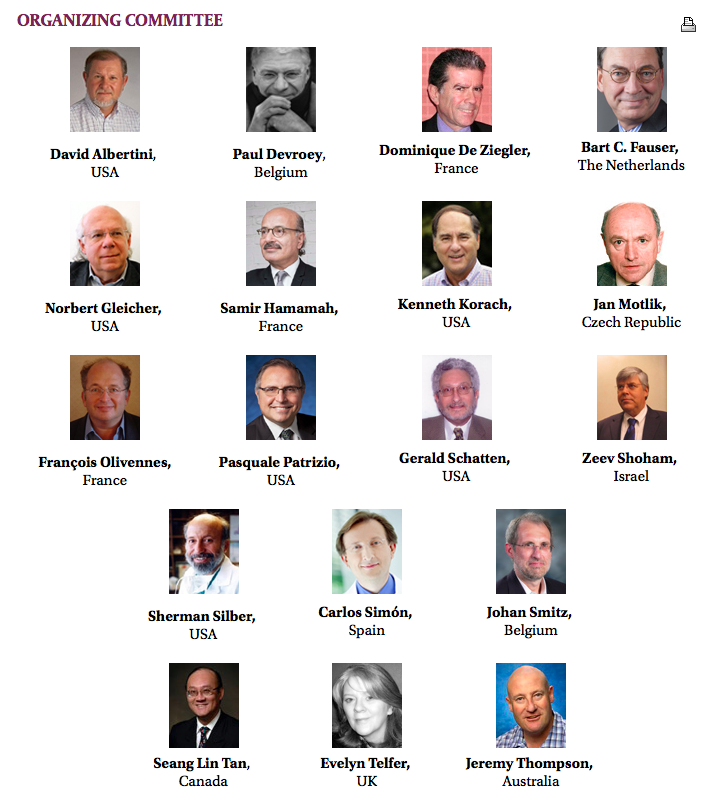
Well, I just got an email invitation to attend CME – OVARIAN CLUB 4.  And alas, rather than just dumping it into SPAM (which I did do) I clicked on one of the links.  I had to know – what was the gender balance at this meeting.  Was there any chance that the organizers would see that it would be ironic to not have a decent number of female speakers?  Alas, nope.

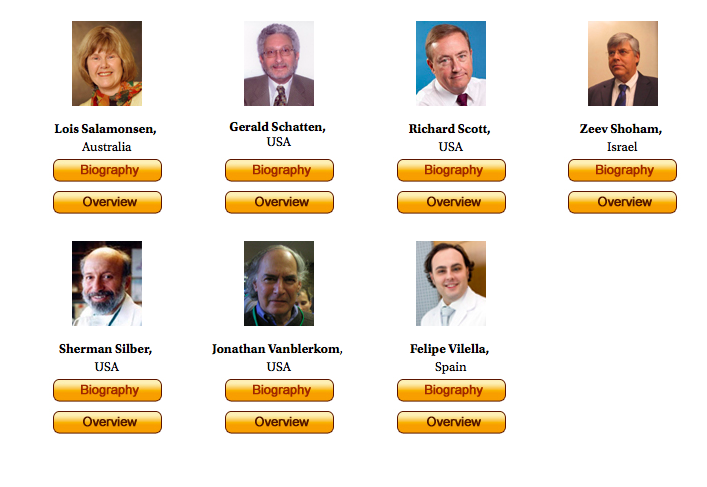
The organizing committee is 17:1 males to females.

And the speaker balance is not much better something like 25:6.

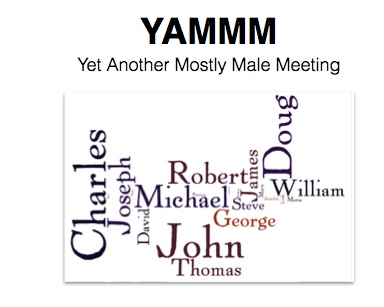
I guess maybe they should rename this “Meeting brought to you by people who mostly do not have ovaries.”  Sad.  Another YAMMM (Yet another mostly male meeting).


Related posts and pages

No #AAAS and ASM you do not deserve good PR for freeing up a few papers on Ebola

Saw a PR from AAAS about how they were freeing up all of ~ 20 papers on Ebola

In light of what has become the largest Ebola outbreak on record, Science and Science Translational Medicine have compiled over a decade’s worth of their published news and research. Researchers and the general public can now view this special collection for free.

OK. More access is good. But alas, they did not even free up all papers in #AAAS journals with Ebola in the Title or Abstract.

And then I started thinking. What about HIV? TB? Malaria? And as I started Tweeting about this, I saw that ASM also was hopping on the “free Ebola” bandwagon (actually I do not know who did it first).

And so I got angry and started Tweeting away. The Storify below sums up most of the details.

//storify.com/phylogenomics/aaas-and-asm-free-up-ebola-papers-show-they-don-t/embed?border=false//storify.com/phylogenomics/aaas-and-asm-free-up-ebola-papers-show-they-don-t.js?border=false[View the story “#AAAS and ASM free up Ebola papers show they don’t care about HIV, malaria, TB, etc.” on Storify]
————————–
UPDATE 9 AM 8/21

Great.  And now the Lancet has joined the bandwagon.

They write
“The current outbreak of Ebola in west Africa constitutes the largest and most complex to date. Declared a public health emergency of international concern by WHO, the outbreak of a disease with no known treatment or vaccination is proving difficult to contain given the already fragile and under resourced health systems in the affected areas.
The Lancet wishes to assist health workers and researchers working under difficult and dangerous conditions to bring this outbreak to a close. This Ebola hub contains all related resources from The Lancet family of journals offered with free access to support their vital work.”
Since they do not make papers available on TB, malaria, AIDS, cancer, etc does this mean people working on those are not doing vital work?
UPDATE 2: 8/21 5:45 PM
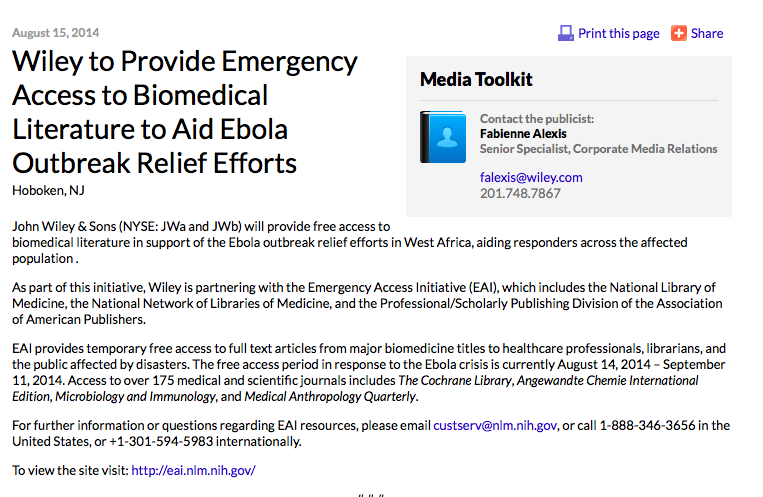
Wiley also trying to get some PR for making papers available.

UPDATE 3: 9/3
Oh look.  ACS cares about Ebola too.  They are making 18 papers available for free.  How generous. Oh and only until February 2015.  After then, they don’t care about Ebola.  Oh and before then, they apparently don’t care about any other affliction affecting the world.  Ebola is the only thing important enough to make freely available.

UPDATE 10/17

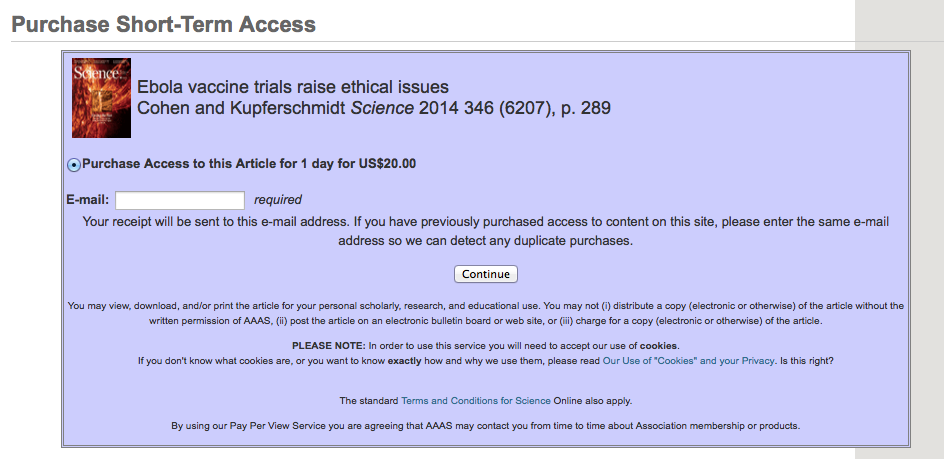
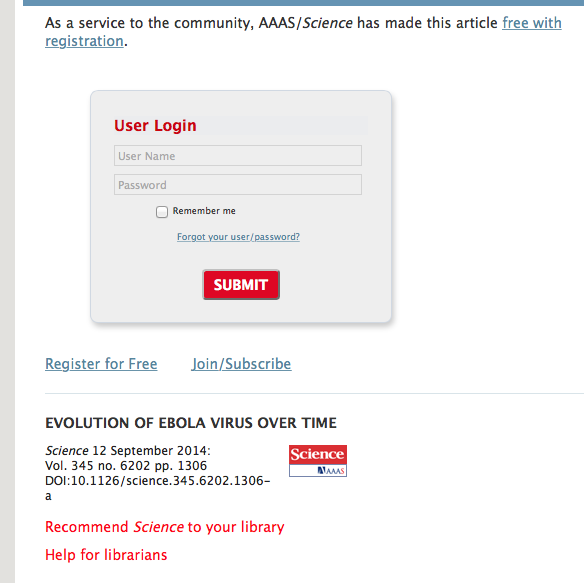
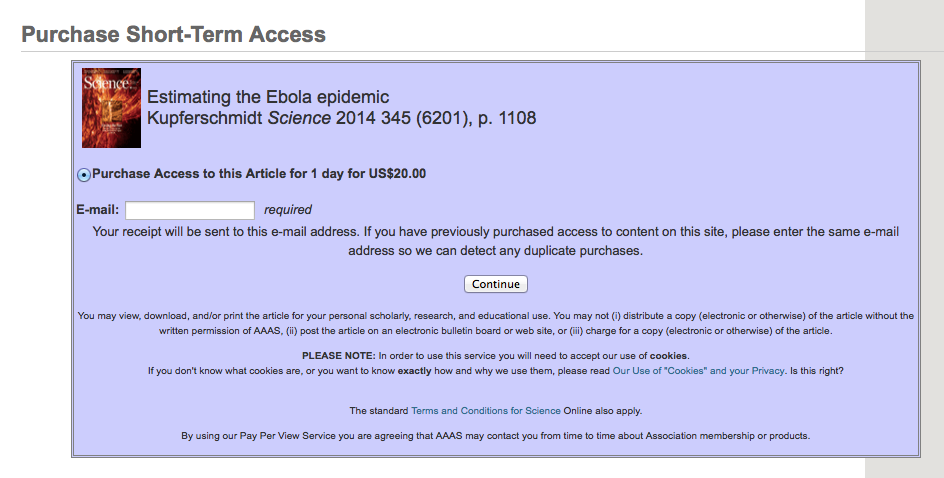
As the Ebola situation worsens, journals and publishers are still trying to get props for making certain papers freely available.  For example, AAAS continues to do this – (see this news story here which ends with a statement about a collection of free ebola papers).  Alas they are being sadly selective in what papers they make available.

Here are some that are not available

What a joke.  If #AAAS really cared about infectious diseases and human health and making papers available, they would stop being one of the most anti-open access publishers out there.

If you want consistently #openaccess papers about Ebola, go to #openAccess journals or do a search in Pubmed Central with a “limit” for Open Access papers: http://www.ncbi.nlm.nih.gov/pmc/?term=ebola%5BAll+Fields%5D+AND+%22open+access%22%5Bfilter%5D&cmd=DetailsSearch