USA Today article on "Your home’s odor may be making you sick"

Quick post – just saw this Tweet from the Airmid Healthgroup

//platform.twitter.com/widgets.js

It points to a story in USA Today that may be of interest – Your home’s odor may be making you sick.  It is about the work on Joan Bennett and researchers from Rutgers and Emory.  I don’t have time to dig into it right now but perhaps others do.

UPDATE 5 minutes later
Oops – posted to the wrong blog. First time I have done this. This was supposed to go to microBEnet. I have posted it there now.

My beloved cat companion Annapurna passed away this AM; I will love and miss her forever

//platform.twitter.com/widgets.js https://photos.gstatic.com/media/slideshow.swf

Bad microbiology reporting of the month award: C-Net on IBM "Sequencing the City" meeting

Well, I am still really annoyed by this unbearable article on C-Net yesterday: IBM sees big opportunity in sequencing microbes by Daniel Terdiman.  The article is about this “Sequencing the City” meeting organized by IBM that was on Tuesday and Wednesday.  I talked at the meeting on Tuesday (I could not go on Wednesday).  For more about my talk see: What to do when you realize the meeting you are speaking at is a YAMMM (yet another mostly male meeting)?.  But I am not criticizing the meeting here.  I am criticizing the article in C-Net which has many many flaws. For example consider:

According to James Kaufman, a research manager at the Almaden Research Center, the move to study metagenomics — the study of systems of micro-organisms — came from what he called a tipping point in big data. As more and more government-funded institutions study organisms and bacteria, they’ve collected more information about them, and submitted much of their work to centralized databases. “So there’s a growing library of genomes across the field of life,” Kaufman said. “That made possible metagenomics.”

What?  Metagenomics has been around for a long time.  Sure, many people in the field are taking advantage of so called big data, but there was no “tipping point” needed to launch the field.  This is just completely misguided.
And then even worse

The result: We can now look at and understand whole ecosystems at the bacterial level. One example of how that manifests is what IBM refers to as the Human Microbiome Project. According to an IBM document, that’s about characterizing “microbial communities found at multiple human body sites to discover correlations between changes in the microbiome with changes in human health.”

So – there have been dozens of high profile papers from the Human Microbiome Project.  There are hundreds of web pages with information about the project.  It was started years and years ago.  And the reporter quotes an “IBM document” to tell us what the Human Microbiome Project is?   And even worse the reporter says “what IBM refers to as the Human Microbiome Project” like they ran it / designed it.  Good that they refer to it as the Human Microbiome Project.  You know why?  Because that is what it is known as to all the other $(&@)(* people in the whole (%&# world.

The reporter goes on to write

This kind of work is not entirely new, but the scientists who will be gathering at IBM Research this week are grappling with one conundrum: they don’t know what they don’t know. So a big topic of conversation, and a big part of what IBM would like to see advanced, is “the ability to do metagenomics on the scale of a city or the world….That will depend on software services available in the cloud,” Kaufman said. “It has to be cheap, easy, and accessible from anywhere. That’s what we’re really good at.”

Once again making it seem like IBM is somehow leading this field.  Not to pick on IBM here.  I am glad they organized the meeting.  But either the reporter just got handed a press release from IBM and wrote it up, or did not do any type of background research, or both.  Sure IBM would like to see this.  But so would lots of other people.  Why make this all about IBM?  There are so many people who have done interesting work in the area of “microbiology of the built environment” – why are none of them even discussed?  What exactly is the point of this article if not to simply be a PR piece for IBM?  Aaaaaarg.

UPDATE 5/9 Storify of some of the Tweets about the meeting

What to do when you realize the meeting you are speaking at is a YAMMM (yet another mostly male meeting)?

I am supposed to be talking at a meeting Tuesday: Almaden Institute 2014: Sequence the City -Metagenomics in the Era of Big Data.

In looking at the agenda for the meeting I am pretty bummed about the gender ratio of speakers. Looks like 18:5 Men to Women. 

  • Jeff Welser IBM 
  • David Haussler UCSC 
  • Daniel Huson Tubingen U 
  • Joe DeRisi UCSF 
  • Jane Carlton NYU 
  • Ajay Royyuru IBM 
  • Paula Olsiewski Sloan Foundation 
  • Christopher Mentzel Moore Foundation 
  • Anne Marie Kimball Gates Foundation 
  • Jonathan Eisen UC Davis 
  • Jessica Green U Oregon 
  • Mark Adams JCVI 
  • Eric Alm MIT 
  • Raul Andino UCSF 
  • Scott Kahn Illumina 
  • Mike Lelivelt Ion Torrent 
  • Radoje (Rade) Drmanac Complete Genomics 
  • Brett Bowman Pacific Biosciences 
  • Chris Mason Cornell 
  • Bart Weimer UC Davis 
  • David Crean Mars 
  • Astri Wayadande Oklahoma State U 
  • Christopher Elkins FDA

Not sure what to do about this. I am certainly (in a few minutes) going to be writing to the organizers. I am also pondering cancelling talking. I try very hard to be vigilant about gender ratios at meetings and it drives me crazy to see such skews. I know it is not always possible to have meetings have equal representation and I know some people try very hard and do not succeed. But this seems unpleasantly extreme. So – any thoughts or recommendations as to what to do would be appreciated.


UPDATE 5/5 –


Well the schedule has been updated – and now the male: female speaker ratio is 21:6. Note – Jack Gilbert is moderating and speaking and I am counting him twice. Also Robert Prill is opening each day and closing day 2 so in a way this could be counted as 23:6.

  • Robert Prill, IBM 
  • Jeff Welser IBM 
  • David Haussler UCSC 
  • Daniel Huson Tubingen U 
  • Joe DeRisi UCSF 
  • Jane Carlton NYU 
  • Ajay Royyuru IBM 
  • Laurie Garrett (moderating) 
  • Paula Olsiewski Sloan Foundation 
  • Christopher Mentzel, Moore Foundation 
  • Anne Marie Kimball Gates Foundation 
  • Jonathan Eisen UC Davis 
  • Jessica Green U Oregon 
  • Robert Prill 
  • Mark Adams JCVI 
  • Eric Alm MIT 
  • Raul Andino UCSF 
  • Jack Gilbert (moderating) 
  • Jack Gilbert (speaking) 
  • Scott Kahn, Illumina 
  • Mike Lelivelt Ion Torrent 
  • Radoje (Rade) Drmanac Complete Genomics 
  • Brett Bowman Pacific Biosciences 
  • Chris Mason Cornell 
  • Bart Weimer UC Davis 
  • David Crean Mars 
  • Astri Wayadande Oklahoma State U 
  • Christopher Elkins FDA 
  • Robert Prill

UPDATE 5/7

So I decided to go to the meeting and talk. Here is a video slideshow of my talk with audio.

 and here are the slides on Slideshare

I am not sure if I made the right decision but what I decided to do was to change my talk to feature the work of women and to highlight those women.


UPDATE 5/8

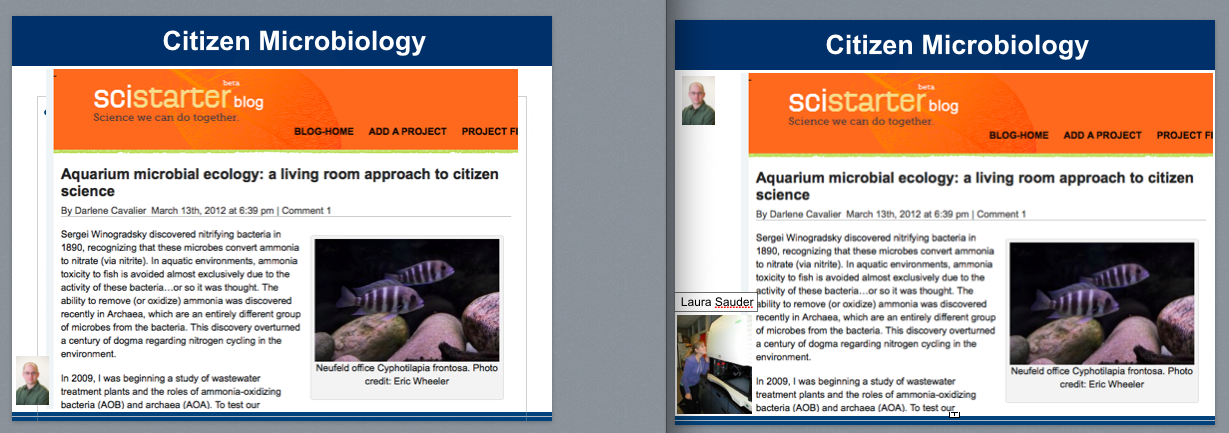
Here are some pics showing the before (left) and after (right) for how I changed my talk from the previous talk I gave about this topic.  Among the changes I made:

  • I added names and pictures of the women behind the work 
  • Changed examples to be about work of women when I had been using work of men
  • Added additional examples of work by women directly related to my talk
And I used the pictures and names on the slides to remind me to talk about the women behind the work. 

I think this strategy is a potentially useful tool in combatting the implicit and subtle biases against women in STEM fields.  All of what I said was true.  I just made sure to emphasize and use examples of work by women when previously I had either not said who did certain work or had sometimes emphasized work by men.  And I made sure to show pictures and say the names of the women behind the work too.

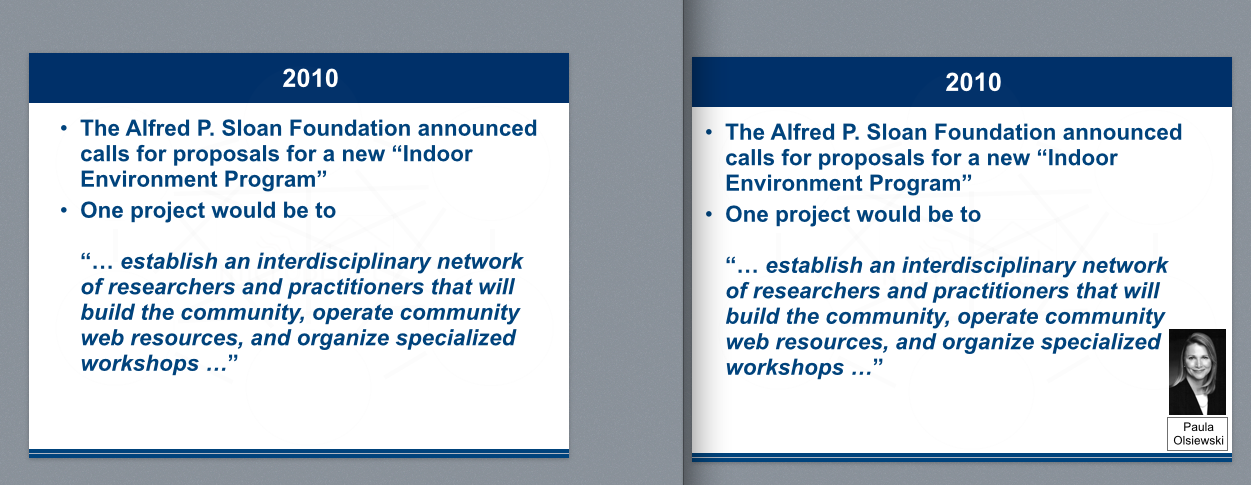
Added name and picture of program officer Paula Olsiweski who I had quoted previously.
Changed example of new publication that we add to our collection and used a publication
by a female graduate student, post doc Rachel Adams.  
Included name and picture of student post-doc Rachel Adams on other slides
about the topic

Included name and picture of student post-doc Rachel Adams on other slides
about the topic. 

Added a mention of the blog post by student post-doc Rachel Adams.

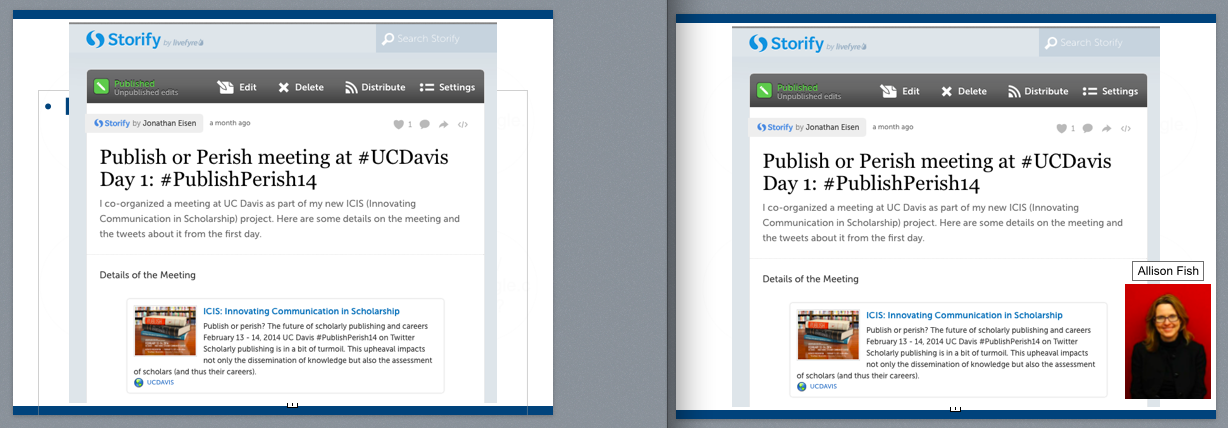
Added picture and name of post doc Allison Fish who organized meeting
I was discussing.

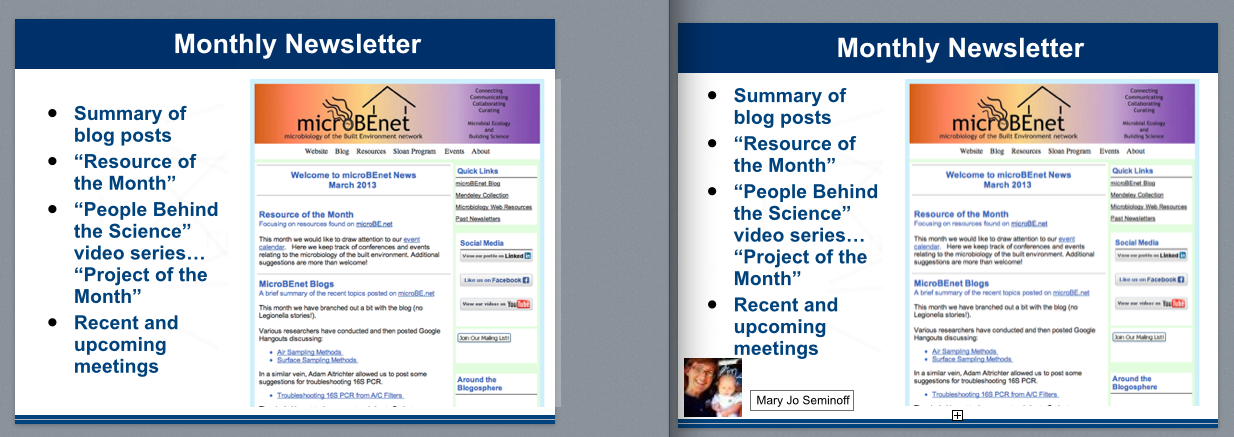
Added name and picture of Mary Jo Seminoff who coordinates
production of the newsletter I had mentioned.

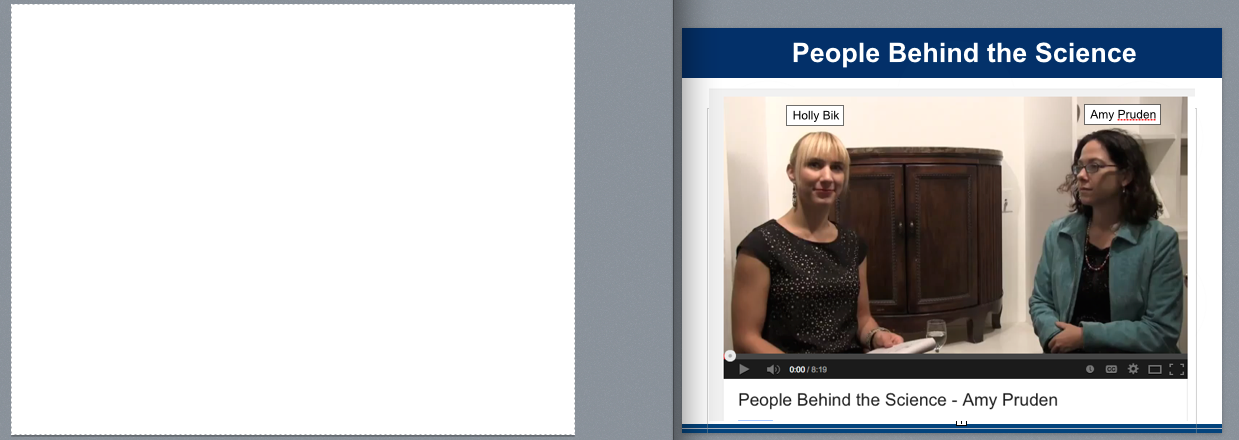
Added screenshot and names of Holly Bik interviewing Amy Pruden for the
“People Behind the Science” series mentioned in previous slide.

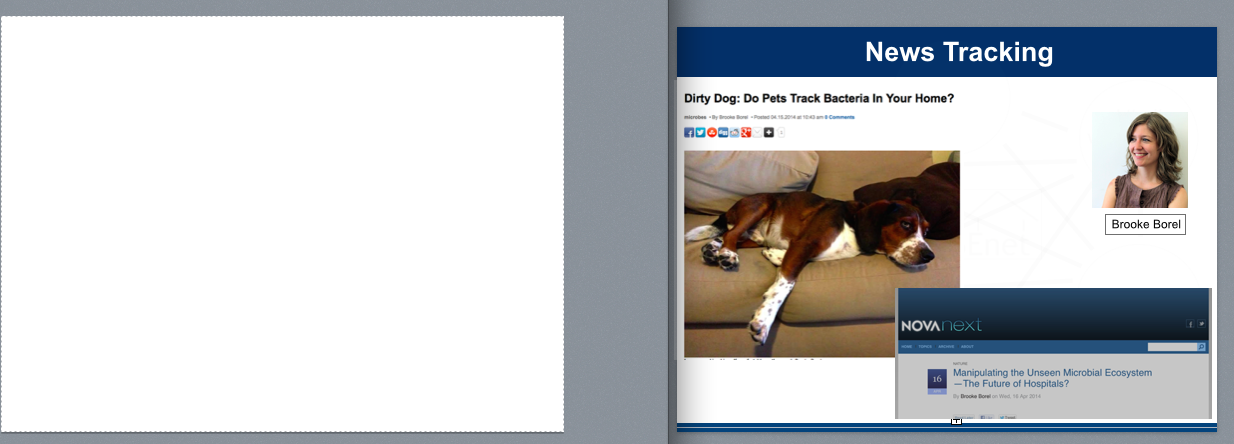
Added name and picture of Brooke Borel and discussed her news stories (had mentioned
news stories in general w/o examples)

Added picture and name and blog post of Holly Ganz who wrote about
the news stories by Brooke Borel.

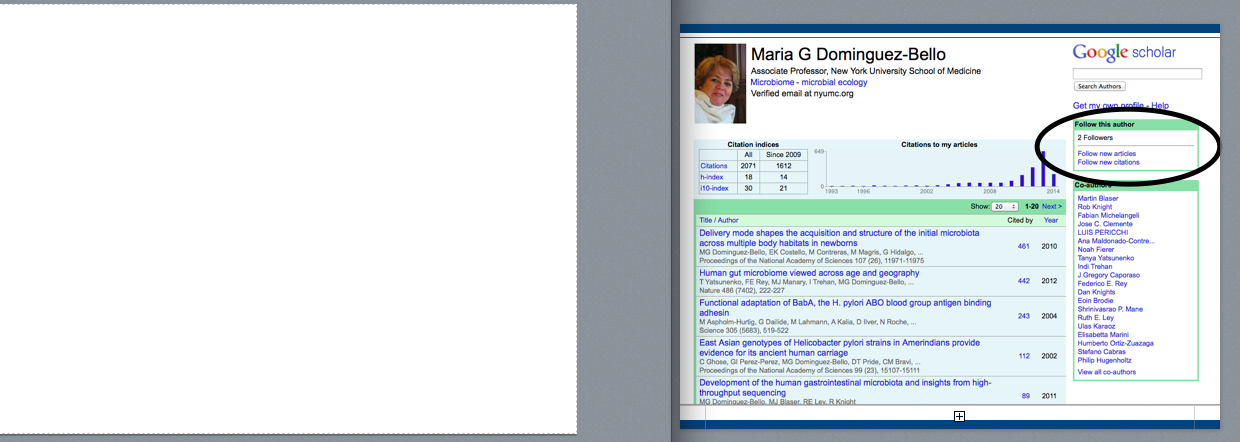
Changed example to be about Maria Gloria Dominguez-Bello instead
of Thomas Bruns.

Changed example to be about Maria Gloria Dominguez-Bello instead
of Thomas Bruns.

Added extra slide discussing Software Carpentry workshop
organized by Jenna Lang and Tracy Teal (and added
names and pics of them).

Added pics and names of Jo Handelsman and Tiffany Tsang who coordinated
one of the examples on the slide but who had not gotten mentioned
specifically.

Added picture and name of undergraduate student Hannah Holland-Moritz who was
involved in this work.

Added picture and name of research associate Madison Dunitz
who led this work.

Added name and picture of undergraduate student Sabreen Aulakh
who was involved in this work.

Added picture of graduate student Laura Sauder who
was our main contact in the lab of Josh Newfeld.

Added pictures and names of Darlene Cavalier and Caren Cooper who
inspired me to get involved in Citizen Science.

Added picture and name of Darlene Cavalier who was keynote speaker
at these meetings.

Added extra slide on the phone microbiome project and added names and pics of the people
involved including graduate student Georgia Barguil.

Added names and pics of the people behind this project (Holly Menninger and Rob Dunn)

Changed slide a little bit and added name and pic of Jessica Richman, one of the people behind the uBiome project.

Added pics that included more of the key women behind this project – including Darlene Cavalier, Wendy Brown
and Jenna Lang.

Added a slide about Altmetrics and added pic and name of Heather Piwowar and mentioned
her work  Had included one line about Altmetrics on a slide before.

Added reference to paper by Holly Bik and Miriam Goldstein and
emphasized the workshops run by Holly Bik.  Included pics and names on slide too.

UPDATE 5/8

Added links to find out more information about the work of the women in the slides (links are in the image captions).
UPDATE 9/6/14 https://apis.google.com/js/plusone.js

NSF asks for comments on "genomes-phenomes" program; here’s a comment – phenome is a silly #badomics term

Hmm.  Just got this in the emails.

BIO seeks community input on Genomes-Phenomes research frontiersJohn Wingfield, Assistant Director of the National Science Foundation Directorate for Biological Sciences (BIO), is pleased to announce the posting of a Wiki to seek community input on the grand challenge of understanding the complex relationship between genomes and phenomes.  The Wiki is intended to facilitate discussion among researchers in diverse disciplines that intersect with biology, such as computation, mathematics, engineering, physics, and chemistry.The Wiki format encourages open communication, captures new viewpoints, and promotes free exchange of ideas about the bottlenecks that impede progress on the genomes-phenomes grand challenge and approaches or strategies to overcome these challenges. Information provided through the Wiki will help inform BIO’s future research investments and activities relevant to understanding genomes-phenomes relationships.To provide comments, ask questions and view input from and interact with other community members, first-time users should sign up for an account via this link:Sign-up.  Once registered, users will be directed to the main page of the NSF Wiki to accept the terms and conditions before proceeding.  Additional guidance and subsequent visits can be accessed via this link: Genomes-Phenomes Wiki.Community members should feel free to forward notice of this to anyone they think might be interested in contributing to the discussion. Questions regarding the Wiki should be sent to bio-gen-phen@nsf.gov.
########################################################################


Nice that they are seeking input. But really – does NSF have to adopt “phenome” as a term? How exactly is this different from “phenotype”? This seems to be a case of exactly what I was criticizing in my Badomics article in Gigascience and in all my posts here (eg bad omics words of the day, Worst New Omics Word Award, badomics, etc). Blech. Genomics is really interesting. I have worked on it for many years. But there is no need to contaminate the literature by using new, uninformative, oversold terms like “phenome”.

Talk 5/7 Daryl Smith “Diversity’s Promise for Excellence in a Pluralistic Society: The Public University and the Common Good”

Email I received:

Dear UC Davis Faculty, Staff, Students and Community Members,

We would like to remind you that the next event in the Provost’s Forums on the Public University and the Social Good will be held next Wednesday, May 7, 2014.

Daryl Smith, Senior Research Fellow and Professor Emerita of Education and Psychology at Claremont Graduate University will be speaking on the topic of “Diversity’s Promise for Excellence in a Pluralistic Society: The Public University and the Common Good”.

Before assuming her current faculty position at CGU, Professor Smith served as a college administrator in planning and evaluation, institutional research, and student affairs. Her research, teaching, and publications have been in the area of organizational implications of diversity, assessment and evaluation, leadership, and change, governance, diversity in STEM fields, and faculty diversity. She is the author or co-author of several books, including Diversity’s Promise for Higher Education: Making it Work, The Challenge of Diversity: Alienation of Involvement in the Academy, and Achieving Faculty Diversity: Debunking the Myths.

Professor Smith will be joined by two UC Davis panelists for this event. Kevin Johnson, Dean of the UC Davis School of Law,
Mabie-Apallas Professor of Public Interest Law, and Professor of Chicana/o Studies, and Maureen Stanton, Vice Provost for Academic Affairs and Professor of Evolution and Ecology.

The event will begin at 3 p.m. in the Multipurpose Room of the Student Community Center and will go until 5:30 p.m. It is free and open to the general public. There will be an hour long reception with light refreshments directly following the end of the lecture.

If you are unable to attend this event, videos of all Provost’s Forums lectures are available to the public and can be found on the official Provost’s Forums website. Our most recent lecture, “Universities and Regional Growth: Insights from the University of California” will soon be available for viewing along with all of the 2013-2014 season lectures.

For more details and information on this event, please see the attached flyer, visit our website: The Provost’s Forum on the Public University and the Social Good, or contact Casey Castaldi. In addition, please forward this information to any interested parties, as all events are open to the public.

We hope to see you at this important event!
Smith Flyer 5.7.14.pdf

#UCDavis seminar Monday Beth Shapiro “The genetic consequences of climate change: lessons from the Pleistocene ice ages”

Forwarding this:

Monday’s Genetics seminar speaker is Beth Shapiro from UCSC. Her title is “The genetic consequences of climate change: lessons from the Pleistocene ice ages”

The seminar is at 4:10pm in LS 1022

Beth uses ancient DNA (paleogenomics) to study the evolution of species and populations.

Beth writes on her website http://pgl.soe.ucsc.edu/index.html : “In the Shapiro lab, a common theme to our research is that it tends to involve some aspect of time. The temporal signal comes from historical information, radiocarbon dates, sampling times (for rapidly evolving viruses), or information from depositional environments. We combine temporal and genetic data to identify periods of growth, decline, dispersal, and replacement in populations. When possible, we integrate these data with climate and environmental records to try to identify the causative factors behind changes in genetic diversity. We have recently been transitioning from single-locus analyses to working with multi-locus, or even complete genome, data… even for our oldest samples!”

Today’s wondering – why are so few of the speakers at "UC Drought Summit" women?

Got pointed to YAMWASGR (yet another meeting with a skewed gender ratio) this AM via Twitter.

//platform.twitter.com/widgets.js

This was in reference to a meeting in Sacramento:  Apr. 25: UC Drought Summit, free and open to public | Center for Watershed Sciences and alas the gender ratio is definitely skewed on the speaker list.  Men in Blue, Women in Yellow.

  • UC activities to reduce water use on and off campus
    • • Barbara Allen-Diaz, UC Division of Agriculture and Natural Resources 
    • • Matthew St.Clair, University Office of the President
  • Current drought: causes, how bad is it, and will we see more like it?
    • • Amir AghaKouchak, UC Irvine
    • • Michael Anderson, State Climatologist
    • • Daniel Cayan, UC San Diego
    • • William Collins, UC Berkeley; Intergovernmental Panel on Climate Change
    • • Glen MacDonald, UCLA
    • • Daniel Swain, Stanford University
  • Drought-proofing California?
    • • Michael Stenstrom, UCLA 
    • • Jay Lund, UC Davis
  • Kenneth Baerenklau, UC Riverside
    • Roger Bales, UC Merced
    • • Charles Burt, Cal Poly San Luis Obispo
    • • Frank Loge, UC Davis
    • • Stephanie Pincetl,UCLA
    • • Scott Stephens, UC Berkeley
  • Remarks by Chancellor Linda P.B. Katehi, UC Davis
  • Economic consequences of the drought: agriculture, energy, forests, industry and water
    • • Katrina Jessoe, UC Davis
    • • Anthony Madrigal, Twenty-Nine Palms Band of Mission Indians 
    • • Josué Medellín-Azuara, UC Davis
    • • Daniel Sumner, UC Agricultural Issues Center
    • • David Sunding, UC Berkeley
  • Endangered species and drought: science, management and policies
    • • Richard Frank, UC Davis
    • • Ellen Hanak, Public Policy Institute of California
    • • David Hayes, Stanford University; former deputy Interior secretary
    •  • Peter Moyle, UC Davis
    • • David Sedlak, UC Berkeley
    • • Joshua Viers, UC Merced
  • State policy for future droughts: groundwater, storage, marketing and conservation
    • • Jay Famiglietti, UC Irvine
    • • Thomas Harter, UC Davis
    • • Ruth Langridge, UC Santa Cruz
    • • Steve Macaulay, consultant
    • • Samuel Sandoval Solis, UC Davis 
    • • Kurt Schwabe, UC Riversidepage2image9504     page2image9928

That comes out to 26:6 in my count or 18.8% female, 81.2% male.  Now, I note – I have no idea what the “pool” looks like in this area, but such a % certainly does not look good from an outside (to the field, even though I am an insider in that this was organized by some people at UC Davis).   Once again, I would like to point out to meeting organizers, that having a diverse pool of speakers for a meeting is important for many reasons and sometimes it takes extra work to pull it off, but in my experience it is definitely worth it.

A special special issue of RNA Biology – dedicated to Carl Woese and Open Access too

A must read for, well, everyone out there: RNA Biology: Table of Contents for a special issue dedicated to / about Carl Woese.  The issue includes an amazing collection of papers:

A special issue in memoriam of Carl Woese
Renée Schroeder
Page 169
http://dx.doi.org/10.4161/rna.28566

Introduction to special Carl Woese issue in RNA Biology
Robin R Gutell
Pages 170 – 171
http://dx.doi.org/10.4161/rna.28393

Carl Woese: A structural biologist’s perspective
Peter B Moore
Pages 172 – 174
http://dx.doi.org/10.4161/rna.27428

Early days with Carl
Ralph Wolfe
Page 175
http://dx.doi.org/10.4161/rna.27429

Molecular phylogenetics before sequences: Oligonucleotide catalogs as k-mer spectra
Mark A Ragan, Guillaume Bernard and Cheong Xin Chan
Pages 176 – 185
http://dx.doi.org/10.4161/rna.27505

Constraint and opportunity in genome innovation
James A Shapiro
Pages 186 – 196
http://dx.doi.org/10.4161/rna.27506

Carl Woese’s vision of cellular evolution and the domains of life
Eugene V Koonin
Pages 197 – 204
http://dx.doi.org/10.4161/rna.27673

From Woese to Wired: The unexpected payoffs of basic research
Ann Reid
Pages 205 – 206
http://dx.doi.org/10.4161/rna.27701

Carl Woese, Dick Young, and the roots of astrobiology
John D Rummel
Pages 207 – 209
http://dx.doi.org/10.4161/rna.27702

Life is translation
Bojan Zagrovic
Pages 210 – 212
http://dx.doi.org/10.4161/rna.27718

Organelle evolution, fragmented rRNAs, and Carl
Michael W Gray
Pages 213 – 216
http://dx.doi.org/10.4161/rna.27799

Remembering Carl Woese
Kenneth R Luehrsen
Pages 217 – 219
http://dx.doi.org/10.4161/rna.27800

Woese on the received view of evolution
Sahotra Sarkar
Pages 220 – 224
http://dx.doi.org/10.4161/rna.27883

This article is open accessSecondary structure adventures with Carl Woese
Harry F Noller
Pages 225 – 231
http://dx.doi.org/10.4161/rna.27970

A backward view from 16S rRNA to archaea to the universal tree of life to progenotes: Reminiscences of Carl Woese
Roger A Garrett
Pages 232 – 235
http://dx.doi.org/10.4161/rna.28228

Carl Woese in Schenectady: The forgotten years
Larry Gold
Pages 236 – 238
http://dx.doi.org/10.4161/rna.28305

History and impact of RDP: A legacy from Carl Woese to microbiology
James R Cole and James M Tiedje
Pages 239 – 243
http://dx.doi.org/10.4161/rna.28306

Casting a long shadow in the classroom: An educator’s perspective of the contributions of Carl Woese
Mark Martin
Pages 244 – 247
http://dx.doi.org/10.4161/rna.28002

Looking in the right direction: Carl Woese and evolutionary biology
Nigel Goldenfeld
Pages 248 – 253
http://dx.doi.org/10.4161/rna.28640

Ten lessons with Carl Woese about RNA and comparative analysis
Robin R Gutell
Pages 254 – 272
http://dx.doi.org/10.4161/rna.28718

Memories of Carl from an improbable friend
Harris A Lewin
Pages 273 – 278
http://dx.doi.org/10.4161/rna.28866

Update on Curtobacterium and Other Musings

In my first year in the Eisen lab, I was lucky to be able to participate on the Undergraduate Genome Sequencing Project in which I published the draft genome of Curtobacterium flaccumfaciens, the first of it’s genus. An important aspect of this project was blogging about what we were doing: All the successes, the failures, and everything in between, something that I was terrible at evidenced by my one maybe two blog posts. However, the longer I have been in this lab, I find the significance of social media in science, both to myself and the world, grows.

After almost a year since the paper was published, the Eisen lab received an email inquiring about my blog post on Curtobacterium and the difficulties we had with getting enough active DNA and continuing with sequencing. They wanted to know if we were having trouble with DNA extractions on the bacteria, especially since they were interested in sequencing other species of Curtobacterium and were worried if the genus was finicky. We had later found that the viability of our ligase decreased with each successive freeze-thaw causing the huge issue in DNA library prep and were able to inform them that extracting DNA and sequencing Curtobacterium should be a relatively painless process.

There were two things that stuck me as interesting when David, my supervisor on the project, informed me about the email exchange. First, that it was awesome that a blog post that I, an insignificant undergraduate, wrote was seen by other researchers and contained information (as small as it was) that could help them in their research. Second, and more abstract, that science has increasingly become more of a collaborative effort. When I originally thought about sharing in science, the infamous Koch-Pasteur rivalry quickly came to mind. Information simply wasn’t shared as readily at that time. I like to think idealistically that the idea of hoarding information to get ahead of contemporaries has become less common and science will become even more collaborative than it is now. Or the idea of charging to view more than just the Abstract will cease to exist and the number of open-access articles will continue to grow because at the root of researchers (at least originally) is the pursuit of knowledge and dissemination of information. Just some musings I had and who am I to talk? I haven’t even graduated undergrad yet and haven’t joined the race to find the richly rewarding cure to cancer.