
Hello,
We will have our weekly lab meeting this week from 1:30 to 3pm in room 4202 of the Genome Center.
Dongying Wu is presenting.
Category: Misc.

The need for a phylogeny driven genomic encyclopedia of eukaryotes
Monday I gave a talk for the SMBE Eukaryotic Omics satellite meeting that has been going on at UC Davis. When Holly Bik, a post doc in my lab asked me to talk at the meeting, I said, basically “Well, OK, but I don’t really do much work on eukaryotes.” And then I came up with an idea – I could make my talk about how it might be good to have a better phylogenetic sampling of eukaryotic genome sequences. I have been a bit obsessed for many many years about phylogenetic sampling of genomes and, well, though I have avoided eukaryotes mostly in most of my genome sequencing work, I figured, I should still get on my soap box about how phylogenetic sampling is a good thing. So, well, I did. And I think we (i.e., the scientific community) really needs a better sampling of eukaryotic genomes.
I have posted my talk to Slideshare and I recorded audio of my talk in synch with the slides and posted that to Youtube. These are below.
I hereby am calling for those people interested in participating in such a phylogeny driven genomic encyclopedia of eukaryotes to make yourselves known. We NEED to do this.
Related posts
- The Tree of Life: Story Behind the Nature Paper on ‘A phylogeny driven genomic encyclopedia of bacteria and archaea…
- The Tree of Life: More coverage of the GEBA “Phylogeny Driven Genomic Encyclopedia paper …
- A phylogeny-driven genomic encyclopaedia of Bacteria and … – Nature
Share this:
I love this … "Dr. Eleanor’s Book of Common Ants" based in part on citizen science data
This is really cool: Dr. Eleanor’s Book of Common Ants. Free to download. With incredible pics from Alex Wild. And based in part on data from the School of Ants citizen science project. You can download the PDF or the iBook from iTunes. From the folks at “Your Wild Life” including Holly Menninger and Rob Dunn and others. Definitely worth checking out.
Share this:
We are getting close to sequencing!
A few of the PCRs last week didn’t work so I’m finishing up the last PCR B’s right now that we’ve had to redo and then all we have to do is Gel confirmations. If I counted correctly there are 24 confirmations to do. I would like to do one now, but I have to catch the bus in 30 minutes and I wouldn’t finish in time 😦 I plan to come in on Friday and possibly Thursday as well and hopefully as a group we can completely finished and get our samples in the sequencer by the end of the week!
Then comes the hard part! Data analysis. I learned a lot about this portion of the project while I was preparing my part of the lab meeting presentation a few weeks ago so hopefully that knowledge helps me understand what’s to come. Like most things, I’m sure it’s much easier said then done!
Share this:
Aquarium project poster at the UCD Undergraduate Research Conference
Here’s the poster that Lakshmi prepared for the conference. The presentation went well! Thanks to everyone who helped out.

Share this:

Trying to sort out all the STEM and STEM related departments, graduate programs , at #UCDavis
Well, I was in a meeting yesterday for the UC Davis ADVANCE program. This program is an NSF funded project to improve presence of women and underrepresented minorities on the faculty in Science, Technology, Engineering and Math (STEM). So I decided to see – how many departments at UC Davis might participate in such an initiative. And, well, wow. I knew there were a lot of STEM or STEM-related departments at UC Davis but I did not know there were this many.
Here is a list I compiled of UC Davis STEM or STEM-related Departments. I included medical departments here since many people in such departments do medical/science research. But clearly this is a broad definition of STEM. But nevertheless, this gives some picture of the scope of science and medicine and related departments at UC Davis.
Vet School departments in Yellow
Med School departments in Red
College of Biological Sciences Departments are In Green
College of Agricultural and Environmental Sciences in Orange
College of Letters and Science in Light Blue
College of Engineering in Grey
- Anatomy, Physiology & Cell Biology
- Anesthesiology
- Animal Science
- Anthropology
- Applied Science
- Biochemistry and Molecular Medicine
- Biological and Agricultural Engineering
- Biomedical Engineering
- Cardiovascular Medicine
- Cell Biology and Human Anatomy
- Chemical Engineering and Materials Science
- Chemistry
- Civil and Environmental Engineering
- Computer Science
- Dermatology
- Electrical and Computer Engineering
- Emergency Medicine
- Entomology
- Environmental Science and Policy
- Environmental Toxicology
- Evolution and Ecology
- Family and Community Medicine
- Food Science and Technology
- Geology
- Human and Community Development
- Infectious Diseases
- Internal Medicine
- Land, Air and Water Resources
- Linguistics
- Mathematics
- Mechanical and Aeronautical Engineering
- Medical Pathology
- Medical Microbiology & Immunology
- Medicine and Epidemiology
- Microbiology and Molecular Genetics
- Molecular and Cellular Biology
- Molecular Biosciences
- Nematology
- Neurobiology, Physiology and Behavior
- Neurological Surgery
- Neurology
- Nursing
- Nutrition
- Obstetrics and Gynecology
- Ophthalmology
- Pathology
- Pathology, Microbiology & Immunology
- Pediatrics
- Pharmacology
- Physical Medicine and Rehabilitation
- Physics
- Physiology and Membrane Biology
- Plant Biology
- Plant Pathology
- Plant Sciences
- Population Health and Reproduction
- Psychiatry
- Psychology
- Public Health Sciences
- Statistics
- Surgery
- Surgical and Radiological Sciences
- Urology
- Viticulture & Enology
- Wildlife, Fish and Conservation Biology
And then of course UC Davis has a TON of graduate groups and almost all of these are separate from departments. They do not hire faculty but they are a key part of the atmosphere and academics at UC Davis. And there are an enormous number of these in STEM or STEM-related fields. See below
Graduate Groups
Agricultural and Environmental Sciences Graduate Programs
- Agricultural and Environmental Chemistry
- Agricultural and Resource Economics
- Animal Biology
- Atmospheric Science
- Biological Systems Engineering
- Ecology
- Ecology (Joint Doctorate with San Diego State University)
- Entomology
- Food Science
- Genetics
- Geography
- Horticulture and Agronomy
- Hydrologic Sciences
- Master of Public Health
- Microbiology
- Nutritional Biology
- Pharmacology and Toxicology
- Plant Biology
- Plant Pathology
- Population Biology
- Soils and Biogeochemistry
- Transportation Technology and Policy
- Viticulture and Enology
Biological and Life Sciences Graduate Programs
- Animal Behavior
- Animal Biology
- Anthropology
- Avian Sciences
- Biochemistry and Molecular Biology
- Biochemistry, Molecular, Cellular and Developmental Biology
- Biological Systems Engineering
- Biomedical Engineering
- Biophysics
- Biostatistics
- Cell and Developmental Biology
- Clinical Research
- Comparative Pathology
- Ecology
- Ecology (Joint Doctorate with San Diego State University)
- Entomology
- Epidemiology
- Exercise Science
- Food Science
- Forensic Science
- Genetics
- Health Informatics
- Immunology
- Master of Public Health
- Maternal and Child Nutrition
- Microbiology
- Molecular, Cellular and Integrative Physiology
- Neuroscience
- Nursing Science and Health-Care Leadership (Doctor of Philosophy)
- Nursing Science and Health-Care Leadership (Master of Science)
- Nutritional Biology
- Pharmacology and Toxicology
- Plant Biology
- Plant Pathology
- Population Biology
Engineering Graduate Programs
- Applied Science Engineering
- Biological Systems Engineering
- Biomedical Engineering
- Chemical Engineering
- Civil and Environmental Engineering
- Computer Science
- Electrical and Computer Engineering
- Materials Science and Engineering
- Mechanical and Aeronautical Engineering
- Transportation Technology and Policy
Health Sciences Graduate Programs
Physical Sciences and Mathematics Graduate Programs
- Applied Mathematics
- Applied Science Engineering
- Atmospheric Science
- Biomedical Engineering
- Biophysics
- Biostatistics
- Chemistry
- Forensic Science
- Geography
- Geology
- Hydrologic Sciences
- Mathematics
- Physics
- Soils and Biogeochemistry
- Statistics
Social Sciences Graduate Programs
- Agricultural and Resource Economics
- Anthropology
- Child Development
- Ecology
- Geography
- Human Development
- Master of Public Health
- Maternal and Child Nutrition
- Nursing Science and Health-Care Leadership (Doctor of Philosophy)
- Nursing Science and Health-Care Leadership (Master of Science)
- Psychology
And then there are the Undergraduate Majors of which many are in STEM or STEM-related fields
- Aerospace Science & Engineering
- Agricultural & Environmental Education
- Animal Biology
- Animal Science
- Animal Science & Management
- Anthropology
- Applied Mathematics
- Applied Physics
- Atmospheric Science
- Biochemical Engineering
- Biochemistry & Molecular Biology
- Biological Sciences
- Biological Systems Engineering
- Biomedical Engineering
- Biotechnology
- Cell Biology
- Chemical Engineering
- Chemical Engineering/Materials Science & Engineering
- Chemical Physics
- Chemistry
- Civil Engineering
- Clinical Nutrition
- Computer Engineering
- Computer Science
- Computer Science and Engineering
- Ecological Management & Restoration
- Electrical Engineering
- Entomology
- Environmental Horticulture & Urban Forestry
- Environmental Policy Analysis & Planning
- Environmental Science & Management
- Environmental Toxicology
- Evolution, Ecology and Biodiversity
- Exercise Biology (suspended for 2013-14)
- Fiber & Polymer Science
- Food Science
- Genetics
- Geology
- Human Development
- Hydrology
- Linguistics
- Materials Science and Engineering
- Mathematical & Scientific Computation
- Mathematics
- Mechanical Engineering
- Mechanical Engineering/Materials Science & Engineering
- Microbiology
- Natural Sciences
- Neurobiology, Physiology & Behavior
- Nutrition Science
- Pharmaceutical Chemistry
- Physics
- Plant Biology
- Plant Sciences
- Psychology
- Science and Technology Studies
- Statistics
- Undeclared – Life Sciences
- Undeclared – Physical Sciences
- Undeclared – Social Sciences
- Viticulture & Enology
- Wildlife, Fish & Conservation Biology
So – lots and lots of STEM stuff at Davis and lots of chances / opportunities to improve the presence / treatment / life of women and underrepresented minorities.
Share this:
Bad Ome-like word of the week: symbiome
Well I got pointed to this paper: Transgenerational Transmission of the Glossina pallidipes Hytrosavirus Depends on the Presence of a Functional Symbiome
And as many might guess – the word “symbiome” did not sit well with me. Alas, they don’t define it in the paper. So I can’t really quibble with their definition. But I did find some other stuff out there that, well, at least helps see how other people are using the word:
- Symbiomism – Wikipedia, the free encyclopedia
- iPhylo: Visualising the symbiome: hosts, parasites, and the Tree of Life
- Observing the Coral Symbiome Using Laser Scanning Confocal
- “Symbiomes: Systems Metagenomics of Host Microbe interactions …
I can’t really tell from most of these if “symbiome” can be a useful term or not sometimes. Certainly the iPhylo example above has potential. But in general, the word seems awkward at best. Now – as far as I can tell, nobody is using it in the context of “genomics” so this does not fit in with my “badomics” obsession. But it still does not make me feel warm and fuzzy so I am going to give it a pseudo-award – the Bad Ome-like word award.
Share this:
UC Davis’ 2nd Annual BioBlitz will be sampling MICROBES!
The first-ever MicroBioBlitz will be held tomorrow, April 27th, from 9am-2pm! Join the Eisen Lab and the UC Davis chapter of SEEDS (the Ecological Society of America’s Undergraduate Ecology Club) at the Putah Creek Riparian Reserve for their second annual BioBlitz. The event is open to the public, and SEEDS just finished putting out some traps, so there could be lots of fun critters to see tomorrow!
I just chatted with the BioBlitz organizers, and they are super-excited to have us there to recruit the BioBlitz participants. As they catch frogs and butterflies, and identify flowers and trees, they will all be armed with a microbial sampling kit! Microbial samples will be sent to Jack Gilbert for sequencing as part of the Earth Microbiome Project!
Bring friends, family, co workers, or anyone else you might know!
Here is the link to iNaturalist, which is the site they will be using to upload all of their species accounts. Come out and help the UCD SEEDS chapter win the BIOBLITZ contest this year!!
Hmmm… wonder if our microbial species will count for the contest???
Here’s the official BIOBLITZ FLYER
and a BioBlitz Map
Share this:
Outreach & Communication for K-12 Students Workshop for Grad Students & Postdocs
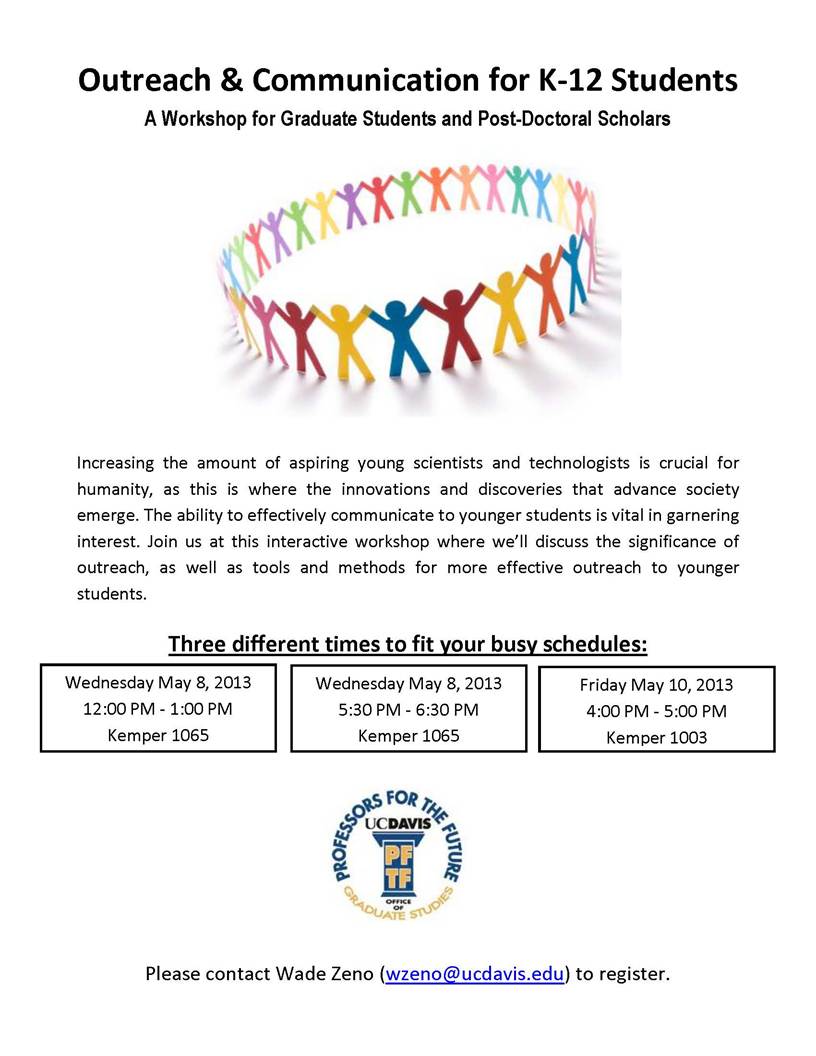
Share this:

Storified tweets from the #UCDavisADVANCE Symposium on Increasing Diversity of STEM Faculty
I live tweeted a symposium at UC Davis yesterday that was part of the UC Davis ADVANCE project to increase diversity of STEM Faculty. Here are the notes.
//storify.com/phylogenomics/ucdavisadvance-symposium.js[View the story “#UCDavisADVANCE symposium” on Storify]
For more on the project see
- Chancellor-led center aims to boost women’s numbers in STEM …
- ‘ADVANCEing STEM Faculty’ topic for symposium :: Dateline UC Davis
- NSF – ADVANCE – ADVANCE at a Glance
- nsf.gov – Funding – ADVANCE: Increasing the Participation and …
 Jonathan Eisen's Lab