For the past week, we’ve been doing preliminary sampling, as well as some DNA extractions and PCR on samples from the saltwater and freshwater flasks of water that we filtered and the wall and protein skimmer from the saltwater tank. Those four samples have now been through PCR. Although we found DNA, but the gel prepared after the PCR failed. We also went back to the tanks to gather samples from a saltwater tank that is soon to be broken up to create two coral ponds.
Eisen Lab Blog
New paper out from my lab/Katie Pollard’s lab on a new protein family collection
Just out as a provisional PDF.
Sifting through genomes with iterative-sequence clustering produces a large, phylogenetically diverse protein-family resource
Thomas J Sharpton, Guillaume Jospin, Dongying Wu, Morgan GI Langille, Katherine S Pollard and Jonathan A Eisen
BMC Bioinformatics 2012, 13:264 doi:10.1186/1471-2105-13-264
Abstract:
Background New computational resources are needed to manage the increasing volume of biological data from genome sequencing projects. One fundamental challenge is the ability to maintain a complete and current catalog of protein diversity. We developed a new approach for the identification of protein families that focuses on the rapid discovery of homologous protein sequences.
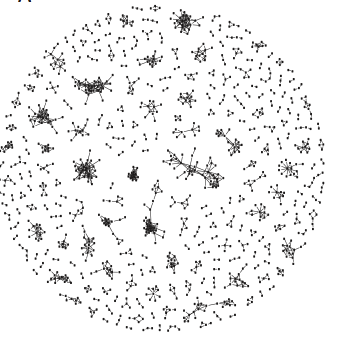
Results We implemented fully automated and high-throughput procedures to de novo cluster proteins into families based upon global alignment similarity. Our approach employs an iterative clustering strategy in which homologs of known families are sifted out of the search for new families. The resulting reduction in computational complexity enables us to rapidly identify novel protein families found in new genomes and to perform efficient, automated updates that keep pace with genome sequencing. We refer to protein families identified through this approach as “Sifting Families,” or SFams. Our analysis of ~10.5 million protein sequences from 2,928 genomes identified 436,360 SFams, many of which are not represented in other protein family databases. We validated the quality of SFam clustering through statistical as well as network topology–based analyses.
Conclusions We describe the rapid identification of SFams and demonstrate how they can be used to annotate genomes and metagenomes. The SFam database catalogs protein-family quality metrics, multiple sequence alignments, hidden Markov models, and phylogenetic trees. Our source code and database are publicly available and will be subject to frequent updates (http://edhar.genomecenter.ucdavis.edu/sifting_families/).
Will try to write more on this soon but am in the middle of teaching a 700 person course so a bit overwhelmed with other things.
Thanks for the Gordon and Betty Moore Foundation for support for this work.
Scouting for recent pubs on origin/evolution of the genetic code – suggestions wanted
A student in my Intro Bio class is interested in learning more about the origin and evolution of the genetic code. I am looking for some relatively recent papers to suggest to her. I have found the following:
- A four-column theory for the origin of the genetic code: tracing the evolutionary pathways that gave rise to an optimized code
- Optimization models and the structure of the genetic code
- Origin and evolution of the genetic code: the universal enigma
- On origin of genetic code and tRNA before translation
- Imprints of the genetic code in the ribosome
- Codon size reduction as the origin of the triplet genetic code
Other suggestions wanted …
—————————
A suggestion from Twitter
Bioinformatics position w/ Dr. Katie Pollard at UCSF/Gladstone
http://gladstone.interviewexchange.com/jobofferdetails.jsp?JOBID=35377
***
The Gladstone Institutes is an independent, not-for-profit research institution affiliated with the University of California San Francisco (UCSF), contributing to the health and well being of all people through medical research, education, and outreach in the areas of heart disease, HIV/AIDS, and neurological disease. Gladstone is composed of three separate institutes and approximately 350 employees. Our employees receive exceptional benefits. We are located in an award winning building adjacent to UCSF’s Mission Bay Campus. Gladstone has consistently ranked as one of the top places to work in academia in the United States. The Gladstone Bioinformatics group provides an active environment for developing solutions from experimental design to analysis and visualization.
Job Description:
We are recruiting a staff scientist to support the bioinformatics needs at Gladstone. Main duties will involve developing and maintaining scientific databases and performing data analysis of large-scale genomic data. Primary projects will include developing tools for analysis of metagenomics data (from human body sites and environmental samples) and designing pipelines for next-generation human genomics and epigenomics research. The candidate will interact with labs spanning all Gladstone Institutes.
Requirements:
The candidate should have a BS/MS in Bioinformatics, Computer Science or similar field and at least 2 years experience with MySQL or other relational database software and scripting languages (e.g., Perl, Python, shell scripting). Experience with analysis of large biological datasets, including developing pipelines for analysis using a scripting language in a Linux environment is required. Knowledge of programming languages (e.g., Java, C/C++) and best practices is also important. Additional useful experience includes the ability to work in a distributed computing environment using a queuing system such as SGE or PBS and a demonstrated ability to create data visualization tools. We need a good communicator who can work across disciplines, and a self-starter who can work effectively on projects with long development times. Please address how your experience fulfills these requirements in a cover letter and/or resume.
Candidates with relevant expertise who wish to join Gladstone’s mission of preventing, treating and curing some of the world’s most relentless diseases should send their curriculum vitae and contact information for three references.
Lab meeting, Oct 16th 2012
Aaron Darling will be presenting for this week’s lab meeting.
We will be meeting from 1:30 to 3:30pm in room 4202 of the genome center.
TDU (M. oxydans) info, and what lies ahead
The ominous clouds in the sky and the cool breeze in the air can only mean one thing – Summer is gone and it’s time to stop slacking off. With that in mind, I thought I would update everyone on how my work on Microbacterium oxydans has progressed. Now that the bioinformatics work is more or less done, I’ve been putting all of the information together and trying to make it sound somewhat coherent. I am currently halfway to the 500 word limit that the Journal of Bacteriology has imposed for genome announcements, so the end is definitely in sight but more work still needs to be done. It’s going to be interesting managing classes, this paper, and another project I’m working on (more on that later) but I’m optimistic that the paper will be completed within the next week or two.
M. oxydans infothat I’ve written about so far:
- Microbacterium have been found in many human associated environments (blood, radioactive sites, food) and also act as plant pathogens in some cases. TDU was found in a toilet (thanks David!)
- The a5 pipeline produced 1,131,749 paired end reads with an average length of 133 base pairs, giving 80.358 fold coverage after error checking and quality control were performed. The N50 value of the genome is 1,056,891 bp (this is a weighted median, denoting the contig size in which 50% of all bases are contained in contigs that size or greater). I still need to include scaffold and contig length information, such as median and mean values
- The size of the genome is 3,746,321 bp comprised of 44 contigs in 8 scaffolds
- RAST was used to automatically predict the genes present in the TDU sequence. The default RAST gene model was used to make these predictions. The program predicted 3,667 coding regions and 357 subsystems. I will probably go more in depth into this area of the paper
- A phylogenetic tree of 16s sequences was created to confirm TDU as M. oxydans. I still need to include information about percent identity
Once this is all taken care of, I will be undertaking a new, independent project through the Provost’s Undergraduate Fellowship. My proposed project will deal with milk pasteurization in regards to cheese safety and quality. I will be creating cheeses using pasteurized cow’s milk and raw, unpasteurized cow’s milk and assessing the microbial content of the final products to see if there is a correlation between pasteurized milk and cheese safety. I will look for and attempt to identify and quantify known cheese pathogens, such as E. coli, Salmonella, and Listeria monocytogenes. The debate between raw milk and pasteurized milk has been ongoing, but with this study I can hopefully provide a little bit of insight into the controversy. Right now I’m writing my proposal (due in 3 weeks, yikes!) and doing hours of research to make sure I am prepared to undergo this project, but it’s still early and I have a lot to learn.
UPDATE (10/15) – So I was able to put some more time into the paper and it looks like I’ve gotten all of the information I need down. I’ll be sending it off to David so he can critique it
Bay Area Biosystematists meeting at #UCDavis, 25 Oct
BAY AREA BIOSYSTEMATISTS (BABS) MEETING
Thursday evening, 25 October 2012
at UC Davis, 2346 Storer Hall (lecture in 1322 Storer Hall)
“PHYLOGENETIC ANALYSIS OF SPECIES INTERACTIONS”
Species interactions, from predation to symbiosis, play an important role in shaping the evolutionary histories of focal taxa. Therefore, it is essential that analyses of such interactions be conducted in a phylogenetic framework. Join us for two stimulating talks on this topic, along with plenty of discussion, leavened by pizza and beer.
Featuring presentations by…
D. LUKE MAHLER, Postdoctoral Fellow, UC Davis
Ecology and Macroevolution in Island Lizards: Have Species
Interactions Left a Mark on Phylogenetic Patterns of Trait Evolution in Anolis?
SANTIAGO RAMIREZ, new faculty member in Evolution & Ecology, UC Davis
Phylogenetic, Comparative, and Genomic Approaches for Studying Coevolution in a Plant-Pollinator Mutualism
Schedule and venue:
5:30 pm: social gathering with beverages (beer and soft drinks) and informal pizza dinner: cost ca. $10, to be collected at door, 2346 Storer Hall, UC Davis campus.
7:00 – 9:00 pm: talks, followed by discussion, in 1322 Storer Hall (1st floor lecture auditorium).
Reservations required for beverages and dinner (but not the talk). Please email reservations to Phil Ward psward@ucdavis.edu by Tuesday, October 23
For a map of UC Davis campus:
http://campusmap.ucdavis.edu/?buildingselect=-1
Parking is available in the West Entry Parking Structure, immediately west of Life Sciences. If coming from the Bay Area take the Hwy. 113 exit off I-80, and then the first exit off Hwy 113, which is Hutchison Drive. This will bring you directly to the parking garage. Or, as Google Maps would say:
All are welcome, members or not. If you want to join the
Biosystematists, sign up for our mailing list at:
https://calmail.berkeley.edu/manage/list/listinfo/babs-l@lists.berkeley.edu
See you in Davis!
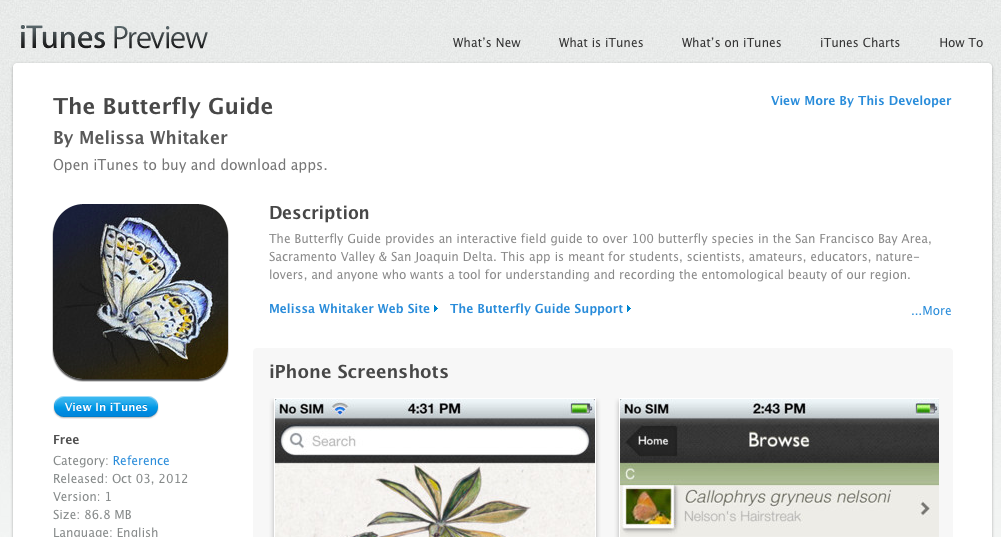
WooHoo – The NorCal Butterfly Guide App (free) is out from Melissa Whitaker from #UCDavis
So cool – check out this Free App The Butterfly Guide for iPhone 3GS, iPhone 4, iPhone 4S, iPhone 5, iPod touch (3rd generation), iPod touch (4th generation), iPod touch (5th generation) and iPad on the iTunes App Store
From Melissa Whitaker who is a PhD student in Art Shapiro’s lab at UC Davis and who comes to my lab meeting occasionally since she is also interested in microbes associated with butterflies …
UC Davis Magazine … not just tooting the #UCDavis horn …
I have just joined an advisory group for the UC Davis Magazine and I am really happy with their new direction. They are trying to make the magazine a little less “UC Davis is awesome” and more “Here are some interesting things to think about, with a UC Davis angle”. The new Fall Issue is a good example of this. There is for example a nice article by Sasha Abramsky about student involvement (or the lack thereof it). Plus there is a little video interview to go with the article. Perhaps even more “interesting” is the article on the future of higher education by Clifton Parker. Not exactly a glory piece about UC or UC Davis. Anyway … just thought I would put this out there. Any opinions on the magazine please send them my way – the staff there seem great and really interested in feedback.
Hi There!
I’m Sabreen Aulakh, one of the undergraduates working on the Undergraduate Aquarium Project! I’m a third year Microbiology major, and my plan is to go to medical school some time in the near future. I’m from San Jose, and I love to dance, specifically Bhangra, which is a traditional North Indian dance from Punjab, India. For those who are curious as to what it looks like, here’s a video of my team. (Nope, I’m not in this video because I was still in school.)
There’s just something about how those teeny tiny microbes have huge impacts on their environment that’s so darn interesting to me! I’m very excited to be a part of this lab, and can’t wait to see how this project unfolds. 🙂