Just got this email. Could be a real conference but am sick of getting SPAM advertising it. I note – the emails look a lot like the ones I get from Bentham publishers. I wonder if they are working together or just use the same email service?
Eisen Lab Blog
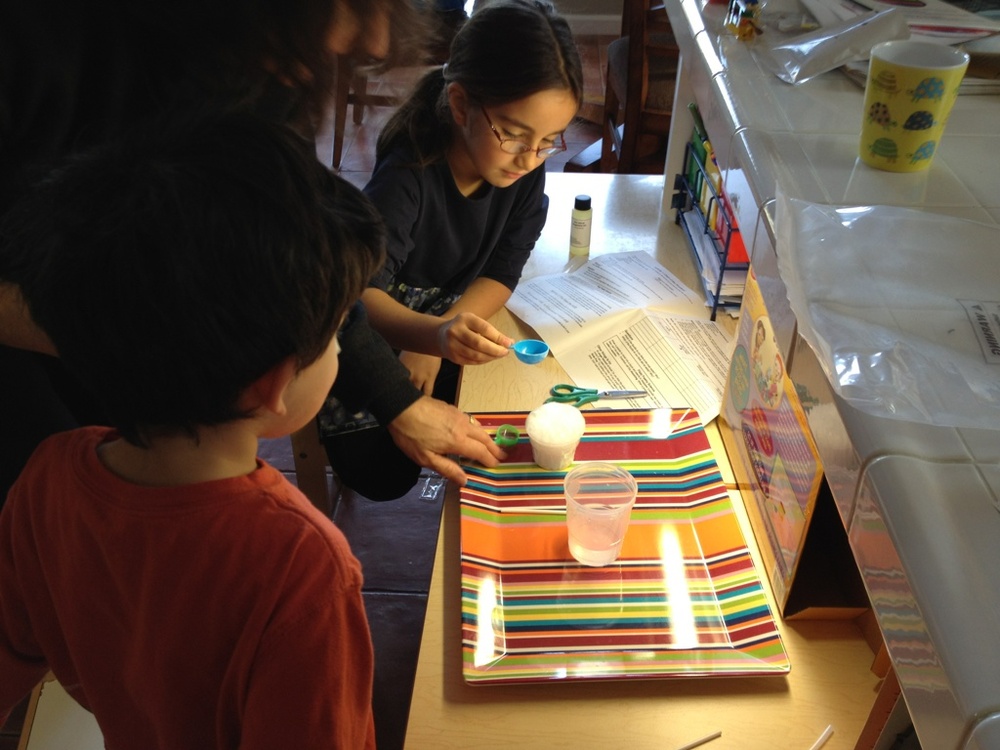
Woohoo – my kids are doing their 1st chemistry experiment (well 1st formal one)
Draft post cleanup #10: trip to LA artificially sweetened by Carolyn de la Peña
Yet another post in my “draft blog post cleanup” series. Here is #10:
Went on a mini trip to UCLA for a mini meeting in November. It seemed appropriate that I brought with me to Los Angeles, land of empty pleasures – the new book from UC Davis Professor Carolyn de la Peña – “Empty Pleasures” on the history of artificial sweeteners. So I took a picture of the book overlooking part of LA from my hotel room:
The book is great read by the way …
Announcement: Workshop on Multiple Sequence Alignment and Phylogeny Estimation
Posting this for Tandy Warnow
Workshop on Advances in Multiple Sequence Alignment and Phylogeny Estimation
The workshop is funded by the National Science Foundation through grant DEB 0733029 to the University of Texas. Registration is required, and attendance is limited to 40 participants. The workshop will include presentations of new methods for multiple sequence alignment and phylogeny estimation, also training in the use of these methods, and personal assistance in analyzing datasets using the SATé software (see this page). Applications for the workshop (and for travel support) are due by February 15, 2012, and will be responded to by March 1. We expect to be able to provide support to all attendees. Please click here for the application form. For more information, please send an email to Tandy Warnow (see below).
- NSF DEB 0733029
- Large-scale simultaneous multiple alignment and phylogeny estimation
- Project Webpage: http://www.cs.utexas.edu/users/tandy/ATOL-MSA.html
- Michael Braun, The Smithsonian Institution
- Mark Holder, The University of Kansas
- Jim Leebens-Mack, The University of Georgia
- Randy Linder, The University of Texas
- Etsuko Moriyama, The University of Nebraska
- Tandy Warnow, The University of Texas
Draft post cleanup #9: Open Access spam from Bentham
Yet another post in my “draft blog post cleanup” series. Here is #9; from June 2008. It can in a way be viewed as an extension of my post from a few days ago about Bentham. Here is what I wrote in 2008:
OK, I know I am supposed to be supportive of Open Access journals, just because a journal is OA does not mean it is OK. Take “The Open Evolution Journal.” being published by Bentham.
On paper, this could be a useful contribution to the list of OA journals. They have some good people on their Editorial Board and I am glad to see such a big list of people in Evolution seemingly supporting OA publishing.
And Bentham is certainly doing the OA talk and pushing OA as a major option for their publications. In fact, they might be pushing OA a bit too much. For example, in their letter to me they say
All published open access articles will receive massive international exposure and as is usually the case for open access publications, articles will also receive high citations.
Hmm. A bit over the top no? I love OA mind you. But OA in and of itself does not guarantee citations and exposure.
But this is a minor quibble. My real issue with them is the SPAM. I keep getting frigging emails from Bentham for all sorts of journals. And some of the emails I get are for accounts that I cannot easily send email from to use their lame unsubscribe option. I assume others out there get these emails from Bentham too, as I have gotten them from like 20 of their journals so far. And many are in areas that I have no expertise in (I just got one for a Geology journal).
Just goes to show – OA sometimes means “Objectively Annoying.”
YHGTBFKM: Ecological Society of America letter regarding #OpenAccess is disturbing
Wow — I am really disturbed by the letter the Ecological Society of America (ESA) has written to the White House OSTP in regard to Open Access publishing. (For some background see Dear Representatives Issa and Maloney – Are you kidding me? Stop this bill now #ClosedAccess and Calling on Publishers to Resign from The Association of American Publishers Re Anti-Open Access Stance).
In the letter they make many statements that bother me deeply including:
However, it is important to note that there is a significant difference between research results and peer-reviewed publications.
Really – how are they different exactly?
Publishers such as ESA have a long record of reporting, analyzing and interpreting federally funded research.
OMG – seriously? Apparently ESA is doing the analyzing and reporting and interpreting. Not the scientists writing the papers. But the publisher. Seriously. This is completely ridiculous.
It is not appropriate for the federal government to expropriate the additional value publishers add to research results.
They can’t be serious. This is not expropriation in any way. This is the trying to guarantee that research taxpayers have paid for – that is done by scientists that taxpayers pay the salaries of – is not then published in a way that forces the taxpayers to pay for it again.
Furthermore, subscription revenue helps to support other Society services, including scientific conferences, education programs, and the distribution of science information resources to policymakers and the public.
So now what they are saying is that the government should hand them money via subscription fees so that they can then carry out some services they think are important. How about this – how about the ESA applies for peer reviewed grants to fund their activities so that these can be reviewed by others. As it is ESA can do whatever it wants with that money – being fed to it without any peer review – via indirect costs and grant money.
Papers published in ESA journals may therefore be just as relevant in several years as they are today, which means that any potential embargo period will do little to mitigate the financial losses that would result from full open access.
So – the justification here for not making ecological articles available is that they are MORE important over time? So the taxpayers pays for research that is valuable and because it is valuable over time we should make it less freely available? Seriously?
And here is the best one:
One way to make taxpayer funded research more visible and accessible to interested members of the public would be to require federally-funded grantees to provide a second version of the research summaries they already prepare, specifically for the lay reader. To aid in online searches, these summaries could also include the source of federal funding institutions and grant numbers. Publishers could also include grant information in paper abstracts which are usually available without a subscription.
That is right, they are suggesting that scientists write a second paper to go with their science papers that would be for the lay reader. And that these summaries could include grant IDs to help in online searches. WTF? So now rather than making the actual scientific papers available they are proposing that scientists write a second paper because lay people would not be able to understand the first paper? And what about scientists who want to read the papers but are at small institutions? And never mind that “open access” is not just about money – it is also about “freedom” in the usage of published material.
The ESA has really gone off the deep end on this. I note – I am in full support of companies and publishers making money. I am also generally against government regulations. But this issue is about taxpayers rights, government waste, and the progress of science. It is simply inexcusable for the government to not use taxpayer money judiciously.
If the government pays for the research, pays for the research supplies, pays the salaries of researchers and peer reviewers, then it is unacceptable that publishers would then limit access to papers and force taxpayers to pay for them again.
The ESA basically is saying “taxpayers should be required to subsidize us“.
Or – another way to look at this – ESA is saying: “Taxpayers – we want your money -but you are too stupid to understand what we are doing with it.“
Ridiculous.
Hat tip to Karen Cranston for pointing this out.
Some responses to this post:
@phylogenomics Ecologists against public access to peer reviewed publications johnhawks.net/node/28402 <– Not ecologists; lobbyists.
— Mike Taylor (@SauropodMike) January 7, 2012
@phylogenomics ESA seems to mimic AAA arguments against #openAccess from 5 years ago alexandriaarchive.org/blog/?p=840#ES…
— Eric Kansa (@ekansa) January 7, 2012
//platform.twitter.com/widgets.js
YHGTBFKM: Ecological Society of America letter regarding #OpenAccess is disturbing – bit.ly/AAfbEj disgusting/insulting, more like
— Glyn Moody (@glynmoody) January 7, 2012
//platform.twitter.com/widgets.js
RT @drcraigmc: Really shocked by this: Ecological Society of America letter regarding #OpenAccess is disturbing shar.es/WJuK3
— Carly Strasser (@carlystrasser) January 7, 2012
//platform.twitter.com/widgets.js
Yes, disturbing, to say the least! YHGTBFKM: Ecological Society of America letter regarding #OpenAccess is disturbing shar.es/WJkdI
— Madhusudan Katti (@leafwarbler) January 7, 2012
//platform.twitter.com/widgets.js
@carlystrasser @drcraigmc That is bad. I hate in when professional societies put their revenue models ahead of their members interests.
— Eric Kansa (@ekansa) January 7, 2012
//platform.twitter.com/widgets.js
Wow, scientists being downright merchant bankers about their revenue streams & tax-funded research: phylogenomics.blogspot.com/2012/01/yhgtbf… via @mattblaze
— Lee Alley (@lee_alley) January 7, 2012
//platform.twitter.com/widgets.js
“We want your money, but you’re too stupid to understand what we’re doing with it.” phylogenomics.blogspot.com/2012/01/yhgtbf… #openaccess
— Michael Ekstrand (@elehack) January 7, 2012
//platform.twitter.com/widgets.js
#OA without programmatic access? So wrong. Publishers, make money while *making your product useful*, would you? bit.ly/AsHetK
— Heather Piwowar (@researchremix) January 7, 2012
//platform.twitter.com/widgets.js
Academics against open access: bit.ly/Albjqt. And a response: bit.ly/wa7tiP
— Kenan Malik (@kenanmalik) January 7, 2012
//platform.twitter.com/widgets.js
Why doesn’t the Ecological Society of America allow their Open Access content to be text mined? wp.me/p22qQ8-22 via @wordpressdotcom
— Scott Chamberlain (@recology_) January 7, 2012
//platform.twitter.com/widgets.js
Still think science and politics don’t mix?… fb.me/W58YnJVK
— Dr. Kiki Sanford (@drkiki) January 6, 2012
Draft post cleanup #8: Don’t let a hospital kill you – CNN.com
Yet another post in my “draft blog post cleanup” series. Here is #8 from 5-1-2008
——————
Saw an interesting article today on CNN.Com: Don’t let a hospital kill you – CNN.com. It has some useful suggestions for how to protect yourself from infection in a hospital. In many cases we have an excessive fear of germs which can be a bad thing. But in hospitals, staying clean is almost certainly a good idea …
Go PLOS Biology – getting lots of press coverage for recent pubs
Just got this email from PLoS Biology and thought I would share – it has links to press coverage of recent PLoS Bio papers :
We are writing to update you on some papers recently published in PLoS Biology.This is a summary of our recent media coverage for PLoS Biology board members, friends, and for editors. Thank you again for your support of the journal.
On January 3, PLoS Biology published an article by Prof. Alex Rogers et al., which detailed a survey of Antarctic waters along the East Scotia Ridge in the Southern Ocean, revealing a new vent biogeographic province among previously uncharacterized deep-sea hydrothermal vent communities. This received significant coverage in the media, a selection of which is below:
PBS News Hour (video)
BBC World Service (audio)
Press Association
Discovery News
Reuters (video)
The Telegraph
Wired
Scientific American
National Geographic
Nature
ABC (Australia)
Sydney Morning Herald
MSNBC
CBC (Canada)
Fox News
New Scientist
The Mirror
The Daily Mail
Indian Express
In the same issue, PLoS Biology published an article by Dr David Ornitz and colleagues, which described how FGF20 signaling in mice is required specifically for the differentiation of cochlear outer hair cells – the cells most often damaged during age-related hearing loss. This also received attention in the media, including the following:
NHS Choices
Press Association
The Mirror
The Daily Mail
Scotsman
Irish Examiner