So – I have been doing a little “hacking” of the Impact Story system to create pages specific for individual projects rather than for me or other researchers. I did this last week for my microBEnet project: Made a project page (hack?) for microBEnet on ImpactStory. And been playing around with the concept some more.
For example see this page I made for the “iSEEM2: Environmental Niche Atlas” project that is a collaboration between my lab and the lab of Katie Pollard at UCSF (supported by the Gordon and Betty Moore Foundation). To do this, I registered a new account in ImpactStory (with the first name i and last name SEEM2; using an alternative email address I have). I then used the “upload individual products” and loaded up Pubmed IDs, DOIs, Github web addresses, Slideshare web addresses and more. And Voila I get I nice page with Altmetrics for our project rather than for myself.
Now I have not loaded everything done on this project yet, but already this is a helpful way to post results from our project and look at some of their metrics. I also updated the website for the project: http://iseem2.wordpress.com.
I think making such project specific pages will end up being useful in many ways. I discovered one this AM in an email I got from Impact Story. I have appended it below. Turns out they give weekly updates on how your metrics have changed for that week. This is the best thing I have seen regarding “Alt Metrics” anywhere. Very very useful. Still not sure if this is an “acceptable” use of ImpactStory but I figure they should be OK with it.
One or more of the 31 products on your profile attracted a combined 8 new SlideShare downloads this week, bringing you to 22 total. Congrats on passing the 20 mark!
This article attracted 4 new Scopus citations this week, bringing it up to 40 total. It marks your 1st product to get this many citations on Scopus. Nice work!
That brings this article up to 29 Scopus citations total. Impressive! Only 1% of 2012 article have reached that many citations. It marks your 2nd product to get this many citations on Scopus. Nice work!
This slides attracted 83 new SlideShare views this week, bringing it up to 83 total. It marks your 3rd product to get this many views on SlideShare. Nice work!
slides milestone
First Delicious bookmarks
on Systematic identification of gene families for use as “markers” for phylogenetic and phylogeny-driven ecological studies of bacteria and archaea and their major subgroups.
This article attracted 1 new Delicious bookmarks this week, bringing it up to 1 total. It marks your 4th unique product to get a bookmarks on Delicious. Nice work!
article milestone
First SlideShare downloads
on Phylogeny-Driven Approaches to Genomics and Metagenomics – talk by Jonathan Eisen at Fresno State May 6, 2013
This slides attracted 7 new SlideShare downloads this week, bringing it up to 7 total. It marks your 3rd unique product to get a downloads on SlideShare. Nice work!
slides milestone
First SlideShare favorites
on Phylogeny-Driven Approaches to Genomics and Metagenomics – talk by Jonathan Eisen at Fresno State May 6, 2013
This slides attracted 2 new SlideShare favorites this week, bringing it up to 2 total. It marks your 1st unique product to get a favorites on SlideShare. Nice work!
According to James Kaufman, a research manager at the Almaden Research Center, the move to study metagenomics — the study of systems of micro-organisms — came from what he called a tipping point in big data. As more and more government-funded institutions study organisms and bacteria, they’ve collected more information about them, and submitted much of their work to centralized databases. “So there’s a growing library of genomes across the field of life,” Kaufman said. “That made possible metagenomics.”
What? Metagenomics has been around for a long time. Sure, many people in the field are taking advantage of so called big data, but there was no “tipping point” needed to launch the field. This is just completely misguided. And then even worse
The result: We can now look at and understand whole ecosystems at the bacterial level. One example of how that manifests is what IBM refers to as the Human Microbiome Project. According to an IBM document, that’s about characterizing “microbial communities found at multiple human body sites to discover correlations between changes in the microbiome with changes in human health.”
So – there have been dozens of high profile papers from the Human Microbiome Project. There are hundreds of web pages with information about the project. It was started years and years ago. And the reporter quotes an “IBM document” to tell us what the Human Microbiome Project is? And even worse the reporter says “what IBM refers to as the Human Microbiome Project” like they ran it / designed it. Good that they refer to it as the Human Microbiome Project. You know why? Because that is what it is known as to all the other $(&@)(* people in the whole (%&# world.
The reporter goes on to write
This kind of work is not entirely new, but the scientists who will be gathering at IBM Research this week are grappling with one conundrum: they don’t know what they don’t know. So a big topic of conversation, and a big part of what IBM would like to see advanced, is “the ability to do metagenomics on the scale of a city or the world….That will depend on software services available in the cloud,” Kaufman said. “It has to be cheap, easy, and accessible from anywhere. That’s what we’re really good at.”
Once again making it seem like IBM is somehow leading this field. Not to pick on IBM here. I am glad they organized the meeting. But either the reporter just got handed a press release from IBM and wrote it up, or did not do any type of background research, or both. Sure IBM would like to see this. But so would lots of other people. Why make this all about IBM? There are so many people who have done interesting work in the area of “microbiology of the built environment” – why are none of them even discussed? What exactly is the point of this article if not to simply be a PR piece for IBM? Aaaaaarg. UPDATE 5/9 Storify of some of the Tweets about the meeting
I truly love the work Bil Gates and the Gates Foundation have been doing over the last years. Absolutely wonderful stuff. But I have a bone (or perhaps a proboscis) to pick with this latest effort: The Deadliest Animal in the World | Bill Gates. The article discusses some “facts” about how many people different animals kill. And it uses this to argue for the need for more attention to be placed on mosquitoes. I agree with the conclusion. Mosquitoes are a big deal and need much much much more work and attention. But the data is just, well, not sound. Here is the problem I have
1. Many of the animals, including mosquitoes, are on the list are there because of the diseases they transmit. For example, dogs are there (for rabies), and tsetse flies are there for sleeping sickness. That is, they do not kill people directly but indirectly because of a disease they transmit.
2. If we follow that logic, which I am fine with, then we need to add a whole lot of deaths to the “human” column. After all, humans transmit a whole heck of a lot of diseases that kill humans. One source I found has the following #s
HIV/AIDS: 1.78 million per year
Tuberculosis: 1.34 million per year
Flu: 250-500,000 per year
HAIs: >100,000
Syphilis: 100,000
Measles: 600,000
and many many many more. The totals are probably greater than 5 million per year that are killed by infectious diseases where it was humans who transmitted the agent to other humans. Way more than the mosquitoes. Again, I agree with the conclusion. We need lots more attention on mosquitoes. But there seems little doubt to me which animal is most responsible for the spread of deadly pathogens to humans. And that animal is us.
UPDATE 5/3
Am kind of annoyed at the press coverage of this Gates – mosquitoes are the deadliest animal – concept. Here are some examples where people just ate up the idea without really asking any questions about its accuracy
In looking at the agenda for the meeting I am pretty bummed about the gender ratio of speakers. Looks like 18:5 Men to Women.
Jeff Welser IBM
David Haussler UCSC
Daniel Huson Tubingen U
Joe DeRisi UCSF
Jane Carlton NYU
Ajay Royyuru IBM
Paula Olsiewski Sloan Foundation
Christopher Mentzel Moore Foundation
Anne Marie Kimball Gates Foundation
Jonathan Eisen UC Davis
Jessica Green U Oregon
Mark Adams JCVI
Eric Alm MIT
Raul Andino UCSF
Scott Kahn Illumina
Mike Lelivelt Ion Torrent
Radoje (Rade) Drmanac Complete Genomics
Brett Bowman Pacific Biosciences
Chris Mason Cornell
Bart Weimer UC Davis
David Crean Mars
Astri Wayadande Oklahoma State U
Christopher Elkins FDA
Not sure what to do about this. I am certainly (in a few minutes) going to be writing to the organizers. I am also pondering cancelling talking. I try very hard to be vigilant about gender ratios at meetings and it drives me crazy to see such skews. I know it is not always possible to have meetings have equal representation and I know some people try very hard and do not succeed. But this seems unpleasantly extreme. So – any thoughts or recommendations as to what to do would be appreciated.
UPDATE 5/5 –
Well the schedule has been updated – and now the male: female speaker ratio is 21:6. Note – Jack Gilbert is moderating and speaking and I am counting him twice. Also Robert Prill is opening each day and closing day 2 so in a way this could be counted as 23:6.
Robert Prill, IBM
Jeff Welser IBM
David Haussler UCSC
Daniel Huson Tubingen U
Joe DeRisi UCSF
Jane Carlton NYU
Ajay Royyuru IBM
Laurie Garrett (moderating)
Paula Olsiewski Sloan Foundation
Christopher Mentzel, Moore Foundation
Anne Marie Kimball Gates Foundation
Jonathan Eisen UC Davis
Jessica Green U Oregon
Robert Prill
Mark Adams JCVI
Eric Alm MIT
Raul Andino UCSF
Jack Gilbert (moderating)
Jack Gilbert (speaking)
Scott Kahn, Illumina
Mike Lelivelt Ion Torrent
Radoje (Rade) Drmanac Complete Genomics
Brett Bowman Pacific Biosciences
Chris Mason Cornell
Bart Weimer UC Davis
David Crean Mars
Astri Wayadande Oklahoma State U
Christopher Elkins FDA
Robert Prill
UPDATE 5/7
So I decided to go to the meeting and talk. Here is a video slideshow of my talk with audio.
I am not sure if I made the right decision but what I decided to do was to change my talk to feature the work of women and to highlight those women.
UPDATE 5/8
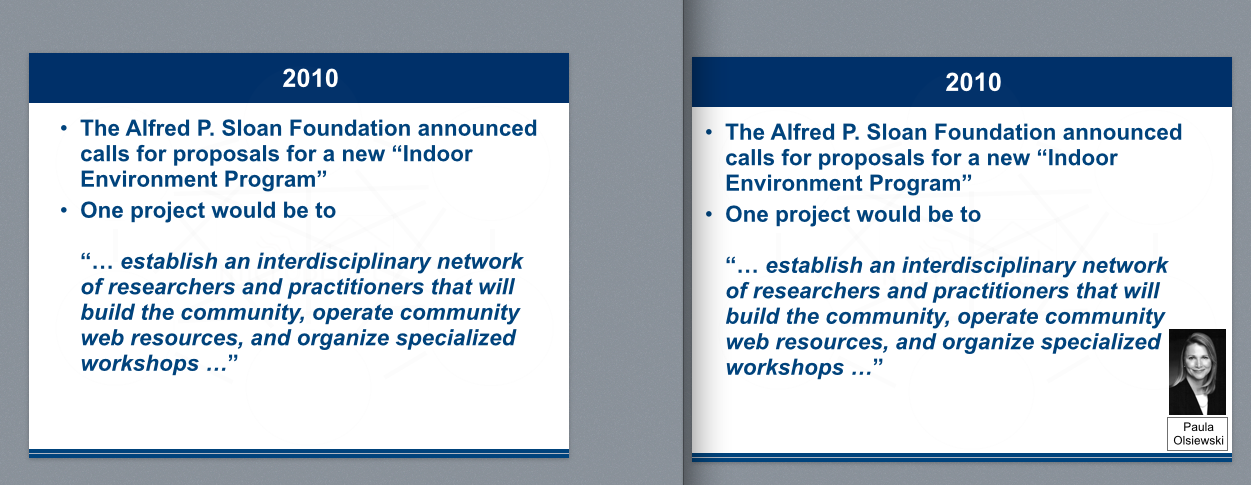
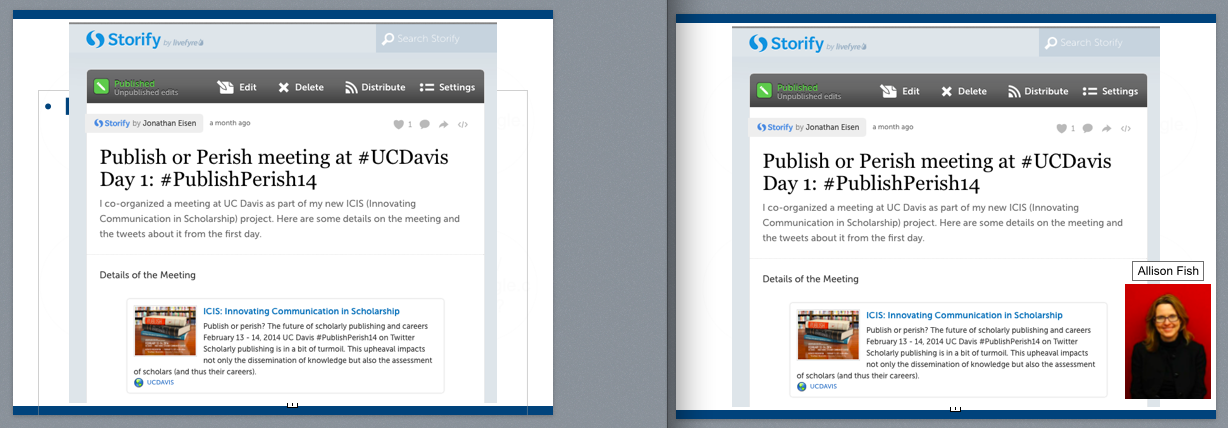
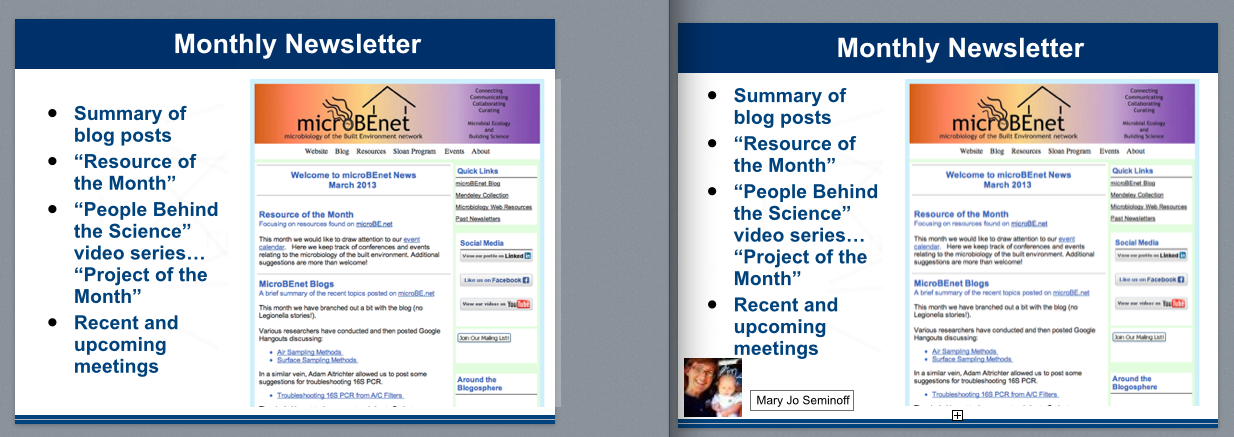
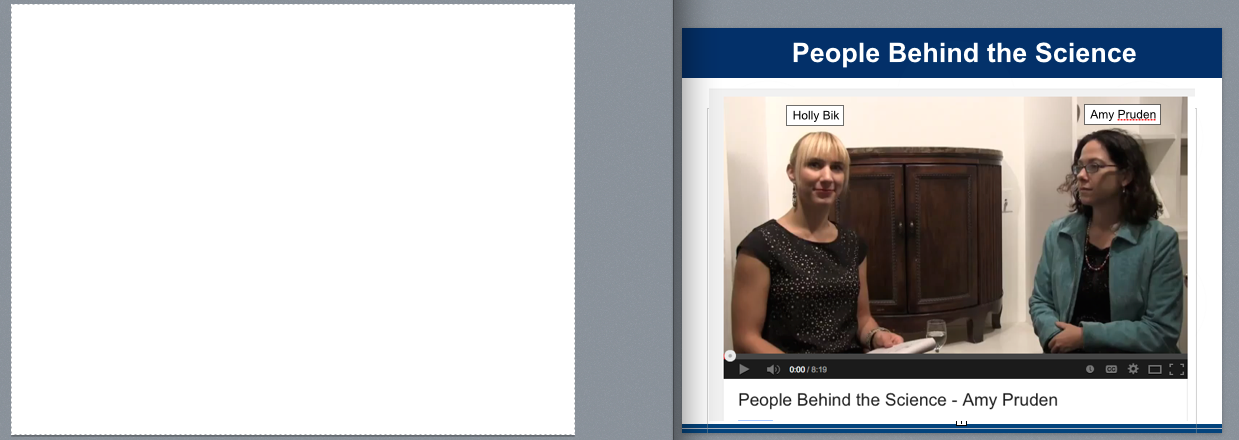
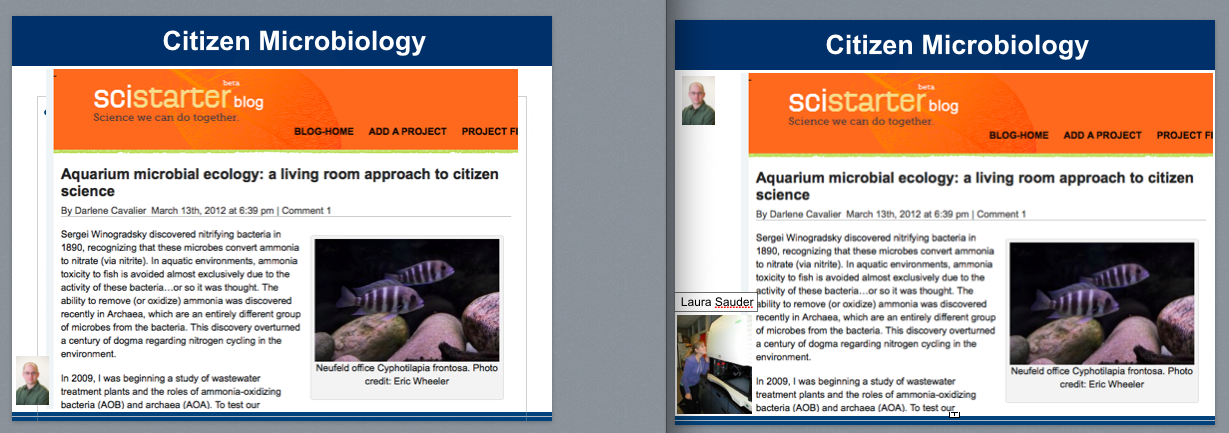
Here are some pics showing the before (left) and after (right) for how I changed my talk from the previous talk I gave about this topic. Among the changes I made:
I added names and pictures of the women behind the work
Changed examples to be about work of women when I had been using work of men
Added additional examples of work by women directly related to my talk
And I used the pictures and names on the slides to remind me to talk about the women behind the work.
I think this strategy is a potentially useful tool in combatting the implicit and subtle biases against women in STEM fields. All of what I said was true. I just made sure to emphasize and use examples of work by women when previously I had either not said who did certain work or had sometimes emphasized work by men. And I made sure to show pictures and say the names of the women behind the work too.
Added name and picture of program officer Paula Olsiweski who I had quoted previously.
Changed example of new publication that we add to our collection and used a publication by a female graduate student, post doc Rachel Adams.
Included name and picture of student post-doc Rachel Adams on other slides about the topic
Included name and picture of student post-doc Rachel Adams on other slides about the topic.
Added a mention of the blog post by student post-doc Rachel Adams.
Added picture and name of post doc Allison Fish who organized meeting I was discussing.
Added name and picture of Mary Jo Seminoff who coordinates production of the newsletter I had mentioned.
Added screenshot and names of Holly Bik interviewing Amy Pruden for the “People Behind the Science” series mentioned in previous slide.
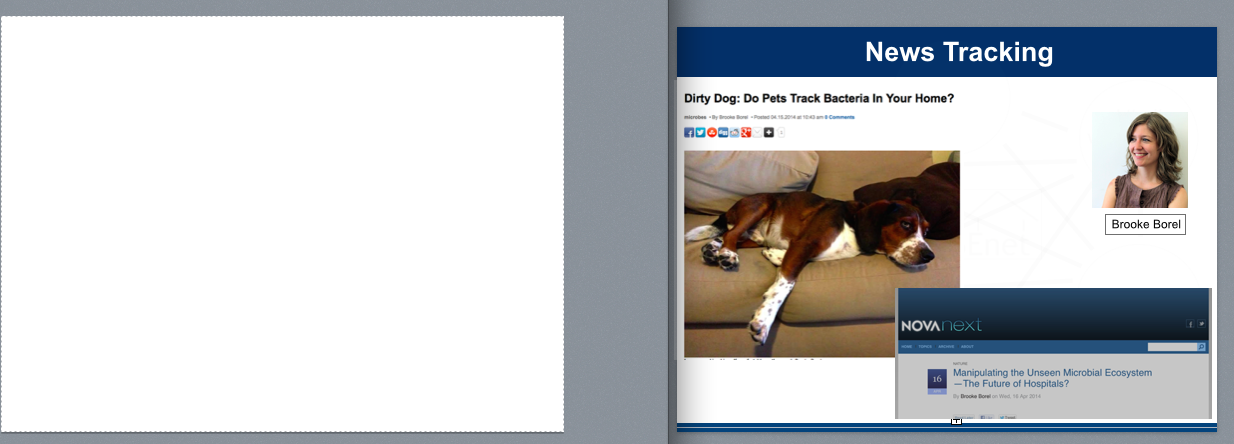
Added name and picture of Brooke Borel and discussed her news stories (had mentioned news stories in general w/o examples)
Added picture and name and blog post of Holly Ganz who wrote about the news stories by Brooke Borel.
Added extra slide discussing Software Carpentry workshop organized by Jenna Lang and Tracy Teal (and added names and pics of them).
Added pics and names of Jo Handelsman and Tiffany Tsang who coordinated one of the examples on the slide but who had not gotten mentioned specifically.
Added picture and name of undergraduate student Hannah Holland-Moritz who was involved in this work.
Added picture and name of research associate Madison Dunitz who led this work.
Added name and picture of undergraduate student Sabreen Aulakh who was involved in this work.
Added picture of graduate student Laura Sauder who was our main contact in the lab of Josh Newfeld.
Added picture and name of Darlene Cavalier who was keynote speaker at these meetings.
Added extra slide on the phone microbiome project and added names and pics of the people involved including graduate student Georgia Barguil.
Added names and pics of the people behind this project (Holly Menninger and Rob Dunn)
Changed slide a little bit and added name and pic of Jessica Richman, one of the people behind the uBiome project.
Added pics that included more of the key women behind this project – including Darlene Cavalier, Wendy Brown and Jenna Lang.
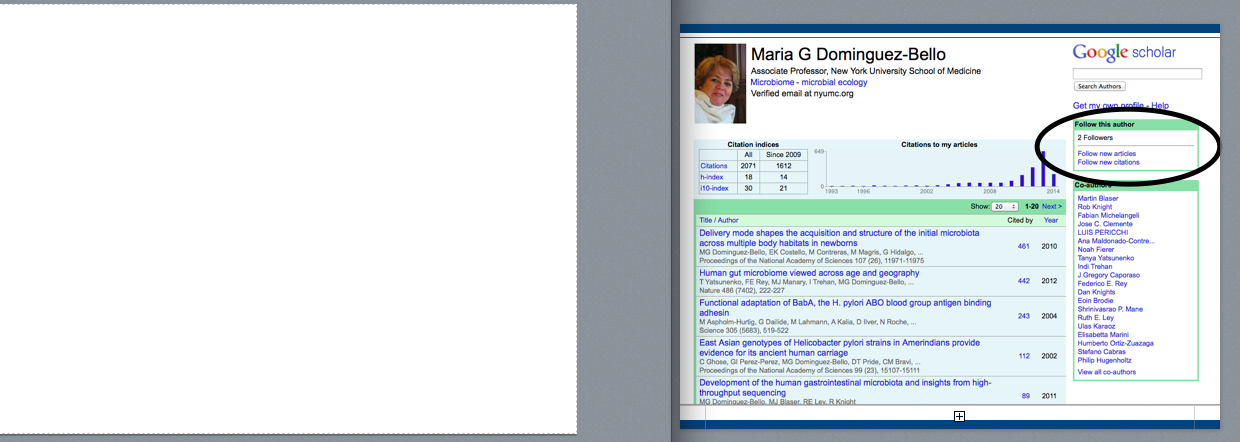
Added a slide about Altmetrics and added pic and name of Heather Piwowar and mentioned her work Had included one line about Altmetrics on a slide before.
Added reference to paper by Holly Bik and Miriam Goldstein and emphasized the workshops run by Holly Bik. Included pics and names on slide too.
UPDATE 5/8
Added links to find out more information about the work of the women in the slides (links are in the image captions). UPDATE 9/6/14 https://apis.google.com/js/plusone.js
The article starts of OK – reporting on the new WHO report on antibiotic resistance. But then it gets into the microbiome and what antibiotics supposedly do to it. Some quotes:
“But even more concerning, say experts like Dr. Martin Blaser, director of the human microbiome program at the New York University Langone Medical Center and author of Missing Microbes, is how these antibiotics are affecting the makeup of both good and bad bacteria that live within us – our microbiome. The first big cost of antibiotics is resistance,” he says. “But the other side of the coin is [the fact that] antibiotics are extinguishing our microbiome and changing human development.”
Extinguishing our microbiome? Really? The evidence simply does not support such a claim. I personally think antibiotics may be contributing to messing up the microbiome in many people and that this in turn might be contributing to the increase in a variety of human ailments (e.g., I mentioned this issue in my TED talk and many many times here and elsewhere). But “extinguishing”? Not even close. In fact, many of the published sutdies done so far suggest that the human microbiome is pretty resilient in response to antibiotics. Really serious overselling of the impact of antiobitcs by Blaser.
And “changing human development?” Not sure what the evidence for that is either. Most likely this refers to the role the microbiome plays in immune system development but I am not aware of strong evidence that antibiotics lead to changes in human devleopment.
They then quote Blaser again:
If I prescribe a heart medicine for a patient, that heart medicine is going to affect that patient,” says Blaser. “But if I prescribe an antibiotic, that antibiotic will affect the entire community to some degree. And the effect is cumulative.
Yes antibiotics can affect more than one person because microbes (and resistance) can spread. But “the effect is cumulative”? I do not think that has been shown.
Finally, Time (well, Alice Park, the author) states (in relation to limiting overuse of antibiotics)
That may also help to protect our microbiomes, which in turn could slow the appearance of chronic diseases such as obesity, cancer and allergies.
What? Now antibiotics cause obesity? And allergies? And cancer? Sure – there is good reason to think that antibiotic usage plays a role in obesity and allergies. The evidence is not yet completely overwhelming but it is certainly a reasonable notion. But how did cancer get thrown in here?
I note – as I assume many know – I think the microbiome is critical to many human functions and phenotypes. And screwing with it via excessive use of antibiotics seems like a very very bad idea. The precautionary principle says to me we should avoid any antimicrobials unless absolutely necessary. But do we really need to overstate what we know in order to effect change? Do we need to say things like “antibiotics are extinguishing our microbiome” which is simply untrue? I don’t think we do. I think we can be more careful, not mislead people, and still have an impact. And thus, I am giving out today’s “Overselling the microbiome” award to Time magazine and Martin Blaser.
Some papers that offer a more tempered view of the role of the microbiome in causing various disease:
CE West, MC Jenmalm, SL Prescott. 2014 The gut microbiota and its role in the development of allergic disease: a wider perspective. Clinical & Experimental Allergy, 2014
Disturbed gut colonisation patterns have been associated with allergic disease, but whether microbial variation is the cause or effect of these diseases is still under investigation. We are far from understanding what constitutes a “healthy gut microbiome” that promotes tolerance. This remains a major limitation and might explain some of the inconsistency in human intervention studies with prebiotics and probiotics. Multidisciplinary integrative approaches with researchers working in networks, using harmonised outcomes and methodologies are needed to advance our understanding in this field.
Such data suggest that bona fide associations may exist between microbiota and obesity in humans, although causality remains to be addressed. Whether these associations will hold up to large-scale replication has yet to be determined. This situation is reminiscent of genetic association studies done in the pre-genome-wide association scan era, during which many candidate associations were found using sample sizes which at the time were considered large, but were rather small in retrospect [54]. Very few of these earlier associations have held up to replication in the modern era, where the threshold for association is more stringent and requires sample sizes orders of magnitude larger [55]. It seems reasonable to postulate that causal contributions from the gut microbiome to the development of human obesity have effect sizes on the order of common genetic variations implicated in complex diseases. If this is the case, much larger studies will be necessary before we have clear evidence of association.
This review considers the nature of the evidence supporting a relationship between the microbiota and the predisposition to disease as associative, correlative, or causal. Altogether, indirect or associative support currently dominates the evidence base, which now suggests that the intestinal microbiome can be linked to a growing number of over 25 diseases or syndromes. While only a handful of cause-and-effect studies have been performed, this form of evidence is increasing.
Talk by Rob Knight on “From Correlation to Causation in Human Microbiome Studies”
Update 5/4 #2. I would also recommend people check out the Helicobacter foundation web site. which has some useful background information on the organism and the diseases it causes.
Update 5/4 #3. Some recent papers by Martin Blaser worth looking at
Oh – and Barry Marshall – winner of the Nobel Prize for discovering how H. pylori causes ulcers and cancer – chimed in on Twitter:
@phylogenomics@barjammar Jonathon, I never killed anyone by giving them antibiotics but I know of plenty who died when they didn’t get ’em. — Barry Marshall (@barjammar) May 3, 2014
Excellent suggestion of @TCNoel to discuss reasons for, against elimination of H. pylori in microbiology course http://t.co/y9P1yXtTDM — WvSchaik (@WvSchaik) May 1, 2014
A related question I have been thinking about involves Caesarian sections and whether they lead to an increased risk of any ailments that might have a microbial connection (e.g., obesity, allergy, autoimmune diseases). I started digging into the literature on this for my TED talk and then again when I posted something from the Smithsonian Genomics Exhibit that suggested there were no risks associated with C-sections.
Some papers on the topic suggest there may be some risks from C-sections related to these topics but that they are very very small:
And in at least a few of these stories, Martin Blaser’s book is referenced in relation to whether antibiotic usage may contribute to this. So one might ask – is there evidence for whether antibiotics contribute to type 1 diabetes? I think the results are unclear and ambigious. See some of these papers and stories:
Wrote a draft of this post in 2012. Decided to post it now since I included some information about it in a talk and it has gotten some reaction on the intertubes (e.g., Blog about science? Kiss your grant proposal goodbye). This is what I wrote after getting the reviews back and decided, for various reasons, to never post. In retrospect, I think I should have posted then …
Got this back in a grant review for a project that I have a minor role in:
Outstanding group of individuals, and the organizational and management structure appears sound with clear roles and responsibilities of theme faculty. There is a large focus on developing this for microbiome research, but Eisen seems to be the only team member with this expertise, and may not have the bandwidth to coordinate this on such a large project alone, especially given his high time commitment to his blog.
I started drafting a letter to the reviewer – partly about how great I think I am and partly to vent some anger … here is the beginning:
My blog is in fact about EXACTLY what we were talking about in the proposal, you fucking piece of fuckingshit.
Fuckyou.
You are right in a way – I have little time to spare. Did I somehow not do something you wanted me to do? Fine. Say that. But focusing on my blog just shows you are a …
But then I realized this was a bit too much. I should not let this comment lead me to get defensive about my career, my blog, etc. Plus, I was spending too much time on this. (The above took 2 minutes and 12 seconds to write and then another 1 minute and 11 seconds to highlight and link up and ponder). So I decided to be more concise
Dear Reviewer
Fuckyou.
Love, Jonathan Eisen
But then I realized, cursing was not the solution. Maybe love would be better?
Dear Reviewer
Thank you for your insight. I will do my best to spend less time blogging in the future.
Love, Jonathan Eisen
But this still did not seem right. So I decided that the best option was to do nothing. So that is what I am doing. Nothing. No response. No blog post. Nothing. There. I feel better already.
NOTE – I HAVE SENT A MESSAGE OF CONCERN/COMPLAINT TO THE PROGRAM OFFICER WHO RESPONDED INSTANTLY AND APOLOGIZED AND ACCEPTS THAT THIS WAS UNACCEPTABLE. PO SAYS THIS HAD NO IMPACT ON FINAL DECISION. PO PROBABLY RIGHT.
NOTE 2 – I HAVE BEEN ON MANY GRANT PANELS WHERE REVIEWERS OR EVEN PANELISTS MAKE INAPPROPRIATE SNARKY COMMENTS. IN MOST CASES PEOPLE / PROGRAM OFFICERS TRY TO REMOVE THESE.
NOTE 3 – SNARKY COMMENTS ARE MADE FOR MANY PAPER REVIEWS TOO. WHEN I AM HANDLING A PAPER AS AN EDITOR I DO NOT REMOVE SUCH COMMENTS BECAUSE I THINK THE AUTHORS DESERVE TO SEE ALL OF THE REVIEW. I DO SAY THAT REVIEWERS COMMENTS WERE DISCOUNTED BECAUSE OF INAPPROPRIATE BEHAVIOR BUT THAT I FELT THAT AUTHOR DESERVED TO SEE REVIEW.
NOTE 4 – IT REALLY IS TOUGH TO RUN A GRANT REVIEW PANEL. YOU CAN DO EVERYTHING RIGHT – HAVE AS FAIR A REVIEW AS POSSIBLE AND THEN SHIT LIKE THIS HAPPENS. I SYMPATHIZE WITH THE PO HERE. I STILL POSTED THIS BECAUSE, WELL, IT IS WHAT I DO.
NOTE 5 – I DO SPEND A LOT OF TIME ON ONLINE COMMUNICATION. BUT MY BLOG IS ONLY ONE PART OF THAT. I LIKE SCIENCE ONLINE STUFF. I REALLY DO. SO SHOOT ME. THOUGH I NOTE – I THINK THIS ONLY HELPS THE RESEARCH/PROJECTS I WORK ON.
Eisen responds to grant reviewer’s idiotic complaint that his blog takes time…by brilliantly blogging about it. http://t.co/sktHe9jL3L — Bill Sullivan (@wjsullivan) May 3, 2014
Hystetical and insightful..perfect..Grant review: you blog too much, Eisen’s response – blog about it http://t.co/gxcaNCXfNS — L Sucheston Campbell (@lsuchcamp) April 30, 2014
BIO seeks community input on Genomes-Phenomes research frontiersJohn Wingfield, Assistant Director of the National Science Foundation Directorate for Biological Sciences (BIO), is pleased to announce the posting of a Wiki to seek community input on the grand challenge of understanding the complex relationship between genomes and phenomes. The Wiki is intended to facilitate discussion among researchers in diverse disciplines that intersect with biology, such as computation, mathematics, engineering, physics, and chemistry.The Wiki format encourages open communication, captures new viewpoints, and promotes free exchange of ideas about the bottlenecks that impede progress on the genomes-phenomes grand challenge and approaches or strategies to overcome these challenges. Information provided through the Wiki will help inform BIO’s future research investments and activities relevant to understanding genomes-phenomes relationships.To provide comments, ask questions and view input from and interact with other community members, first-time users should sign up for an account via this link:Sign-up. Once registered, users will be directed to the main page of the NSF Wiki to accept the terms and conditions before proceeding. Additional guidance and subsequent visits can be accessed via this link: Genomes-Phenomes Wiki.Community members should feel free to forward notice of this to anyone they think might be interested in contributing to the discussion. Questions regarding the Wiki should be sent to bio-gen-phen@nsf.gov. ########################################################################
Nice that they are seeking input. But really – does NSF have to adopt “phenome” as a term? How exactly is this different from “phenotype”? This seems to be a case of exactly what I was criticizing in my Badomics article in Gigascience and in all my posts here (eg bad omics words of the day, Worst New Omics Word Award, badomics, etc). Blech. Genomics is really interesting. I have worked on it for many years. But there is no need to contaminate the literature by using new, uninformative, oversold terms like “phenome”.
Congrats to all involved: Madison Dunitz, Pamela James, Guillaume Jospin, David Coil and Angus Chandler. Getting data out there to the community and writing up a description of how the data was generated is an important part of open science.
Dear UC Davis Faculty, Staff, Students and Community Members,
We would like to remind you that the next event in the Provost’s Forums on the Public University and the Social Good will be held next Wednesday, May 7, 2014.
Daryl Smith, Senior Research Fellow and Professor Emerita of Education and Psychology at Claremont Graduate University will be speaking on the topic of “Diversity’s Promise for Excellence in a Pluralistic Society: The Public University and the Common Good”.
Before assuming her current faculty position at CGU, Professor Smith served as a college administrator in planning and evaluation, institutional research, and student affairs. Her research, teaching, and publications have been in the area of organizational implications of diversity, assessment and evaluation, leadership, and change, governance, diversity in STEM fields, and faculty diversity. She is the author or co-author of several books, including Diversity’s Promise for Higher Education: Making it Work, The Challenge of Diversity: Alienation of Involvement in the Academy, and Achieving Faculty Diversity: Debunking the Myths.
Professor Smith will be joined by two UC Davis panelists for this event. Kevin Johnson, Dean of the UC Davis School of Law,
Mabie-Apallas Professor of Public Interest Law, and Professor of Chicana/o Studies, and Maureen Stanton, Vice Provost for Academic Affairs and Professor of Evolution and Ecology.
The event will begin at 3 p.m. in the Multipurpose Room of the Student Community Center and will go until 5:30 p.m. It is free and open to the general public. There will be an hour long reception with light refreshments directly following the end of the lecture.
If you are unable to attend this event, videos of all Provost’s Forums lectures are available to the public and can be found on the official Provost’s Forums website. Our most recent lecture, “Universities and Regional Growth: Insights from the University of California” will soon be available for viewing along with all of the 2013-2014 season lectures.
For more details and information on this event, please see the attached flyer, visit our website: The Provost’s Forum on the Public University and the Social Good, or contact Casey Castaldi. In addition, please forward this information to any interested parties, as all events are open to the public.
Monday’s Genetics seminar speaker is Beth Shapiro from UCSC. Her title is “The genetic consequences of climate change: lessons from the Pleistocene ice ages”
The seminar is at 4:10pm in LS 1022
Beth uses ancient DNA (paleogenomics) to study the evolution of species and populations.
Beth writes on her website http://pgl.soe.ucsc.edu/index.html : “In the Shapiro lab, a common theme to our research is that it tends to involve some aspect of time. The temporal signal comes from historical information, radiocarbon dates, sampling times (for rapidly evolving viruses), or information from depositional environments. We combine temporal and genetic data to identify periods of growth, decline, dispersal, and replacement in populations. When possible, we integrate these data with climate and environmental records to try to identify the causative factors behind changes in genetic diversity. We have recently been transitioning from single-locus analyses to working with multi-locus, or even complete genome, data… even for our oldest samples!”