So I just don’t have time to do a compilation of links with extra detail about them like some people do regarding interesting information and stories they have seen over the last week or so. Instead I am trying to compile such information via Twitter posts of mine and then converting the more relevnt ones into a Storify. So here is one such storification for the last month or so.
Eisen Lab Blog
Storify summary of Tweets from Publication Mismatches meeting at #UCDavis
I made a brief Storification of some of the Tweets from the meeting. I ended up doing this a bit late and now the Twitter API makes it hard to find some of the Tweets but I think I captured much of the original posts (though miss out on some of the discussion).
Today’s wondering – why are so few of the speakers at "UC Drought Summit" women?
Got pointed to YAMWASGR (yet another meeting with a skewed gender ratio) this AM via Twitter.
@phylogenomics I’ve read your blogs about lack of diversity on conference panels, thoughts on UC drought summit’s? https://t.co/PsH1dOikc9
— Elizabeth Case (@elizabeth_case) April 25, 2014
//platform.twitter.com/widgets.js
This was in reference to a meeting in Sacramento: Apr. 25: UC Drought Summit, free and open to public | Center for Watershed Sciences and alas the gender ratio is definitely skewed on the speaker list. Men in Blue, Women in Yellow.
- UC activities to reduce water use on and off campus
- • Barbara Allen-Diaz, UC Division of Agriculture and Natural Resources
- • Matthew St.Clair, University Office of the President
- Current drought: causes, how bad is it, and will we see more like it?
- • Amir AghaKouchak, UC Irvine
- • Michael Anderson, State Climatologist
- • Daniel Cayan, UC San Diego
- • William Collins, UC Berkeley; Intergovernmental Panel on Climate Change
- • Glen MacDonald, UCLA
- • Daniel Swain, Stanford University
- Drought-proofing California?
- • Michael Stenstrom, UCLA
- • Jay Lund, UC Davis
- Kenneth Baerenklau, UC Riverside
- • Roger Bales, UC Merced
- • Charles Burt, Cal Poly San Luis Obispo
- • Frank Loge, UC Davis
- • Stephanie Pincetl,UCLA
- • Scott Stephens, UC Berkeley
- Remarks by Chancellor Linda P.B. Katehi, UC Davis
- Economic consequences of the drought: agriculture, energy, forests, industry and water
- • Katrina Jessoe, UC Davis
- • Anthony Madrigal, Twenty-Nine Palms Band of Mission Indians
- • Josué Medellín-Azuara, UC Davis
- • Daniel Sumner, UC Agricultural Issues Center
- • David Sunding, UC Berkeley
- Endangered species and drought: science, management and policies
- • Richard Frank, UC Davis
- • Ellen Hanak, Public Policy Institute of California
- • David Hayes, Stanford University; former deputy Interior secretary
- • Peter Moyle, UC Davis
- • David Sedlak, UC Berkeley
- • Joshua Viers, UC Merced
- State policy for future droughts: groundwater, storage, marketing and conservation
- • Jay Famiglietti, UC Irvine
- • Thomas Harter, UC Davis
- • Ruth Langridge, UC Santa Cruz
- • Steve Macaulay, consultant
- • Samuel Sandoval Solis, UC Davis
- • Kurt Schwabe, UC Riverside
That comes out to 26:6 in my count or 18.8% female, 81.2% male. Now, I note – I have no idea what the “pool” looks like in this area, but such a % certainly does not look good from an outside (to the field, even though I am an insider in that this was organized by some people at UC Davis). Once again, I would like to point out to meeting organizers, that having a diverse pool of speakers for a meeting is important for many reasons and sometimes it takes extra work to pull it off, but in my experience it is definitely worth it.
A special special issue of RNA Biology – dedicated to Carl Woese and Open Access too
A must read for, well, everyone out there: RNA Biology: Table of Contents for a special issue dedicated to / about Carl Woese. The issue includes an amazing collection of papers:
A special issue in memoriam of Carl Woese
Renée Schroeder
Page 169
http://dx.doi.org/10.4161/rna.28566
Introduction to special Carl Woese issue in RNA Biology
Robin R Gutell
Pages 170 – 171
http://dx.doi.org/10.4161/rna.28393
Carl Woese: A structural biologist’s perspective
Peter B Moore
Pages 172 – 174
http://dx.doi.org/10.4161/rna.27428
Early days with Carl
Ralph Wolfe
Page 175
http://dx.doi.org/10.4161/rna.27429
Molecular phylogenetics before sequences: Oligonucleotide catalogs as k-mer spectra
Mark A Ragan, Guillaume Bernard and Cheong Xin Chan
Pages 176 – 185
http://dx.doi.org/10.4161/rna.27505
Constraint and opportunity in genome innovation
James A Shapiro
Pages 186 – 196
http://dx.doi.org/10.4161/rna.27506
Carl Woese’s vision of cellular evolution and the domains of life
Eugene V Koonin
Pages 197 – 204
http://dx.doi.org/10.4161/rna.27673
From Woese to Wired: The unexpected payoffs of basic research
Ann Reid
Pages 205 – 206
http://dx.doi.org/10.4161/rna.27701
Carl Woese, Dick Young, and the roots of astrobiology
John D Rummel
Pages 207 – 209
http://dx.doi.org/10.4161/rna.27702
Life is translation
Bojan Zagrovic
Pages 210 – 212
http://dx.doi.org/10.4161/rna.27718
Organelle evolution, fragmented rRNAs, and Carl
Michael W Gray
Pages 213 – 216
http://dx.doi.org/10.4161/rna.27799
Remembering Carl Woese
Kenneth R Luehrsen
Pages 217 – 219
http://dx.doi.org/10.4161/rna.27800
Woese on the received view of evolution
Sahotra Sarkar
Pages 220 – 224
http://dx.doi.org/10.4161/rna.27883
This article is open accessSecondary structure adventures with Carl Woese
Harry F Noller
Pages 225 – 231
http://dx.doi.org/10.4161/rna.27970
A backward view from 16S rRNA to archaea to the universal tree of life to progenotes: Reminiscences of Carl Woese
Roger A Garrett
Pages 232 – 235
http://dx.doi.org/10.4161/rna.28228
Carl Woese in Schenectady: The forgotten years
Larry Gold
Pages 236 – 238
http://dx.doi.org/10.4161/rna.28305
History and impact of RDP: A legacy from Carl Woese to microbiology
James R Cole and James M Tiedje
Pages 239 – 243
http://dx.doi.org/10.4161/rna.28306
Casting a long shadow in the classroom: An educator’s perspective of the contributions of Carl Woese
Mark Martin
Pages 244 – 247
http://dx.doi.org/10.4161/rna.28002
Looking in the right direction: Carl Woese and evolutionary biology
Nigel Goldenfeld
Pages 248 – 253
http://dx.doi.org/10.4161/rna.28640
Ten lessons with Carl Woese about RNA and comparative analysis
Robin R Gutell
Pages 254 – 272
http://dx.doi.org/10.4161/rna.28718
Memories of Carl from an improbable friend
Harris A Lewin
Pages 273 – 278
http://dx.doi.org/10.4161/rna.28866
Update on Curtobacterium and Other Musings
In my first year in the Eisen lab, I was lucky to be able to participate on the Undergraduate Genome Sequencing Project in which I published the draft genome of Curtobacterium flaccumfaciens, the first of it’s genus. An important aspect of this project was blogging about what we were doing: All the successes, the failures, and everything in between, something that I was terrible at evidenced by my one maybe two blog posts. However, the longer I have been in this lab, I find the significance of social media in science, both to myself and the world, grows.
After almost a year since the paper was published, the Eisen lab received an email inquiring about my blog post on Curtobacterium and the difficulties we had with getting enough active DNA and continuing with sequencing. They wanted to know if we were having trouble with DNA extractions on the bacteria, especially since they were interested in sequencing other species of Curtobacterium and were worried if the genus was finicky. We had later found that the viability of our ligase decreased with each successive freeze-thaw causing the huge issue in DNA library prep and were able to inform them that extracting DNA and sequencing Curtobacterium should be a relatively painless process.
There were two things that stuck me as interesting when David, my supervisor on the project, informed me about the email exchange. First, that it was awesome that a blog post that I, an insignificant undergraduate, wrote was seen by other researchers and contained information (as small as it was) that could help them in their research. Second, and more abstract, that science has increasingly become more of a collaborative effort. When I originally thought about sharing in science, the infamous Koch-Pasteur rivalry quickly came to mind. Information simply wasn’t shared as readily at that time. I like to think idealistically that the idea of hoarding information to get ahead of contemporaries has become less common and science will become even more collaborative than it is now. Or the idea of charging to view more than just the Abstract will cease to exist and the number of open-access articles will continue to grow because at the root of researchers (at least originally) is the pursuit of knowledge and dissemination of information. Just some musings I had and who am I to talk? I haven’t even graduated undergrad yet and haven’t joined the race to find the richly rewarding cure to cancer.
My talk for “Publication Mismatches” meeting” “The Bleeting Edge: Blog and Tweet or Perish”
Global Engage Plant Genomics Meeting – Bring Your Y Chromosome Because they Don’t Take XX – Calling for a Boycott of this Group
Saw this tweet earlier today
Not one woman: http://t.co/zU0uhELuvI. WTF
— Female Scientist (@female_science) April 16, 2014
//platform.twitter.com/widgets.js
And something seemed hauntingly familiar about the organization referenced. Turns out this is not the first time they have had issues with Gender Balance. So I responded
Well @female_science Global Engage does it again – I posted about their previous meeting gender ratio issues here http://t.co/8fIr2KZjTK
— Jonathan Eisen (@phylogenomics) April 16, 2014
//platform.twitter.com/widgets.js
Incredibly distasteful and painful to see this. This group “Global Engage” ran a Plant Genomics meeting last year that I posted about becuase the gender ratio was quite bad for the speakers: YAMMGM – yet another mostly male genomics meeting (series): Plant Genomic Congresses by Global Engage
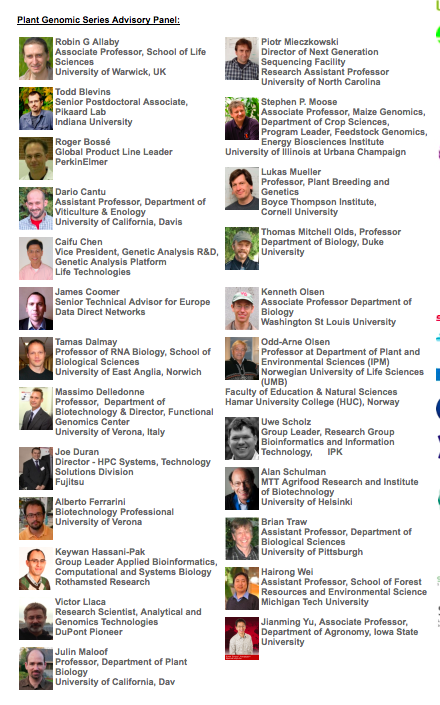
And after seeing this new Tweet I dug around their web site some more and it is really unpleasant. Look at their Advisory Panel (which is what Female Scientist was pointing to):
24 scientists. All of them men. If you know any of them, as I do, I would recommend you contact them and suggest they resign from this apparently gender-biased organization or force them to add some women to their advisory panel.
The speaker list for their next plant genomics meeting is quite skewed too. I could find 49 men and 5 women. What a joke.
I call upon everyone in the community to boycott this meeting and any organized by Global Engage in the future. They have been informed previously of their gender ratio issues and are clearly not doing anything about it. And in plant genomics there are so many excellent female scientists that this simply has to be a case of some type of bias.
In addition, I would recommend calling on the sponsors to withhold funding from this meeting and others organized by this group.
Sponsors include
Illumina
Life Technologies
Lucigen
Raindance
Takara
Clontech
Nugen
and
Sigma-Aldrich
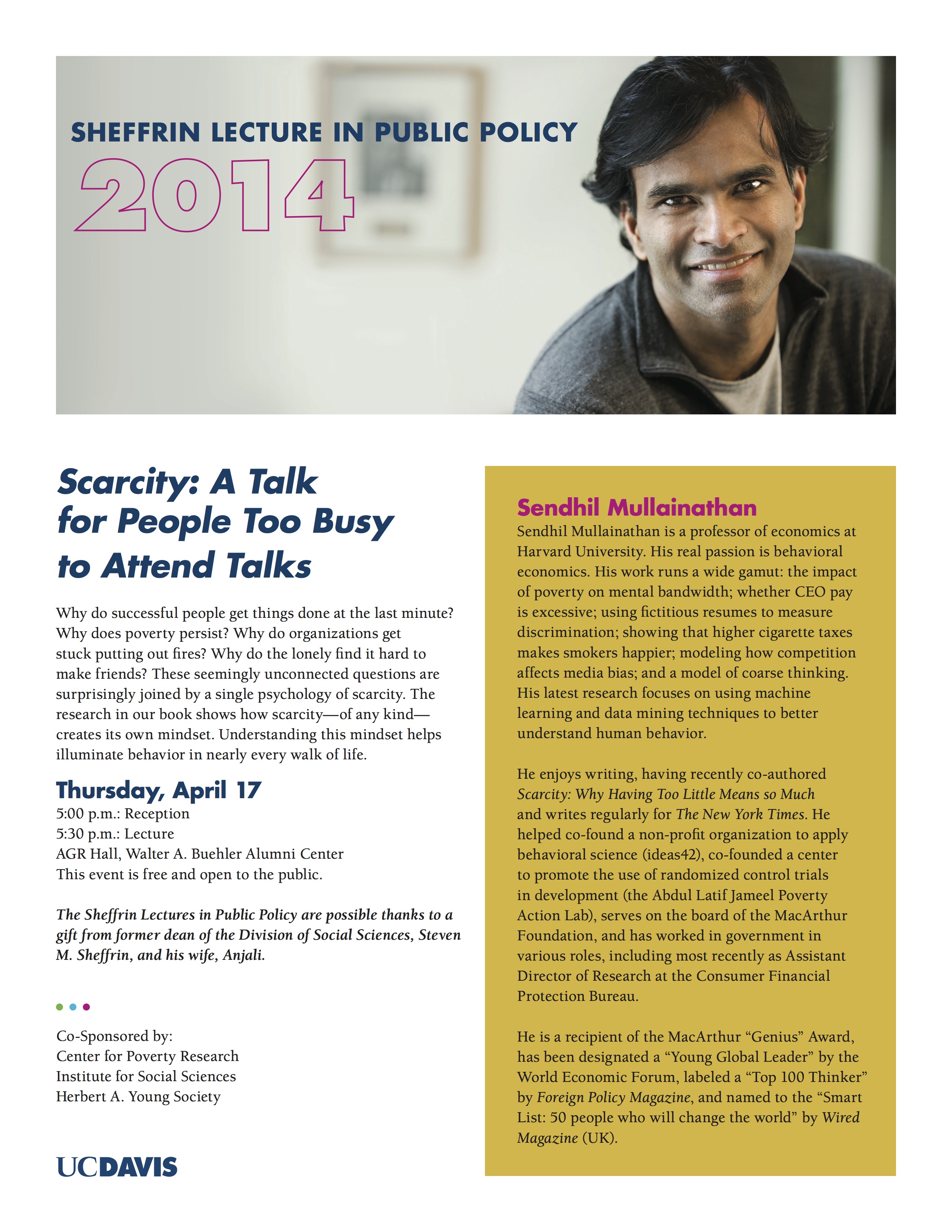
Sheffrin Lecture – Sendhil Mullainathan – 4/17 5:30 PM “Scarcity: A Talk for People Too Busy to Attend Talks”
From an email I recieved:
The annual Sheffrin Lecture in Public Policy (an annual Division of Social Sciences Event) will take place this Thursday, April 17th, 5:30 pm in the Alumni Center (AGR Room) and will feature Professor Sendhil Mullainathan from Harvard, talking about his recent book, Scarcity (co-authored with Princeton Psychologist Eldar Shafir).
Some more detail is below:
Special Seminar: Single Cell Genomics – 4/25 at #UCDavis
Sharing …
**Please share this special seminar announcement with others who may be interested
Luke Stewart
Senior Field Application Specialist
Fluidigm Corporation
Noriko Satake, MD
Assistant Professor, UC Davis
Single Cell Genomics – cutting edge microfluidic tools defy the law of averages by enabling resolution at the single cell level
Friday, April 25, 12:10 – 1:00 pm
Education Building, Lecture Hall 1222
4610 X Street, Sacramento 95817
UC Davis Health System campus
Light lunch will be provided for those who
RSVP by April 22 to ocr@ucdavis.edu
Co-hosted by:
BGI@UC Davis, the UCDCCC Genomics Shared Resource and the Department of Pathology & Laboratory Medicine
BGI@UC Davis will be presenting a seminar series to be held once per quarter during the academic year. If you have questions or need additional information, please email bgi-ucdavis@ucdavis.edu.
BGI UC Davis seminar Stewart 4-2014.pdf
And let the microbiology word play begin (re Entamoeba feeding)
New paper out about feeding by the parasitic amoeba Entamoeba histolytica. Apparently, the work shows that this organism feeds by in essence taking bites out of cells. (I say apparently because the paper is not open access and I don’t have access to it from where I am writing).
Anyway – there are a lot of news stories about this. And for some reason (I am not quite sure why) this has inspired headline writers to get out their pun pens and creative thinking caps. Here are some of the headlines:
- USA Today: Biting amoeba acts a bit like the werewolf of parasites
- Zee News: Amoeba study puts bite on dysentery
- Augusta Free Press Nibbled to death: UVa. discovers new way human cells are killed
And more coming I assume.
Though as far as I can tell none of the stories picked up on a key word play that could have been made. The lead scientist behind the study is named Petri. Someone really should have had “dish” in the title …