Progress Report

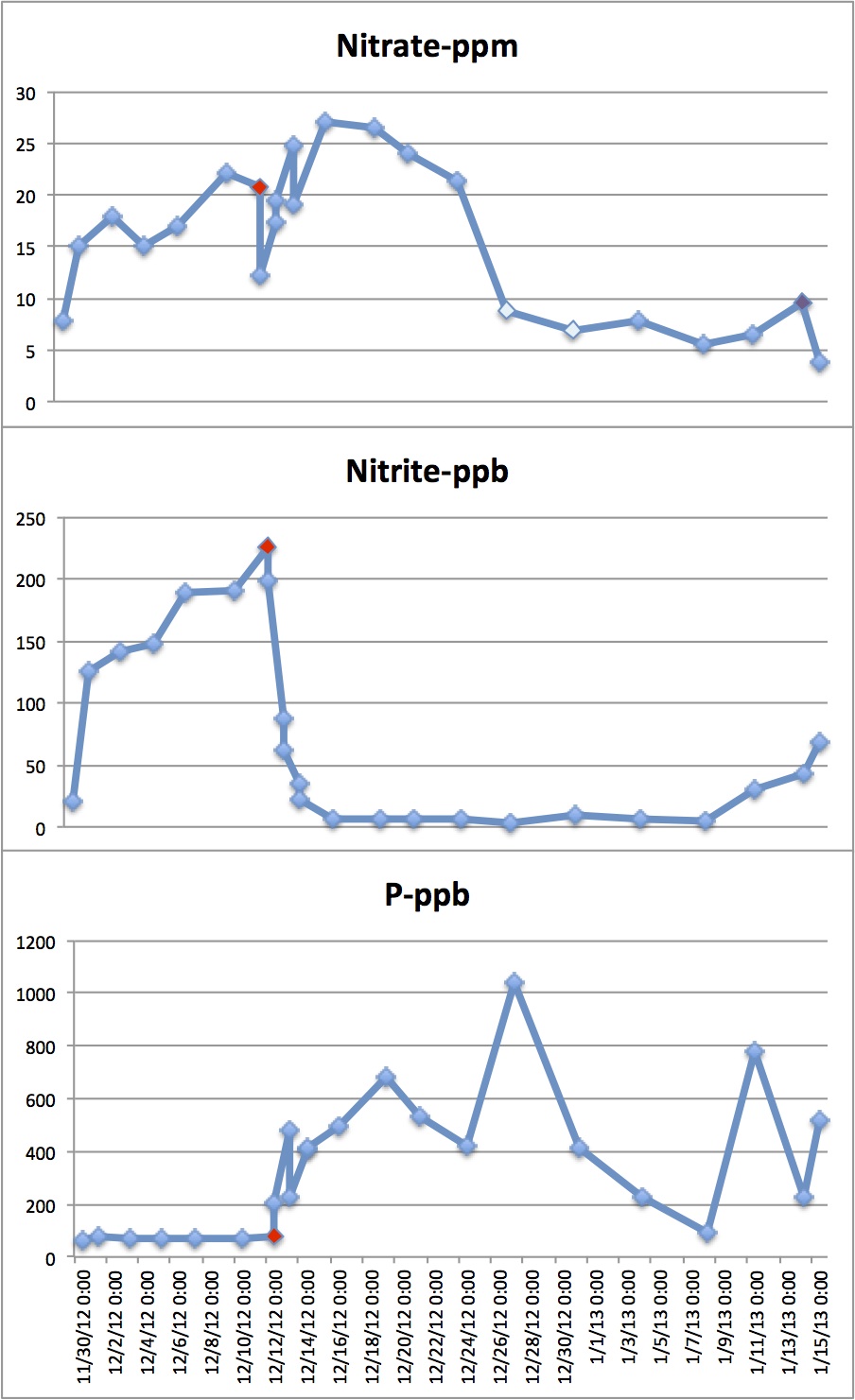
Coral Pond 1 Graphs copy copyThe first coral pond has been running for 49 days now. We have followed them through their initial construction, the inoculation from an established coral tank and now the addition of live rock so that more corals can be added. Our collection of over 400 samples is continuing to grow and we are seeing nice trends in our water chemistry parameters.  We are excited to start looking at the DNA and have been extracting a number of samples.

Here is a quick look at coral pond one. I believe David has already shown some of this data. The red dot is the time point when we inoculated the coral ponds with microbes from an established coral reef tank.

Evolutionary Biology of the Built Environment Working Group: Call for Participants

Call for participants: Evolutionary Biology of the Built Environment Working Group.  Details copied from the announcement pasted below:

The Basics: We need your help. We are organizing the first working group aimed at understanding the evolutionary biology of the built environment—our bedrooms, our houses, our backyards and our cities. This working group will occur June 10 – 14, 2013, in Durham, North Carolina. We are now inviting applications for participants in the working group.
Why: As recently as one hundred thousand years ago the indoor environment did not exist. Yet, this is now where most humans spend the majority of their life. One might imagine that in its relatively short history the built environment might have had time to accumulate very few species. Far from the case, an emerging body of literature shows that hundreds of multicellular species and thousands of unicellular species can be found in houses and buildings more generally. Among the species found in homes are those whose presence (or absence) is likely to have a large impact on human health and well-being, species including beneficial microbiota on the body but also pathogens and potential pathogens or toxic species such as extremophilic fungi. Yet, with the exception of a few deadly pathogens (such as MRSA), the evolutionary history of most of the species with which we most intimately interact in our homes remains unknown. To remedy our lack of knowledge and take advantage of recent advances in disparate fields we will bring together scientists studying both the fauna (microbiologists, entomologists, mammalogists, and any other -ologists you can convince us have some bearing on house biomes) and environment (engineers, architects) along with social scientists (anthropologists) and evolutionary biologists (e.g. theoreticians, bioinformaticians, geneticists) to begin to build a framework for the evolution of the indoor and more generally built biome. Our goal is to develop a framework for a comprehensive understanding of the evolution of the species we most intimately interact with, particularly in the context of considering how to build and design our environments so as to favor beneficial (rather than dangerous) evolutionary trajectories. We aim to understand both how to prevent the extinction of beneficial species and to favor the evolution of lineages and species with beneficial attributes, whether those be ecological functions, health benefits or simply aesthetic value.
Who: We’d like to convene a diverse group of scientists and practitioners at various stages in their careers, from graduate students and post-docs to senior scientists, representing an array of disciplines including the organismal -ologies (e.g. microbiology, entomology, etc.), engineering, architecture, anthropology, evolution, genetics, bioinformatics, art and design. We want to be inclusive of any field that you can convince us has something to bear on studying evolution in the built environment.
How: We are currently accepting applications to be part of this working group. If you are interested, you can apply online apply online here, but do so soon. We will select a group of 30 scholars and practitioners from the applicant pool who will meet in Durham with the goal of producing a series of general audience and peer-reviewed publications about the evolutionary biology of the built environment.
Sponsored by a partnership between the Sloan Foundation and the National Evolutionary Synthesis Center.
Have questions? Drop us a note at yourwildlife@gmail.com.

Phyloseminar: ""Language phylogenies and cultural evolution" Online 1/16 2 PM PST

From phyloseminar.org home

“Language phylogenies and cultural evolution”

Simon Greenhill (Australian National University)

“Charles Darwin famously noted that there were many curious parallels between the evolution of species and languages. Since then evolutionary biology and historical linguistics have used trees to conceptualise evolution. However, whilst evolutionary biology developed the vast discipline of phylogenetic methods, linguistics dabbled with computational methods before rejecting them. The last decade or so has seen the introduction of phylogenetic methods into linguistics, often with some startling results. In this talk I will present some of these studies, and discuss how phylogenetics can help us grapple with the problems of linguistic and cultural evolution. These problems range from testing population dispersal hypotheses, to investigating the shape of cultural evolution, to inferring the rates at which languages change.

West Coast USA:14:00 (02:00 PM) on Wednesday, January 16
East Coast USA:17:00 (05:00 PM) on Wednesday, January 16
UK:22:00 (10:00 PM) on Wednesday, January 16
France:23:00 (11:00 PM) on Wednesday, January 16
Japan:07:00 (07:00 AM) on Thursday, January 17
New Zealand:11:00 (11:00 AM) on Thursday, January 17

10 things you can do to REALLY support #OpenAccess #PDFTribute

I wrote a post earlier today in relation to the #PDFTribute movement: Ten simple ways to share PDFs of your papers #PDFtribute.  I wrote it largely to give people an outlet and information and ideas about how to better share PDFs of their academic work.  I think the more people share the better.

However, I also got shit from my brother Michael – co founder of PLoS on Twitter about how this is partly a “feel good” action.  I do think he underestimates the surge of anger over the death of Aaron Swartz and the momentum right now in the semi-civil disobedience being seen in the #PDFTribute movement.  But I also think he is right in part. So, I thought I would follow up with suggestions for what people should do in the future to really support full and open access to the academic literature.

  1. Only publish in fully open access journals.  See DOAJ — Directory of Open Access Journals.
  2. Do not do ANY work for non open access journals. That includes reviewing, suggesting reviewers, etc. 
  3. Cancel all subscriptions to closed access journals. The subscription model is part of the problem. 
  4. Work for open access journals. 
  5. Embrace openness in other aspects of your academic work. See for example Open science – Wikipedia, the free encyclopedia and Open Humanities Alliance
  6. Learn the difference between “open” and “freely available.” See Peter Suber, Open Access Overview (definition, introduction) and Open Access | PLOS
  7. Reward people in job hiring, merits and promotions for their level of openness.  Do not reward them for closed activities.
  8. Lobby for more open access requirements at the Federal, State, and Institutional level.  Make sure they are not mealy mouthed or mediocre. See What the UC “open access” policy should say for example.
  9. Embrace other changes in scientific publishing such as post-publication review that enable more rapid sharing of publications (see The Glacial Pace of Change in Scientific Publishing). 
  10. Read up on what else you can do (e.g., Peter Suber, What you can do to promote open access) and come up with your own ideas.  Oh and share them.  Openly.

Related posts from The Tree of Life


Other ideas? Please post in comments.


Introduction and my first day of sampling: Undergraduate Aquarium Project

Hello Everyone!

Since I am new to the lab and not many of you know me, I thought of positing a quick introduction along with my first day experiences with sampling.

My name is Lakshmi Bharadwaj, you’ll probably see a lot of me this quarter.

IMG_9470

(That is how I look like if you find me walking into the lab, you can say hello!)

I hope that I get to work in the lab with all of you at least once. Here’s a little bit about me:

I am a senior Biomedical Engineering major and I love photography, writing, swimming and microbes! Currently, I am extremely curious about bacteria, and my senior design project is all about how they infect your bloodstream, their clinical relevance and detection. I haven’t really dealt with a lot of microbial procedures: my time in engineering lab has been mostly machine work. So I’m really excited to learn from all of you and also observe how things work in a biology lab!

My first day in the lab was exciting because I hadn’t really seen anything like it before. I got introduced to the basics. I learnt how to correctly obtain the water, sediment and wipe samples. I learnt of the rate-limiting step in the procedure, proper techniques etc. Then, David taught me some lab protocols that I needed to follow. I was really glad with the pipettes that the lab uses because I find it extremely convenient. The only one time I have used micropipettes before involved stops and was slightly confusing. I find our pipettes so much easier to use.

I also got a basic understanding of what water chemistry involved. I learnt about how there were different tests for different chemicals and all of them required a different procedure. Although I couldn’t perform all the procedures, I got a pH reading and observed how oxygen levels were tested for.  I hope to perform each test individually and learn it in greater detail next time.

I was half-way through testing, but I had to abandon it last minute because of incorrect dilution. I did obtain a fair understanding of how this should be done in my two and a half hours in the laboratory though.

During my time in the lab and with the genome project, I hope to use this blogging space to document my observations and have it act as my notes/log book. You should expect a blogpost from me weekly.

I wish to come in every week, probably on Tuesdays or Wednesday mornings and I look forward to meeting everybody.


Ten simple ways to share PDFs of your papers #PDFtribute

There is a spreading surge of PDF sharing going on in relation to a tribute to Aaron Swartz who died a few days ago.  For more on Aaron and tributes to him see the collection I am making here: The Tree of Life: RIP: Aaron Swartz.  For more on the PDF sharing see this CNET story for example: Researchers honor Swartz’s memory with PDF protest and http://pdftribute.net.

I should say, sharing your PDFs is not necessarily clearly not enough (the license on the PDF may affect what people can do with them if they feel constrained to follow the law).  It is also critical to think about the level of openness of a paper, but I will save most of the comments on that for another time. What I wanted to do here is point out various ways to share PDFs for people who don’t know how …

UPDATE 1/14: See follow up post 10 things you can do to REALLY support #OpenAccess #PDFTribute

Ten simple ways to share PDFs of your papers.

1. Publish your paper in a fully #openaccess journal (so called GOLD OpenAccess).

Such journals immediately post your paper online for all to see and frequently also post your paper in various formats to repositories like Pubmed Central.  For a list of such journals see the “Directory of Open Access Journals“.  In my opinion, this is the best, and, well, really only viable long term option.  This is what I do for papers from my lab.

2. Publish your paper in a non #openaccess journal that has the option of selecting / paying for #openaccess on a case by case basis. 

Many journals that are not fully #openaccess have the option of paying extra to have your paper be published in an #openaccess manner and then the journal handles not only posting the paper on their site but also frequently depositing in a repository of their or your choosing.  UPDATE: Note – in many cases the licenses used by journals for such one-off “open” publishing are not fully open, despite what some of the journals claim so proceed with caution (see PLOS Biology: Why Full Open Access Matters for example).

3. Publish in a non #openaccess journal that releases papers to a repository after a delay.

Many journals put papers behind a paywall initially but then “free”them up in some way after a set period of delay.  For example a large number in biomedicine will deposit papers to Pubmed Central and also make them freely available on their website after 6 months.  Frequently as with #2 above, the licenses associated with such release of papers are not fully open, but this is a way to have your papers be at least accessible to others after a period of time.

4. Deposit your paper in a preprint server before you submit it for publication.  

For more on preprint servers see

Examples of commonly used preprint servers include

5. Self-archive your PDF in a repository (so called GREEEN OpenAccess).

Various repositories out there exist for posting ones papers.  They work in essence like a preprint server though some people use them more for posting papers after they have been published so I am listing them separately here.  More detail on self-archiving can be found here.  A good source of information about repositories is the Registry of Open Access repositories.  Also the Directory of Open Access repositories.  Another good source is SPARC. Also see here.

One repository commonly used in biomedicine in Pubmed Central.  Alas one is only allowed to post papers there by oneself if the work in the paper was funded by an NIH grant.

Another approach is to use arXiv as a repository where you can post things even after they are published.

Another growing venue for self-archiving is an institutional repository.  As many universities expand their commitment to open access or access university repositories are becoming a source of more and more publications.  Check to see if your institution has a repository and use it.

UPDATE: Note, just depositing your paper in a repository or preprint server does not necessarily mean your paper is open access.  Look in detail at the license and copyright policies of the archives you are considering before using them.

6. Self post your PDFs to a website you control.

If you do not have a personal website and/or do not know how to post a paper to your website, well, you should learn more about this.  A few simple ways to quickly post a PDF for others to get access to include

Create a new blog / website with a system that allows posting PDFs.  There are many many options for this.  One is Posterous.  Another is WordPress.Com.  There are certainly a million other ways.  Upload a PDF to Google Docs and then share the Google Doc link.  Post to Dropbox and share the link there.  Etc. etc. etc.  I ended up using WordPress.Com to create my lab page and to post all my PDFs.

7. Post your PDFs to an online reference collection.

Many systems now exist for collecting and collating and sharing reference collections online.  They include CiteULike, Zotero, and Mendeley.  I particularly like Mendeley right now in part because it makes it very easy to share PDFs privately or publicly.  I for example have posted all my own papers on Mendeley as well as papers of my father’s (for more on this see The Tree of Life: Freeing My Father’s Publications and Free Science, One Paper at a Time | Wired Science | Wired.com).

8. Create an academic profile page and post PDFs there.

Many systems now exist for creating a personal Academic profile of sorts.  One example is Academia.Edu. I have created a page here  Jonathan Eisen | University of California, Davis – Academia.edu although I confess I have not been updating it much.

9. Post to Slideshare.

Though many people end up only posting slideshows to Slideshare, and I use it for that purpose, I have posted many of my papers there as well. See for example:

10. Post to “Data” archives.

There is a large growing collection of places to post “Data” to share it with others.  Some of these sites also allow posting of papers.  For example, I have posted multiple papers to Figshare, a great data sharing site that can be used to post and share just about anything. I have also used Figshare for this (for example – here is my PhD thesis there).

11. Ask a Librarian. (Yes it goes to 11)

Probably the best way to figure out how to better share your PDFs if the options above don’t work for you (or even if they do) is to talk to a librarian.  They are the most knowledgable people in regard to methods and systems and other issues for sharing academic work.


Some related posts from The Tree of Life


Other ideas? Please post in comments …


RIP: Aaron Swartz (collection of news stories, articles, etc)

Aaron Swartz from the AWL

Compiling links to stories, posts, information about Aaron Swartz and his untimely death. RIP Aaron.

About Aaron

News and Posts about his death
More from 1/14
More from 1/17-22

Storifies about Aaron Swartz

PDF upload tribute

The kitten microbiome – new related paper and Mendeley collection

Saw this new paper today: Dietary format alters fecal bacterial populations in the domestic cat (Felis catus) – Bermingham – 2013 – MicrobiologyOpen – Wiley Online Library

And was reminded on the Kitten Microbiome project. It was conceived as a (sort of) joke but studying the microbes in our domestic companion animals is a good thing and could be very interesting in many ways.

So I created a Mendeley group on cat / kitten microbiome studies:
http://www.mendeley.com/groups/2960631/kitten-microbiome-oh-and-other-cats-too/widget/21/3/

Oh, and while I was at it I created a group for the Dog Microbiome.

http://www.mendeley.com/groups/2960691/dog-microbiome/widget/29/3/

Not sure these should really be completely separate (i.e., there could be a collection on the domestic animal microbiome) but am keeping them separate for now.

Interesting new #PLOS One paper on study design in rRNA surveys

Interesting new paper in PLoS One:  PLOS ONE: Taxonomic Classification of Bacterial 16S rRNA Genes Using Short Sequencing Reads: Evaluation of Effective Study Designs

Abstract: Massively parallel high throughput sequencing technologies allow us to interrogate the microbial composition of biological samples at unprecedented resolution. The typical approach is to perform high-throughout sequencing of 16S rRNA genes, which are then taxonomically classified based on similarity to known sequences in existing databases. Current technologies cause a predicament though, because although they enable deep coverage of samples, they are limited in the length of sequence they can produce. As a result, high-throughout studies of microbial communities often do not sequence the entire 16S rRNA gene. The challenge is to obtain reliable representation of bacterial communities through taxonomic classification of short 16S rRNA gene sequences. In this study we explored properties of different study designs and developed specific recommendations for effective use of short-read sequencing technologies for the purpose of interrogating bacterial communities, with a focus on classification using naïve Bayesian classifiers. To assess precision and coverage of each design, we used a collection of ~8,500 manually curated 16S rRNA gene sequences from cultured bacteria and a set of over one million bacterial 16S rRNA gene sequences retrieved from environmental samples, respectively. We also tested different configurations of taxonomic classification approaches using short read sequencing data, and provide recommendations for optimal choice of the relevant parameters. We conclude that with a judicious selection of the sequenced region and the corresponding choice of a suitable training set for taxonomic classification, it is possible to explore bacterial communities at great depth using current technologies, with only a minimal loss of taxonomic resolution.

Not sure I like everything in the paper.  For example, they focus on naive Bayesian classification methods … when (of course) I prefer phylogenetic methods.  But that is a small issue.  Overall there is a lot of useful detail in here about rRNA based taxonomic studies.  I note – some of this probably applies to metagenomic studies as well … perhaps this group will do a comparable analysis of metagenomics next?

Mizrahi-Man O, Davenport ER, Gilad Y (2013) Taxonomic Classification of Bacterial 16S rRNA Genes Using Short Sequencing Reads: Evaluation of Effective Study Designs. PLoS ONE 8(1): e53608. doi:10.1371/journal.pone.0053608

I note – if you want to catch up / learn / research metagenomics and phylogeny or classification check out the Mendeley group I started on the topic:

http://www.mendeley.com/groups/1152921/phylogenetic-and-related-analyses-of-metagenomic-data/widget/29/3/

Come all ye Citizen Microbiologists – to Denver 5/19 for ASM Meeting – abstracts due 1/15

This is going to rock.  Citizen microbiology – highlighted at the American Society for Microbiology Annual Meeting in Denver in May.  The details on the session are below.  Sunday May 19 at the American Society for Microbiology General Meeting in Denver.  If you are interested in attending Register here.  If you work on some aspect of Citizen Microbiology please consider submitting an abstract for a talk or poster. The deadline is January 15.  We will highlight ALL accepted abstracts in some way both during the session and in blogs, tweets, interviews, etc.  So please consider participating.
Citizen Microbiology: Enhancing Microbiology Education and Research with the Help of the Public OralAbstract Image
3:00 p.m.- 5:30 p.m.
Conveners:
JONATHAN EISEN; Univ. of California-Davis, Davis, CA
DAVID COIL; Univ. of California-Davis, Davis, CA
Invited Speakers:
GRAHAM HATFULL; Univ. of Pittsburgh, Pittsburgh, PA
   Carski Foundation Distinguished Undergraduate Teaching Award and Division W Lecturer
DARLENE CAVALIER; Sci. Starter, Sci. Cheerleader, Philadelphia, PA
ROB DUNN; North Carolina State Univ., Raleigh, NC
Description:
Citizen Science is a valuable way to both generate scientific data and to engage and educate a broad audience. Some areas of biology such as astronomy and ornithology have conducted multiple successful citizen science projects over the years. Surprisingly, there are not many citizen science projects in microbiology even though microbes are of interest to the majority of the public, as well as being tractable for these kinds of studies. This session will focus on citizen science in microbiology. This session will examine the diversity of Citizen Science projects, outline what makes a successful project, and highlight examples of past, current and future Citizen Microbiology projects. Speakers will also provide details on overcoming challenges in Citizen Science (e.g., visualization, permissions, privacy, standardization, informed consent). Our belief is that more projects, throughout the different domains of microbiology, could benefit from incorporating a citizen science component. Having this session at the General Meeting will help bring together people interested in this topic, as well as fostering collaboration on existing and future citizen science projects.
Sunday May 19 at the American Society for Microbiology General Meeting in Denver.  Register here.