New publication from members of the lab in Nucleic Acids Research:
A workflow for genome-wide mapping of archaeal transcription factors with ChIP-seq.
Congrats. Gonna have to make some new jam …

New publication from members of the lab in Nucleic Acids Research:
A workflow for genome-wide mapping of archaeal transcription factors with ChIP-seq.
Congrats. Gonna have to make some new jam …
Just got this email below regarding the “New York Times Insight Panel.” Seems like a scam to me. If it is real, then it seems pretty, well, lame. Anyone know anything about this?
Dear New York Times Subscriber,
We would like to invite you to become a member of our community of engaged New York Times readers by joining The New York Times Insight Panel and sharing your opinions with us.
This important panel is made up of readers like you who are interested in giving us feedback on a variety of topics, including their involvement with The Times. Here’s a quick overview of the benefits of being a member:
Help guide research at The Times by offering your opinions on a variety of topics related to your lifestyle and interests
Earn points that can be redeemed for New York Times premiums and other rewards
Learn about new features as they become available to Times subscribers
If you have any questions, take a look at the FAQ’s section on our Web site http://NYTPanel.com or contact NYTPanelQuestions@BetaPanel.com . Please be assured that your privacy will be respected and kept strictly confidential. No one will try to sell you anything. For more information please review our privacy policy: The New York Times privacy policy .
To get started with your Panel registration, you will need to complete a membership survey. Please click on the URL below or copy and paste it into your browser:
http://betasurvey.com/n/nytimes/InsightPanel11/?PIN=————
Your personal password (PIN) is: ———
Please add your voice to our Insight Panel today!
Sincerely,
Ben Sider
Customer Research Manager
The New York Times
If you have any questions or comments regarding delivery of your newspaper, please contact The New York Times Customer Care Service by clicking on customercare@nytimes.com to send an e-mail.
Note: You are receiving this e-mail because you are part of an opt-in list provided by the survey’s sponsor. If you wish to not receive e-mails like this in the future, please reply to this e-mail with “unsubscribe ——–” in the subject line or click on the following URL to send an unsubscribe message (please include your PIN in the message): mailto:NYTPanelQuestions@BetaPanel.com
For more information, please visit www.betaresearch.com .
Well today I am finally getting around to voting on some UC Davis Academic Senate resolutions relating to the Occupy UC Davis pepper spray incident. For those not familiar with this – first – I offer you my undying love – second – here are some of my previous posts on the theme:
I wrote a lot about the pepper spray incident here and on twitter – I felt in many ways like I had to report on what was going on for the outside world. Here are some of my key posts:
Catching up to today – now the issue (for me and other faculty/members of the Academic Senate) is that we have to vote on some resolutions regarding the pepper spray incident.
Below are the three for which I am supposed to vote. I am asking anyone out there for input on these. All of them seem pretty, well, lame to me and I am inclined to vote no on all of them. But I am reserving judgement and looking for feedback from others out there. Any comments / suggestions welcome.
#1 Motion Concerning the Chancellor’s Judgment
TO: Professor Linda Bisson, Chair, Davis Division of the Academic Senate
Dear Chair Bisson
The undersigned members of the Davis Division of the Academic Senate hereby petition you to put the following motion of non-confidence in the leadership of the Chancellor to a vote of the entire membership of the Davis Division of the Academic Senate at the earliest date that is feasible under Senate rules.
Motion: In light of the events on the quadrangle of the UC Davis campus on the afternoon of Friday November 18, 2011, in light of Chancellor Linda Katehi’s email to faculty of November 18 in which she admitted that she had ordered the police to take action against the students who were demonstrating on the quadrangle and said that she had had “no option” but to proceed in this way, and in light of the failure of Chancellor Katehi to act effectively to resolve the resulting crisis in the intervening days,
Be it therefore resolved that the Davis Division of the Senate of the University of California lacks confidence in the leadership of Chancellor Katehi, and
Be it also resolved that the result of the vote on this motion be communicated to the Board of Regents and the President of the University of California.
Thank you for your attention to this matter.
Yours sincerely,
View signatories
#2: Five-Resolution Vote of Confidence
To: The Davis Division of the Academic Senate
Re: Petition for Ballot on Issues
We, the undersigned members of the UC Davis faculty, petition the Davis Division of the Academic Senate to hold a vote on the issues below.
Preamble
Whereas non-violent political protest, free assembly, and free speech are constitutional rights valued at the UC Davis,
And whereas the response of the UC Davis Police Department to peaceful protestors on November 18, 2011 was appalling,
And whereas in the UC Davis culture it is customary for representative(s) from the highest levels of the administration to engage in direct dialogue with demonstrators,
And whereas prior to November 18, 2011 Chancellor Linda Katehi worked diligently to elevate the national and international stature of the Davis campus,
And whereas the presence of an accomplished scholar at the top post has helped UC Davis attract and retain outstanding scholars, including faculty members serving at the highest levels of administration,
And whereas in the last two years, Chancellor Linda Katehi developed a bold plan for campus growth that includes an aggressive fund-raising campaign that will alleviate the burden imposed by ever decreasing state financial support,
And whereas Chancellor Linda Katehi apologized to University community for the events of November 18, 2011,
And whereas Chancellor Linda Katehi publically stated that she will ensure that such events do not recur,
And whereas the events of November 18 transformed Linda Katehi into a Chancellor who engages in a full and open dialogue with students, staff, and faculty,
And whereas Chancellor Katehi moved expeditiously to replace the flawed communications in the two days following the events with a campus-wide dialogue through a series of town hall meetings with students, staff, and faculty,
And whereas a Chancellor with first-hand experience of the horrific events of November 18, 2011 is better qualified to deal with its aftermath,
And whereas dispatching police before engaging in a direct dialogue with protesters, while running counter to the UC Davis culture, does not outweigh the Chancellor Katehi’s impeccable performance of all her other duties,
And whereas Chancellor Katehi’s resignation would have devastating effects on the moral and academic standing of the campus, thereby making it highly unlikely that UC Davis could attract a Chancellor of her stature,
And whereas it is time to promote a constructive healing process rather than risk more harm by pressuring the Chancellor to resign:
Resolution:
Be it therefore resolved that the Davis Division of the Academic Senate:
Condemns both the dispatch of police in response to non-violent protests and the use of excessive force that led to the deplorable pepper-spraying events of November 18, 2011.
Opposes all violent police responses to non-violent protests on campus.
Demands that police deployment against protesters be considered only after all reasonable administrative efforts to bridge differences have been exhausted, including direct consultation with the leadership of the Davis Division of the Academic Senate.
Accepts Chancellor Linda Katehi’s good faith apology.
Expresses confidence in Chancellor Linda Katehi’s leadership and efforts to place UC Davis among the top 5 public universities in the nation.
#3: Motion Concerning Police Actions
TO: Professor Linda Bisson, Chair, Davis Division of the Academic Senate
Dear Chair Bisson
The undersigned members of the Davis Division of the Academic Senate hereby petition you to put the following motion to a vote of the entire membership of the Davis Division of the Academic Senate at the earliest date that is feasible under Senate rules.
Motion:
Be it resolved that that the Davis Division of the Senate of the University of California hereby (1) condemns both the dispatch of police and use of excessive force in response to non-violent protests on November 18, 2011;
(2) opposes violent police response to non-violent protests on campus;
(3) demands that police deployment against protestors be considered only after all reasonable efforts have been exhausted and with direct consultation with Academic Senate leadership.
Thank you for your attention to this matter.
Yours sincerely,
View signatories
Just a quick one here. There is an (openaccess) publication I thought people might find interesting: The origin of multicellularity in cyanobacteria. Schirrmeister BE, Antonelli A, Bagheri HC. BMC Evol Biol. 2011 Feb 14;11:45.
In particular it has some very nice figures on phylogeny of cyanobacteria and the evolution of phenotypes in the group.
 |
| Figure 1. Phylogenetic tree of 1,254 cyanobacterial species. |
 |
| Figure 4. Phylogenetic tree of a cyanobacterial subset. |
Some of the same authors also have a paper on the need for better phylogenetic sampling of genome data in the group:
Evolution of cyanobacterial morphotypes: Taxa required for improved phylogenomic approaches. Schirrmeister BE, Anisimova M, Antonelli A, Bagheri HC. Commun Integr Biol. 2011 Jul;4(4):424-7. Epub 2011 Jul 1.
Though I note, I am a bit annoyed and surprised they did not cite my “Phylogeny driven genomic encyclopedia” paper in this pub …
Biodiversity Museum Day on Sunday, Feb. 12
UC Davis will celebrate “Biodiversity Museum Day” on Sunday, Feb. 12 when four museums or centers that engage in education and research involving insects, vertebrates or plants will host open houses. The Bohart Museum of Entomology, the Museum of Wildlife and Fish Biology and the Botanical Conservatory will be open to the public from 1 to 4 p.m., while the Center for Plant Diversity will be open from 2 to 4 p.m. “This will be a fun day where people of all ages can visit UC Davis and check out a number of our research and teaching collections,” said Tabatha Yang, education and outreach coordinator for the Bohart Museum and Museum of Wildlife and Fish Biology. “Each collection is special and an important scientific resource. I think people will be amazed.”
http://entomology.ucdavis.edu/news/biodiversitymuseumday.html
Just got an annoying email regarding patents that is a follow up to one I wrote about previously (Wondering – can UC force me to sign new patent agreement?). I have appended the text of the email below. I am still wondering if the University of California can actually force me to sign this agreement. In addition, I am wondering about the competence and/or honesty of the people behind this amendment as it is pretty clear it is a major change and not as they claim in essence no change at all. If it is really in essence no change – then what is the point? If it is a major change why was there little if any discussion prior to the edict?
For other comments and questions about the UC attempt to force employees to sign this agreement see UC Patent Amendment: To Sign or Not to Sign? by my brother (I did not know until a Google search that he had written this post in December … I guess we need to talk more) and this post Sample language for my UC friends and
UC Patent Amendment: To Sign or Not to Sign? | UC San Diego … and Davis Faculty Association » Blog Archive » UC’s Patent Amendment …
UPDATE: someone thought the email might have been a PHISHING attack: Fwd: PLEASE SIGN NOW: UC Patent Amendment – Micronet at UC …
I find the style and tactics of UC on this to be obnoxious and bullying. I fight for many many things for UC and UC Davis. Being bullied into signing a amendment that is claimed to not be any change even though it is clearly a big change – not something I can support.
Here is the email, which I note, had as the header a big seal of the University of California – I assume to try and intimidate me into signing.
————————
Dear UC Colleague,
This is your final reminder to sign the University of California’s amendment to the Patent Acknowledgment or Agreement you signed when you joined UC. You have until Feb. 29 to sign the amendment through the electronic process outlined below.
The Patent Acknowledgment or Agreement you previously signed requires you to promptly report and fully disclose potentially patentable inventions. You also acknowledged an obligation to assign to the University rights to inventions and patents conceived or developed while employed by the University or while using University research facilities or UC gift, grant, or contract research funds.
As a result of recent court decisions, UC’s ability to meet its various obligations associated with rights to inventions and patents are at risk. It is important that you sign an Amendment to the Patent Acknowledgment or Agreement you previously signed. This amendment is not unique to UC. Other universities are taking similar action to protect their intellectual property rights.
This is not a change in the Patent Policy; it is simply an amendment that clarifies the existing Acknowledgment or Agreement in light of the court decisions.
Your electronic signature on the Patent Acknowledgment/Agreement Amendment available here will ensure that the University is able to fulfill its intellectual property obligations to research sponsors, industrial partners, the federal government and others.
The Amendment also helps to protect the University and its employees should future consulting or visitor arrangements inadvertently give rights away.
Signing the Amendment is easy. Simply write down your PIN number shown below; then click on the signature link to sign your Patent Acknowledgment/Agreement Amendment. You will also need your Employee ID number, which you can find on your earnings statement available by signing in to your personal account on At Your Service Online (https://atyourserviceonline.ucop.edu/). You will be able to view the Amendment prior to signing.
Personal Identification Number : XXXX Link to Sign Patent Amendment
(or paste this URL into your browser: http://www.vres.us/ucpatent.html.)
Thank you for promptly signing,
Please do not respond to this e-mail.
This e-mail was sent by:
VR Election Services,
3222 Skylane Dr Bldg 100
Carrollton, TX, 75006.
VR Election Services, an independent firm, is conducting this election on behalf of the University of California. More details are available on At Your Service (http://atyourservice.ucop.edu/employees/policies_employee_labor_relations/patent-acknowledgment).
Please note: Your PIN is personalized for you and should not be shared with or forwarded to another.
Estimado colega de la UC,
Este es su final recordatorio para firmar la enmienda de la Universidad de California al Acuerdo o Reconocimiento de Patentes que usted firmó cuando entró a la UC. Tendrá hasta el 29 de febrero para firmar la enmienda através del proceso electrónico que se describe abajo.
El Acuerdo o Reconocimiento de Patentes que usted firmó previamente requiere que usted informe con prontiud y divulgue por completo cualquier invención potencialmente patentable. Usted también reconoció la obligación de asignar a la Univeridad los derechos a las invenciones y patentes concebidas o desarrolladas durante su empleo en la Universidad o mientras use las instalaciones investigativas de la Universidad u obsequios, subvenciones o fondos de contratos para la investigación de la UC.
Como resultado de decisiones judiciales recientes, la capacidad de la UC para cumplir con sus diversas obligaciones en relación con los derechos a invenciones y patentes conllevan un riesgo. Es importante que firme una Enmienda al Acuerdo o Reconocimiento de Patentes que usted firmó previamente. Esta enmienda no es algo único de la UC. Otras universidades están iniciando acciones similares para proteger sus derechos de propiedad intelectual.
Esto no es un cambio en las Normativas de Patentes; es, sencillamente, una enmienda que aclara el actual Acuerdo o Reconocimiento de Patentes, a la luz de las decisiones judiciales.
Su firma electrónica en la Enmienda del Acuerdo o Reconocimiento de Patentes aquí disponible asegurará que la Univeridad sea capaz de cumplir con sus obligaciones de propiedad intelectual ante los patrocinadores de investigaciones, socios industriales, el gobierno federal y otros.
La Enmienda también ayuda a proteger a la Univeridad y a sus empleados en caso de que futuros acuerdos de consultoría o de visitas inadvertidamente cedieran los derechos.
Firmar la Enmienda es fácil. Sencillamente escriba su Número de Identificación Personal (PIN, por sus siglas en inglés), que aparece abajo; entonces haga clic en el enlace de la firma para firmar su Enmienda al Acuerdo o Reconocimiento de Patentes. Usted también necesitará su Número de Identificación de Empleado, el cual podrá encontrar en la declaración de ganancias, disponible al entrar a su cuenta personal en At Your Service Online (https://atyourserviceonline.ucop.edu/). Usted será capaz de ver la Enmienda antes de la firma.
Número de Identificación Personal: XXXX Link to Sign Patent Amendment
(o pegue este URL en su buscador: http://www.vres.us/ucpatent.html.)
Gracias por firmar con prontitud,
Por favor no responda a este email.
Este e-mail fue enviado por:
VR Election Services,
3222 Skylane Dr Bldg 100
Carrollton, TX, 75006.
VR Election Services, una empresa independiente, está efectuando esta elección en nombre de la Univeridad de California. Más detalles disponibles en At Your Service (http://atyourservice.ucop.edu/employees/policies_employee_labor_relations/patent-acknowledgment).
Por favor note que: Su PIN es algo personalizado para usted y no deberá compartirse ni remitirse a otros.
OK I am now officially completely driven insane by email. As part of my attempt to reduce email communication with people I am going to start posting some of the emails I get often into FAQs.
Today’s email relates to the 2009 paper on a “Phylogeny driven genomic encyclopedia of bacteria and archaea” for which I was the senior and corresponding author. The email is asking for higher resolution figures that were published in the paper. This person and many others have asked for a higher res. version of our “genome tree” which was Figure 1. Here is the version from the paper
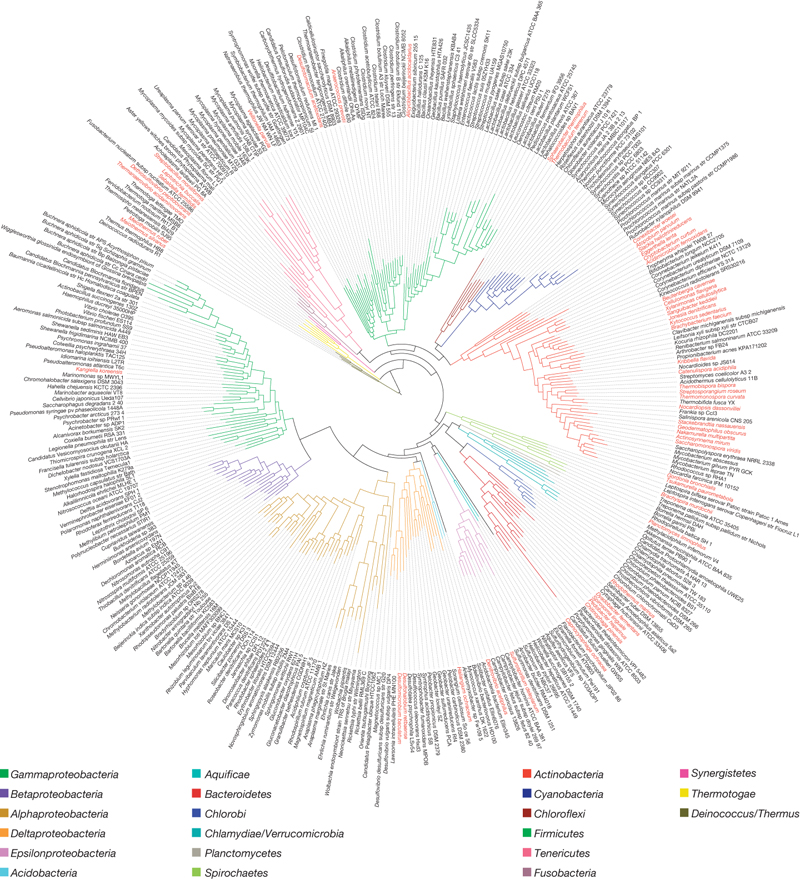
But alas, as a JPG when you zoom in you can’t see the text very well. And about 30 or so people, maybe more, have asked for a higher res. version. Well, the simplest way to get this figure with legible fonts when zoomed in is to get the PDF of the paper and zoom in on it. But that may not be for everyone – so here is a link to the PDF of the figure that I posted on postures (Blogger does not allow PDF uploads). I also posted PDFs of the other figures.
Many people also ask for the treefile (which is basically a coded version of the phylogenetic tree for viewing and analysis). I am directly posting the treefile below and have also submitted it to “Treebase” (which we should have done before). Enjoy … and in the future I will be pointing people to this page when they ask for the figure/treefile. Not sure this will have saved me anytime but am sick of writing a lot of this in emails back to people …
#NEXUS
BEGIN trees;
TREE ‘Tree1’ = (((((‘GEBA_Thermanaerovibrio_acidaminovorans’:0.190689,’GEBA_Dethiosulfovibrio_peptidovorans’:0.263143):0.276658,((((((((((((((((((((((((((((((((((((((((‘Escherichia_coli_O157_H7_str_Sakai’:0.0,’Escherichia_coli_str_K12_substr_MG1655′:0.0):1.51E-4,’Escherichia_coli_str_K12_substr_DH10B’:0.0):2.0E-5,(‘Escherichia_coli_ATCC_8739′:1.7E-4,’Escherichia_coli_HS’:1.71E-4):1.7E-4):0.0,(‘Escherichia_coli_536′:0.001196,’Escherichia_coli_APEC_O1’:0.0):0.0):0.0,((‘Shigella_flexneri_2a_str_301′:0.001883,’Shigella_flexneri_2a_str_2457T’:0.0):1.71E-4,’Shigella_flexneri_5_str_8401′:3.44E-4):5.12E-4):0.0,(‘Shigella_boydii_CDC_3083_94′:5.13E-4,’Shigella_boydii_Sb227′:8.57E-4):3.42E-4):0.0,’Escherichia_coli_SMS_3_5′:0.0):0.0,’Escherichia_coli_O157_H7_EDL933′:0.0):0.0,’Escherichia_coli_CFT073′:0.0):0.0,’Escherichia_coli_UTI89′:0.0):0.0,’Escherichia_coli_E24377A’:0.0):0.0,’Shigella_dysenteriae_Sd197′:0.001025):1.69E-4,’Shigella_sonnei_Ss046′:0.001028):0.012167,(((((((‘Salmonella_enterica_subsp_enterica_serovar_Typhi_str_Ty2′:0.0,’Salmonella_enterica_subsp_enterica_serovar_Typhi_str_CT18′:1.7E-4):3.4E-4,’Salmonella_typhimurium_LT2′:0.0):0.0,’Salmonella_enterica_subsp_enterica_serovar_Paratyphi_A_str_ATCC_9150′:8.5E-4):2.0E-6,’Salmonella_enterica_subsp_enterica_serovar_Paratyphi_B_str_SPB7′:1.8E-4):1.69E-4,’Salmonella_enterica_subsp_enterica_serovar_Choleraesuis_str_SC_B67′:3.48E-4):0.001774,’Salmonella_enterica_subsp_arizonae_serovar_62_z4_z23_’:0.001673):0.008533,’Citrobacter_koseri_ATCC_BAA_895′:0.007106):0.003103):0.00437,’Klebsiella_pneumoniae_subsp_pneumoniae_MGH_78578′:0.012094):0.004392,’Enterobacter_sakazakii_ATCC_BAA_894′:0.019781):0.007021,’Enterobacter_sp_638′:0.019532):0.027075,(‘Erwinia_tasmaniensis’:0.033979,’Serratia_proteamaculans_568′:0.033607):0.013319):0.008604,’Erwinia_carotovora_subsp_atroseptica_SCRI1043′:0.03122):0.012206,((((((‘Yersinia_pestis_KIM’:0.0,’Yersinia_pseudotuberculosis_IP_31758′:0.0):0.0,’Yersinia_pestis_CO92′:0.0):0.0,’Yersinia_pseudotuberculosis_IP_32953′:0.0):0.0,((((‘Yersinia_pseudotuberculosis_PB1_’:0.0,’Yersinia_pestis_Pestoides_F’:0.0):0.0,(‘Yersinia_pseudotuberculosis_YPIII’:0.0,’Yersinia_pestis_Nepal516′:0.0):0.0):0.0,’Yersinia_pestis_Antiqua’:1.72E-4):0.0,’Yersinia_pestis_biovar_Microtus_str_91001′:0.0):0.0):0.0,’Yersinia_pestis_Angola’:3.44E-4):0.00575,’Yersinia_enterocolitica_subsp_enterocolitica_8081′:0.009468):0.030284):0.008222,((((‘Candidatus_Blochmannia_pennsylvanicus_str_BPEN’:0.111832,’Candidatus_Blochmannia_floridanus’:0.199319):0.14508,(((‘Buchnera_aphidicola_str_APS_Acyrthosiphon_pisum_’:0.081646,’Buchnera_aphidicola_str_Sg_Schizaphis_graminum_’:0.078489):0.090786,’Buchnera_aphidicola_str_Bp_Baizongia_pistaciae_’:0.232468):0.043831,(‘Wigglesworthia_glossinidia_endosymbiont_of_Glossina_brevipalpis’:0.30099,’Buchnera_aphidicola_str_Cc_Cinara_cedri_’:0.303142):0.063766):0.064196):0.054991,’Baumannia_cicadellinicola_str_Hc_Homalodisca_coagulata_’:0.166451):0.081445,’Sodalis_glossinidius_str_morsitans_’:0.026696):0.024889):0.01239,’Photorhabdus_luminescens_subsp_laumondii_TTO1′:0.048195):0.050763,((((‘Haemophilus_somnus_129PT’:9.73E-4,’Haemophilus_somnus_2336′:7.28E-4):0.038446,’Pasteurella_multocida_subsp_multocida_str_Pm70′:0.033371):0.011204,((‘Mannheimia_succiniciproducens_MBEL55E’:0.02899,’Actinobacillus_succinogenes_130Z’:0.035825):0.013874,(((‘Haemophilus_influenzae_Rd_KW20′:0.002043,’Haemophilus_influenzae_PittGG’:0.00105):5.49E-4,’Haemophilus_influenzae_86_028NP’:5.15E-4):2.24E-4,’Haemophilus_influenzae_PittEE’:0.001026):0.040304):0.008478):0.011217,(((‘Actinobacillus_pleuropneumoniae_L20′:0.00137,’Actinobacillus_pleuropneumoniae_serovar_7_str_AP76′:3.39E-4):1.74E-4,’Actinobacillus_pleuropneumoniae_serovar_3_str_JL03′:0.003062):0.011765,’Haemophilus_ducreyi_35000HP’:0.024577):0.038512):0.080775):0.047571,(((((‘Vibrio_cholerae_O1_biovar_eltor_str_N16961′:3.64E-4,’Vibrio_cholerae_O395’:8.38E-4):0.041305,(‘Vibrio_vulnificus_CMCP6′:5.27E-4,’Vibrio_vulnificus_YJ016’:1.72E-4):0.020829):0.011445,(‘Vibrio_parahaemolyticus_RIMD_2210633′:0.00625,’Vibrio_harveyi_ATCC_BAA_1116′:0.010839):0.011481):0.027253,’Vibrio_fischeri_ES114′:0.05376):0.027779,’Photobacterium_profundum_SS9’:0.072105):0.054993):0.023142,(‘Aeromonas_hydrophila_subsp_hydrophila_ATCC_7966′:0.006284,’Aeromonas_salmonicida_subsp_salmonicida_A449’:0.0108):0.109795):0.020707,((((((‘Shewanella_halifaxensis_HAW_EB4′:0.008905,’Shewanella_pealeana_ATCC_700345’:0.003805):0.025082,(‘Shewanella_sediminis_HAW_EB3′:0.019306,’Shewanella_woodyi_ATCC_51908′:0.012326):0.017175):0.016987,’Shewanella_loihica_PV_4’:0.021173):0.024752,((((((‘Shewanella_sp_ANA_3′:0.002092,’Shewanella_sp_MR_4′:9.8E-4):7.54E-4,’Shewanella_sp_MR_7′:3.48E-4):0.003036,’Shewanella_oneidensis_MR_1’:0.002265):0.010027,(‘Shewanella_sp_W3_18_1′:3.26E-4,’Shewanella_putrefaciens_CN_32’:1.85E-4):0.001996):0.006463,((‘Shewanella_baltica_OS155′:0.001236,’Shewanella_baltica_OS195′:0.0):5.23E-4,’Shewanella_baltica_OS185’:6.84E-4):0.009966):0.015626,(‘Shewanella_denitrificans_OS217′:0.017657,’Shewanella_frigidimarina_NCIMB_400′:0.02512):0.022711):0.020469):0.018183,’Shewanella_amazonensis_SB2B’:0.035265):0.092511,’Psychromonas_ingrahamii_37′:0.170059):0.021406):0.025447,((‘Idiomarina_loihiensis_L2TR’:0.129215,’Pseudoalteromonas_atlantica_T6c’:0.121204):0.026755,(‘Pseudoalteromonas_haloplanktis_TAC125′:0.120366,’Colwellia_psychrerythraea_34H’:0.144993):0.031198):0.015669):0.082415,’GEBA_Kangiella_koreensis’:0.172853):0.0486,((((((‘Acinetobacter_baumannii_ACICU’:8.84E-4,’Acinetobacter_baumannii_ATCC_17978′:0.003413):5.27E-4,(‘Acinetobacter_baumannii_SDF’:8.48E-4,’Acinetobacter_baumannii_AYE’:1.7E-4):0.0):0.020056,’Acinetobacter_sp_ADP1′:0.027905):0.107102,((‘Psychrobacter_arcticus_273_4′:0.006888,’Psychrobacter_cryohalolentis_K5′:0.006086):0.066403,’Psychrobacter_sp_PRwf_1′:0.060503):0.121017):0.15381,’Alcanivorax_borkumensis_SK2’:0.175254):0.040455,(((‘Chromohalobacter_salexigens_DSM_3043′:0.167612,’Marinomonas_sp_MWYL1’:0.175719):0.038094,(‘Marinobacter_aquaeolei_VT8′:0.1125,’Hahella_chejuensis_KCTC_2396’:0.130701):0.053467):0.019075,(((((((((‘Pseudomonas_syringae_pv_syringae_B728a’:0.001801,’Pseudomonas_syringae_pv_phaseolicola_1448A’:0.002321):0.002597,’Pseudomonas_syringae_pv_tomato_str_DC3000′:0.003918):0.02921,’Pseudomonas_fluorescens_Pf_5′:0.014609):0.00751,’Pseudomonas_fluorescens_PfO_1′:0.010753):0.026949,((((‘Pseudomonas_putida_KT2440′:1.71E-4,’Pseudomonas_putida_F1′:0.0):0.001622,’Pseudomonas_putida_GB_1′:0.003034):0.003248,’Pseudomonas_putida_W619′:0.007868):0.003675,’Pseudomonas_entomophila_L48′:0.007306):0.02498):0.030505,’Pseudomonas_mendocina_ymp’:0.030084):0.018411,’Pseudomonas_stutzeri_A1501′:0.035067):0.021645,((‘Pseudomonas_aeruginosa_PAO1′:0.0,’Pseudomonas_aeruginosa_UCBPP_PA14′:1.71E-4):0.001113,’Pseudomonas_aeruginosa_PA7’:0.001132):0.032184):0.118537,(‘Saccharophagus_degradans_2_40′:0.107494,’Cellvibrio_japonicus_Ueda107’:0.109149):0.090952):0.024456):0.029903):0.041423):0.029921,(((‘Legionella_pneumophila_str_Corby’:0.001506,’Legionella_pneumophila_subsp_pneumophila_str_Philadelphia_1′:5.43E-4):3.1E-4,(‘Legionella_pneumophila_str_Lens’:0.00222,’Legionella_pneumophila_str_Paris’:0.001831):3.76E-4):0.255271,((‘Coxiella_burnetii_RSA_331′:0.00102,’Coxiella_burnetii_RSA_493′:5.1E-4):0.001141,’Coxiella_burnetii_Dugway_5J108_111’:0.001413):0.286937):0.063734):0.020357,((((((((‘Francisella_tularensis_subsp_tularensis_SCHU_S4′:0.0,’Francisella_tularensis_subsp_tularensis_FSC198′:0.0):0.001507,’Francisella_tularensis_subsp_tularensis_WY96_3418’:3.35E-4):3.34E-4,((‘Francisella_tularensis_subsp_holarctica_OSU18′:0.0,’Francisella_tularensis_subsp_holarctica’:5.02E-4):0.0,’Francisella_tularensis_subsp_holarctica_FTNF002_00′:3.35E-4):0.002852):0.0,’Francisella_tularensis_subsp_mediasiatica_FSC147′:0.002516):0.001333,’Francisella_tularensis_subsp_novicida_U112′:6.81E-4):0.02679,’Francisella_philomiragia_subsp_philomiragia_ATCC_25017′:0.028537):0.343835,’Dichelobacter_nodosus_VCS1703A’:0.35117):0.058577,((‘Candidatus_Ruthia_magnifica_str_Cm_Calyptogena_magnifica_’:0.048117,’Candidatus_Vesicomyosocius_okutanii_HA’:0.070088):0.299069,’Thiomicrospira_crunogena_XCL_2′:0.218606):0.069384):0.027865):0.019953,(((‘Halorhodospira_halophila_SL1′:0.175731,’Alkalilimnicola_ehrlichei_MLHE_1′:0.10505):0.103584,’Nitrosococcus_oceani_ATCC_19707’:0.225193):0.031953,((((((‘Xanthomonas_campestris_pv_campestris_str_8004′:3.43E-4,’Xanthomonas_campestris_pv_campestris_str_ATCC_33913′:5.15E-4):3.45E-4,’Xanthomonas_campestris_pv_campestris’:1.7E-4):0.006192,(((‘Xanthomonas_oryzae_pv_oryzae_KACC10331′:1.75E-4,’Xanthomonas_oryzae_pv_oryzae_MAFF_311018′:0.0):0.0,’Xanthomonas_oryzae_pv_oryzae_PXO99A’:0.002957):0.008947,(‘Xanthomonas_campestris_pv_vesicatoria_str_85_10′:0.001996,’Xanthomonas_axonopodis_pv_citri_str_306′:0.00127):0.004934):0.005782):0.031343,’Stenotrophomonas_maltophilia_K279a’:0.060056):0.030521,(((‘Xylella_fastidiosa_M23′:0.0,’Xylella_fastidiosa_Temecula1′:1.74E-4):0.005446,’Xylella_fastidiosa_M12′:0.003419):0.005622,’Xylella_fastidiosa_9a5c’:0.003688):0.09616):0.251782,’Methylococcus_capsulatus_str_Bath’:0.208011):0.028921):0.02517):0.056558,((((((‘Nitrosomonas_europaea_ATCC_19718′:0.04084,’Nitrosomonas_eutropha_C91′:0.04959):0.144982,’Nitrosospira_multiformis_ATCC_25196′:0.08516):0.076439,’Thiobacillus_denitrificans_ATCC_25259′:0.145726):0.023371,’Methylobacillus_flagellatus_KT’:0.155554):0.027233,(((‘Azoarcus_sp_BH72′:0.052172,’Azoarcus_sp_EbN1′:0.058776):0.062917,’Dechloromonas_aromatica_RCB’:0.113139):0.05407,((((((‘Polynucleobacter_sp_QLW_P1DMWA_1′:0.011,’Polynucleobacter_necessarius_STIR1’:0.023235):0.136644,((((‘Cupriavidus_taiwanensis’:0.005601,’Ralstonia_eutropha_H16′:0.005264):0.006279,’Ralstonia_eutropha_JMP134′:0.007605):0.010799,’Ralstonia_metallidurans_CH34′:0.013934):0.029247,(‘Ralstonia_solanacearum_GMI1000′:0.02203,’Ralstonia_pickettii_12J’:0.021784):0.025195):0.037629):0.022794,(((‘Burkholderia_phytofirmans_PsJN’:0.004098,’Burkholderia_xenovorans_LB400′:0.002629):0.017129,’Burkholderia_phymatum_STM815′:0.017185):0.015186,(((((‘Burkholderia_ambifaria_AMMD’:0.001201,’Burkholderia_ambifaria_MC40_6′:1.65E-4):0.00415,(((‘Burkholderia_cenocepacia_AU_1054′:0.0,’Burkholderia_cenocepacia_HI2424′:1.71E-4):1.71E-4,’Burkholderia_cenocepacia_MC0_3′:0.0):0.002317,’Burkholderia_sp_383′:0.007333):0.002889):0.00261,’Burkholderia_vietnamiensis_G4′:0.003346):0.015421,’Burkholderia_multivorans_ATCC_17616’:0.005208):0.005853,((((((((‘Burkholderia_mallei_NCTC_10247′:0.0,’Burkholderia_mallei_NCTC_10229′:1.72E-4):3.43E-4,’Burkholderia_mallei_ATCC_23344′:1.91E-4):0.0,’Burkholderia_mallei_SAVP1′:0.0):1.71E-4,’Burkholderia_pseudomallei_K96243′:5.16E-4):0.0,’Burkholderia_pseudomallei_1710b’:0.0):0.0,’Burkholderia_pseudomallei_668′:0.0):0.0,’Burkholderia_pseudomallei_1106a’:1.71E-4):0.004036,’Burkholderia_thailandensis_E264′:0.005011):0.007936):0.019911):0.063072):0.026718,(‘Herminiimonas_arsenicoxydans’:0.021781,’Janthinobacterium_sp_Marseille’:0.013485):0.104015):0.024622,((‘Methylibium_petroleiphilum_PM1′:0.071447,’Leptothrix_cholodnii_SP_6’:0.085431):0.041536,((((‘Delftia_acidovorans_SPH_1′:0.061373,’Acidovorax_sp_JS42′:0.025396):0.016116,’Acidovorax_avenae_subsp_citrulli_AAC00_1′:0.025052):0.01365,’Verminephrobacter_eiseniae_EF01_2’:0.072504):0.026641,((‘Polaromonas_naphthalenivorans_CJ2′:0.031581,’Polaromonas_sp_JS666′:0.022265):0.044515,’Rhodoferax_ferrireducens_T118’:0.06856):0.022175):0.065841):0.119404):0.025568,((((‘Bordetella_bronchiseptica_RB50′:1.72E-4,’Bordetella_parapertussis_12822′:0.001377):1.18E-4,’Bordetella_pertussis_Tohama_I’:0.001433):0.021534,’Bordetella_avium_197N’:0.031614):0.010355,’Bordetella_petrii_DSM_12804′:0.021324):0.132685):0.071258):0.027059):0.037078,(((‘Neisseria_gonorrhoeae_FA_1090′:5.0E-4,’Neisseria_gonorrhoeae_NCCP11945’:0.001485):0.006103,(((‘Neisseria_meningitidis_MC58′:0.001366,’Neisseria_meningitidis_Z2491′:0.00101):7.87E-4,’Neisseria_meningitidis_FAM18′:0.001575):5.57E-4,’Neisseria_meningitidis_053442′:0.002602):0.001738):0.167934,’Chromobacterium_violaceum_ATCC_12472’:0.09855):0.087498):0.124859):0.205339,(((((((((((((‘Rhizobium_etli_CIAT_652′:0.003437,’Rhizobium_etli_CFN_42′:0.005094):0.006043,’Rhizobium_leguminosarum_bv_viciae_3841′:0.011645):0.036083,’Agrobacterium_tumefaciens_str_C58’:0.045233):0.016839,(‘Sinorhizobium_meliloti_1021′:0.006124,’Sinorhizobium_medicae_WSM419’:0.006258):0.029756):0.070623,(((((‘Bartonella_henselae_str_Houston_1′:0.020444,’Bartonella_quintana_str_Toulouse’:0.029388):0.009808,’Bartonella_tribocorum_CIP_105476′:0.025338):0.031387,’Bartonella_bacilliformis_KC583′:0.065286):0.098029,(((((‘Brucella_canis_ATCC_23365′:6.88E-4,’Brucella_suis_1330′:1.72E-4):6.89E-4,’Brucella_suis_ATCC_23445’:0.001033):0.0,(((‘Brucella_abortus_S19′:1.76E-4,’Brucella_melitensis_biovar_Abortus_2308′:1.72E-4):0.0,’Brucella_abortus_biovar_1_str_9_941′:0.0):6.84E-4,’Brucella_melitensis_16M’:0.002611):1.71E-4):0.0,’Brucella_ovis_ATCC_25840′:0.001206):0.013975,’Ochrobactrum_anthropi_ATCC_49188′:0.01275):0.047742):0.034988,(‘Mesorhizobium_loti_MAFF303099′:0.077568,’Mesorhizobium_sp_BNC1’:0.07419):0.027327):0.021349):0.086016,((((((‘Methylobacterium_extorquens_PA1′:0.011368,’Methylobacterium_populi_BJ001′:0.004799):0.03256,’Methylobacterium_radiotolerans_JCM_2831′:0.045067):0.041026,’Methylobacterium_sp_4_46′:0.058056):0.074338,’Beijerinckia_indica_subsp_indica_ATCC_9039’:0.149061):0.026115,(‘Xanthobacter_autotrophicus_Py2′:0.058512,’Azorhizobium_caulinodans_ORS_571’:0.044976):0.079042):0.02072,((((‘Bradyrhizobium_sp_ORS278′:0.007711,’Bradyrhizobium_sp_BTAi1′:0.006207):0.029183,’Bradyrhizobium_japonicum_USDA_110’:0.033032):0.020122,(((‘Rhodopseudomonas_palustris_TIE_1′:0.0,’Rhodopseudomonas_palustris_CGA009’:3.43E-4):0.030733,(‘Rhodopseudomonas_palustris_BisB5′:0.012815,’Rhodopseudomonas_palustris_HaA2’:0.011805):0.010984):0.018577,(‘Rhodopseudomonas_palustris_BisB18′:0.037297,’Rhodopseudomonas_palustris_BisA53’:0.031869):0.014739):0.023424):0.01122,(‘Nitrobacter_winogradskyi_Nb_255′:0.018532,’Nitrobacter_hamburgensis_X14′:0.017835):0.041031):0.111343):0.056949):0.041219,’Parvibaculum_lavamentivorans_DS_1’:0.17312):0.029751,((‘Maricaulis_maris_MCS10′:0.176054,’Hyphomonas_neptunium_ATCC_15444’:0.253873):0.037937,(‘Caulobacter_sp_K31′:0.046364,’Caulobacter_crescentus_CB15’:0.03404):0.177012):0.067981):0.024054,(((((‘Silicibacter_pomeroyi_DSS_3′:0.054186,’Silicibacter_sp_TM1040′:0.048369):0.026318,’Roseobacter_denitrificans_OCh_114′:0.076151):0.022514,’Jannaschia_sp_CCS1′:0.099178):0.015502,’Dinoroseobacter_shibae_DFL_12’:0.062324):0.048422,(((‘Rhodobacter_sphaeroides_ATCC_17029′:3.54E-4,’Rhodobacter_sphaeroides_2_4_1′:7.92E-4):0.0133,’Rhodobacter_sphaeroides_ATCC_17025′:0.013986):0.076691,’Paracoccus_denitrificans_PD1222’:0.091793):0.030158):0.202704):0.030795,(((‘Novosphingobium_aromaticivorans_DSM_12444′:0.086704,’Erythrobacter_litoralis_HTCC2594′:0.121244):0.045873,’Sphingopyxis_alaskensis_RB2256’:0.085216):0.03517,(‘Sphingomonas_wittichii_RW1′:0.074921,’Zymomonas_mobilis_subsp_mobilis_ZM4’:0.113715):0.03071):0.187787):0.027917,((‘Rhodospirillum_rubrum_ATCC_11170′:0.169238,’Magnetospirillum_magneticum_AMB_1’:0.125062):0.055149,(((‘Gluconobacter_oxydans_621H’:0.101123,’Gluconacetobacter_diazotrophicus_PAl_5′:0.059111):0.060663,’Granulibacter_bethesdensis_CGDNIH1′:0.085514):0.032014,’Acidiphilium_cryptum_JF_5′:0.120348):0.145099):0.055072):0.09899,(((((‘Rickettsia_bellii_RML369_C’:6.4E-4,’Rickettsia_bellii_OSU_85_389′:6.24E-4):0.053585,(((‘Rickettsia_typhi_str_Wilmington’:0.015422,’Rickettsia_prowazekii_str_Madrid_E’:0.012042):0.039247,((‘Rickettsia_felis_URRWXCal2′:0.00684,’Rickettsia_akari_str_Hartford’:0.024586):0.00502,(((‘Rickettsia_rickettsii_str_Iowa’:0.0,’Rickettsia_rickettsii_str_Sheila_Smith_’:0.0):0.00663,’Rickettsia_conorii_str_Malish_7′:0.002765):0.00386,’Rickettsia_massiliae_MTU5′:0.00794):0.008218):0.002179):0.00446,’Rickettsia_canadensis_str_McKiel’:0.030982):0.03239):0.199956,(‘Orientia_tsutsugamushi_Boryong’:0.012903,’Orientia_tsutsugamushi_str_Ikeda’:0.003049):0.386268):0.180586,((((‘Anaplasma_phagocytophilum_HZ’:0.123173,’Anaplasma_marginale_str_St_Maries’:0.120008):0.159306,((‘Ehrlichia_ruminantium_str_Gardel’:0.002292,’Ehrlichia_ruminantium_str_Welgevonden’:0.002453):0.053871,(‘Ehrlichia_canis_str_Jake’:0.027749,’Ehrlichia_chaffeensis_str_Arkansas’:0.027236):0.031378):0.134774):0.151991,((‘Wolbachia_pipientis’:0.072061,’Wolbachia_endosymbiont_of_Drosophila_melanogaster’:0.04265):0.018425,’Wolbachia_endosymbiont_strain_TRS_of_Brugia_malayi’:0.077353):0.269684):0.141145,’Neorickettsia_sennetsu_str_Miyayama’:0.697366):0.171539):0.064736,’Candidatus_Pelagibacter_ubique_HTCC1062′:0.549831):0.056614):0.089191,’Magnetococcus_sp_MC_1′:0.339568):0.063213):0.093791,((‘Acidobacteria_bacterium_Ellin345′:0.221486,’Solibacter_usitatus_Ellin6076’:0.235193):0.269435,((((((‘Geobacter_sulfurreducens_PCA’:0.05188,’Geobacter_metallireducens_GS_15′:0.04331):0.045927,’Geobacter_uraniireducens_Rf4′:0.08407):0.035503,(‘Pelobacter_propionicus_DSM_2379′:0.107415,’Geobacter_lovleyi_SZ’:0.104313):0.062144):0.11137,’Pelobacter_carbinolicus_DSM_2380′:0.218315):0.102231,(((((((‘Desulfovibrio_vulgaris_subsp_vulgaris_DP4′:2.75E-4,’Desulfovibrio_vulgaris_subsp_vulgaris_str_Hildenborough’:2.47E-4):0.096556,’Desulfovibrio_desulfuricans_subsp_desulfuricans_str_G20′:0.130391):0.041935,’Lawsonia_intracellularis_PHE_MN1_00′:0.194671):0.108731,(‘GEBA_Desulfohalobium_retbaense’:0.206905,’GEBA_Desulfomicrobium_baculatum’:0.21572):0.039647):0.204436,’Desulfotalea_psychrophila_LSv54′:0.368324):0.05185,(‘Desulfococcus_oleovorans_Hxd3′:0.325853,’Syntrophobacter_fumaroxidans_MPOB’:0.267991):0.045811):0.045242,’Syntrophus_aciditrophicus_SB’:0.335728):0.039815):0.036306,(((‘Sorangium_cellulosum_So_ce_56_’:0.340758,’GEBA_Haliangium_ochraceum’:0.326975):0.069132,((‘Anaeromyxobacter_sp_Fw109_5′:0.05281,’Anaeromyxobacter_dehalogenans_2CP_C’:0.046187):0.14976,’Myxococcus_xanthus_DK_1622′:0.199974):0.121235):0.065096,’Bdellovibrio_bacteriovorus_HD100′:0.487944):0.045793):0.04331):0.033782):0.033693,’GEBA_Denitrovibrio_acetiphilus’:0.52279):0.036282,(((((((‘Sulfurimonas_denitrificans_DSM_1251′:0.23347,’Arcobacter_butzleri_RM4018′:0.208618):0.040632,’Sulfurovum_sp_NBC37_1’:0.230443):0.030751,(((((‘Campylobacter_jejuni_subsp_jejuni_NCTC_11168′:0.001263,’Campylobacter_jejuni_RM1221’:9.27E-4):6.61E-4,((‘Campylobacter_jejuni_subsp_doylei_269_97′:0.006051,’Campylobacter_jejuni_subsp_jejuni_81116′:3.16E-4):0.001123,’Campylobacter_jejuni_subsp_jejuni_81_176’:9.26E-4):3.5E-4):0.119606,((‘Campylobacter_curvus_525_92′:0.03145,’Campylobacter_concisus_13826′:0.037212):0.061724,’Campylobacter_fetus_subsp_fetus_82_40′:0.097271):0.023098):0.020182,’Campylobacter_hominis_ATCC_BAA_381′:0.16927):0.075991,’GEBA_Sulfurospirillum_deleyianum’:0.136694):0.07072):0.026032,((((((‘Helicobacter_pylori_HPAG1′:0.003032,’Helicobacter_pylori_26695′:0.004293):9.24E-4,’Helicobacter_pylori_Shi470′:0.004956):0.002035,’Helicobacter_pylori_J99′:0.00625):0.008252,’Helicobacter_acinonychis_str_Sheeba’:0.010673):0.199339,’Helicobacter_hepaticus_ATCC_51449′:0.121696):0.062387,’Wolinella_succinogenes_DSM_1740′:0.107844):0.108511):0.052813,’Nitratiruptor_sp_SB155_2′:0.132215):0.401479,(‘Aquifex_aeolicus_VF5′:0.291771,’Sulfurihydrogenibium_sp_YO3AOP1′:0.270137):0.202377):0.049843,’Elusimicrobium_minutum_Pei191’:0.667875):0.034753):0.023181,(((((((‘GEBA_Dyadobacter_fermentans’:0.115999,’GEBA_Spirosoma_linguale’:0.124662):0.074785,’Cytophaga_hutchinsonii_ATCC_33406′:0.182703):0.054101,’Candidatus_Amoebophilus_asiaticus_5a2′:0.332349):0.041954,((‘GEBA_Pedobacter_heparinus’:0.181859,’GEBA_Chitinophaga_pinensis’:0.30193):0.037197,(((((‘Flavobacterium_psychrophilum_JIP02_86′:0.059237,’Flavobacterium_johnsoniae_UW101′:0.052582):0.072716,’Gramella_forsetii_KT0803′:0.133872):0.034419,’GEBA_Capnocytophaga_ochracea’:0.123672):0.087924,’Candidatus_Sulcia_muelleri_GWSS’:0.665368):0.057908,((((‘Bacteroides_fragilis_YCH46′:0.0,’Bacteroides_fragilis_NCTC_9343′:0.0):0.024113,’Bacteroides_thetaiotaomicron_VPI_5482′:0.02726):0.02733,’Bacteroides_vulgatus_ATCC_8482’:0.051865):0.063951,((‘Porphyromonas_gingivalis_ATCC_33277′:8.58E-4,’Porphyromonas_gingivalis_W83′:0.001013):0.151787,’Parabacteroides_distasonis_ATCC_8503’:0.06466):0.046245):0.18136):0.057273):0.041539):0.194704,(‘GEBA_Rhodothermus_marinus’:0.154571,’Salinibacter_ruber_DSM_13855′:0.312844):0.159944):0.062353,((((‘Chlorobium_tepidum_TLS’:0.032082,’Chlorobaculum_parvum_NCIB_8327′:0.032712):0.058237,(((‘Prosthecochloris_vibrioformis_DSM_265′:0.059493,’Pelodictyon_luteolum_DSM_273′:0.0478):0.035359,’Chlorobium_chlorochromatii_CaD3’:0.105899):0.014378,(‘Chlorobium_limicola_DSM_245′:0.051253,’Chlorobium_phaeobacteroides_DSM_266′:0.062034):0.016101):0.038256):0.042465,’Chlorobium_phaeobacteroides_BS1′:0.115118):0.129491,’Chloroherpeton_thalassium_ATCC_35110’:0.162073):0.253695):0.148638,((((‘Akkermansia_muciniphila_ATCC_BAA_835′:0.396966,’Opitutus_terrae_PB90_1′:0.451463):0.059359,’Methylacidiphilum_infernorum_V4’:0.427955):0.105972,(((((‘Chlamydia_trachomatis_D_UW_3_CX’:0.002254,’Chlamydia_trachomatis_A_HAR_13′:0.002736):0.004197,(‘Chlamydia_trachomatis_434_Bu’:0.0,’Chlamydia_trachomatis_L2b_UCH_1_proctitis’:3.44E-4):0.002396):0.021326,’Chlamydia_muridarum_Nigg’:0.019605):0.087368,(((‘Chlamydophila_abortus_S26_3′:0.030285,’Chlamydophila_caviae_GPIC’:0.023437):0.007338,’Chlamydophila_felis_Fe_C_56′:0.022986):0.042096,((‘Chlamydophila_pneumoniae_AR39′:0.0,’Chlamydophila_pneumoniae_J138’:1.71E-4):1.71E-4,(‘Chlamydophila_pneumoniae_CWL029′:3.42E-4,’Chlamydophila_pneumoniae_TW_183′:3.44E-4):0.0):0.088464):0.034515):0.269463,’Candidatus_Protochlamydia_amoebophila_UWE25’:0.26373):0.294159):0.072779,(‘Rhodopirellula_baltica_SH_1′:0.328464,’GEBA_Planctomyces_limnophilus’:0.334605):0.359784):0.051776):0.041976):0.020277,((((((‘Borrelia_afzelii_PKo’:0.011852,’Borrelia_garinii_PBi’:0.016443):0.006519,’Borrelia_burgdorferi_B31′:0.013496):0.093741,’Borrelia_hermsii_DAH’:0.090331):0.391295,((‘Treponema_pallidum_subsp_pallidum_SS14′:0.0,’Treponema_pallidum_subsp_pallidum_str_Nichols’:0.0):0.267368,’Treponema_denticola_ATCC_35405′:0.151221):0.231493):0.155836,’GEBA_Brachyspira_murdochii’:0.52097):0.062841,(((‘Leptospira_borgpetersenii_serovar_Hardjo_bovis_L550′:2.2E-4,’Leptospira_borgpetersenii_serovar_Hardjo_bovis_JB197’:0.0):0.017229,(‘Leptospira_interrogans_serovar_Lai_str_56601′:1.81E-4,’Leptospira_interrogans_serovar_Copenhageni_str_Fiocruz_L1_130’:8.38E-4):0.020842):0.144917,(‘Leptospira_biflexa_serovar_Patoc_strain_Patoc_1_Paris_’:0.0,’Leptospira_biflexa_serovar_Patoc_strain_Patoc_1_Ames_’:1.71E-4):0.165532):0.395767):0.1053):0.036183,((((((((‘Mycoplasma_hyopneumoniae_J’:0.002353,’Mycoplasma_hyopneumoniae_7448′:0.003734):0.002271,’Mycoplasma_hyopneumoniae_232′:0.003699):0.430983,((((‘Mycoplasma_synoviae_53′:0.261036,’Mycoplasma_agalactiae_PG2′:0.263813):0.099129,’Mycoplasma_pulmonis_UAB_CTIP’:0.278073):0.046282,’Mycoplasma_arthritidis_158L3_1′:0.383762):0.035874,’Mycoplasma_mobile_163K’:0.328229):0.046689):0.262618,(((‘Ureaplasma_parvum_serovar_3_str_ATCC_700970′:1.66E-4,’Ureaplasma_parvum_serovar_3_str_ATCC_27815′:0.0):0.453388,’Mycoplasma_penetrans_HF_2’:0.366678):0.056306,((‘Mycoplasma_pneumoniae_M129′:0.106972,’Mycoplasma_genitalium_G37′:0.117431):0.32371,’Mycoplasma_gallisepticum_R’:0.299834):0.137813):0.242873):0.06613,((‘Mycoplasma_mycoides_subsp_mycoides_SC_str_PG1′:0.018411,’Mycoplasma_capricolum_subsp_capricolum_ATCC_27343′:0.013116):0.146931,’Mesoplasma_florum_L1’:0.163211):0.286922):0.11052,(((‘Onion_yellows_phytoplasma_OY_M’:0.016914,’Aster_yellows_witches_broom_phytoplasma_AYWB’:0.018909):0.202409,’Candidatus_Phytoplasma_mali’:0.277597):0.160881,’Acholeplasma_laidlawii_PG_8A’:0.249163):0.180723):0.122978,(((‘GEBA_Streptobacillus_moniliformis’:0.173665,’GEBA_Leptotrichia_buccalis’:0.08471):0.045217,’GEBA_Sebaldella_termitidis’:0.115851):0.114134,’Fusobacterium_nucleatum_subsp_nucleatum_ATCC_25586′:0.22874):0.263641):0.093021,((((((((‘Desulfitobacterium_hafniense_Y51′:0.199501,’Heliobacterium_modesticaldum_Ice1′:0.161842):0.040662,’Moorella_thermoacetica_ATCC_39073’:0.189602):0.025151,((((‘Desulfotomaculum_reducens_MI_1′:0.141921,’GEBA_Desulfotomaculum_acetoxidans’:0.173079):0.026808,’Pelotomaculum_thermopropionicum_SI’:0.119406):0.031051,’Candidatus_Desulforudis_audaxviator_MP104C’:0.239396):0.041262,’Carboxydothermus_hydrogenoformans_Z_2901′:0.192197):0.033883):0.022877,’Syntrophomonas_wolfei_subsp_wolfei_str_Goettingen’:0.340927):0.029485,’Symbiobacterium_thermophilum_IAM_14863′:0.302816):0.024169,(‘Natranaerobius_thermophilus_JW_NM_WN_LF’:0.328273,’GEBA_Veillonella_parvula’:0.318108):0.03302):0.020798,((((((((((((((‘Bacillus_thuringiensis_serovar_konkukian_str_97_27′:3.38E-4,’Bacillus_thuringiensis_str_Al_Hakam’:1.69E-4):1.69E-4,((‘Bacillus_anthracis_str_Sterne’:0.0,’Bacillus_anthracis_str_Ames_Ancestor_’:0.0):0.0,’Bacillus_anthracis_str_Ames’:0.0):0.001183):6.51E-4,’Bacillus_cereus_E33L’:5.32E-4):0.001131,(‘Bacillus_cereus_ATCC_14579′:0.002251,’Bacillus_weihenstephanensis_KBAB4′:0.013987):0.004118):0.001515,’Bacillus_cereus_ATCC_10987′:2.57E-4):0.020967,’Bacillus_cereus_subsp_cytotoxis_NVH_391_98’:0.013733):0.085584,(((‘Bacillus_subtilis_subsp_subtilis_str_168′:0.015012,’Bacillus_amyloliquefaciens_FZB42′:0.015183):0.020109,’Bacillus_pumilus_SAFR_032′:0.040049):0.011797,’Bacillus_licheniformis_ATCC_14580’:0.023456):0.065389):0.021459,(‘Geobacillus_thermodenitrificans_NG80_2′:0.011367,’Geobacillus_kaustophilus_HTA426’:0.01873):0.094956):0.020796,((((((((‘Staphylococcus_aureus_subsp_aureus_Mu3′:0.0,’Staphylococcus_aureus_subsp_aureus_Mu50′:1.67E-4):1.67E-4,’Staphylococcus_aureus_subsp_aureus_N315’:1.67E-4):0.0,(‘Staphylococcus_aureus_subsp_aureus_JH9′:0.001001,’Staphylococcus_aureus_subsp_aureus_JH1’:0.0):3.34E-4):5.16E-4,(((‘Staphylococcus_aureus_subsp_aureus_MRSA252′:6.67E-4,’Staphylococcus_aureus_RF122’:3.35E-4):0.0,(((‘Staphylococcus_aureus_subsp_aureus_NCTC_8325′:6.77E-4,’Staphylococcus_aureus_subsp_aureus_USA300_TCH1516′:0.0):0.0,’Staphylococcus_aureus_subsp_aureus_USA300’:0.0):0.0,(‘Staphylococcus_aureus_subsp_aureus_COL’:6.68E-4,’Staphylococcus_aureus_subsp_aureus_str_Newman’:3.33E-4):3.34E-4):1.67E-4):0.0,(‘Staphylococcus_aureus_subsp_aureus_MSSA476′:0.0,’Staphylococcus_aureus_subsp_aureus_MW2’:0.0):3.34E-4):1.51E-4):0.032187,((‘Staphylococcus_epidermidis_ATCC_12228′:3.35E-4,’Staphylococcus_epidermidis_RP62A’:1.66E-4):0.023543,’Staphylococcus_haemolyticus_JCSC1435′:0.025193):0.012868):0.014679,’Staphylococcus_saprophyticus_subsp_saprophyticus_ATCC_15305′:0.045225):0.208482,((((((((((‘Streptococcus_pyogenes_SSI_1′:1.69E-4,’Streptococcus_pyogenes_MGAS315’:3.35E-4):3.86E-4,(((((‘Streptococcus_pyogenes_M1_GAS’:3.34E-4,’Streptococcus_pyogenes_MGAS5005′:1.67E-4):3.34E-4,(((‘Streptococcus_pyogenes_MGAS8232′:6.78E-4,’Streptococcus_pyogenes_MGAS10750′:8.62E-4):1.67E-4,’Streptococcus_pyogenes_str_Manfredo’:5.01E-4):3.34E-4,’Streptococcus_pyogenes_MGAS10394′:5.01E-4):0.0):1.67E-4,(‘Streptococcus_pyogenes_MGAS9429′:5.01E-4,’Streptococcus_pyogenes_MGAS2096′:0.0):5.01E-4):0.0,’Streptococcus_pyogenes_MGAS10270′:5.09E-4):3.34E-4,’Streptococcus_pyogenes_MGAS6180’:5.01E-4):2.83E-4):0.032705,((‘Streptococcus_agalactiae_2603V_R’:5.02E-4,’Streptococcus_agalactiae_A909′:0.0):5.02E-4,’Streptococcus_agalactiae_NEM316′:0.0):0.032531):0.009744,((‘Streptococcus_thermophilus_LMG_18311′:4.96E-4,’Streptococcus_thermophilus_CNRZ1066′:6.75E-4):0.001002,’Streptococcus_thermophilus_LMD_9′:8.46E-4):0.042346):0.010989,’Streptococcus_mutans_UA159’:0.053241):0.014154,((‘Streptococcus_suis_98HAH33′:1.41E-4,’Streptococcus_suis_05ZYH33’:0.003069):0.045053,((((‘Streptococcus_pneumoniae_D39′:0.0,’Streptococcus_pneumoniae_R6’:0.0):0.001089,(‘Streptococcus_pneumoniae_TIGR4′:7.57E-4,’Streptococcus_pneumoniae_CGSP14′:0.001274):5.04E-4):1.79E-4,’Streptococcus_pneumoniae_Hungary19A_6’:5.78E-4):0.025464,(‘Streptococcus_gordonii_str_Challis_substr_CH1′:0.013866,’Streptococcus_sanguinis_SK36’:0.013168):0.014048):0.01685):0.015608):0.079689,((‘Lactococcus_lactis_subsp_cremoris_SK11′:0.001565,’Lactococcus_lactis_subsp_cremoris_MG1363′:8.56E-4):0.005333,’Lactococcus_lactis_subsp_lactis_Il1403′:0.005458):0.157584):0.124114,’Enterococcus_faecalis_V583’:0.096988):0.030082,(((((‘Lactobacillus_acidophilus_NCFM’:0.017053,’Lactobacillus_helveticus_DPC_4571′:0.025039):0.047802,(‘Lactobacillus_gasseri_ATCC_33323′:0.008251,’Lactobacillus_johnsonii_NCC_533’:0.00468):0.081515):0.035749,(‘Lactobacillus_delbrueckii_subsp_bulgaricus_ATCC_BAA_365′:0.001075,’Lactobacillus_delbrueckii_subsp_bulgaricus_ATCC_11842’:9.47E-4):0.095385):0.189762,((‘Lactobacillus_casei_BL23′:1.67E-4,’Lactobacillus_casei_ATCC_334′:1.71E-4):0.13496,’Lactobacillus_sakei_subsp_sakei_23K’:0.116042):0.029638):0.037981,(((((‘Lactobacillus_brevis_ATCC_367′:0.113171,’Lactobacillus_plantarum_WCFS1′:0.09989):0.023598,’Pediococcus_pentosaceus_ATCC_25745’:0.140539):0.018317,(‘Lactobacillus_fermentum_IFO_3956′:0.075472,’Lactobacillus_reuteri_F275’:0.062813):0.114981):0.022679,((‘Leuconostoc_mesenteroides_subsp_mesenteroides_ATCC_8293′:0.031056,’Leuconostoc_citreum_KM20′:0.035589):0.124121,’Oenococcus_oeni_PSU_1′:0.234536):0.131959):0.021585,’Lactobacillus_salivarius_UCC118’:0.124879):0.034651):0.077386):0.111668,(((‘Listeria_monocytogenes_EGD_e’:0.00208,’Listeria_monocytogenes_str_4b_F2365′:7.75E-4):0.001511,’Listeria_welshimeri_serovar_6b_str_SLCC5334′:0.003974):0.001047,’Listeria_innocua_Clip11262′:0.001031):0.107265):0.033808):0.044404,’Lysinibacillus_sphaericus_C3_41′:0.152339):0.036331):0.021337,’Oceanobacillus_iheyensis_HTE831′:0.18896):0.019902,(‘Bacillus_clausii_KSM_K16′:0.093196,’Bacillus_halodurans_C_125′:0.066964):0.053506):0.027554,’Exiguobacterium_sibiricum_255_15′:0.211271):0.115095,’GEBA_Alicyclobacillus_acidocaldarius’:0.223192):0.06559,(((((‘Clostridium_acetobutylicum_ATCC_824′:0.123954,’Clostridium_novyi_NT’:0.114099):0.023517,((((‘Clostridium_perfringens_ATCC_13124′:5.13E-4,’Clostridium_perfringens_str_13′:0.001376):4.86E-4,’Clostridium_perfringens_SM101’:0.00102):0.09186,((‘Clostridium_botulinum_E3_str_Alaska_E43′:0.003782,’Clostridium_botulinum_B_str_Eklund_17B’:0.003812):0.055674,’Clostridium_beijerinckii_NCIMB_8052′:0.067314):0.054513):0.057627,((((((‘Clostridium_botulinum_A_str_ATCC_3502′:0.0,’Clostridium_botulinum_A_str_ATCC_19397′:0.0):0.0,’Clostridium_botulinum_A_str_Hall’:1.67E-4):0.001673,(‘Clostridium_botulinum_F_str_Langeland’:0.001211,’Clostridium_botulinum_B1_str_Okra’:0.003486):0.001309):0.001791,’Clostridium_botulinum_A3_str_Loch_Maree’:0.007218):0.098641,’Clostridium_kluyveri_DSM_555′:0.121865):0.020585,’Clostridium_tetani_E88′:0.115493):0.020236):0.012084):0.136573,’Clostridium_phytofermentans_ISDg’:0.312208):0.036695,((‘GEBA_Anaerococcus_prevotii’:0.28787,’Finegoldia_magna_ATCC_29328′:0.211317):0.173769,((‘Alkaliphilus_metalliredigens_QYMF’:0.12868,’Alkaliphilus_oremlandii_OhILAs’:0.107044):0.082634,’Clostridium_difficile_630′:0.211875):0.045791):0.027696):0.039355,((((‘Thermoanaerobacter_pseudethanolicus_ATCC_33223′:0.004904,’Thermoanaerobacter_sp_X514′:0.004594):0.034053,’Thermoanaerobacter_tengcongensis_MB4′:0.041493):0.149566,’Caldicellulosiruptor_saccharolyticus_DSM_8903′:0.23409):0.036154,’Clostridium_thermocellum_ATCC_27405’:0.176618):0.036512):0.061826):0.019474):0.069313,((((((((((((((‘GEBA_Sanguibacter_keddieii’:0.064063,’GEBA_Jonesia_denitrificans’:0.099947):0.030002,’GEBA_Xylanimonas_cellulosilytica’:0.094672):0.01975,’GEBA_Cellulomonas_flavigena’:0.082405):0.035617,’GEBA_Beutenbergia_cavernae’:0.115349):0.051352,((‘GEBA_Brachybacterium_faecium’:0.196353,’GEBA_Kytococcus_sedentarius’:0.168724):0.036428,((((‘Arthrobacter_aurescens_TC1′:0.020568,’Arthrobacter_sp_FB24′:0.028887):0.039891,’Renibacterium_salmoninarum_ATCC_33209′:0.068094):0.050028,’Kocuria_rhizophila_DC2201’:0.130484):0.065937,((‘Clavibacter_michiganensis_subsp_michiganensis_NCPPB_382′:0.003996,’Clavibacter_michiganensis_subsp_sepedonicus’:0.003983):0.084663,’Leifsonia_xyli_subsp_xyli_str_CTCB07′:0.089834):0.133992):0.04523):0.013623):0.017241,’Kineococcus_radiotolerans_SRS30216′:0.154573):0.033958,(((((((‘GEBA_Nocardiopsis_dassonvillei’:0.093463,’Thermobifida_fusca_YX’:0.072507):0.074571,’GEBA_Thermomonospora_curvata’:0.099223):0.020272,(‘GEBA_Thermobispora_bispora’:0.072121,’GEBA_Streptosporangium_roseum’:0.083245):0.048392):0.038128,’Acidothermus_cellulolyticus_11B’:0.153492):0.027393,(((‘Frankia_sp_CcI3′:0.019914,’Frankia_alni_ACN14a’:0.017049):0.027318,’Frankia_sp_EAN1pec’:0.039855):0.137522,((((((((((‘Mycobacterium_gilvum_PYR_GCK’:0.025373,’Mycobacterium_vanbaalenii_PYR_1′:0.014398):0.020335,((‘Mycobacterium_sp_KMS’:0.0,’Mycobacterium_sp_MCS’:0.0):2.54E-4,’Mycobacterium_sp_JLS’:4.38E-4):0.029295):0.012695,’Mycobacterium_smegmatis_str_MC2_155′:0.027998):0.015961,((((((((‘Mycobacterium_bovis_AF2122_97′:0.0,’Mycobacterium_bovis_BCG_str_Pasteur_1173P2′:3.48E-4):5.22E-4,’Mycobacterium_tuberculosis_F11′:3.48E-4):0.0,’Mycobacterium_tuberculosis_H37Ra’:0.0):0.0,’Mycobacterium_tuberculosis_H37Rv’:0.0):1.74E-4,’Mycobacterium_tuberculosis_CDC1551′:3.48E-4):0.028503,(‘Mycobacterium_marinum_M’:2.83E-4,’Mycobacterium_ulcerans_Agy99′:0.005107):0.026919):0.008581,’Mycobacterium_leprae_TN’:0.050438):0.008421,(‘Mycobacterium_avium_104′:1.71E-4,’Mycobacterium_avium_subsp_paratuberculosis_K_10′:0.001878):0.024032):0.041807):0.021744,’Mycobacterium_abscessus’:0.054563):0.05338,((‘GEBA_Gordonia_bronchialis’:0.080084,’GEBA_Tsukamurella_paurometabola’:0.095182):0.023186,(‘Nocardia_farcinica_IFM_10152′:0.066164,’Rhodococcus_sp_RHA1’:0.059553):0.015357):0.01873):0.081897,((‘GEBA_Saccharomonospora_viridis’:0.098036,’Saccharopolyspora_erythraea_NRRL_2338′:0.100342):0.021978,’GEBA_Actinosynnema_mirum’:0.097173):0.027185):0.031045,’GEBA_Nakamurella_multipartita’:0.151197):0.032028,’GEBA_Geodermatophilus_obscurus’:0.140115):0.027068,((‘Salinispora_arenicola_CNS_205′:0.012069,’Salinispora_tropica_CNB_440′:0.010019):0.097618,’GEBA_Stackebrandtia_nassauensis’:0.170224):0.084563):0.033468):0.03169):0.026445,(((‘Streptomyces_avermitilis_MA_4680′:0.027139,’Streptomyces_coelicolor_A3_2_’:0.027351):0.021484,’Streptomyces_griseus_subsp_griseus_NBRC_13350′:0.037328):0.090414,’GEBA_Catenulispora_acidiphila’:0.137426):0.05113):0.0286,((‘GEBA_Kribbella_flavida’:0.118628,’Nocardioides_sp_JS614′:0.133604):0.026332,’Propionibacterium_acnes_KPA171202′:0.242956):0.044904):0.019561):0.056195,((((‘Corynebacterium_glutamicum_R’:4.77E-4,’Corynebacterium_glutamicum_ATCC_13032′:0.001073):0.033614,’Corynebacterium_efficiens_YS_314′:0.038791):0.051561,’Corynebacterium_diphtheriae_NCTC_13129′:0.068116):0.044622,(‘Corynebacterium_urealyticum_DSM_7109′:0.065695,’Corynebacterium_jeikeium_K411’:0.054499):0.056416):0.221144):0.045301,((‘Bifidobacterium_longum_DJO10A’:1.88E-4,’Bifidobacterium_longum_NCC2705′:3.39E-4):0.040933,’Bifidobacterium_adolescentis_ATCC_15703′:0.037617):0.303161):0.039753,(‘Tropheryma_whipplei_TW08_27′:8.95E-4,’Tropheryma_whipplei_str_Twist’:6.79E-4):0.478476):0.120846,’GEBA_Acidimicrobium_ferrooxidans’:0.43829):0.090081,(((‘GEBA_Cryptobacterium_curtum’:0.142154,’GEBA_Eggerthella_lenta’:0.088587):0.047811,’GEBA_Slackia_heliotrinireducens’:0.117231):0.104268,’GEBA_Atopobium_parvulum’:0.269623):0.198082):0.036936,(‘GEBA_Conexibacter_woesei’:0.383152,’Rubrobacter_xylanophilus_DSM_9941′:0.357989):0.109409):0.087352,(((((((((‘Synechococcus_sp_WH_7803′:0.023543,’Synechococcus_sp_CC9311’:0.044194):0.014221,((‘Synechococcus_sp_CC9605′:0.022222,’Synechococcus_sp_WH_8102′:0.025798):0.006423,’Synechococcus_sp_CC9902’:0.032326):0.022152):0.016325,(((‘Prochlorococcus_marinus_subsp_marinus_str_CCMP1375′:0.058394,’Prochlorococcus_marinus_str_MIT_9211’:0.053438):0.019947,((‘Prochlorococcus_marinus_str_NATL2A’:0.00276,’Prochlorococcus_marinus_str_NATL1A’:0.002109):0.070906,((‘Prochlorococcus_marinus_str_MIT_9515′:0.013908,’Prochlorococcus_marinus_subsp_pastoris_str_CCMP1986’:0.016702):0.023743,(((‘Prochlorococcus_marinus_str_AS9601′:0.005031,’Prochlorococcus_marinus_str_MIT_9301′:0.005416):0.003975,’Prochlorococcus_marinus_str_MIT_9215′:0.011185):0.004908,’Prochlorococcus_marinus_str_MIT_9312’:0.010415):0.020455):0.117983):0.022565):0.040798,(‘Prochlorococcus_marinus_str_MIT_9313′:0.00429,’Prochlorococcus_marinus_str_MIT_9303′:0.003453):0.043557):0.012995):0.046129,’Synechococcus_sp_RCC307’:0.067465):0.195828,(‘Synechococcus_elongatus_PCC_7942′:3.21E-4,’Synechococcus_elongatus_PCC_6301’:0.00142):0.098101):0.061386,(((((‘Nostoc_sp_PCC_7120′:0.004827,’Anabaena_variabilis_ATCC_29413′:0.003501):0.036361,’Nostoc_punctiforme_PCC_73102′:0.042386):0.086848,’Trichodesmium_erythraeum_IMS101’:0.151445):0.024405,(((‘Cyanothece_sp_ATCC_51142′:0.088208,’Microcystis_aeruginosa_NIES_843′:0.108904):0.018975,’Synechocystis_sp_PCC_6803′:0.111161):0.027275,’Synechococcus_sp_PCC_7002’:0.127272):0.053965):0.023778,(‘Acaryochloris_marina_MBIC11017′:0.127345,’Thermosynechococcus_elongatus_BP_1’:0.138774):0.035212):0.017944):0.063385,(‘Synechococcus_sp_JA_3_3Ab’:0.023735,’Synechococcus_sp_JA_2_3B_a_2_13_’:0.025648):0.172906):0.056598,’Gloeobacter_violaceus_PCC_7421′:0.211642):0.301851,(((((‘Roseiflexus_castenholzii_DSM_13941′:0.02822,’Roseiflexus_sp_RS_1′:0.017828):0.118476,’Chloroflexus_aurantiacus_J_10_fl’:0.154341):0.066504,’Herpetosiphon_aurantiacus_ATCC_23779′:0.219302):0.124086,(‘GEBA_Sphaerobacter_thermophilus’:0.242004,’GEBA_Thermobaculum_terrenum’:0.272557):0.055029):0.055648,((‘Dehalococcoides_sp_CBDB1′:5.54E-4,’Dehalococcoides_sp_BAV1′:8.51E-4):0.017643,’Dehalococcoides_ethenogenes_195’:0.014048):0.50406):0.083393):0.032459):0.039409):0.035188):0.022061):0.039665):0.054226,(((‘Thermosipho_melanesiensis_BI429′:0.127803,’Fervidobacterium_nodosum_Rt17_B1’:0.188887):0.074834,(((‘Thermotoga_maritima_MSB8′:0.007577,’Thermotoga_sp_RQ2′:5.3E-4):0.005057,’Thermotoga_petrophila_RKU_1′:0.006656):0.159923,’Thermotoga_lettingae_TMO’:0.230211):0.037393):0.080613,’Petrotoga_mobilis_SJ95′:0.362128):0.246177):0.287154,((‘Thermus_thermophilus_HB8′:0.001498,’Thermus_thermophilus_HB27’:0.001224):0.144321,(‘GEBA_Meiothermus_ruber’:0.114423,’GEBA_Meiothermus_silvanus’:0.077947):0.086289):0.12529):0.1212895,(‘Deinococcus_geothermalis_DSM_11300′:0.043888,’Deinococcus_radiodurans_R1’:0.07314):0.1212895);
END;
The 7 Secrets of Highly Successful PhDs and Masters Students
March 1, 2012 12-2:30 PM
UC Davis: Internship and Career Center.
A new Open Access paper from my lab was just published in PLoS One: Accounting For Alignment Uncertainty in Phylogenomics. Wu M, Chatterji S, Eisen JA (2012) Accounting For Alignment Uncertainty in Phylogenomics. PLoS ONE 7(1): e30288. doi:10.1371/journal.pone.0030288
The paper describes the software “Zorro” which is used for automated “masking” of sequence alignments. Basically, if you have a multiple sequence alignment you would like to use to infer a phylogenetic tree, in some cases it is desirable to block out regions of the alignment that are not reliable. This blocking is called “masking.”
Masking is thought by many to be important because sequence alignments are in essence a hypothesis about the common ancestry of specific residues in different genes/proteins/regions of the genome. This “positional homology” is not always easy to assign and for regions where positional homology is ambiguous it may be better to ignore such regions when inferring phylogenetic trees from alignments.
Historically, masking has been done by hand/eye looking for columns in a multiple sequence alignment that seem to have issues and then either eliminating those columns or giving them a lower weight and using a weighting scheme in the phylogenetic analysis.
What Zorro does is it removes much of the subjectivity of this process and generates automated masking patterns for sequence alignments. It does this by assigning confidence scores to each column in a multiple seqeunce alignment. These scores can then be used to account for alignment accuracy in phylogenetic inference pipelines.
The software is available at Sourceforge: ZORRO – probabilistic masking for phylogenetics. It was written primarily by Martin Wu (who is now a Professor at the University of Virginia) and Sourav Chatterji with a little help here and there from Aaron Darling I think. The development of Zorro was part of my “iSEEM” project that was supported by the Gordon and Betty Moore Foundation.
In the interest of sharing, since the paper is fully open access, I am posting it here below the fold. UPDATE 2/9 – decided to remove this since it got in the way of getting to the comments …
The UC Davis Law School is having a symposium on scientific evidence. Information can be found here: UC Davis School of Law – News & Events – Events.
I have copied text from the announcement below:
Law Review Symposium “The Daubert Hearing – From All the Critical Perspectives”
Friday, March 2
Kalmanovitz Appellate Courtroom
March 2, 9:00 a.m. – 4:30 p.m.
Free – MCLE CREDIT provided (approx. 6 hours)
Come and learn from the experts about the tactical use of scientific evidence in litigation. On March 2, 2012, the UC Davis Law Review will host a symposium in two parts. In the first half, a federal judge and two experienced attorneys will conduct a Daubert hearing on a controversial type of expert testimony. During the second segment, our expert academic panel will comment on scientific evidence and discuss the law and tactics of Daubert hearings.
This symposium is designed to help scientists and litigators better produce and evaluate scientific evidence.
The Supreme Court’s celebrated 1993 decision in Daubert v. Merrell Dow Pharmaceuticals, Inc. adopted a new empirical validation test for the admissibility of scientific evidence.
In criminal cases, defense counsel started challenging the prosecution’s forensic evidence identifying the accused as the perpetrator. In civil tort cases, defense counsel filed motions attacking the plaintiff’s evidence on general causation. When counsel won these motions, the opposition lacked sufficient evidence to go to trial. The hearing on the pretrial Daubert motion became the centerpiece of the litigation.
The participants are:
Hon. James Rosenbaum, a distinguished former federal District Court judge in Minnesota who has lectured widely on the subject of expert testimony;
Mr. Bert Black from Minnesota, a leading plaintiff’s attorney who coauthored one of the leading articles on Daubert in Texas Law Review;
Mr. Robert Smith, a veteran defense attorney from Maryland who specializes in major cases involving expert testimony;
Dr. William Toscano, Professor and Division Head of Environmental Health Sciences at the University of Minnesota;
Dr. Sander Greenland, Professor of Epidemiology and Professor of Statistics at UCLA.
After the demonstration, all of the participants will deliver remarks, giving their perspective on the law, strategy, and tactics of Daubert hearings. In addition, there will be expert academic commentary by Professor David Faigman of U.C. Hastings School of Law, the lead author of the popular treatise, Modern Scientific Evidence. The moderator will be Professor Edward Imwinkelried of U.C. Davis, the coauthor of Scientific Evidence (with Giannelli).
There will be a complimentary breakfast spread, lunch, and post-event hors d’oeuvres and wine/coffee.
EVENT: The Daubert Hearing Symposium – UC Davis Law Review
TIME: March 2, 2012. 9:00 a.m. – 4:30 p.m.
LOCATION: UC DAVIS School of Law, 400 Mrak Circle Drive, Davis, CA. King Hall Room 1001 (Kalmanovitz Appellate Courtroom)
COST: FREE MCLE CREDIT (approx. 6 hours)
RSVP: lawreview@law.ucdavis.edu


