Hmm … City of Davis definition of microorganism needs work

From City of Davis Guide to Composting

MICROORGANISM microscopic plants and animals.They exist in soil for the purpose of breaking down organic matter into basic mineral elements.They include bacteria, fungi, actinomycetes, algae, protozoa, yeast, germs, ground pearls, and nematodes.

Gonna have to get them to work on this …

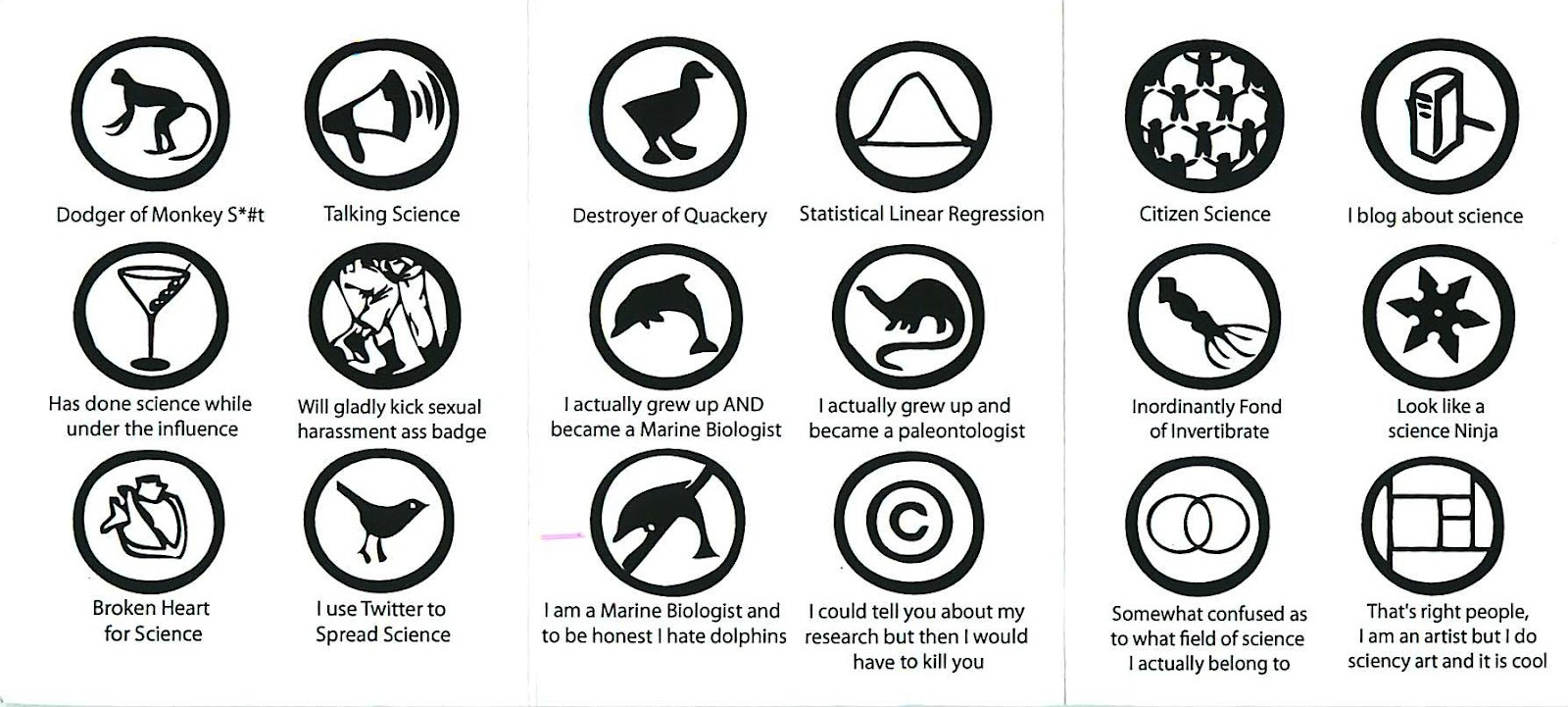
One of the coolest things I discovered at Science Online 2012: Science Scout Stickers #scio12

They were giving some out at Science Online 2012 and I really like them. They had texture and look very cool on my laptop (computer that is). Pondering getting some more. Wondering how I convince them to make some other kinds …
Here are scans of the handout from Science Online 2012

Microbial metaomics discussion group this week: metatranscriptomics and biogeography

A visiting student at my lab Lea Benedicte Skov Hansen will be leading our “metaomics” discussion group this week.  We will be discussing a combination of metatranscriptomics and biogeography and the papers of the week are:

Metatranscriptomics paper:

Microbial community gene expression in ocean surface waters. Frias-Lopez J, Shi Y, Tyson GW, Coleman ML, Schuster SC, Chisholm SW, Delong EF. Proc Natl Acad Sci U S A. 2008 Mar 11;105(10):3805-10. Epub 2008 Mar 3.

Some related papers of potential interest from DeLong

We are also discussing:

Drivers of bacterial beta-diversity depend on spatial scale. Martiny JB, Eisen JA, Penn K, Allison SD, Horner-Devine MC.
Proc Natl Acad Sci U S A. 108(19):7850-4.  (NOTE I am an author on this one – but the meat of the ideas/work was done by Jen Martiny, Claire Horner-Devine and others).

Related papers of possible interest by Jen Martiny and Claire Horner-Divine include:

Will let everyone know how the discussions go.  

Hard to tell if this is a SPAM conference or not "4th Intntl. Science in Society Conference"

Hard to tell if this is email I just got is about a SPAM Conference or not.

Dear Colleague,


On behalf of the Conference Organizing Committee, I would like to inform you of the:


FOURTH INTERNATIONAL CONFERENCE ON SCIENCE IN SOCIETY
University of California, Berkeley, USA
17 – 19 November 2012
http://science-society.com/conference-2012/


This conference addresses the social impacts, values, pedagogies, politics and economics of science. It is an inclusive forum that welcomes a breadth of perspectives on science from practitioners, teachers and researchers representing a wide range of academic disciplines.


The Science in Society Conference is held annually in different locations around the world. The Inaugural Science in Society Conference was held at the University of Cambridge United Kingdom, in 2009. The Conference was held at the Universidad Carlos III de Madrid, Madrid, Spain in 2010; and the Catholic University of America, Washington DC, USA in 2011.


In addition to Plenary Presentations from leading speakers in the field, the Science in Society Conference includes parallel presentations by practitioners, teachers and researchers. We invite you to respond to the conference Call-for-Papers. Presenters submit their written papers for publication in the peer refereed “International Journal of Science in Society”. If you are unable to attend the conference in person, virtual registrations are also available which allow you to submit a paper for refereeing and possible publication in the journal as well as the option of uploading a video presentation to our YouTube channel.


The deadline for the next round in the call for papers (a title and short abstract) is 21 February 2012. Future deadlines will be announced on the conference website after this date. Proposals are reviewed within two weeks of submission. Full details of the conference, including an online proposal submission form, may be found at the conference website: http://science-society.com/conference-2012/ .


We look forward to receiving your proposal and hope you will be able to join us in Berkeley, USA in August.

EVE198 / EVE161 Microbial Phylogenomics Course Spring 2012

Image

EVE 198 – Spring Quarter 2012 – CRN 74485 – 3 units P/NP grading

Microbial Phylogenomics:  The Evolutionary Diversification of Microbes and their Genomes

Professor Jonathan Eisen


TR 1:40-3:00pm

Room 1344 Storer Hall

 Prerequisites for this EVE 198 / Jonathan Eisen course are BIS 2ABC (or its equivalent, for transfer students). (This course is moving through the course approval process, and will eventually be EVE 161!)

New #openaccess paper in G3 from my lab w/ many others on ‘Programmed DNA elimination in Tetrahymena’ #CiliatesRule

A new paper in which the lab was involved has been published recently (just found it though it is not in Pubmed yet): Genome-Scale Analysis of Programmed DNA Elimination Sites in Tetrahymena thermophila.  It was a collaboration between Kathy Collins, multiple Tetrahymena researchers, the Eisen lab, and the UC Davis Genome Center Bioinformatics core (Joseph Fass and Dawei Lin).  The paper is in G3, an open access journal from the Genetics Society. 


This stems from the project I coordinated on the sequencing and analysis of the macronuclear genome of the single-celled ciliate Tetrahymena thermophila.  This organism, like other ciliates, has two nuclei – one called the micronucleus and one called the micronucleus macronucleus.  In essence you can view the micronucleus as the germ line for this single-celled creature and the micronucleus macronucleus is akin to somatic cells.  The micronucleus is reserved mostly for reproduction.  And the micronucleus macronucleus is used for gene expression.  In sexual reproduction, haploid versions of the micronuclear genomes from two lineages merge together just like in sexual reproduction for other eukaryotes.  After sex the offspring then create a macronuclear genome by taking the micronuclear genome and processing it in a variety of ways – going from 5 chromosomes for example to hundreds.  Plus many regions of the micronuclear genome are “spliced” out and never make it into the macronuclear genome.  Our new paper focuses on trying to better characterize which regions of the micronuclear genome get eliminated.


For more on our past work on Tetrhymena genomics see here which includes links to much more information including to my 2006 blog post about our first paper on the project. 


Note – the work in my lab on the sequencing was supported by grants from NSF and NIH-NIGMS.

New paper from lab: Genome-Scale Analysis of Programmed DNA Elimination Sites in Tetrahymena thermophila

A new paper in which the lab was involved has been published recently (just found it though it is not in Pubmed yet): Genome-Scale Analysis of Programmed DNA Elimination Sites in Tetrahymena thermophil a.  It was a collaboration between Kathy Collins, multiple Tetrahymena researchers, the Eisen lab, and the UC Davis Genome Center Bioinformatics core.  The paper is in G3, an open access journal from the Genetics Society.

New publication from members of my lab (e.g., @ryneches) & lab of Marc Facciotti on ChIP-seq based mapping of archaeal transcription factors

New publication from members of my lab and the lab of Marc Facciotti on a workflow for ChIP-seq based mapping of archaeal transcription factors. The paper includes a description of new software from Russell Neches in my lab called pique for peak calling.

See: A workflow for genome-wide mapping of archaeal transcription factors with ChIP-seq

Russell’s pique software is available on github here: https://github.com/ryneches/pique.
The Pique software package processes ChIP-seq coverage data to predict protein-binding sites. Strand-specific coverage data are output as tracks for the Gaggle Genome Browser, and putative-binding sites (peaks) are output as ‘bookmark files’. (A) Screenshot of data browsing in the Gaggle Genome Browser. Green box outlines the navigation window for clicking through bookmarks of predicted binding sites. Details of each site can be displayed (inset). The Gaggle toolbar (shown with black arrow) can be used to broadcast selected data to other ‘geese’ in the gaggle package, programs such as R, cytoscape, BLAST or KEGG. (B) Schematic overview of bioinformatics workflow.

ResearchBlogging.org Wilbanks, E., Larsen, D., Neches, R., Yao, A., Wu, C., Kjolby, R., & Facciotti, M. (2012). A workflow for genome-wide mapping of archaeal transcription factors with ChIP-seq Nucleic Acids Research DOI: 10.1093/nar/gks063

New publication from Lizzy Wilbanks, Russell Neches, et al

New publication from members of the lab in Nucleic Acids Research:

A workflow for genome-wide mapping of archaeal transcription factors with ChIP-seq.

Congrats.  Gonna have to make some new jam …

New York Times "Insight Panel" – SPAM? SCAM? or just LAME? cc: @nytimes

Just got this email below regarding the “New York Times Insight Panel.” Seems like a scam to me. If it is real, then it seems pretty, well, lame. Anyone know anything about this?

Dear New York Times Subscriber,

We would like to invite you to become a member of our community of engaged New York Times readers by joining The New York Times Insight Panel and sharing your opinions with us.

This important panel is made up of readers like you who are interested in giving us feedback on a variety of topics, including their involvement with The Times. Here’s a quick overview of the benefits of being a member:

Help guide research at The Times by offering your opinions on a variety of topics related to your lifestyle and interests

Earn points that can be redeemed for New York Times premiums and other rewards

Learn about new features as they become available to Times subscribers

If you have any questions, take a look at the FAQ’s section on our Web site http://NYTPanel.com or contact NYTPanelQuestions@BetaPanel.com . Please be assured that your privacy will be respected and kept strictly confidential. No one will try to sell you anything. For more information please review our privacy policy: The New York Times privacy policy .

To get started with your Panel registration, you will need to complete a membership survey. Please click on the URL below or copy and paste it into your browser:

http://betasurvey.com/n/nytimes/InsightPanel11/?PIN=————

Your personal password (PIN) is: ———

Please add your voice to our Insight Panel today!

Sincerely,

Ben Sider

Customer Research Manager

The New York Times

If you have any questions or comments regarding delivery of your newspaper, please contact The New York Times Customer Care Service by clicking on customercare@nytimes.com to send an e-mail.

Note: You are receiving this e-mail because you are part of an opt-in list provided by the survey’s sponsor. If you wish to not receive e-mails like this in the future, please reply to this e-mail with “unsubscribe ——–” in the subject line or click on the following URL to send an unsubscribe message (please include your PIN in the message): mailto:NYTPanelQuestions@BetaPanel.com

For more information, please visit www.betaresearch.com .