Registration Open for Data Rights & Data Wrongs workshop, 12/10 at #UCDavis

Data Rights & Data Wrongs

A workshop organized by
Innovating Communication in Scholarship (ICIS)

University of California, Davis

Date & Time: December 10, 2014 from 9:00 am – 5:00 pm

Location: MPR, Student Community Center, UC Davis

Register: https://www.eventbrite.com/e/data-rights-data-wrongs-tickets-14079810091

Full Agenda: http://icis.ucdavis.edu/?page_id=329

Keynote talks:
Dr. Christine Borgman, Professor & Presidential Chair, iSchool, UCLA
John Wilbanks, Chief Commons Officer, Sage Bionetworks

Scholars are increasingly subject to pressures from funding bodies, disciplinary norms, professional and personal ethics, and institutional directives to share their research data and make it available for reuse. There is, however, a great deal of heterogeneity across the research enterprise with respect to what is meant by ‘data’ and ‘data sharing,’ why data sharing is deemed important, and what data management strategies are considered most effective. Moreover, data are often difficult and costly to produce and share. Therefore, many scholars view these as a significant product of their intellectual labor for which they should receive some sort of credit towards tenure and promotion, authorial recognition through citation, or financial compensation. While balancing all of these considerations is desirable to promote increased access to data, it is difficult to guarantee that the concerns of all research stakeholders will be met given (1) the diverse forms that data can take, as well as the mobility and malleability of data given widespread access to new information technologies, (2) the complex and variable legal status of data as not-quite/not-always property, and (3) the ethical considerations and legal restrictions implicated in the sharing and reuse of data related to sensitive topics such as personal health information, national security, and vulnerable populations. This workshop will address theoretical concerns and pragmatic solutions that can be harnessed to help researchers comply with requirements or desires to share their data in ways they deem appropriate for their goals.

11_07 Data Rights flyer.pdf

Wanted: Program Directors in the Division of Mathematical Sciences (DMS)

Got this by email:
Dear Colleagues,

The Division of Mathematical Sciences (DMS), within the Directorate for Mathematical and Physical Sciences, National Science Foundation (NSF), announces a nationwide search for mathematical sciences professionals to fill Program Director positions. Formal consideration of interested applications will begin on November 18, 2014 and will continue until selections are made.

NSF Program Directors bear the primary responsibility for carrying out the Agency’s overall mission. To discharge this responsibility requires not only knowledge in the appropriate disciplines, but also a commitment to high standards, a considerable breadth of interest and receptivity to new ideas, a strong sense of fairness, good judgment, and a high degree of personal integrity.

Continue reading “Wanted: Program Directors in the Division of Mathematical Sciences (DMS)”

Today’s Open Science Reading: the Open Science Reviewer’s Oath

Well this certainly is interesting: The Open Science Peer Review Oath – F1000Research.  This emerged apparently from the AllBio: Open Science & Reproducibility Best Practice Workshop.  The “Oath” is summarized in the following text from a box in their paper:

Box 1. While reviewing this manuscript:

  1. I will sign my review in order to be able to have an open dialogue with you
  2. I will be honest at all times
  3. I will state my limits
  4. I will turn down reviews I am not qualified to provide
  5. I will not unduly delay the review process
  6. I will not scoop research that I had not planned to do before reading the manuscript
  7. I will be constructive in my criticism
  8. I will treat reviews as scientific discourses
  9. I will encourage discussion, and respond to your and/or editors’ questions
  10. I will try to assist in every way I ethically can to provide criticism and praise that is valid, relevant and cognisant of community norms
  11. I will encourage the application of any other open science best practices relevant to my field that would support transparency, reproducibility, re-use and integrity of your research
  12. If your results contradict earlier findings, I will allow them to stand, provided the methodology is sound and you have discussed them in context
  13. I will check that the data, software code and digital object identifiers are correct, and the models presented are archived, referenced, and accessible
  14. I will comment on how well you have achieved transparency, in terms of materials and methodology, data and code access, versioning, algorithms, software parameters and standards, such that your experiments can be repeated independently
  15. I will encourage deposition with long-term unrestricted access to the data that underpin the published concept, towards transparency and re-use
  16. I will encourage central long-term unrestricted access to any software code and support documentation that underpin the published concept, both for reproducibility of results and software availability
  17. I will remind myself to adhere to this oath by providing a clear statement and link to it in each review I write, hence helping to perpetuate good practice to the authors whose work I review.

I note – I reformatted the presentation a tiny bit here.   The Roman numerals in the paper annoyed me.  Regardless of the formatting, this is a pretty long oath.  I think it is probably too long.  Some of this could be reduced.  I am reposting the Oath below with some comments:

  1. I will sign my review in order to be able to have an open dialogue with you.  I think this is OK to have in the oath. 
  2. I will be honest at all times. Seems unnecessary.
  3. I will state my limits. Not sure what this means or how it differs from #4.  I would suggest deleting or merging with #4.
  4. I will turn down reviews I am not qualified to provide.  This is good though not sure how it differs from #3. 
  5. I will not unduly delay the review process. Good. 
  6. I will not scoop research that I had not planned to do before reading the manuscript. Good. 
  7. I will be constructive in my criticism. Good. 
  8. I will treat reviews as scientific discourses.  Not sure what this means or how it is diffeent from #9. 
  9. I will encourage discussion, and respond to your and/or editors’ questions.  Good though not sure how it differs from #8. 
  10. I will try to assist in every way I ethically can to provide criticism and praise that is valid, relevant and cognisant of community norms. OK though this seems to cancel the need for #7. 
  11. I will encourage the application of any other open science best practices relevant to my field that would support transparency, reproducibility, re-use and integrity of your research.  Good.  Seems to cancel the need for #13, #14, #15, #16. 
  12. If your results contradict earlier findings, I will allow them to stand, provided the methodology is sound and you have discussed them in context. OK though I am not sure why this raises to the level of a part of the oath over other things that should be part of a review. 
  13. I will check that the data, software code and digital object identifiers are correct, and the models presented are archived, referenced, and accessible.  Seems to be covered in #11. 
  14. I will comment on how well you have achieved transparency, in terms of materials and methodology, data and code access, versioning, algorithms, software parameters and standards, such that your experiments can be repeated independently. Seems to be covered in #11. 
  15. I will encourage deposition with long-term unrestricted access to the data that underpin the published concept, towards transparency and re-use. Seems to be covered in #11. 
  16. I will encourage central long-term unrestricted access to any software code and support documentation that underpin the published concept, both for reproducibility of results and software availability. Seems to be covered in #11. 
  17. I will remind myself to adhere to this oath by providing a clear statement and link to it in each review I write, hence helping to perpetuate good practice to the authors whose work I review.  Not sure this is needed.

The paper then goes on to provide what they call a manifesto.  I very much prefer the items in the manifesto over those in the oath:

  • Principle 1: I will sign my name to my review – I will write under my own name
  • Principle 2: I will review with integrity
  • Principle 3: I will treat the review as a discourse with you; in particular, I will provide constructive criticism
  • Principle 4: I will be an ambassador for good science practice
  • Principle 5: Support other reviewers

In fact I propose here that the authors considering reversing the Oath and the Manifesto.  What they call the Manifesto shoud be the Oath.  It is short.  And works as an Oath.  The longer, somewhat repetitive list of specific details would work better as the basis for a Manifesto.

Anyway – the paper is worth taking a look at.  I support the push for more consideration of Open Science in review though I am not sure if this Oath is done right at this point.

Job Announcement: Moore Foundation Program Associate

This seems like a potentially interesting job.  I note – I love the Moore Foundation – and just about everything they are doing in science.  Below is the email I recieved from the Project Lead Jon Kaye:

We have opened a search for a Program Associate. Details at the link below and attached. Please share with Bachelor’s and Master’s level individuals who may be interested. http://www.moore.org/about/careers?gnk=job&gni=8a8725d0494f97e601495deb88ba30cb We will also be opening a search for a PhD-level Program Officer position soonstay tuned for details.


Full text of the announcement is below:

Program Associate, Marine Microbiology Initiative
 
Marine Microbiology Initiative
The Marine Microbiology Initiative (MMI) seeks to gain a comprehensive understanding of marine microbial communities, including their genetic diversity, composition and function; their ecological role in the oceans; and their contribution to ocean health and productivity.
 
 
The Position
The Program Associate will provide programmatic support to the Marine Microbiology Initiative. The primary responsibility is to ensure that the systems to manage grants and strategic workflows are implemented efficiently by the MMI team through effective coordination of team processes and activities.
 
Key Responsibilities
  • Facilitate coordination of overall Initiative grantmaking processes and strategic planning efforts.
  • Employ project and grant management tools to manage information on the grant pipeline, including grant requirements, preparing reporting templates for grantees and tracking payments.
  • Support timely programmatic decisions through tracking and analyzing the Initiative budget allocation, including funding and grantmaking projections.
  • Assist with analysis of current and prospective grantees’ legal and financial status.
  • Analyze grantee financial reports.
  • Develop, solicit and manage website content.
  • Analyze and report on media, news outlets, and scientific journals and share relevant information with the team.
  • Collect and organize scientific publications, including compiling citations using bibliographic software.
  • Help organize and schedule conferences, workshops and meetings with members of the MMI community, including arranging travel (meals, lodging, etc.) for meeting participants as needed, managing event expenses and participant reimbursements, etc.
  • Develop and give presentations for internal and external audiences regarding the Initiative’s activities.
  • Apply knowledge of MMI and the Science Program when addressing inquiries from the MMI community.
  • Actively participate in Science Program and Foundation meetings, trainings, and other activities.
  • Communicate directly with grantees and prospective grantees regarding grantmaking procedures.
  • Support team by helping manage review process for grant proposals, as needed.
  • Coordinate MMI team activities, organize team meetings and calendars, manage documents, and carry out other administrative duties as requested.
  • Maintain meeting agendas, create and distribute meeting notes and synthesis documents, maintain action items for the team.
 
Experience and Education
The ideal candidate will have:
  • Bachelor’s or Master’s degree in a relevant field.
  • Demonstrated work experience in administration and/or project management.
  • Interest in scientific research (such as biology, environmental microbiology, oceanography, ecology, earth sciences, chemistry, physics, etc.) demonstrated through work, extracurricular activities, and/or volunteer programs.
 
Competencies and Attributes
The ideal candidate will also have:
  • Strong attention to detail and organizational skills.
  • Excellent project management and analytical skills.
  • A strong team orientation, positive attitude, integrity, self-motivation, discipline, and reliability.
  • Ability to work independently, self-manage priorities and goals for projects, meet deadlines, and multi-task while working well under pressure.
  • Work proactively and take initiative while consulting with Program Director and Program Officers as appropriate.
  • Ability to think critically and exercise judgment within defined procedures and practices to determine appropriate courses of action.
  • Interest and ability to synthesize knowledge in a variety of scientific fields.
  • Willingness to ask for help and identify appropriate resources to accomplish tasks, when necessary.
  • Strong written, oral, graphic, and inter-personal communication skills (e.g. phone inquiries, webpages, PowerPoint presentations, correspondence, and research summaries).
  • Proficiency with office productivity software (e.g. Outlook, Word, Excel, PowerPoint, etc.).
 
Desired Behavioral Characteristics
The ideal candidate will also demonstrate the following behaviors, which are the hallmarks of our culture and characterize how we strive to do our work with each other and our partners: 
  • Practice courageous conversations 
  • Build trusted relationships 
  • Move with speed 
  • Build high-performing teams 
  • Focus on what matters 
  • Take smart risks 
  • Plan outcomes, learn and adapt      
Compensation and Benefits
Compensation includes a competitive base salary and an excellent package of health, retirement savings and other benefits.
 
Application Process
Applicants must be legally authorized to work in the United States.  Pursuant to the San Francisco Fair Chance Ordinance, we will consider for employment qualified applicants with criminal histories in a manner consistent with the requirements of the ordinance.
 
The Gordon and Betty Moore Foundation is an equal opportunity employer. All correspondence will remain confidential. 


The future of Google Scholar

There is an interesting interview out in Nature where Richard van Noorden interviewed Anurag Acharya from Google Scholar: Google Scholar pioneer on search engine’s future : Nature News & Comment.  Definitley worth a look.  It has tidbits on the past, present and future of Google Scholar.

There are also some follow ups to this.  For example on Twitter I saw the following exchange:

//platform.twitter.com/widgets.js

I am in general agreement here that the cmmnity needs to start thinking about an open alternative.  Yes, I like Google Scholar (e.g., see my post on the Google Scholar blog: Using Google Scholar in Scholarly Workflows that I wrote in honor of the 10th Anniversary og GS.  But the lack of an API interface and the givng in to publishers demands seems lame.  So I do think we need to start to build up new strategies.  //platform.twitter.com/widgets.js

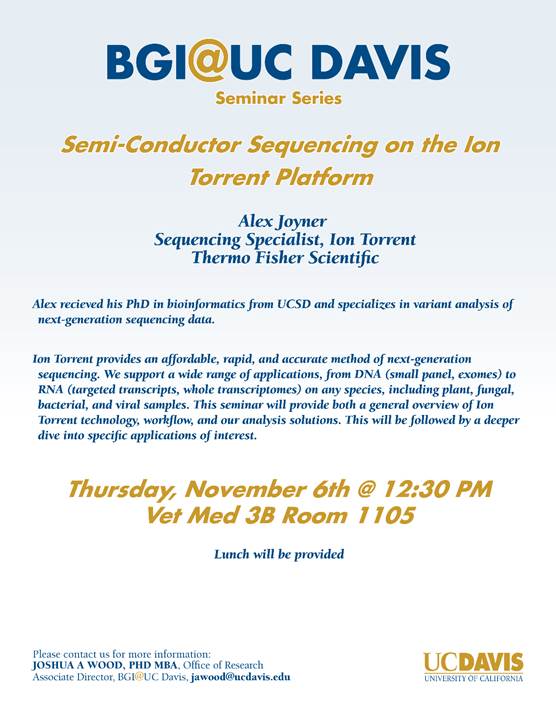
At #UCDavis today: Semi-Conductor Sequencing on the Ion Torrent Platform – 12:30 Vet Med 3B room 1105

Crosspost from #microBEnet: More scary than Halloween: this month in germophobia microbophobia

Crossposting this from the microBEnet blog where I originally posted it 10/31/14:

It seems that any time a holiday comes around in the US, the press starts to ramp up the writing of stories about evil microbes that are lurking all around us. And Halloween appears to be no exception. I am now planning on referring to this attitude as “microbophobia” rather than “germophobia” because to some “germ” implies pathogen and many of these stories fan the flames of fear about any kind of microbe not just pathogens. I note – the term microbophobia comes from some searches I did recently of Google books.

I was thinking of writing up yet another post trying to counter this excessive microbophobia but decided instead to just provide a collection of links to stories over the last month that have a distinctive microbophobia flavor.  Mind you – there are real reasons to be afraid of some of the microbes circulating around these days.  But the links below seem to me to be serious overkill.

These are but a few of the many examples of microbophobia being pushed by the press. Again, there are certainly things to worry about in terms of pathogens in our immediate environment.  Flu season is coming.  Enterovirus might be on the upswing.  Antibiotic resistance is a massive and troubling problem.  And so on.  But please let us not go completely over the top because the more we promote the idea that we should be killing all microbes, the more trouble we are likely to cause, rather than prevent.

The flawed and offensive logic of "Academic Science Isn’t Sexist" in the @nytimes

OK.  It is Halloween night and I am tired and need to get my kids to sleep.  But someone on Twitter just pointed me to an opinion piece just out in the New York Times: Academic Science Isn’t Sexist – NYTimes.com and after reading it I felt I had to write a quick post.

The opinion piece is by Wendy M. Williams and Stephen J. Ceci and discusses work by them (and coauthors).  In particular they discuss findings in a massive report “Women in Academic Science: A Changing Landscape” by Stephen J. Ceci, Donna K. Ginther, Shulamit Kahn, and Wendy M. Williams in Psychological Science in the Public Interest.  I note – kudos to the authors for making this available freely and under what may be an open license and also apparently for making much of their data available behind their analyses.

The opinion piece and the associated article have a ton of things to discuss and ponder and analyze for anyone interested in the general issue of women in academic science.  I am not in any position at this time to comment on any of the specific claims made by the authors on this topic.  But certainly I have a ton of reading to do and am looking forward to it.

However, I do want to write about one thing – really just one single thing –  that really bothers me about their New York Times article.  I do not know if this was intentional on their part, but regardless I think there is a major flaw in their piece.

First, to set the stage — their article starts off with the following sentences:

Academic science has a gender problem: specifically, the almost daily reports about hostile workplaces, low pay, delayed promotion and even physical aggression against women.  Particularly in math-intensive fields like the physical sciences, computer science and engineering, women make up only 25 to 30 percent of junior faculty, and 7 to 15 percent of senior faculty, leading many to claim that the inhospitable work environment is to blame.

This then sets the stage for the authors to discuss their analyses which leads them to conclude that in recent times, there are not biases against women in hiring, publishing, tenure, and other areas.  Again, I am not in any position to examine or dispute their claims about these analyses – to either support them or refute them.

But the piece makes what to me appears to be a dangerous and unsupported connection.  They lump together what one could call “career progression” topics (such as pay, promotion, publishing, citation, etc) with workplace topics (hostility and physical aggression against women).  And yet, they only present or discuss data on the career progression issues.  Yet once they claim to find that career progression for women in math heavy fields seems to be going well recently, they imply that the other workplace issues must not be a problem.  This is seen in statements like “While no career is without setbacks and challenges” and “As we found, when the evidence of mistreatment goes beyond the anecdotal” and “leading many to claim that the inhospitable work environment is to blame.”

Whether one agrees with any or all of their analyses (which again, I am not addressing here) I see no justification for their inclusion of any mention of hostile workplaces and physical agression against women.  So – does this mean that a woman who does well in her career cannot experience physical aggression of any kind?  Also – I note – I am unclear I guess in some of their terminology usage – is their use of the term “physical aggression” here meant to discount reports of sexual violence?   This reminds me of the “Why I stayed” stories of domestic violence.  Just because a women’s career is doing OK does not mean that she did not experience workplace hostility or physical or sexual violence.  I hope – I truly hope – that the authors did not intend to imply this.  But whether they did or not, their logic appears to be both flawed and offensive.

UPDATE 1. November 1, 8:30 AM

Building a Storify about this.

UPDATE 2: Nov 3, 2014. Some other posts also criticizing the NY Times piece

UPDATE 3: Nov. 4, 2014.  More posts about the NY Times piece

Rediscovering some critical terms of use in microbial discussions: #microbiomania and #microbophobia

Earlier this week I was trying to come up with a short term to use when referring to the “Overselling of the Microbiome” and related hype. And I came up with one I really really like: microbiomania. The term just captures the essence of hype about microbiomes to me I guess.

So – of course – the first thing to do was to see if anyone else used this term.  And the number one thing I looked at was domain names.  Nope.  Microbiomania.Com and Microbiomania.Org are now mine.  And then I started to search the interwebs. And surprsingly there was not much (in English at least).  But some links showed up to books in Google Books with passages from > 100 years ago.  And this is when the digging got to be fun.  Here are some of the things I found.

1. A section from “The Medical Era

When copying this section of the search results I discovered Google Books has an embed tool for Google Books though not sure how well it works: here is a try

Anyway – the text of this section of the book reads:

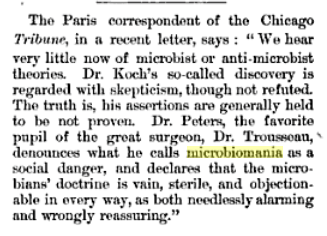
The Paris correspondent of the Chicago Tribune in a recent letter says We hear very little now of microbist or anti microbist theories Dr Koch’s so called discovery is regarded with skepticism though not refuted The truth is his assertions are generally held to be not proven Dr Peters the favorite pupil of the great surgeon Dr Trousseau denounces what he calls microbiomania as a social danger and declares that the micro bians doctrine is vain sterile and objectionable in every way as both needlessly alarming and wrongly reassuring 

So I guess there were some folks who did not like the Koch and his silly theories about germs.

2. The Eclectic Medical Journal Volume 48

OCR text:

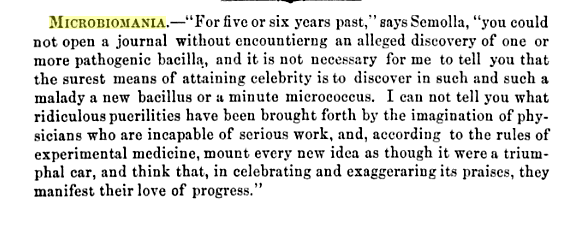
Microbiomania For five or six years past says Semolla you could not open a journal without encountierng an alleged discovery of one or more pathogenic bacilla and it is not necessary for me to tell you that the surest means of attaining celebrity is to discover in such and such a malady a new bacillus or a minute micrococcus I can not tell you what ridiculous puerilities have been brought forth by the imagination of physicians who are incapable of serious work and according to the rules of experimental medicine mount every new idea as though it were a triumphal car and think that in celebrating and exaggeraring its praises they manifest their love of progress 

Pretty awesome stuff I think.

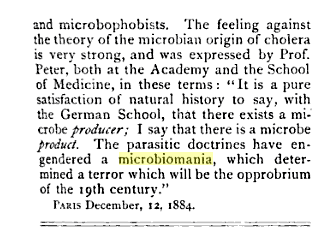
3. The Louisville Medical Journal also comes up with a hit to microbiomania

Here is the attempt at an embed:

and the OCR interpreted text reads

and microbophobists The feeling against the theory of the microbial origin of cholera is very strong and was expressed by Prof Peter both at the Academy and the School of Medicine in these terms It is a pure satisfaction of natural history to say with the German School that there exists a microbe producer I say that there is a microbe product The parasitic doctrines have engendered a microbiomania which determined a terror which will be the opprobrium of the 19th century
Faris December 12 1884 

Now – nevermind that the OCR is not perfect (where is Faris?).  But not only is this fascinating.  But the beginning of the page has another word that seems worthy of resurrecting: microbophobists,  And this pulls up all sorts of fascinating discussions:


And the related search is perhaps more fascinating: microbophobia

So – in the end I did not come up with a totally new word.  But I do now have two words I really want to use more often and which I will use in the following ways:

  • Microbiomania which I define here as the overselling of the impact (beneficial or detrimental or otherwise) of microbiomes without the evidence to support such impact 
  • Microbophobia which I define here as the overwhelming and unreasonable fear of microbes (of any kinds).  This is similar in concept to “germophobia” but gets around the issue some people have with whether “germ” is a term that should be reserved for pathogens and thus that germophobia could be viewed as the fear of pathogens.  

11/3 at #UCDavis: Dr. Sarah Mathew “The Evolution of Large Scale Cooperation in Humans: Insights from Turkana Warfare”

Evolutionary Anthropology Colloquium Series
Mondays at 4:10 pm in 273 SS&H

November 3rd:
The Evolution of Large Scale Cooperation in Humans: Insights from Turkana Warfare

Dr. Sarah Mathew
School for Human Evolution & Social Change
Arizona State University