
Author: Jonathan Eisen
I am an evolutionary biologist and a Professor at U. C. Davis. (see my lab site here). My research focuses on the origin of novelty (how new processes and functions originate). To study this I focus on sequencing and analyzing genomes of organisms, especially microbes and using phylogenomic analysis
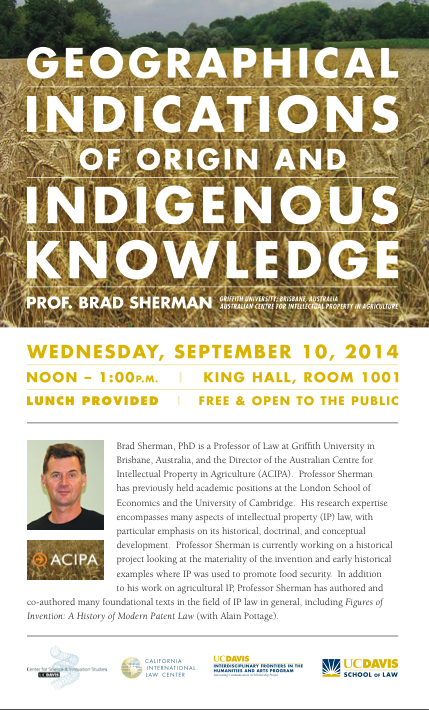

Science Journal SPAM of the Week: the Journal of HIV/AIDS from Sci Forschen
Well, got this email this AM. It is yet another spammy journal (I don’t work on HIV/AIDS). I particularly like the part where I am called an “eminent personality”.
Dear Dr. Jonathan Eisen,
Greetings from the Journal of HIV/AIDS,
We take great delight in inviting you to join the Editorial Board for the Journal of HIV/AIDS , which is an open access, peer reviewed journal managed by Sci Forschen. Ensuring quality and accuracy for every submitted article is the top most priority for Sci Forschen, and we genuinely believe that someone with the knowledge and experience, such as yourself, can really make a huge difference for us.
Journal of HIV/AIDS , publishes cutting edge research work submitted by scholars from all over the world, and we believe that your presence will polished up with the help of illustrious experts in research field.
We are always striving to involve eminent personalities like you and your standing in the global community makes us confident.
Kindly let us know your valuable response and acceptance if possible with in 48 hours.
Please kindly submit your following particulars to update in our journal website
1. Updated CV
2. Passport Size Photo
3. Short Biography
4. Research Interest
Looking forward for your valuable and soon response.
Regards,
Editorial Office
Sci Forschen Incorporation
913 Catkin Ct.
San Jose, CA 95128, USA.
Share this:

A tale of salt and gender: participation of women in halophile research
Interesting paper on women in science of direct relevance to my work: Frontiers | Salty sisters: The women of halophiles | Extreme Microbiology. I have been working on halophilic archaea for many years (since introduced to them in graduate school) and published papers on this topic (e.g., see The Complete Genome Sequence of Haloferax volcanii DS2, a Model Archaeon and Sequencing of seven haloarchaeal genomes reveals patterns of genomic flux and more coming). However, I have never been to a meeting dedicated to the topic and confess I have not thought specifically about the gender of scientists in this field and at meetings in the field and such. Thus I was pleasantly surprised to see this analysis from Bonnie Baxter, Nina Gunde-Cimerman and Ahoren Oren. Their abstract is below:
A history of halophile research reveals the commitment of scientists to uncovering the secrets of the limits of life, in particular life in high salt concentration and under extreme osmotic pressure. During the last 40 years, halophile scientists have indeed made important contributions to extremophile research, and prior international halophiles congresses have documented both the historical and the current work. During this period of salty discoveries, female scientists, in general, have grown in number worldwide. But those who worked in the field when there were small numbers of women sometimes saw their important contributions overshadowed by their male counterparts. Recent studies suggest that modern female scientists experience gender bias in matters such as conference invitations and even representation among full professors. In the field of halophilic microbiology, what is the impact of gender bias? How has the participation of women changed over time? What do women uniquely contribute to this field? What are factors that impact current female scientists to a greater degree? This essay emphasizes the “her story” (not “history”) of halophile discovery.
As part of their paper they analyze participation of women at conference on halophiles:
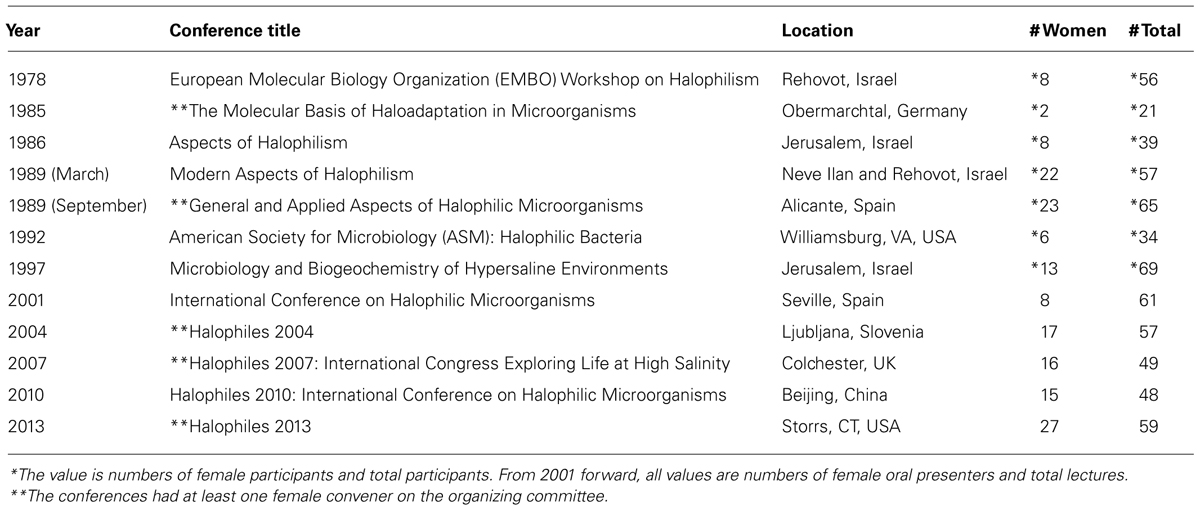
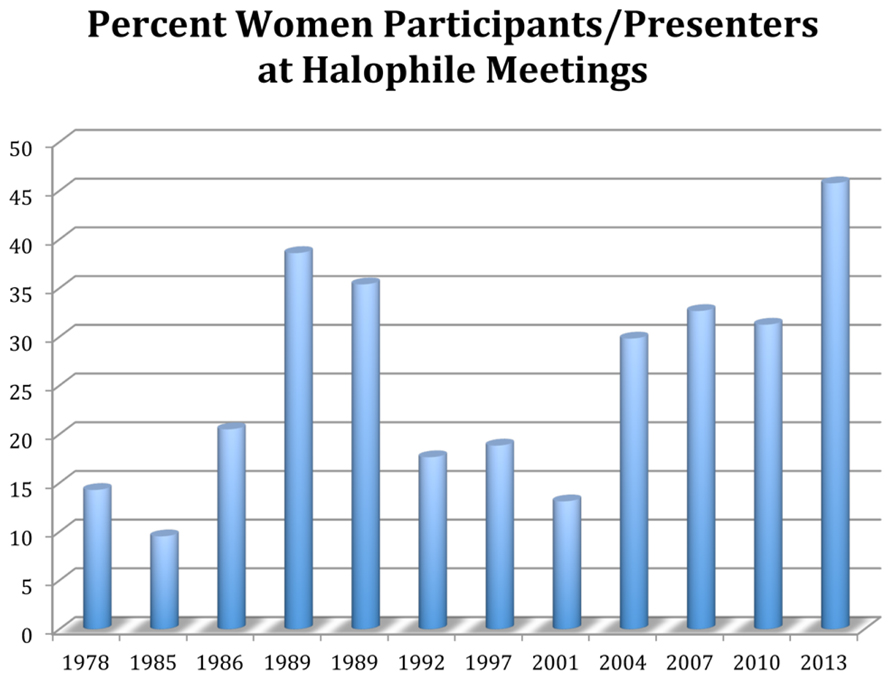
This is a useful analysis and compendium and it would be great to see this done for as many fields as possible.
Share this:

Mesquite "A modular system for evolutionary analysis" v3.0 released from Team Maddison

Just found out about this on Facebook via Rod Page: Mesquite V3.0 has been released. Mesquite is from Team Maddison (Wayne and David). I have been using their software since 1987 when I took Stephen Jay Gould’s course at Harvard and they were TAs for the course demoing an early version of MacClade. Lots of nice features and it is available in Mac, Unix/Linux, and Windows versions. They describe “What Mesquite Does” on their Wikispaces site in the following way:
Mesquite is software for evolutionary biology, designed to help biologists manage and analyze comparative data about organisms. Its emphasis is on phylogenetic analysis, but some of its modules concern population genetics, while others do non-phylogenetic multivariate analysis. Because it is modular, the analyses and management features available depend on the modules installed. Here is a brief overview of some of Mesquite’s features. See also a more complete outline of features, and the Mesquite Project Youtube channel, with instructional videos helping you learn Mesquite.
Despite Mesquite’s broad analytical capabilities, the developers of Mesquite find that we use Mesquite most often to provide a workflow of data editing, management, and processing. We will therefore begin there.
Definitely worth a look.
Share this:

NIH Announces Revised Genome Data Release Policies
Just got notified of this by the UC Davis Med. School grants administration: NOT-OD-14-124: NIH Genomic Data Sharing Policy. Lots of interesting things in here including a summary of the comments that they received on the draft policy.
I have copied some of the more interesting and relevant bits below:
- Sharing research data supports the NIH mission and is essential to facilitate the translation of research results into knowledge, products, and procedures that improve human health. NIH has longstanding policies to make a broad range of research data, in addition to genomic data, publicly available in a timely manner from the research activities that it funds.
- The public comments have been posted on the NIH GDS website. http://gds.nih.gov/pdf/GDS_Policy_Public_Comments.PDF
- The statement of scope remains intentionally general enough to accommodate the evolving nature of genomic technologies and the broad range of research that generates genomic data.
- Several comments were submitted by representatives or members of tribal organizations about data access. Tribal groups expressed concerns about the ability of DACs to represent tribal preferences in the review of requests for tribal data.
- The GDS Policy expects that basic sequence and certain related data made available through NIH-designated data repositories and all conclusions derived from them will be freely available. It discourages patenting of “upstream” discoveries, which are considered pre-competitive, while it encourages the patenting of “downstream” applications appropriate for intellectual property.
- NIH expects investigators and their institutions to provide basic plans for following this Policy in the “Genomic Data Sharing Plan” located in the Resource Sharing Plan section of funding applications and proposals. Any resources that may be needed to support a proposed genomic data sharing plan (e.g., preparation of data for submission) should be included in the project’s budget.
- Large-scale non-human genomic data, including data from microbes, microbiomes, and model organisms, as well as relevant associated data (e.g., phenotype and exposure data), are to be shared in a timely manner.
Share this:
Kudos to Dr. Roizen’s Personalized, Preventive, & Integrative Medicine "Focus on Women’s Health" Conference #NoMoreYAMMMs
Quick post here as I have a bit of a cold. I post a lot of critiques here about meetings that have bad gender ratios for the speakers. But I do focus on the negative and am trying to also call attention to the good cases. Well here is one: the 12th Annual Dr. Roizen’s Personalized, Preventive, and Integrative Medicine Conference with a focus on Women’s Health. And unlike the recent Ovarian Club meeting (see No Ovaries? Well this Ovarian Club Conference is For You (YAMMMs for everyone)) which had few female speakers despite the topic, Dr. Roizen and the other organizers (including one of my favorite colleagues Rosane Oliveira) did a great job. The gender ratio of organizers, moderators and speakers all looks good (see images below). Kudos to all involved.


Share this:

Could be interesting: @jennomics “Biogeography of microbial communities associated with seagrasses”
Postdoc Seminar Series presents:
Jenna Morgan Lang
Eisen lab, Genome Center
Biogeography of microbial communities associated with seagrasses
1022 Life Sciences
12:10 pm on Tuesday 2nd September
Share this:
Simons Early Career Investigator in Marine Microbial Ecology and Evolution Awards (RFA)
|


Share this:
UC Davis Genome Center job: #Bioinformatics Core Manager #Genomics
You know you want this job:
The UC Davis Genome Center integrates experimental and computational approaches to address
key problems at the forefront of genomics. The Center is housed in a new research building with state-of-the-art computational and laboratory facilities. The Center comprises 23 research faculty and five technology service cores that serve the whole campus. The faculty and
service cores contribute to an internationally recognized program in genomics research at Davis, building on and enhancing the unique strengths and unmatched breadth of the life sciences on the UC Davis campus.
The Bioinformatics Service Core provides a broad range of services in computational biology and bioinformatics on a recharge basis to diverse research groups on campus. The Core is responsible for providing consulting, software and access to computational resources to address needs in all areas of bioinformatics, including data acquisition and curation, database construction and integration, sequence analysis, molecular structure and network analyses, expression profile analysis and statistics.
The Genome Center invites applications for the position of
Bioinformatics Core Manager. The incumbent will be responsible for the day-to-day running of the Bioinformatics Service Core. This includes but is not limited to management of staff and computational
infrastructure and budgetary aspects of the core. The manager will be responsible for ongoing assessment of computational needs, including staff, hardware, software and databases required to perform the multiple types of bioinformatics analyses for cutting- edge genomics research. The manager also will be responsible for recruiting and training staff, assessing the campus-wide needs for bioinformatics services and prioritizing their provision, representation of the Genome Center at scientific conferences and the writing and submission of grant proposals to maintain the core with state-of-the-art resources.
This position requires a Ph.D. or equivalent in a relevant area, such as Computer Science, Statistics, Applied Mathematics or Computational or Mathematical Biology. Applicants should have experience in the management of a production bioinformatics facility and broad technical knowledge sufficient to supervise technical staff, troubleshoot problems, acquire and maintain hardware, refine bioinformatics approaches, and advise faculty and their research groups. The position will be open until filled. Consideration of applications will begin October 1, 2014. Applicants should apply on line at
https://recruit.ucdavis.edu/apply/JPF00320
Further information about genomics and bioinformatics at UC Davis is available at http://www.genomecenter.ucdavis.edu .
The University of California is an affirmative action/equal opportunity employer
Bio Core Manager Advert 8-2014.pdf
Share this:
Overselling the Microbiome Award: The Microbiome Diet Book
Well, umm, I do not know what to say: The Microbiome Diet: The Scientifically Proven Way to Restore Your Gut Health and Achieve Permanent Weight Loss: Raphael Kellman MD: 9780738217659: Amazon.com: Books. I got pointed to this book by Dorothy Timmermans and she wondered if this was a case of “overselling the microbiome” or not. I guess I don’t know because I have not read the book. Nor will I most likely. But I think almost certainly it is a case of “Overselling the Microbiome” based just on reading the blurb on Amazon from the Publisher which I paste below. It contains a litany of over the top statements:
Cutting-edge science has shown that the microbiome is the secret to healthy weight loss and to feeling healthy, energized, optimistic, and at the top of your game. The microbiome is a whole inner world that lives within your intestines—trillions of tiny microbes that help you extract the nutrients from your food, balance your mood, and sharpen your clarity and focus.
These beneficial bacteria make up a separate ecology within the body and have an enormous influence on your metabolism, your hormones, your cravings—even your genes. The microbiome’s health is intimately involved with yours: when it flourishes, you flourish. When it craves sugar, so do you. When it operates at peak efficiency, so does your metabolism. And when your microbiome is out of balance, you might find yourself gaining weight or unable to lose weight, no matter how much you exercise or how carefully you eat. To achieve your ideal weight, you need the help of your microbiome.
Now, drawing from nearly two decades of experience as a specialist in functional medicine and intestinal health, Raphael Kellman, MD, has developed the first diet based upon on these scientific breakthroughs. The Microbiome Diet offers an effective three-phase plan to heal your gut, reset your metabolism, and achieve dramatic, sustainable weight loss. The Microbiome Diet will help you…
Reset your metabolism
Free yourself from food cravings and uncontrollable appetite
Incorporate prebiotics, probiotics, and healing foods into every meal
Lose weight—and keep it off—with a nonrestrictive life plan
With delicious recipes, convenient meal plans, and helpful information on Microbiome Superfoods and Supersupplements—including prebiotics and probiotics—The Microbiome Diet gives you the tools to achieve your healthy weight, boost your mood, regain your mental focus, and be in your best shape for life.
Sound too good to be true? Well, that is because it is.

