Advice needed from a future reviewer…

I found myself writing this email to some collaborators, but halfway through realized that it’d be nice to get EVERYBODY’s input. Probably, one of you is going to review my next paper, so how awesome would it be for you to just tell me what you think now, and make both of our lives easier later.

To test whether taxa vary significantly across groups of samples, we first need to filter the OTU table to get rid of OTUs that are not present in most of the samples and/or that do not vary across samples. This must happen for statistical reasons.

As far as I know, there are two ways to do this. One, is to remove OTUs that occur in fewer than 25% of the samples (25% is suggested by the QIIME folks). The other is to calculate the variance of the OTUs across samples and remove the OTUs that have a variance less than 0.00001 (0.00001 is an arbitrary number thrown out there by the phyloseq developer.)

A third option would be to apply both criteria.

My inclination would be to go with the third option, but mostly because I want to limit as much as possible the number of hypothesis tests that we do in order to avoid draconian p-value corrections.

I’m not a big fan of arbitrary thresholds, but they are so frequently required that I’ve made my peace with them. However, if someone can suggest a non-arbitrary threshold, that’d be great.

But mostly, I want to make sure that everyone agrees now on the method that we use so that I only have to do this once. Thoughts?

Microbe-themed art of the month: Seung-Hwan Oh portraits w/ mold

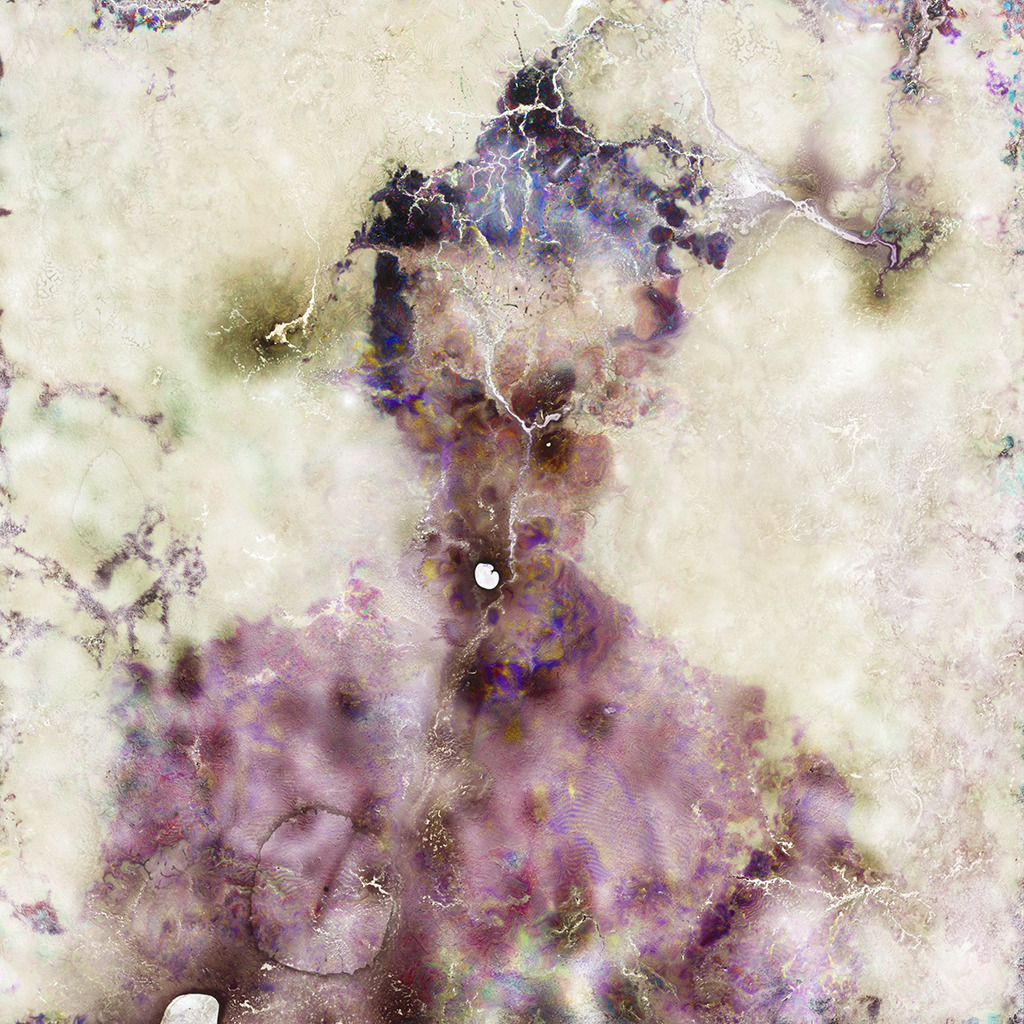
OK this is pretty cool (from a microbe-art-science point of view): An Artist Who Paints Portraits With Mold | WIRED.  Seung-Hwan Oh “had to set up a micro-fungus farm in his studio” and he puts film in a warm wet environment (note to self – there could be a new human microbiome aspect of this project depending on what warm wet environment is chosen) and sometimes seeds the system with some mold.  And then he lets nature do its work.

See more about his Impermanence works here. (Really – check out the works – they are wild).

At that site the work is described in the following way:

The visual result of the symbiosis between film matter and organic matter is the conceptual origin of this body of work. The process involves the cultivation of emulsion consuming microbes on a visual environment created through portraits and a physical environment composed of developed film immersed in water. As the microbes consume light-sensitive chemical over the course of months or years, the silver halides destabilize, obfuscating the legibility of foreground, background, and scale. This creates an aesthetic of entangled creation and destruction that inevitably is ephemeral, and results in complete disintegration of the film so that it can only be delicately digitized before it is consumed.

Also see his Tumbl page where one can find many other images like this one:

Hat tip to Kate Scow for posting about this on Facebook.

UC #OpenAccess policy comments wanted from Academic Senate members by 1/7/15

The University invites comments on the proposed draft Presidential Policy on Open Access, which is based on the Academic Senate Open Access Policy for all Academic Senate members adopted on July 24, 2013.

The proposed new policy extends open access rights and responsibilities to all non-Senate members of the UC community who are authors of scholarly articles, including faculty, other academic personnel, students, administrators, and staff. The policy allows non-Senate authors of scholarly articles to maintain legal control over their research articles while making their work freely available to the public. In addition, the proposed policy outlines procedures for implementing the policy for all UC authors, both Senate and non-Senate. Although the policy assumes all authors will make their scholarly articles available to the public, there is a procedure, which authors must undertake proactively, to opt out of the open access process.

The proposal is located on the UCOP Academic Personnel and Programs website, “Policies under review,” under the “Systemwide Review” tab at http://www.ucop.edu/academic-personnel-programs/academic-personnel-policy/policies-under-review/index.html. If you prefer these documents as attachments, please let me know.

Talk for UC Davis Pre-Health Meeting (#UCDPHSA): Opening up to Diversity

Sunday I gave a talk at the “12th National UC Davis Pre-Health Student Alliance Pre-Medical and Pre-Health Professions Conference“.  I normally try to not give talks on weekends (to spend time with my family) but I made an exception here since this meeting has a strong commitment to issues relating to diversity in health and STEM fields.  This mission statement for the meeting reads:

The UC Davis Pre-Health Student Alliance’s objective is to introduce and support academic, admission, and preparatory opportunities for all students interested in health professions with a focus on those underrepresented in healthcare (with regard to gender, economic, social, educational, linguistic, cultural, racial, and ethnic background). We target universities, community colleges and high schools throughout the United States. The UC Davis Pre-Health Student Alliance aims to impact health education, increase diversity amongst the healthcare workforce, and inspire future leaders of healthcare through hosting the largest national pre-health professions conference.

It was that mission statement that got me to ditch my wife and kids Sunday AM (and also much of Saturday PM for a dinner and to work on my talk).  I went to a dinner Saturday for some of the speakers with the new Dean of the UC Davis School of Medicine Julie Freischlag.  The dinner had about 20 or so people and I met some quite interesting folks there working on various aspects of human and animal health.

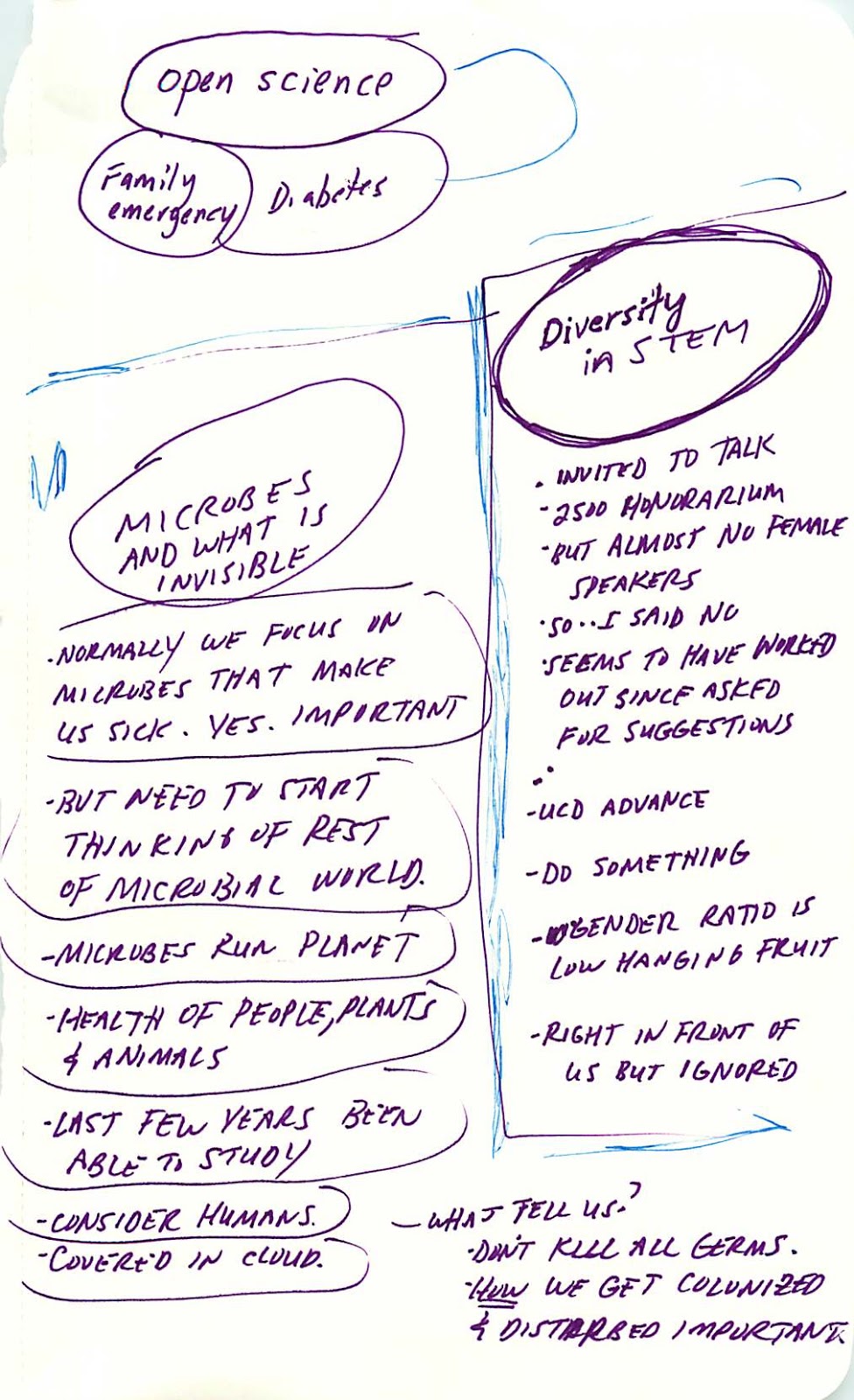
And then Sunday AM I got up early, decided to use slides (was not sure) and finished off the slide set I had worked on the night before.  I decided that, in the spirit of the meeting, I would talk about two main things – diversity and access.  And I planned to tell three stories about my work in this area.  I wove in some personal stories since, at the dinner the night before Barbara Ross-Lee (who I sat next to) helped remind me of the importance of making talks personal.  So in the end I talked about myself, diabetes, diversity of microbes, antibiotics, diversity in STEM, and open science.  I came up with a title I was OK with: Opening up to Diversity.

My talk went well, I think.  I am pretty sure it was vbideotaped but not sure where that recording will end up. I did however post my slides to slideshare.  See below:

Opening up to Diversity talk by @phylogenomics at #UCDPHSA from Jonathan Eisen

And I also recorded the talk using Camtasia (basically, it allows recording of the screen, the video camera on my computer, and the audio).  I posted the recording (without the video feed which shows mostly my neck) to Youtube.  See below:

UPDATE 10/16 –

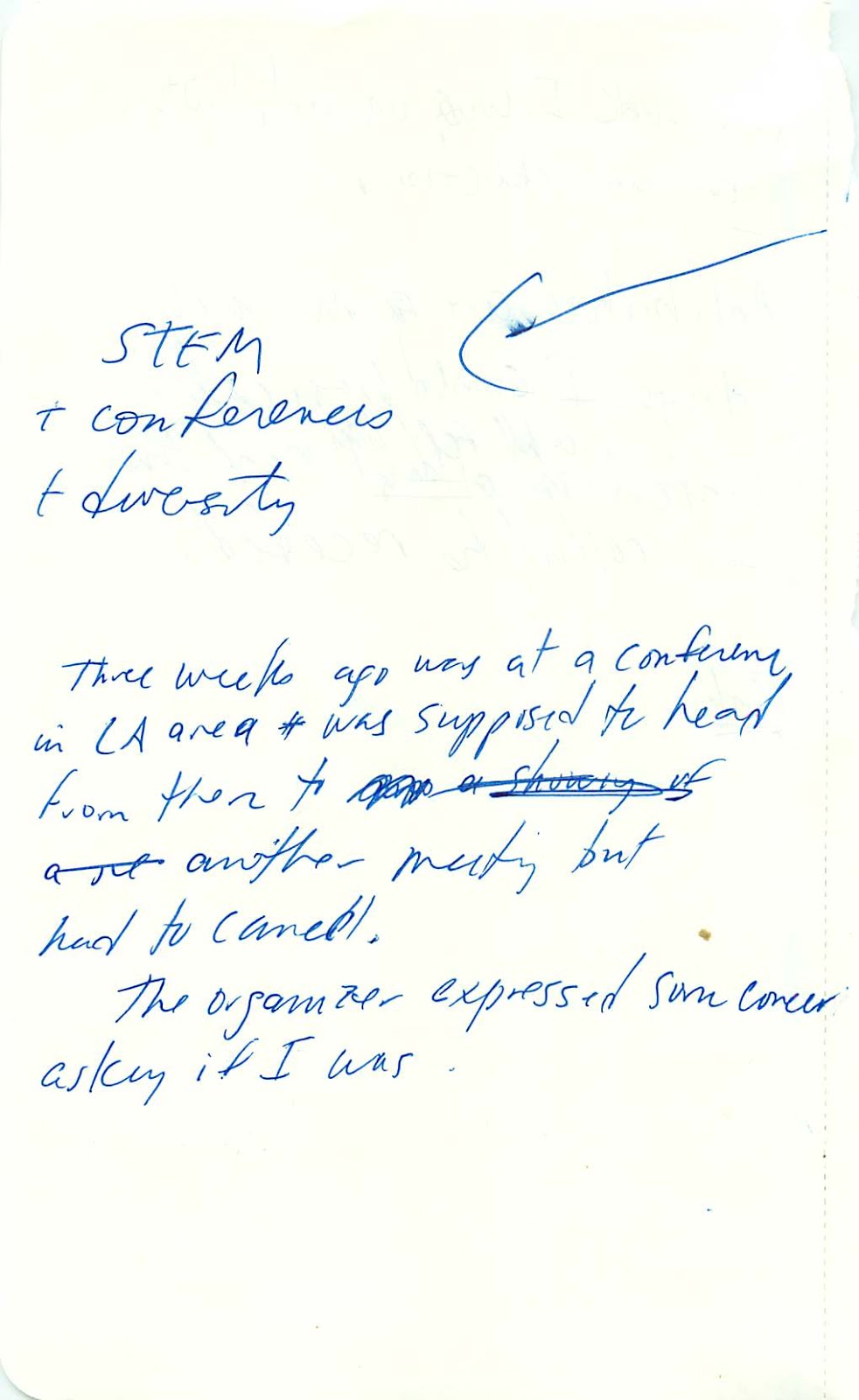
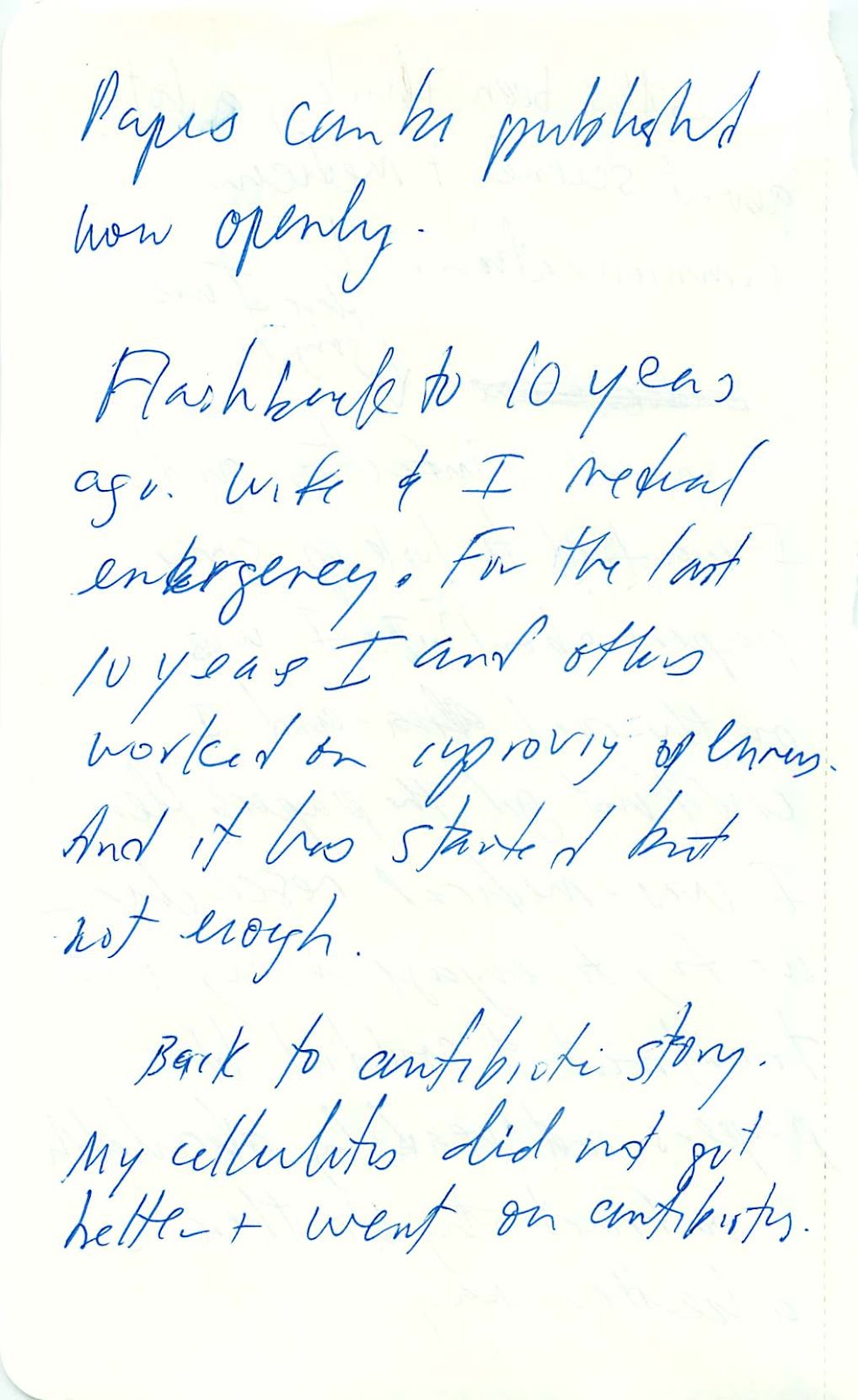
I have scanned in my notes that I made in planning this talk.  Figured, why not post them.

Update: 12/10/2014 – just discovered a video of the talk was posted to Youtube 

Aspen Center for Biophysics: Workshop on Microscale Ocean Biophysics

Just got this from the Moore Foundation ..

Dear colleague,

The MMI team would like to apprise you of the following meeting on microscale ocean processes. Please share with potentially interested colleagues; the application deadline is quickly approaching — October 15, 2014. Further information can be found at http://www.aspenphys.org/physicists/winter/winterapps.html and tinyurl.com/MicroAspen.

Workshop on Microscale Ocean Biophysics

At Aspen center for physics

11-16 January 2015

Application deadline: 15 October

This highly interdisciplinary meeting will focus on how physical processes affect aquatic organisms at small scales, and thereby the global processes in oceans and lakes that microorganisms overwhelmingly govern. Over the past two decades, there has been a growing realization that the ecology of these organisms depends not only on the bulk environmental conditions, but also crucially on small-scale biophysical interactions and microscale heterogeneity in the physical and chemical conditions. It is becoming clear that physical processes play a fundamental role in shaping the microscale landscapes that form the arena in which these organisms forage, reproduce and encounter each other. A key goal of this meeting is to help advance our understanding of aquatic ecosystems by replacing current statistical and heuristic descriptions with a mechanistic understanding of the component processes. This cannot be achieved without a strong appeal to small-scale fluid physics, mass transport, active suspensions, turbulence, and mechanics in general. The result is a rich landscape of opportunities for physicists, mathematicians, chemists and engineers to be involved in oceanographic and environmental problems, and for oceanographers, biologists and ecologists to inspire and utilize physical concepts and approaches more pervasively. The vision underpinning this meeting is that the interdisciplinary application and advancement of these topics in the context of oceanographic processes will greatly improve our understanding of how organism life is constrained and has evolved to exploit the fundamental laws of physics.

Deadline to apply is October 15, 2014

Apply here:

http://www.aspenphys.org/physicists/winter/winterapps.html

Organizers:
Roman Stocker (MIT)
Stuart Humphries (University of Hull)
Thomas Kiørboe (Technical University of Denmark)
Lee Karp-Boss (University of Maine)
Justin Seymour (University of Technology, Sydney)

Why I Tweet and Blog: Captured by Beryl Lieff Benderly

You know, many people ask me – why do I talk to science reporters so often.  They ask this and then claim that science reporters are just all kinds of evil because they always get quotes and facts and concepts wrong.  Well, that has really not been my experience.  Sure, I have my examples of problems.  But overall, I have been impressed and pleased more often than not.  And here is a great example. I was interviewed a while back by Beryl Lieff Benderly about my somewhat obsessive experimentation with social media for communicating science.  And then, of course, I forgot about it.  So I was exceptionally pleased when I saw the story come out today: To tweet or not to tweet? | Science Careers.  Beryl did a remarkably good job in capturing the essence of my thoughts about Tweeting, Blogging, social media, and science communication.

If you want to know what I think about how to not get overwhelmed with Twitter, how to not spend too much time on social media, and what I think abotu aboutb social media, you don’t need to wait for me to try to write my thoughts on the topic down.  Read what Beryl wrote.

Sexism in Science

“Are you going to church before your oral exam?”. That was the question I’d asked my friend jokingly when I saw her dressed in a funny looking attire, which I can only describe as a floral print, beige colored, raincoat. Except it wasn’t waterproof.
“No, I’m wearing it to the oral exam”, was her simple response. Something didn’t seem right here. This is a girl who is very fashion conscious and in a city like Davis, where T-shirt and jeans/shorts is the norm she can sometimes standout as well dressed.
She doesn’t just wear clothes that are “expected” of a female grad student, but she also wear skirts, dresses and a menagerie of clothing articles for which I don’t even know the names. She dresses nice because she like to. That’s her individuality and freedom of expression. So I probed her some more.

She said, “One of my committee member had given me a review on one of my previous talks. It said, Please don’t treat these seminars as a fashion show. It distracts the people away from your work”.

Safe to say I was not only stunned but riled up. It was incredibly sexist.
And then she pointed out that she also sewed another button to make sure that this dress can’t be considered even revealing. A beige color floral dress with puffy shoulders going below the knees that could be adorned by septuagenarian.
How can someone say that? This is not appropriate. This is was my second hand encounter was with sexism in science.
No one would ever say such a thing to me. Not that I dress very fashionably, but to any man. No one points out a guy’s baggy jeans mopping up the university buildings. Or comments on the unkempt male grad students who might be spreading more than their “usual” skin microbiota around. And trust me, there are plenty of those in Davis. That’s a ok. But we are judging a woman’s clothes because she decides to “dress up”. And to make it worse, we are blaming her of distracting people from her talk/seminar/work. Where have I heard that before. Ohh, here or here or here.
I know it’s taking it to extreme, but this is where is begins. One that needs to be distracted at a science talk can always look at the guy sleeping in the front row, or the loud whisperers in the back. They don’t need to look at a speaker’s clothes for that.

But the cake isn’t finished without the icing.

After her exams, I met up with her to congratulate. I asked about what all happened in the exam. She said something to the tune of “Towards the end, the person who’d commented earlier was apologetic for clothing remarks. But.”
There was a but.
“But when reviewing my transcript the committee laughed about how come I played varsity basketball. And as I was leaving another committee member tried to explain that they weren’t laughing about my basketball career because I was short, but because I wore a dress”.
Listening to it my jaw dropped. Are you f…ing kidding me? They’re incredulous towards her sports career. And made an effort to explain that’s not because of her below average height but the fact she wore a dress. I didn’t realize that for a girl to be taken seriously as an athlete she has to wear Tee, shorts and sneakers. Even three-four years after the fact. And these are “well educated” scientists from a renowned university we’re talking about.

How is that we have seminars and counseling available on sexual harassment and ethics in science, but nothing on sexism, another widespread scourge in the STEM fields. It should be part of the sensitivity training. It might be possible that the university offers it now, but I don’t remember being mandated to take one. They could also be useful for the international students like myself, where the cultural differences may require one to get acquainted with the local customs and the knowledge of “Acceptable or not acceptable”. It is about time we realize and break the stereotypes that were created decades (if not centuries) ago. No one deserves to be mistreated and (mis)judged because of their genitalia. We need an environment which supports science from men and women equally. Gone are the days when universities had only men’s room, today’s scientists should be free to do science in a supportive environment, free of sexism and gender discrimination.

Disclaimer
As a promise to her, I’ve kept certain details confidential and will not be divulged.
My PI is one of the campaigners for the women’s right and #STEMwomen and had no influence on this post. It is my own rant.

Michi Taga at #UCDavis today: Corrinoids in Communities: Nutrient Sharing in the Microbial World

MIC 291: Selected Topics in Microbiology

Work-in-Progress Seminars

Dr. Michi Taga
(UC Berkeley)

"Corrinoids in Communities: Nutrient Sharing in the Microbial World"

Wednesday, October 1, 2014

4:10 pm

1022 Life Sciences

Taga 10-01-14.doc

Crosspost from microBEnet: Some interesting new papers on functional analysius of metagenomics

Crossposting from microBEnet:

Some new papers that may be of interest to people:

Crosspost from microBEnet: Collection of papers on "The Science of Science Communication"

Crossposting this from microBEnet 

 Just got pointed to this by Sharon Strauss, the chair of the Evolution and Ecology department here at UC Davis: The Science of Science Communication II Sackler Colloquium.  This is a collection of papers from a colloquium held in Septment 2013.  Slides and videos of the talks are available online. The papers and links (copied from the PNAS site) are listed below.  There are many papers here of relevance to work done at microBEnet and are also likely of general interest to many:

  • Select this article
  • Select this article
  • Select this article
  • Select this article
  • Select this article
  • Select this article
  • Select this article
  • Select this article
  • Select this article
  • Select this article
  • Select this article