So cool – NSF has a program to provide supplemental funds when CAREER PIs go on family leave

Just got pointed to this by Siobhan Brady from UC Davis:

US NSF – Dear Colleague Letter: FY 2013 Career-Life Balance (CLB)-Faculty Early Career Development Program (CAREER) Supplemental Funding Requests (nsf13075)

It is an NSF program to

“The purpose of this DCL is to announce the continuation of the supplemental funding opportunity initiated in FY 2012 for PIs supported in the CAREER program. CAREER Principal Investigators (PIs) are invited to submit supplemental funding requests to support additional personnel (e.g., research technicians or equivalent) to sustain research when the PI is on family leave. These requests may include funding for up to 3 months of salary support, for a maximum of $12,000 in salary compensation. The fringe benefits and associated indirect costs may be in addition to the salary payment and therefore, the total supplemental funding request may exceed $12,000.”

This is part of a larger program on Career-Life Balance:

Instituted in 2012, NSF’s Career-Life Balance (CLB) Initiative is an ambitious, ten-year initiative that will build on the best of family-friendly practices among individual NSF programs to expand them to activities NSF-wide.  This agency-level approach will help attract, retain, and advance graduate students, postdoctoral students, and early-career researchers in STEM fields.  This effort will help reduce the rate at which women depart from the STEM workforce.  By the end of this ten-year initiative (2021), it is expected that women will represent 41 percent of newly tenured doctoral S&E faculty—the same percentage as the available pool of women S&E doctorate recipients in 2009; and that women of color will comprise 17 percent of newly tenured faculty, the same percentage of their PhD production rate in 2009.  Further information on the CLB initiative may be found on the Foundation’s website.  

The primary emphasis of NSF’s CLB initiative in FY 2012 was focused on opportunities such as dependent-care issues (child birth/adoption and elder care).  These issues initially were addressed through NSF’s Faculty Early Career Development (CAREER) program, where career-life balance opportunities can help retain a significant fraction of early career STEM talent.  In FY 2013, the Foundation intends to further integrate CLB opportunities through other programs such as the Graduate Research Fellowship and postdoctoral fellowship programs, as well as expand opportunities such as dual career-hiring through the Increasing the Participation and Advancement of Women in Academic Science and Engineering Careers (ADVANCE) program.  Each of these opportunities will be described and implemented separately.

I am involved in the UC Davis ADVANCE program (minor advisory role) and am always on the lookout for ways that institutions and fundings agencies try to increase representation of women and minorities in STEM fields so if you know of other examples – please post details.

If you are into microbial diversity and use R this may be worth checking out: phyloseq

Just got pointed (by the lead author) to this new paper: PLOS ONE: phyloseq: An R Package for Reproducible Interactive Analysis and Graphics of Microbiome Census Data

Abstract:

Background
The analysis of microbial communities through DNA sequencing brings many challenges: the integration of different types of data with methods from ecology, genetics, phylogenetics, multivariate statistics, visualization and testing. With the increased breadth of experimental designs now being pursued, project-specific statistical analyses are often needed, and these analyses are often difficult (or impossible) for peer researchers to independently reproduce. The vast majority of the requisite tools for performing these analyses reproducibly are already implemented in R and its extensions (packages), but with limited support for high throughput microbiome census data.
Results
Here we describe a software project, phyloseq, dedicated to the object-oriented representation and analysis of microbiome census data in R. It supports importing data from a variety of common formats, as well as many analysis techniques. These include calibration, filtering, subsetting, agglomeration, multi-table comparisons, diversity analysis, parallelized Fast UniFrac, ordination methods, and production of publication-quality graphics; all in a manner that is easy to document, share, and modify. We show how to apply functions from other R packages to phyloseq-represented data, illustrating the availability of a large number of open source analysis techniques. We discuss the use of phyloseq with tools for reproducible research, a practice common in other fields but still rare in the analysis of highly parallel microbiome census data. We have made available all of the materials necessary to completely reproduce the analysis and figures included in this article, an example of best practices for reproducible research.
Conclusions
The phyloseq project for R is a new open-source software package, freely available on the web from both GitHub and Bioconductor.

Seems similar in some ways to the WATERs Kepler Workflow that we released a few years ago.   Anyway – if you use R and are into microbial diversity studies this may be worth checking out.  As a bonus – it has a strong emphasis on reproducibility – which is a good thing.

Goodbye EL Konigsburg

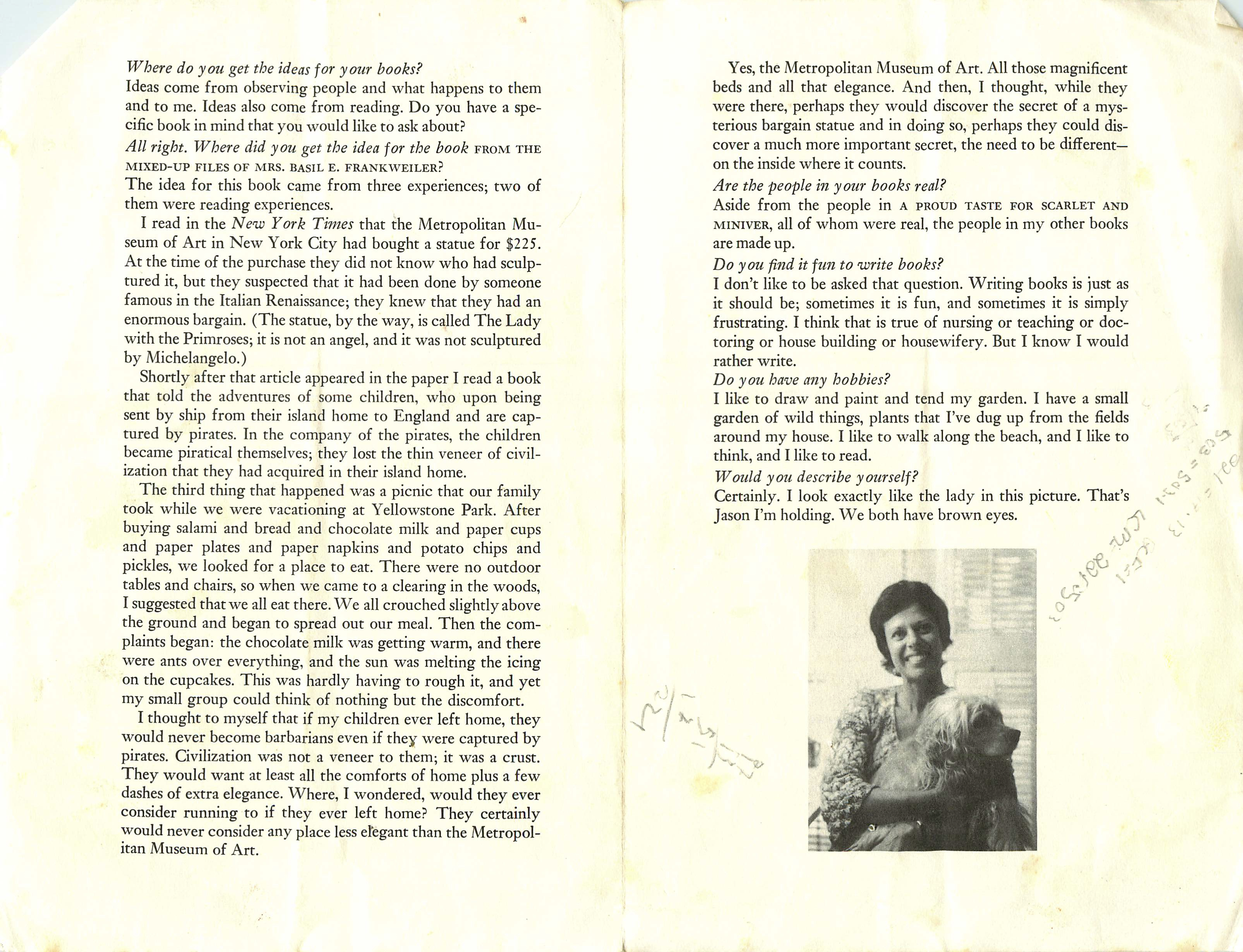
ElKonigsbergElKonigsberg2ElKonigsberg4ElKonigsberg3Sad to hear that EL Konigsburg died a few days ago.  She was one of my favorite authors when I was a kid.  Here is a note I kept from her that she wrote (when I was very young) after I had written her a letter about loving her books …ElKonigsburg

Announcement: Intntl. BioInformatics Workshop on Virus Evolution & Molecular Epidemiology

This looks pretty good:

18th International BioInformatics Workshop on Virus Evolution and Molecular Epidemiology
University of Florida, Emerging Pathogens Institute
Gainesville, Florida, USA.
August 25th – August 30th, 2013

Bioinformatics Methods Applied to Virology and Epidemiology

We are announcing the organization of the international workshop on Virus Evolution and Molecular Epidemiology (VEME) in 2013, hosted by the Emerging Pathogens Institute in the warm city of Gainsville and sponsored by several local partners.
We plan to organize a ‘Phylogenetic Inference’ module that offers the theoretical background and hands-on experience in phylogenetic analysis for those who have little or no prior expertise in sequence analysis. An ‘Evolutionary Hypothesis Testing’ is targeted to participants who are well familiar with alignments and phylogenetic trees, and would like to extend their expertise to likelihood and Bayesian inference in phylogenetics, coalescent and phylogeographic analyses (‘phylodynamics’) and molecular adaptation. A ‘Large Dataset Analysis’ module will cover the more complex analysis of full genomes, huge datasets of pathogens including Next Generation Sequencing data, and combined analyses of pathogen and host. Practical sessions in these modules will involve software like, PHYLIP, PAUP*, PHYML, MEGA, PAML or HYPHY, TREE-PUZZLE, SplitsTree, BEAST, MrBayes Simplot and RDP3.
We recommend participants to buy The Phylogenetic Handbook as a guide during the workshop, and to bring their own data set.
For further information and applications we refer to a dedicated website that will be announced here soon.
Abstract and application deadline is April 30th.
Selections will be made by end of May 2013.
The registration fee of 1000 USD covers attendance, lunches and coffee breaks.
Participation is limited to 25 scientists in each module and is dependent on a selection procedure based on the submitted abstract and statement of motivation. A limited number of grants are available for scientists who experience difficulties to attend because of financial reasons.
For further information and applications we refer this website: http://conferences.dce.ufl.edu/vemei/http://conferences.dce.ufl.edu/veme/ 

YAMMGM: Yet another mostly male genomics meeting

Just got an email from Illumina – key parts are below:

2013 Illumina Scientific Summit

Dear Jonathan,

Illumina’s third annual Scientific Summit will be held June 3rd through 7th in charming New Orleans, Louisiana, at the Loews Hotel. Described by a past attendee as, “an upscale Gordon Conference”, the Scientific Summit is an invitation-only meeting of 120 leading scientists and thought leaders plus the Illumina executive and R&D leadership teams. 

Plenary sessions will be focused on the Genetic Etiology of Cancer and Genetic Diseases, The Changing Landscape of Medical Genetics, Microbial Detection, and Epigenetics. The formal presentations will be complemented by attendee-driven discussion sessions on a variety of topics ranging from workflow bottlenecks to future applications of Next Generation Sequencing in single cells and diagnostics.

The following distinguished scientists are scheduled to speak:

Dr. Mark Adams, Scientific Director, J. Craig Venter Institute

Dr. Kenneth J. Bloom, Chief Medical Officer, Clarient

Dr. David Craig, Deputy Director of Bioinformatics, Associate Professor and Director, Neurogenomics Division, Head Neurobehavioral Research Unit, TGen

Dr. Richard Gibbs, Wofford Cain Chair in Molecular and Human Genetics, Professor, Department of Molecular and Human Genetics, Professor, Programs in Translational Biology & Molecular Medicine, Baylor College of Medicine

Dr. David Goldstein, Director, Duke Medical Center for Human Genome Variation, Duke University

Dr. Steven Jones, Head of Bioinformatics and Associate Director, Michael Smith Genome Sciences Centre, BC Cancer Agency 

Dr. Michael Katze, Professor, Microbiology, University of Washington

Dr. Jim Knowles, Professor and Associate Chair for Research and Psychiatry and the Behavioral Sciences, USC

Dr. Peter Laird, Director, USC Epigenome Center, Professor of Surgery,Biochemistry and Molecular Biology, Keck School of Medicine, USC

Neil Miller,  Director of Informatics and Software Development, Center for Pediatric Genomic Medicine, Children’s Mercy Hospital, Kansas City

Dr. Steven Musser, Director, Office of Regulatory Science, FDA Center for Food Safety and Applied Nutrition

Dr. Charles Perou, Distinguished Professor of Genetics, Professor, Pathology & Lab Medicine, Lineberger Comprehensive Cancer Center, University of North Carolina School of Medicine

Dr. Jonathan Sebat, Chief, Beyster Center for Genomics of Neuropsychiatric Diseases, Associate Professor, Department of Psychiatry & Cellular and Molecular Medicine, University of California, San Diego

Dr. George Weinstock, Professor of Genetics and Molecular Microbiology, Washington University

Dr. Liz Worthey, Director of Genomic Informatics, Medical College of Wisconsin

I love Illumina sequencing toys.  I really do.  No so impressed with the gender ratio of this meeting however.  Would not have gone anyway … but if I COULD have attended I would not have.  I wonder -did they even think about whether there might be some bias here?  There certainly are plenty of female candidates they could have invited. Maybe they did not invite women? Maybe all the women said no?

Do we need naming regulations for computer software?

Well, just saw this new paper: BMC Bioinformatics | Full text | Bellerophon: a hybrid method for detecting interchromo-somal rearrangements at base pair resolution using next-generation sequencing data.  Seems potentially interesting.  But one part of it struck me as very awkward.  You see, there already is a Bellerophon software program used by many in my field: Bellerophon: a program to detect chimeric sequences in multiple sequence alignments.  Seems like a very bad idea to have a new program with the same name as an existing (and still used) one in a similar general field (DNA sequence analysis).

This leads me to the following question – do we need some sort of naming guidelines or regulations for computer software?  We have all sorts of naming regulations and conventions for genes, for species, for other groups of taxa, and more.  Why not software tools?  But seriously, I don’t think we need such a thing – we just need people to use Google and to do a little searching before they invent / publish a software package in case it’s name is, well, already used.

Amazon Research Grant for Aquarium Project

Just an FYI that Holly and I received a grant from Amazon for a bunch of cloud computing credits for the aquarium project.   This will allow us to run all of our various 16S analyses for free on their servers.


PCR B

Today I did 32 PCR B’s. It may sound like a lot but PCR B’s are extremely easy so it went by pretty quick. I also messed up on updating the google doc and had to throw away three PCR A’s that I did last week. Not a huge deal, but kind of annoying!


Right now we have a lot of Gel Confirmations to do. I counted and there’s 48. So to whoever is in the lab next… have fun! 😉  I’m hoping they all come out good so we can get some sequencing done!

Today in the lab

Today I primarily focused on reorganizing some of our stuff. First, I went through our two boxes of extracted DNA and put them in numerical order by sample ID. I think at one point they were in order but with all the PCR redos they’ve gotten quite mixed up and I’ve found it hard and annoying to find the right samples. The first box has any samples under #160 and the second box is any number above #160. The samples are also in order in each box, but I have a feeling that won’t last long 😛


Next I reorganized our PCR box. This didn’t take long. All I did was check to make sure all the forward and reverse primers had stuff in them, replaced a couple empty ones, and put them in order in the box. I did have one concerning discovery though: One of the primers said F2 on the side but F3 on top. I threw that tube away to avoid further confusion.


Lastly, I went through each box of samples from the minus 80 degree freezer and wrote the sample ID range of the samples in that box. For example I would have written “#’s 200-300” for a box with all samples between 200 and 300. It was a bit difficult to write on the boxes because they were so cold!

PCR A, PCR A, and more PCR A…

I’ve spent the week doing PCR A! So far I’m up to 40+ PCR A reactions. I finished up the 20 remaining samples needing PCR A this morning. After losing track of where I was in the PCR A process on Tuesday (and having to restart half of them) I developed an extremely organized way to do today’s set of samples! I meant to take a picture of the chart I made and used and post it here, but I forgot 😦


We are almost done with our preliminary set of samples to be sequenced! Assuming all the PCR A’s work, we will have quite a bit of PCR B to do (which is a lot quicker than PCR A!) and then gel confirmation, quantification, and dilutions to 1 ul. Maybe we can get it done in the next week.. too optimistic? We’ll see!


On a side note, David and a few others get to go to the Kings vs. Spurs game in San Antonio to collect samples for their space project. What a cool opportunity! (Say hi to Tim Duncan for me!)