The evil germy pacifier story is getting out of hand – w/ Dr. Glass misleading the charge

From Wikipedia

Oh for crying out loud.  This is getting out of control.  Two weeks ago I wrote about an over the top story in US News and World Report about pacifiers and microbes: The Tree of Life: Germophobia 101: there are microbes on pacifiers ….  The culprit in this story was a Dr. – Dr. Tom Glass – who was the lead presenter of some study at a meeting.  His study involved counting the number of colony forming units on used vs. new pacifiers.  And low and behold used ones were covered in germs.  Amazingly, this led Glass to say ridiculous things like

In the long run, it may be that what you do now [using a pacifier] may have a lot to do with whether a child ends up developing atherosclerosis or type 2 diabetes.

Completely misleading and deceptive and dangerous I would say.  And alas, the story has been crawling it’s way around the web picking up speed.  Now it is at Time.Com with another story about Glass’ work: Bacteria on Binkies: A Recipe for Crankiness | TIME.com.  Glass apparently is now blaming biofilms of pacifiers for all the problems.  And again Dr. Glass is (mis)leading the charge against pacifiers.

A lot of times when a child is cranky, the first thing a parent does is reach for a pacifier,” says Dr. R. Tom Glass, the study’s principal investigator and a professor of forensic sciences, pathology and dental medicine at Oklahoma State University. “But what are you using to treat the crankiness? It’s a vicious cycle.

and

“biofilms can potentially increase the likelihood of colic or ear infections and could possibly heighten the risk of allergies or asthma, says Glass.”

The reporter does present some skepticism from parents and from the literature.  But come one – why even report this crap from Glass.  I mean – I am all for keeping babies from getting sick and pacifiers very well may be a source of some nasties.  But let’s think about the big picture here.  Parents buy pacifier.  Parents open package.  Parents give to baby.  Baby puts in mouth.  Baby drops pacifier and it gets dirt on it as well as some germs.  Baby puts back in mouth.  Pacifier gets left on counter.  Things from babies mouth grow on pacifier.  Baby puts pacifier back in mouth.  And so on.  Tell me again where the pacifier introduces bad germs to this system?

UPDATE: some reading material

Schedule for the new Coral ponds!

We have received a tentative schedule for the new ponds that we will be studying succession on.

Right now they (the people who set up and monitor the tanks) are rinsing the containers with freshwater as well as rinsing the sand with freshwater. The sand is going into the containers as they are getting rinsed. We will take a few samples here before anything else gets added.

Then they will fill the containers with new saltwater and run pumps for a few days with just the new seawater and sand. (too make sure everything is working well) This should be done by mid December. We will also take a few samples here.

Still in mid December (hopefully) they will  add old sand, rocks and animals from old reef tank.  This is where we will start extensively taking samples because we really want to see how the microbial communities become established. We will sample lots for the first couple days and slowly decrease the amount of sampling for the following few weeks. This is because we know most of the changes will happen within the first couple of days.
Then they are going to add live rock that have been curing. Curing basically gets rid of the dead stuff so the live and healthy organisms can thrive! We will again sample more extensively immediately after the rocks are added to catch the rapid changes happening to the microbial communities. We also might sample the rocks before they are put into the ponds.
After a short adjustment period due to all the new organisms, they will begin to populate the ponds with corals and other inverts. Once again we plan to sample a lot for the first few days but continue to sample, but less often after the first few days.

The next change that we predict will occur when students begin to reach into the ponds in the Spring. We will sample during this time too, to see how human interaction affects the microbial communities.


That’s the plan for now! 🙂

My new microbe art corner w/ three works by @artologica

New Parameters to Test!

We’ve ordered and are recieving a series of equipment to measure Nitrate, Nitrite, Ammonia, dissolved Oxygen, pH, salinity, temperature, Phosphate, alkalinity, Chloride, hardness, Iron, and Sulfite in the tanks’ waters. Now we can gather more information about the environment these microbes are thriving in.

Microbes, art and a bit of satire all in one place – Design Interactions at the RCA

Got pointed to an interesting site recently – “Design Interactions at the RCA”  This is a program (or as they call it – a programme) at the Royal College of Art in London.  One of the current students – Lana Porter – contacted me about a possible project she was working on involving microbes.  She also pointed me to some past projects connected to microbes from the program.  The two she pointed to are:

  • Viruses, close enemies or distant cousins? | Design Interactions at the RCA. From Mikael Metthey.  It appears to be from a few years ago but I am not sure.  Regardless, it is pretty humorous.  It is basically a description of an attempt to create “more intimate ways to approach the process of vaccination” by having poxteddy bears and cowpox rides and vaccination playgrounds.
  • The Race.  From Michael Burton.  Also from a few years ago. This one is about antibiotics and microbial evolution and the hygiene hypothesis.  

And then browsing around the site led to some other interesting concepts:

Seems like a fun programme (or program) …

Fermentation microbiomes part 2 from #UCDavis: American coolship ale microbiome

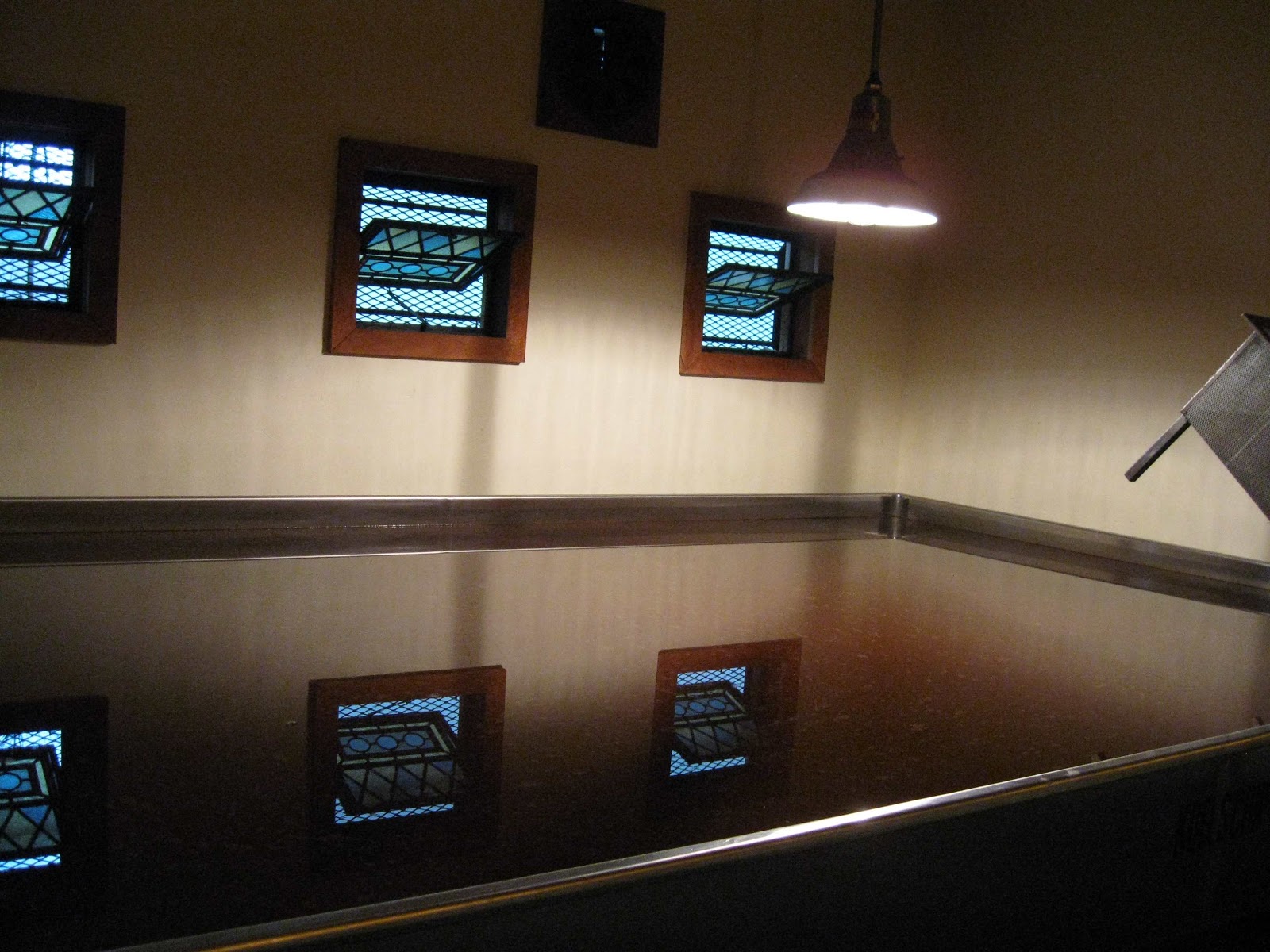
 From Nick Bokulich: This is an image of the “coolship” where the cooling wort
(pre-fermented beer) is left overnight and presumably where wild
microbes are introduced to kick off the fermentation. This is the
morning after, still full of wort.

Just a quick follow up to my recent post on How did I miss this? The botrytized wine microbiome … from #UCDavis colleague David Mills.  There is a similar paper from the same group also in PLoS One from about the same time: PLOS ONE: Brewhouse-Resident Microbiota Are Responsible for Multi-Stage Fermentation of American Coolship Ale.  What a job — microbes, ales and wines, and sequencing.  One of the few times when reading a paper where I have said “I wish that was me doing that work.” … must look into getting involved in such studies …

How did I miss this? The botrytized wine microbiome … from #UCDavis colleague David Mills

From here.

Fun use of next generation sequencing in this paper: PLOS ONE: Next-Generation Sequencing Reveals Significant Bacterial Diversity of Botrytized Wine.  They used sequencing to characterize the diversity of microbes associated with botrytized wine (wine produced from grapes infected with the mold Botrytis cinerea.  They focused in particular on Dolce wine (not 100% sure what this is but I think it is wine from the Dolce winery …).  And they focused in particular on the bacteria associated with this wine as it was being produced.  Anyway … I am no food/drink microbiologist .. but this seems cool.

Important & neglected aspect of lab studies of animals : effect of habitat change on microbiome

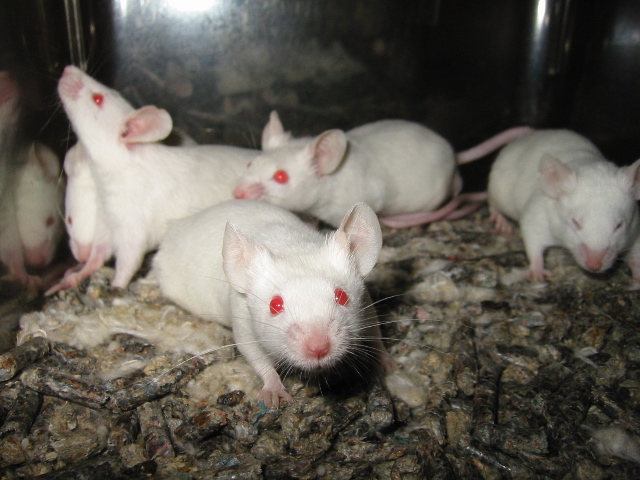
By Aaron Logan via Wikipedia 

Very very interesting paper came out recent from some colleagues at UC Davis: PLOS ONE: Routine Habitat Change: A Source of Unrecognized Transient Alteration of Intestinal Microbiota in Laboratory Mice

Abstract: The mammalian intestine harbors a vast, complex and dynamic microbial population, which has profound effects on host nutrition, intestinal function and immune response, as well as influence on physiology outside of the alimentary tract. Imbalance in the composition of the dense colonizing bacterial population can increase susceptibility to various acute and chronic diseases. Valuable insights on the association of the microbiota with disease critically depend on investigation of mouse models. Like in humans, the microbial community in the mouse intestine is relatively stable and resilient, yet can be influenced by environmental factors. An often-overlooked variable in research is basic animal husbandry, which can potentially alter mouse physiology and experimental outcomes. This study examined the effects of common husbandry practices, including food and bedding alterations, as well as facility and cage changes, on the gut microbiota over a short time course of five days using three culture-independent techniques, quantitative PCR, terminal restriction fragment length polymorphism (TRFLP) and next generation sequencing (NGS). This study detected a substantial transient alteration in microbiota after the common practice of a short cross-campus facility transfer, but found no comparable alterations in microbiota within 5 days of switches in common laboratory food or bedding, or following an isolated cage change in mice acclimated to their housing facility. Our results highlight the importance of an acclimation period following even simple transfer of mice between campus facilities, and highlights that occult changes in microbiota should be considered when imposing husbandry variables on laboratory animals.

I personally think that we as a community are going to have to come to grips with the fact that the microbial communities in / on research organisms (of all kinds) may have a profound effect on experimental results.  This may explain many of the differences seen in experiments between facilities or over time within a facility.  In general, I think either controlling the microbes more carefully in lab experiments (e.g., using defined flora) or at least monitoring them is going to be very important to best interpret studies of plants and animals in the lab (or for that matter – in the field too).  Anyway -this paper is a tiny window into one of the ways that controlling for microbiomes may be important in lab studies.

Citation: Ma BW, Bokulich NA, Castillo PA, Kananurak A, Underwood MA, et al. (2012) Routine Habitat Change: A Source of Unrecognized Transient Alteration of Intestinal Microbiota in Laboratory Mice. PLoS ONE 7(10): e47416. doi:10.1371/journal.pone.0047416

Guest post on "CHANCE" ChIP-seq QC and validation software

Guest post by Aaron Diaz from UCSF on a software package called CHANCE which is for ChIP-seq analyses.  Aaron wrote to me telling me about the software and asking if I would consider writing about it on my blog.  Not really the normal topic of my blog but it is open source and published in an open access journal and is genomicy and bioinformaticy in nature.   So I wrote back inviting him to write about it.  Here is his post:


CHANCE: A comprehensive and easy-to-use graphical software for ChIP-seq quality control and validation


Our recent paper presents CHANCE a user-friendly software for ChIP-seq QC and protocol optimization. Our user-friendly graphical software quickly estimates the strength and quality of immunoprecipitations, identifies biases, compares the user’s data with ENCODE’s large collection of published datasets, performs multi-sample normalization, checks against qPCR-validated control regions, and produces publication ready graphical reports. CHANCE can be downloaded here.

An overview of ChIP-seq: cross-
linked chromatin is sheared,
enriched for a transcription factor
or epigenetic mark of interest
using an antibody, purified and
sequenced.

Chromatin immunoprecipitation followed by high throughput sequencing (ChIP-seq) is a powerful tool for constructing genome wide maps of epigenetic modifications and transcription factor binding sites. Although this technology enables the study of transcriptional regulation with unprecedented scale and throughput interpreting the resulting data and knowing when to trust the data can be difficult. Also, when things go wrong it is hard to know where to start when troubleshooting. CHANCE provides a variety of tests to help debug library preparation protocols.

One of the primary uses of CHANCE is to check the strength of the IP. CHANCE produces a summary statement which will give you an estimate of the percentage of the IP reads which map DNA fragments pulled down by the antibody used for the ChIP. In addition to the size of this signal component within the IP CHANCE reports the fraction of the genome these signal reads cover, as well as the statistical significance of the genome wide percentage enrichment relative to control in the form of a q-value (positive false discovery rate). CHANCE has been trained on CHIP-seq experiments from the ENCODE repository by making over 10,000 Input to IP and Input to replicate Input comparisons. The q-value reported gives then the fraction of comparisons between Input sample techinical replicates that report an enrichment for signal in one sample compared to another equal to the user provided sample or greater. CHANCE identifies insufficient sequencing depth, PCR amplification bias in library preparation, and batch effects.

CHANCE identifies biases in sequence content and quality, as well as cell-type and laboratory-dependent biases in read density. Read-density bias reduces the statistical power to distinguish subtle but real enrichment from background noise. CHANCE visualizes base-call quality and nucleotide frequency with heat maps. Furthermore, efficient techniques borrowed from signal processing uncover biases in read density caused by sonication, chemical digestion, and library preparation.

A typical IP enrichment report.

CHANCE cross-validates enrichment with previous ChIP-qPCR results. Experimentalists frequently use ChIP-qPCR to check the enrichment of positive control regions and the background level of negative control regions in their IP DNA relative to Input DNA. It is thus important to verify whether those select regions originally checked with PCR are captured correctly in the sequencing data. CHANCE’s spot-validation tool provides a fast way to perform this verification. CHANCE also compares enrichment in the user’s experiment with enrichment in a large collection of experiments from public ChIP-seq databases.

CHANCE has a user friendly graphical interface.
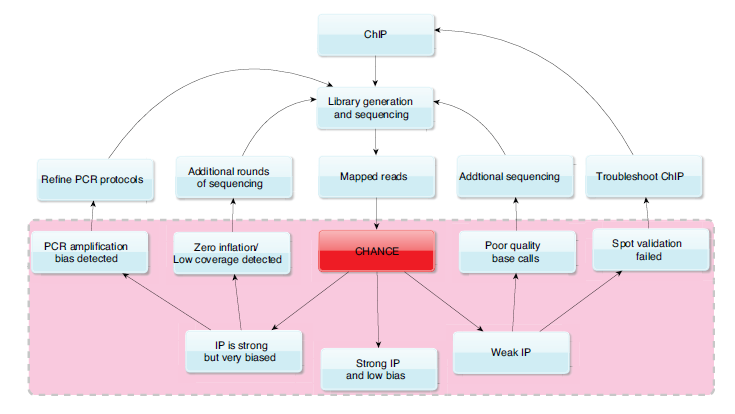
How CHANCE might be used to provide feedback on protocol optimization.

Gotta love those DNA extractions :)

Because I was so late to introduce myself, I can also talk about what we’ve been doing for the last few weeks. We’ve gone to the aquariums and collected samples, done some DNA extractions, and done PCR on our samples. Our samples came from salt water and fresh water tanks and include water, sediment, and gunk from the walls of the tanks. Our latest issue has come after PCR, while running the Gel. It seems like our issue might be all the way back in PCR A. I am very excited for the new aquatic systems that we will start sampling in the next couple weeks. We are hoping to start sampling the minute they load the tubs. Our hope is to sample very frequently in the first couple days because we know much of the microbial community will develop in this time. So what’s the point of that, you ask? Well we would love to study the succession of microbial communities in these new aquatic systems.  That’s all for now!