Three talks, 1.5 days at #ISMB … phylogeny, phylogenomics, open science and more

Gave three talks in 1.5 days here in Long Beach as part of the satellite meetings associated with the “Intelligent Systems for Molecular Biology” (ISMB) 2012 Conference. I will write more about the meeting and the craziness of giving three very different talks in 1.5 days. But for now I wanted to at least get my talks posted here since I posted the slides to slideshare and recorded the audio in synch with the slides and posted these “slideshows” to YouTube. Here are the talks below:


Talk 1 for the “Bioinformatics Open Source Conference” BOSC2012.  Was asked to talk about Open Science … so … I did …

Slideshow with audio:


Talk 2 for the Student Council Symposium SCS2012. Sort of supposed to be a career guidance discussion so I geared my talk on the lines of “lessons learned” …

Slideshow with audio:


Talk 3 for the “Automated function prediction” AFP2012 satellite meeting.  I decided to talk about phylogenetic and phylogenomics approaches to functional prediction …

Slideshow with audio:


http://storify.com/phylogenomics/jonathan-eisen-talks-at-ismb-satellite-meetings.js[<a href=”http://storify.com/phylogenomics/jonathan-eisen-talks-at-ismb-satellite-meetings” target=”_blank”>View the story “Jonathan Eisen @phylogenomics talks at #ISMB Satellite Meetings” on Storify</a>]

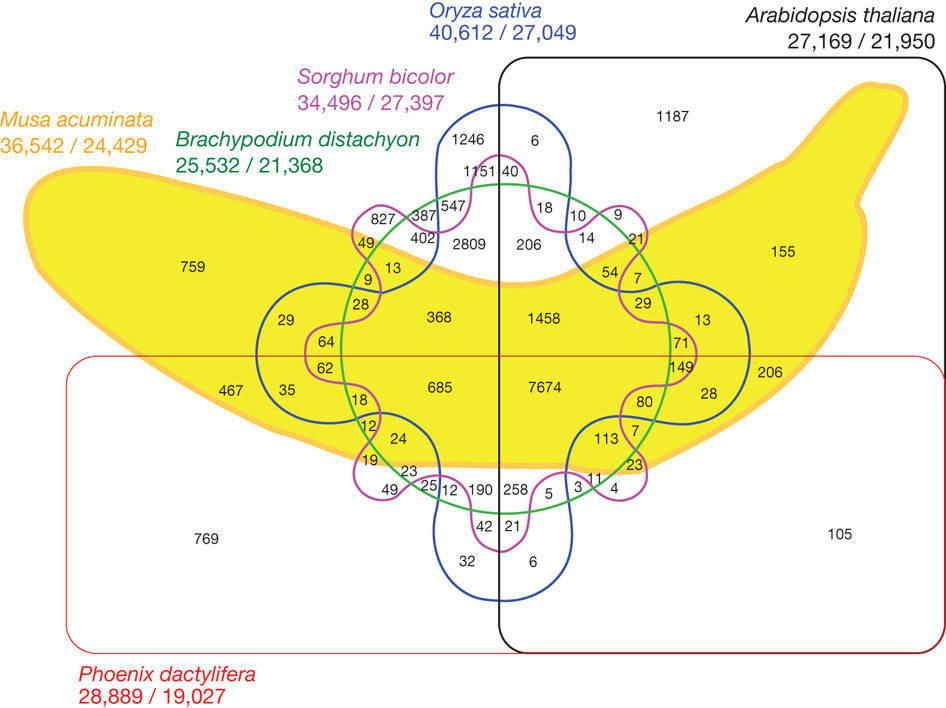
Posted to Twitter, FB, etc but had to post to blog too: best genomics Venn Diagram ever

Words do not do this justice.  This is just stunning.
From here.
Ref: “The banana (Musa acuminata) genome and the evolution of monocotyledonous plants” Nature 2012 doi:10.1038/nature11241
Also see this Storify.

Lake Arrowhead Microbial Genomes 2012 #Genomes #Microbes #Mountains #Lake #Fun #Wine #MustGo

Helping the organizers plan the Lake Arrowhead Microbial Genomes meeting this year (see Microbial Genomics – ARROWHEAD 2012).  In particular I organized a session on Microbiology of the Built Environment relating to the http://microbe.net project.

This session should be good

  • Session Chair: Jonathan Eisen – University of California, Davis, CA “Alfred P. Sloan Foundation Workshop”
  • Anne M. Womack – University of Oregon, Eugene, OR “Microbial Ecology of the Built Environment”
  • Jason E. Stajich – University of California, Riverside, CA “Fungi in the Built Environment”
  • Laura Sauder – University of Waterloo, Waterloo, Ontario “Archaea in the Built Environment”
  • Scott Kelley – San Diego State University, San Diego, CA “The Indoor Microbiome: Bacterial and Metagenomic Approaches for Studying the Built Environment”
  • Susanna Remold – University of Louisville, Louisville, KY “Pseudomonas as a Model for Studies of Microbes in the Home”

And the other sessions that the meeting also look good (see program here).  But whatever you think of the speaker list, the best part of the Lake Arrowhead meetings is the venue and the interactions among people.  I have been going to this meeting for many years and here are some posts of mine about previous meetings

Can food safety be fun? Not sure, but this video is OK. #microbes

Continuing with my running theme of microbe-related music videos here is another one. It has good and bad parts. But then again, don’t we all …

Microbial music: Christine Lavin and the Amoeba Hop

Always searching for science-art-music combinations.  Especially ones that focus on some aspect of science I work on, like microbes. And, well, though this recording is less than ideal, and you need to wait a minute and a half or so, once you get to the song it is worth it.

The song is “The Amoeba Hop” and the singer is the brilliant Christine Lavin.

I have had this song in my head on and off for years and wanted to post about it for a while.  I finally remembered to Google it tonight after reading a tweet about combining music and biology.  I used to listen to Lavin all the time in college and even went to a show of hers in 1989 in Ft. Collins, CO with my brother and my friend Saul Jacobson.  As a side note – we saw Lavin at some music hall type of place the the night after seeing Killdozer at a VFW post.  As a second side note – the Killdozer show was crazy (and I even found someone else who wrote about it here).

Anyway – not only did I find the video posted above but I discovered she wrote a book in 2002 based on the song – and the book even got a review in the New York Times.   Gonna probably have to get that book at some point …

Ion Torrent Mobile Sequencing Bus Coming to #UCDavis 7/9/12!

Just got this by email. I have no idea what is in the Mobile Bus but thought it might be of interest:

bus flyer – UC Davis 7-9.pdf

Call For Papers: “Phylogenomics & Population Genomics: Models, Algorithms, & Analytical Tools” Session at PSB 2013]

Call for papers

Phylogenomics and Population Genomics: Models, Algorithms, and Analytical Tools Co-chairs: Luay Nakhleh (Rice U.), Noah Rosenberg (Stanford U.), and Tandy Warnow (U. Texas)

A session at the Pacific Symposium on Biocomputing (PSB 2013) http://psb.stanford.edu/cfp.html#ppg

January 3-7, 2013
The Big Island of Hawaii

Background:

The increasing availability of whole-genome data from diverse species across the Tree of Life has propelled phylogenomics, the evolutionary analysis of genomes and their relationships, to the forefront of research. Research in phylogenomics has contributed to fundamental questions in biology including, but not limited to: orthology identification, species evolution, the extent and role of horizontal gene transfer, and protein function prediction. Further, as sequencing techniques continue to improve in efficiency and cost, whole-genome data is becoming available for many individuals within populations. This has given rise to interesting questions and problems in population genomics, such as comparative analysis of conserved and ultra-conserved regions, the interplay between adaptive and
non-adaptive evolutionary forces, and the detection of regulatory regions.

Research areas targeted in this session encompass mathematical models and computational tools that enable and/or utilize phylogenomic analyses. These include, but are not limited to: orthology detection, gene tree incongruence and its reconciliation (incomplete lineage sorting, gene duplication and loss, and horizontal gene transfer), protein function prediction, ancestral genome reconstruction, and elucidating the adaptive roles of evolutionary events such as gene duplication and horizontal gene transfer.

Session theme:

We invite contributions with a substantial and innovative mathematical or computational component (such as computational models, algorithms, simulation studies, and computationally innovative analyses of biological data) in all areas of phylogenomics, including, but not limited to, gene tree incongruence, species phylogeny inference, ancestral genome reconstruction, and integration with population genetics.

Important Dates
• Paper submission deadline: July 31, 2012
• Notification of paper acceptance: September 10, 2012
• Camera-ready copy deadline: October 1, 2012

All deadlines are at midnight Pacific Standard Time.

Paper Format
Please see the PSB paper format template and instructions at http://psb.stanford.edu/psb-online/psb-submit.

The file formats we accept are: Postscript (*.ps) and Portable Document Format (*.pdf). Attached files should be named with the last name of the first author (e.g., altman.ps or altman.pdf). Hardcopy submissions or unprocessed TEX or LATEX files will be rejected without review.

Each paper must be accompanied by a cover letter. The cover letter must state the following:
• The email address of the corresponding author
• The specific PSB session that should review the paper or abstract • The submitted paper contains original, unpublished results, and is not currently under consideration elsewhere.
• All co-authors concur with the contents of the paper.

Submitted papers are limited to twelve (12) pages in our publication format. Please format your paper according to instructions found at http://psb.stanford.edu/psb-online/psb-submit/. If figures cannot be easily resized and placed precisely in the text, then it should be clear that with appropriate modifications, the total manuscript length would be within the page limit.

Contact PSB (psb.hawaii @ gmail.com) for additional information about paper submission requirements.

#Microbe humor: Spacewalk 1986: Bacteria

“Who Cares About Bacteria?”

Huffington Post picks me & two members of lab as top biologists/chemists to follow on Twitter

From here.

Good press for my lab here: Scientists On Twitter: 30 Biologists And Chemists To Follow

The list (which started out at 30 and expanded to 47) included three people from my lab: me (@phylogenomics), post doc Holly Bik (@dr_bik) and PhD student Russell Neches (@ryneches).

I like that I am the first one shown on the slideshow (though not sure if this means I am #1 on their list or just random …).

Making such lists is always a challenge and also rife with issues.  There are many many great tweeters of chemistry and biology not on the list, for example. But I think they did a pretty good job covering diverse types of people here.  Lots of women too, which was good to see.

Anyway – thanks to Rebecca Searles and her advisor Jason Goldman for compiling the list and making my lab look pretty good …

Full list:

  1. @phylogenomics
  2. @NerdyChristie
  3. @nparmalee
  4. @biochembelle
  5. @kejames
  6. @DrBondar
  7. @kzelnio
  8. @girlscientist
  9. @MiriamGoldste
  10. @modernscientist
  11. @PolymerPhD
  12. @toraks
  13. @RichardDawkins
  14. @nuin
  15. @DrRubidium
  16. @mitpostdoc
  17. @Evolutionistrue
  18. @ChemicalBiology
  19. @WhySharksMatter
  20. @Aur_ora
  21. @ChemistPD
  22. @dgmacarthur
  23. @DNLee5
  24. @aetiology
  25. @Myrmecos
  26. @thisischristina
  27. @deborahblum
  28. @SeeArrOh
  29. @carmendrahl
  30. @Dr_Bik
  31. @TCNoel
  32. @nssampson
  33. @sciencegeist
  34. @SFriedScientist
  35. @kg_science
  36. @JATetro
  37. @JacquelynGill
  38. @Katie_PhD
  39. @D_Aldridge
  40. @JohnFBruno
  41. @ScientistMags
  42. @jtotheizzoe
  43. @MayaPlass
  44. @scimomof2
  45. @DrTwittenheimer
  46. @leonidkruglyak
  47. @ryneches

LinkedIn unlinked from Twitter Sharing