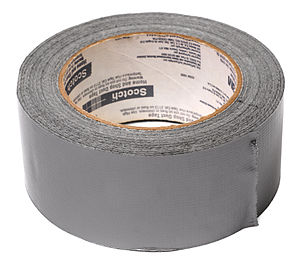
Is Illumina the "duct tape" of sequencing?

Photo from Wikipedia.  Photo by Evan-Amos

For the last year or so I have become a big fan of Illumina sequencing.  We are using it for everything in the lab.  And many others are using it quite a lot too.  All sorts of interesting applications.  But of course -there are other sequencing systems that each have some advantages relative to Illumina.  And one of the key limitations of Illumina sequencing has been the read length (though that limitation gets less and less as read lengths get longer and longer from Illumina machines).

The UC Davis Genome Center has had Illumina sequencing systems for many years now and we use them extensively.  However, we felt for some time that we and others around town could benefit from complementary methods, especially those that could get longer reads.  So we sought funding to buy other systems.  And fortunately we got an NSF MRI grant to do just that -which we used to buy a Roche 454 Jr machine and contribute to the purchase of a Pacific Biosciences machine.  These are good to have around because they open up new windows into sequencing – not just long reads but other areas as well.  For example, the PacBio system also has the ability to use it to detect modifications to bases like methylation.

Alas, both the 454 and PacBio systems have higher error rates than the Illumina systems.  And this makes some analyses challenging and limits the benefits that come from the longer reads.  So what to do?  For a while people have been using Illumina sequencing to “correct” the errors make by 454 and PacBio sequencing.  And today Matt Herper at Forbes (For A New DNA Sequencer, A Technical Fix May Have Come Too Late – Forbes) discusses a new further improvement in the ability to do this error correction (a paper just came out on the topic from Adam Phillippy, Sergey Koren, Michael Schatz, and others).

I find this whole concept a bit funny / interesting.  Not only does Illumina sequencing have many uses but one of its uses in essence helps keep aloft the potential of some of it’s competitors.  In this way – Illumina can be considered the duct tape of sequencing systems.  1001 uses.  Not sure the Illumina folks will be overly thrilled with this use but that is the way it goes …

(As an aside – any high throughput highly accurate sequencing method could be used in the same way as Illumina in most cases – ABI solid for example.  But alas for ABI Illumina has kind of taken over this part of the market).

(An another aside – we will have to wait and see how/if the Ion Torrent systems take off in the sequencing ecosystem)

(As another aside – still waiting to see some more detail from the Oxford Nanopores folks … I would be happy to be a beta tester if anyone from Oxford is reading this).

Sharing on LinkedIn and Twitter

Resharing this email I received:

Hi Jonathan,

LinkedIn and Twitter have worked together since 2009 to enable you to share your professional conversations on both platforms. Twitter recently evolved its strategy and this will result in a change to the way Tweets appear in third-party applications. Starting today Tweets will no longer be displayed on LinkedIn.

We know that sharing updates from LinkedIn to Twitter is a valuable service for our members. Moving forward, you will still be able to share updates with your Twitter audience by posting them on LinkedIn.

How can I continue to share updates on both LinkedIn and Twitter? Simply start your conversation on LinkedIn. Compose your update, check the box with the Twitter icon, and click “Share.” This will
automatically push your update to both your LinkedIn connections and your Twitter followers just as before.

What changes can I expect to see on LinkedIn? Any conversation you start on Twitter will no longer be automatically shared with your LinkedIn network, even if you synced your LinkedIn and Twitter accounts.

If you would like more information about what this means for your synced LinkedIn and Twitter accounts, please visit our related Help Center topics.

Thank you,
The LinkedIn Team

LinkedIn unlinked from Twitter Sharing

Of possible interest: Annual Notification of “How to File Whistleblower Reports” at #UCDavis

Just received this:

From: Office of the Provost and Executive Vice Chancellor <whistleblower>
Date: Fri, Jun 29, 2012 at 9:01 AM
Subject: Annual Notification: How to File Whistleblower Reports
To: UC Davis Employees

Greetings:

In accordance with the California Government Code, UC Davis must annually provide all employees with the attached information from the State Auditor’s office on how to file whistleblower reports of improper activities. Please review the attached poster, which contains information on how and where employees may file reports of improper activities at both the Davis campus and the Health System. Departments are encouraged to print the updated 2012 poster for posting to unit bulletin boards.

Thank you,

Wendi Delmendo

Chief Compliance Officer, General Campus

Office of the Provost and Executive Vice Chancellor

WB_Poster_legal_UCD_2012.pdf

National Research Council awards for graduate, postdoctoral & senior researchers at participating federal laboratories & affiliated institutions.

Just got this …

Dear Department Head:

We are asking your assistance in forwarding this message to inform students and faculty in your department of these outstanding fellowship opportunities. More detailed information and an online application can be found at www.nationalacademies.org/rap.

The National Research Council of the National Academies sponsors a number of awards for graduate, postdoctoral and senior researchers at participating federal laboratories and affiliated institutions. These awards include generous stipends ranging from $42,000 – $75,000 per year for recent Ph.D. recipients, and higher for additional experience.Graduate entry level stipends begin at $30,000. These awards provide the opportunity for recipients to do independent research in some of the best-equipped and staffed laboratories in the U.S. Research opportunities are open to U.S. citizens, permanent residents, and for some of the laboratories, foreign nationals.

Detailed program information, including online applications, instructions on how to applyand a list of participating laboratories, is available on the NRC Research AssociateshipPrograms Website (see link above).

Questions should be directed to the NRC at 202-334-2760 (phone) or rap@nas.edu.

There are four annual review cycles.

Review Cycle: November; Opens September 1; Closes November 1
Review Cycle: February; Opens December 1; Closes February 1
Review Cycle: May; Opens March 1; Closes May 1
Review Cycle: August; Opens June 1; Closes August 1

Applicants should contact prospective Adviser(s) at the lab(s) prior to the application deadline to discuss their research interests and funding opportunities.

Thank you for your assistance.

Sincerely yours,
H. Ray Gamble
Director of the Fellowship Programs
National Research Council
The National Academies
500 5th Street NW, Keck 568
Washington, DC 20001

Nice review on HiSeq/MiSeq rRNA sequencing from Caporaso et al #microbes

Quick post — nice review worth checking out: The ISME Journal – Ultra-high-throughput microbial community analysis on the Illumina HiSeq and MiSeq platforms

from Caporaso JG, Lauber CL, Walters WA, Berg-Lyons D, Huntley J, Fierer N, Owens SM, Betley J, Fraser L, Bauer M, Gormley N, Gilbert JA, Smith G, Knight R.

A key part of the paper, with highlighting from me:-

These observations, in agreement with studies that have addressed this question directly (Kuczynski et al., 2010), suggest that increasing the sequencing depth is not likely to provide additional insight into questions of beta diversity, and we therefore argue that (for questions of beta diversity in particular) the decreased cost of sequencing should be applied to study microbial systems using many more samples, for example, in dense temporal or spatial analyses, rather than with many more sequences per sample.  Of course, if the objective is to identify taxa that are very rare in communities, deeper sequencing will be advantageous. Additionally we note that while as few as 10 sequences per sample may be useful for differentiating very different environment types (for example, soil and feces), as environments become more similar (for example, two soil samples of different pH) more sequences will be required to differentiate them.

Most unusual use of #microbes of the week: fermented fashion

Fermented clothing on mannequin from
http://bioalloy.org/o/projects/micro-be.html

Well, this is certainly unusual: The Genteel | Fermented Fashion.  I found out about this from a Tweet from Irene Kim

Anyway the article describes the “Micro’be'” project for which more details are available here.  Some interesting details at that site include a description

Imagine a fabric that grows…a garment that forms itself without a single stitch!
The fashion that starts with a bottle of wine…
Micro’be’ fermented fashion investigates the practical and cultural biosynthesis of clothing – to explore the possible forms and cultural implications of futuristic dress-making and textile technologies.
Instead of lifeless weaving machines producing the textile, living microbes will ferment a garment.
A fermented garment will not only rupture the meaning of traditional interactions with body and clothing; but also raise questions around the contentious nature of the living materials themselves.
This project redefines the production of woven materials.
By combining art and science knowledge and with a little inventiveness, the ultimate goal will be to produce a bacterial fermented seamless garment that forms without a single stitch. 

So – in essence they are trying to grow clothing as a side product of wine fermentation.  Not sure what it is like to wear such clothing – or to be around someone wearing it – but it is a fun idea.

//platform.twitter.com/widgets.js

Video, slides & storify of my talk on "#Phylogeny-driven approaches to #genomics and #metagenomics" from #CSMUBC2012

Just got back from the Canadian Society for Microbiology meeting where I gave the keynote talk on the last day of the meeting (Saturday).  Was a very short, but good trip.  Got to see some key collaborators and colleagues and Vancouver was very nice for the few days I was there.

I recorded my talk on my laptop using the Keynote “Record Slideshow” function.  I then exported it to Slideshare (just the slides – no audio) and to Youtube (video of slides with audio).  They are posted below.  I also did a mini storification of my talk which is also below.

http://storify.com/phylogenomics/my-talk-at-csmubc2012.js[&amp;amp;amp;amp;amp;amp;amp;amp;amp;amp;amp;amp;amp;amp;lt;a href=”http://storify.com/phylogenomics/my-talk-at-csmubc2012&#8243; target=”_blank”&amp;amp;amp;amp;amp;amp;amp;amp;amp;amp;amp;amp;amp;amp;gt;View the story “My talk at CSMUBC2012” on Storify&amp;amp;amp;amp;amp;amp;amp;amp;amp;amp;amp;amp;amp;amp;lt;/a&amp;amp;amp;amp;amp;amp;amp;amp;amp;amp;amp;amp;amp;amp;gt;]

For those who missed it: "Science as an open enterprise" from Royal Society

This will be of interest to many I think: Science as an open enterprise – Report | Royal Society

It is a comprehensive report from the Royal Society with links to videos, text, previous meetings, references, EPUBs, and more relating to a report that was released a few days ago.  From the web site:

Six key areas for action are highlighted in the report:

  • Scientists need to be more open among themselves and with the public and media
  • Greater recognition needs to be given to the value of data gathering, analysis and communication
  • Common standards for sharing information are required to make it widely usable
  • Publishing data in a reusable form to support findings must be mandatory
  • More experts in managing and supporting the use of digital data are required
  • New software tools need to be developed to analyse the growing amount of data being gathered

Definitely worth a serious browsing/reading.

For more on this see …

Science Magazine Special Issue on H5N1 #Links #Microbes

"As a service to the community, AAAS is also making these articles free to the public. "

Would be nice to make ALL of Science available to the public but AAAS is a dinosaur of sorts. Anyway — at least these are available. (Thanks to Eileen Choffnes for the links).

H5N1: Bruce Alberts

Science 22 June 2012: 1521

http://www.sciencemag.org/content/336/6088/1521.full.pdf

Benefits and Risks of Influenza Research: Lessons Learned: Anthony S. Fauci and Francis S. Collins

http://www.sciencemag.org/content/336/6088/1522.full.pdf

Implementing the New U.S. Dual-Use Policy:Carrie D. Wolinetz

http://www.sciencemag.org/content/336/6088/1525.full.pdf

Evolution, Safety, and Highly Pathogenic Influenza Viruses:Marc Lipsitch, Joshua B. Plotkin, Lone Simonsen, and Barry Bloom

http://www.sciencemag.org/content/336/6088/1529.full.pdf

Influenza: Options to Improve Pandemic Preparation : Rino Rappuoli and Philip R. Dormitzer

http://www.sciencemag.org/content/336/6088/1531.full.pdf

Perspectives

Regulating the Boundaries of Dual-Use Research – Mark Frankel http://www.sciencemag.org/content/336/6088/1523.full.pdf

Securing Medical Research: A Cybersecurity Point of View : Bruce Schneier http://www.sciencemag.org/content/336/6088/1527.full.pdf

Airborne Transmission of Influenza A/H5N1 Virus Between Ferrets (2012). Sander Herfst et al. http://www.sciencemag.org/content/336/6088/1534.full.pdf

· Materials/Methods, Supporting Text, Tables, Figures, and/or References Download Supplement

The Potential for Respiratory Droplet–Transmissible A/H5N1 Influenza Virus to Evolve in a Mammalian Host. Colin A. Russell et al. (2012). http://www.sciencemag.org/content/336/6088/1541.full.pdf

· Materials/Methods, Supporting Text, Tables, Figures, and/or References Download Supplement