Eisen Lab Blog

Trying to sort out all the STEM and STEM related departments, graduate programs , at #UCDavis

Well, I was in a meeting yesterday for the UC Davis ADVANCE program.  This program is an NSF funded project to improve presence of women and underrepresented minorities on the faculty in Science, Technology, Engineering and Math (STEM).  So I decided to see – how many departments at UC Davis might participate in such an initiative.  And, well, wow.  I knew there were a lot of STEM or STEM-related departments at UC Davis but I did not know there were this many.

Here is a list I compiled of UC Davis STEM or STEM-related Departments.  I included medical departments here since many people in such departments do medical/science research.  But clearly this is a broad definition of STEM.  But nevertheless, this gives some picture of the scope of science and medicine and related departments at UC Davis.

Vet School departments in Yellow
Med School departments in Red
College of Biological Sciences Departments are In Green
College of Agricultural and Environmental Sciences in Orange
College of Letters and Science in Light Blue
College of Engineering in Grey

  1. Anatomy, Physiology & Cell Biology
  2. Anesthesiology
  3. Animal Science
  4. Anthropology
  5. Applied Science
  6. Biochemistry and Molecular Medicine
  7. Biological and Agricultural Engineering
  8. Biomedical Engineering
  9. Cardiovascular Medicine
  10. Cell Biology and Human Anatomy
  11. Chemical Engineering and Materials Science
  12. Chemistry
  13. Civil and Environmental Engineering
  14. Computer Science
  15. Dermatology
  16. Electrical and Computer Engineering
  17. Emergency Medicine
  18. Entomology
  19. Environmental Science and Policy
  20. Environmental Toxicology
  21. Evolution and Ecology
  22. Family and Community Medicine
  23. Food Science and Technology
  24. Geology
  25. Human and Community Development
  26. Infectious Diseases
  27. Internal Medicine
  28. Land, Air and Water Resources
  29. Linguistics
  30. Mathematics
  31. Mechanical and Aeronautical Engineering
  32. Medical Pathology
  33. Medical Microbiology & Immunology
  34. Medicine and Epidemiology
  35. Microbiology and Molecular Genetics 
  36. Molecular and Cellular Biology
  37. Molecular Biosciences
  38. Nematology
  39. Neurobiology, Physiology and Behavior
  40. Neurological Surgery
  41. Neurology
  42. Nursing
  43. Nutrition
  44. Obstetrics and Gynecology
  45. Ophthalmology
  46. Pathology
  47. Pathology, Microbiology & Immunology
  48. Pediatrics
  49. Pharmacology
  50. Physical Medicine and Rehabilitation
  51. Physics
  52. Physiology and Membrane Biology
  53. Plant Biology
  54. Plant Pathology
  55. Plant Sciences
  56. Population Health and Reproduction
  57. Psychiatry
  58. Psychology
  59. Public Health Sciences
  60. Statistics
  61. Surgery
  62. Surgical and Radiological Sciences 
  63. Urology
  64. Viticulture & Enology
  65. Wildlife, Fish and Conservation Biology
And then of course UC Davis has a TON of graduate groups and almost all of these are separate from departments.  They do not hire faculty but they are a key part of the atmosphere and academics at UC Davis.  And there are an enormous number of these in STEM or STEM-related fields.  See below
Graduate Groups

Agricultural and Environmental Sciences Graduate Programs

  1. Agricultural and Environmental Chemistry
  2. Agricultural and Resource Economics
  3. Animal Biology
  4. Atmospheric Science
  5. Biological Systems Engineering
  6. Ecology
  7. Ecology (Joint Doctorate with San Diego State University)
  8. Entomology
  9. Food Science
  10. Genetics
  11. Geography
  12. Horticulture and Agronomy
  13. Hydrologic Sciences
  14. Master of Public Health
  15. Microbiology
  16. Nutritional Biology
  17. Pharmacology and Toxicology
  18. Plant Biology
  19. Plant Pathology
  20. Population Biology
  21. Soils and Biogeochemistry
  22. Transportation Technology and Policy
  23. Viticulture and Enology

Biological and Life Sciences Graduate Programs

  1. Animal Behavior
  2. Animal Biology
  3. Anthropology
  4. Avian Sciences
  5. Biochemistry and Molecular Biology
  6. Biochemistry, Molecular, Cellular and Developmental Biology
  7. Biological Systems Engineering
  8. Biomedical Engineering
  9. Biophysics
  10. Biostatistics
  11. Cell and Developmental Biology
  12. Clinical Research
  13. Comparative Pathology
  14. Ecology
  15. Ecology (Joint Doctorate with San Diego State University)
  16. Entomology
  17. Epidemiology
  18. Exercise Science
  19. Food Science
  20. Forensic Science
  21. Genetics
  22. Health Informatics
  23. Immunology
  24. Master of Public Health
  25. Maternal and Child Nutrition
  26. Microbiology
  27. Molecular, Cellular and Integrative Physiology
  28. Neuroscience
  29. Nursing Science and Health-Care Leadership (Doctor of Philosophy)
  30. Nursing Science and Health-Care Leadership (Master of Science)
  31. Nutritional Biology
  32. Pharmacology and Toxicology
  33. Plant Biology
  34. Plant Pathology
  35. Population Biology
Engineering Graduate Programs

  1. Applied Science Engineering
  2. Biological Systems Engineering
  3. Biomedical Engineering
  4. Chemical Engineering
  5. Civil and Environmental Engineering
  6. Computer Science
  7. Electrical and Computer Engineering
  8. Materials Science and Engineering
  9. Mechanical and Aeronautical Engineering
  10. Transportation Technology and Policy 

Health Sciences Graduate Programs

  1. Clinical Research
  2. Health Informatics
  3. Physician Assistant Studies
  4. Preventive Veterinary Medicine

Physical Sciences and Mathematics Graduate Programs

  1. Applied Mathematics
  2. Applied Science Engineering
  3. Atmospheric Science
  4. Biomedical Engineering
  5. Biophysics
  6. Biostatistics
  7. Chemistry
  8. Forensic Science
  9. Geography
  10. Geology
  11. Hydrologic Sciences
  12. Mathematics
  13. Physics
  14. Soils and Biogeochemistry
  15. Statistics

Social Sciences Graduate Programs

  1. Agricultural and Resource Economics
  2. Anthropology
  3. Child Development
  4. Ecology
  5. Geography
  6. Human Development
  7. Master of Public Health
  8. Maternal and Child Nutrition
  9. Nursing Science and Health-Care Leadership (Doctor of Philosophy)
  10. Nursing Science and Health-Care Leadership (Master of Science)
  11. Psychology

And then there are the Undergraduate Majors of which many are in STEM or STEM-related fields

    1. Aerospace Science & Engineering
    2. Agricultural & Environmental Education
    3. Animal Biology
    4. Animal Science
    5. Animal Science & Management
    6. Anthropology
    7. Applied Mathematics
    8. Applied Physics
    9. Atmospheric Science
    10. Biochemical Engineering
    11. Biochemistry & Molecular Biology
    12. Biological Sciences
    13. Biological Systems Engineering
    14. Biomedical Engineering
    15. Biotechnology
    16. Cell Biology
    17. Chemical Engineering
    18. Chemical Engineering/Materials Science & Engineering
    19. Chemical Physics
    20. Chemistry
    21. Civil Engineering
    22. Clinical Nutrition
    23. Computer Engineering
    24. Computer Science
    25. Computer Science and Engineering
    26. Ecological Management & Restoration
    27. Electrical Engineering
    28. Entomology
    29. Environmental Horticulture & Urban Forestry
    30. Environmental Policy Analysis & Planning
    31. Environmental Science & Management
    32. Environmental Toxicology
    33. Evolution, Ecology and Biodiversity
    34. Exercise Biology (suspended for 2013-14)
    35. Fiber & Polymer Science
    36. Food Science
    37. Genetics
    38. Geology
    39. Human Development
    40. Hydrology
    41. Linguistics
    42. Materials Science and Engineering
    43. Mathematical & Scientific Computation
    44. Mathematics
    45. Mechanical Engineering
    46. Mechanical Engineering/Materials Science & Engineering
    47. Microbiology
    48. Natural Sciences
    49. Neurobiology, Physiology & Behavior
    50. Nutrition Science
    51. Pharmaceutical Chemistry
    52. Physics
    53. Plant Biology
    54. Plant Sciences
    55. Psychology
    56. Science and Technology Studies
    57. Statistics
    58. Undeclared – Life Sciences
    59. Undeclared – Physical Sciences
    60. Undeclared – Social Sciences
    61. Viticulture & Enology
    62. Wildlife, Fish & Conservation Biology

    So – lots and lots of STEM stuff at Davis and lots of chances / opportunities to improve the presence / treatment / life of women and underrepresented minorities.



    Bad Ome-like word of the week: symbiome

    Well I got pointed to this paper: Transgenerational Transmission of the Glossina pallidipes Hytrosavirus Depends on the Presence of a Functional Symbiome

    And as many might guess – the word “symbiome” did not sit well with me.  Alas, they don’t define it in the paper.  So I can’t really quibble with their definition.  But I did find some other stuff out there that, well, at least helps see how other people are using the word:

    I can’t really tell from most of these if “symbiome” can be a useful term or not sometimes.  Certainly the iPhylo example above has potential.  But in general, the word seems awkward at best.  Now – as far as I can tell, nobody is using it in the context of “genomics” so this does not fit in with my “badomics” obsession.  But it still does not make me feel warm and fuzzy so I am going to give it a pseudo-award – the Bad Ome-like word award.

    UC Davis’ 2nd Annual BioBlitz will be sampling MICROBES!

    The first-ever MicroBioBlitz will be held tomorrow, April 27th, from 9am-2pm! Join the Eisen Lab and the UC Davis chapter of SEEDS (the Ecological Society of America’s Undergraduate Ecology Club) at the Putah Creek Riparian Reserve for their second annual BioBlitz. The event is open to the public, and SEEDS just finished putting out some traps, so there could be lots of fun critters to see tomorrow!

    I just chatted with the BioBlitz organizers, and they are super-excited to have us there to recruit the BioBlitz participants. As they catch frogs and butterflies, and identify flowers and trees, they will all be armed with a microbial sampling kit! Microbial samples will be sent to Jack Gilbert for sequencing as part of the Earth Microbiome Project!

    Bring friends, family, co workers, or anyone else you might know!

    Here is the link to iNaturalist, which is the site they will be using to upload all of their species accounts. Come out and help the UCD SEEDS chapter win the BIOBLITZ contest this year!!

    Hmmm… wonder if our microbial species will count for the contest???

    Here’s the official BIOBLITZ FLYER 

    and a BioBlitz Map

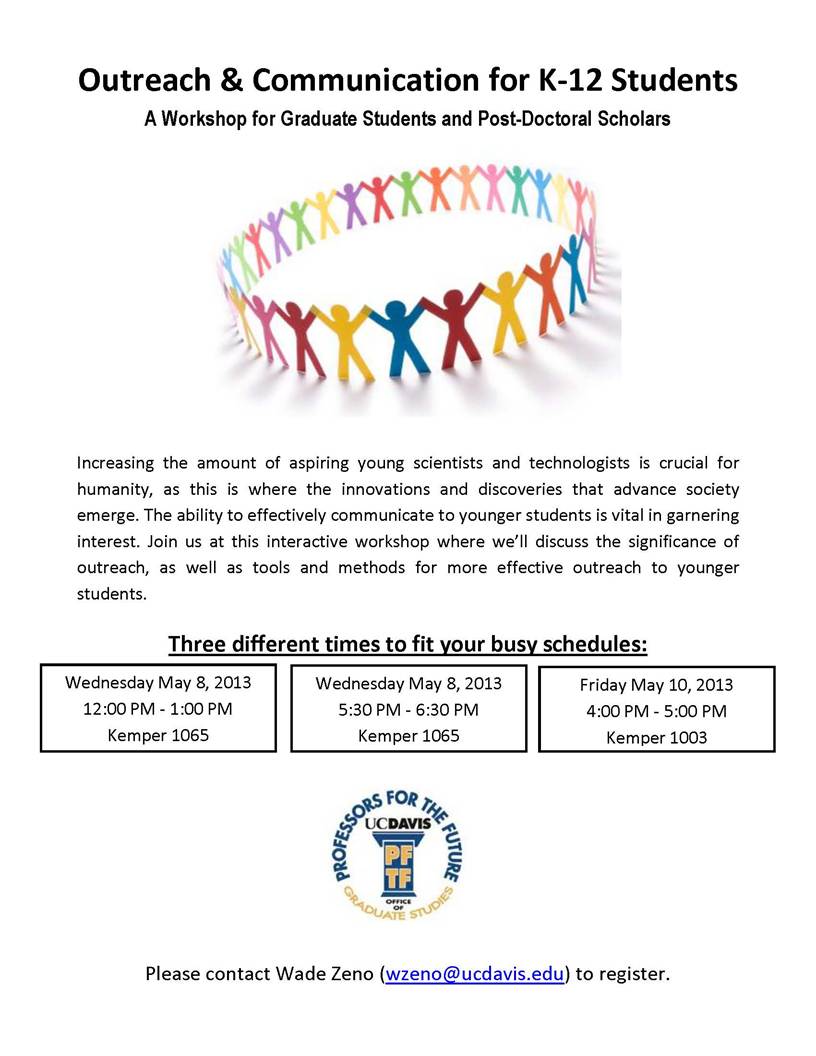
    Outreach & Communication for K-12 Students Workshop for Grad Students & Postdocs

    Next phyloseminar: Ed Delong on Carl Woese 5/13

    Next talk on http://phyloseminar.org

    "How Carl Woese transformed the field of microbial ecology"
    Ed DeLong (MIT)

    The challenges of dissecting naturally occurring microbial
    assemblages, with respect to their community composition, interspecies
    interactions, functional attributes, and activities, are numerous and
    daunting. For many years, these challenges impeded our understanding
    of the properties and dynamics of microbial communities, and thus
    hindered development of the field of microbial ecology. Enter Carl
    Woese: the theory and application of molecular phylogenetics and
    genomics in studies of microbial evolution and ecology can be traced
    directly to Woese and one of his primary collaborators, Norman Pace.
    This lecture will trace the logic and roots of the application of
    molecular phylogenetics and genomics to the study of microbial
    ecology, through a historical review and examination of its past and
    current applications.

    West Coast USA: 10:00 (10:00 AM) on Monday, May 13
    East Coast USA: 13:00 (01:00 PM) on Monday, May 13
    UK: 18:00 (06:00 PM) on Monday, May 13
    France: 19:00 (07:00 PM) on Monday, May 13
    Japan: 02:00 (02:00 AM) on Tuesday, May 14
    New Zealand: 05:00 (05:00 AM) on Tuesday, May 14

    Seminar at #UCDavis 5/7 – David Botstein

    Special Seminar

    Department of Microbiology and Molecular Genetics

    *Note the special time and day

    Dr. David Botstein
    (Anthony B. Evnin Professor of Genomics)

    "Coordination of Growth Rate, Stress Response and Metabolic Activity in Yeast"

    Tuesday, May 7, 2013

    10:00 am

    1022 Life Sciences

    Botstein 5-7-13.doc

    Storified tweets from the #UCDavisADVANCE Symposium on Increasing Diversity of STEM Faculty

    I live tweeted a symposium at UC Davis yesterday that was part of the UC Davis ADVANCE project to increase diversity of STEM Faculty. Here are the notes.

      //storify.com/phylogenomics/ucdavisadvance-symposium.js[View the story “#UCDavisADVANCE symposium” on Storify]

    For more on the project see

    So cool – NSF has a program to provide supplemental funds when CAREER PIs go on family leave

    Just got pointed to this by Siobhan Brady from UC Davis:

    US NSF – Dear Colleague Letter: FY 2013 Career-Life Balance (CLB)-Faculty Early Career Development Program (CAREER) Supplemental Funding Requests (nsf13075)

    It is an NSF program to

    “The purpose of this DCL is to announce the continuation of the supplemental funding opportunity initiated in FY 2012 for PIs supported in the CAREER program. CAREER Principal Investigators (PIs) are invited to submit supplemental funding requests to support additional personnel (e.g., research technicians or equivalent) to sustain research when the PI is on family leave. These requests may include funding for up to 3 months of salary support, for a maximum of $12,000 in salary compensation. The fringe benefits and associated indirect costs may be in addition to the salary payment and therefore, the total supplemental funding request may exceed $12,000.”

    This is part of a larger program on Career-Life Balance:

    Instituted in 2012, NSF’s Career-Life Balance (CLB) Initiative is an ambitious, ten-year initiative that will build on the best of family-friendly practices among individual NSF programs to expand them to activities NSF-wide.  This agency-level approach will help attract, retain, and advance graduate students, postdoctoral students, and early-career researchers in STEM fields.  This effort will help reduce the rate at which women depart from the STEM workforce.  By the end of this ten-year initiative (2021), it is expected that women will represent 41 percent of newly tenured doctoral S&E faculty—the same percentage as the available pool of women S&E doctorate recipients in 2009; and that women of color will comprise 17 percent of newly tenured faculty, the same percentage of their PhD production rate in 2009.  Further information on the CLB initiative may be found on the Foundation’s website.  

    The primary emphasis of NSF’s CLB initiative in FY 2012 was focused on opportunities such as dependent-care issues (child birth/adoption and elder care).  These issues initially were addressed through NSF’s Faculty Early Career Development (CAREER) program, where career-life balance opportunities can help retain a significant fraction of early career STEM talent.  In FY 2013, the Foundation intends to further integrate CLB opportunities through other programs such as the Graduate Research Fellowship and postdoctoral fellowship programs, as well as expand opportunities such as dual career-hiring through the Increasing the Participation and Advancement of Women in Academic Science and Engineering Careers (ADVANCE) program.  Each of these opportunities will be described and implemented separately.

    I am involved in the UC Davis ADVANCE program (minor advisory role) and am always on the lookout for ways that institutions and fundings agencies try to increase representation of women and minorities in STEM fields so if you know of other examples – please post details.

    If you are into microbial diversity and use R this may be worth checking out: phyloseq

    Just got pointed (by the lead author) to this new paper: PLOS ONE: phyloseq: An R Package for Reproducible Interactive Analysis and Graphics of Microbiome Census Data

    Abstract:

    Background
    The analysis of microbial communities through DNA sequencing brings many challenges: the integration of different types of data with methods from ecology, genetics, phylogenetics, multivariate statistics, visualization and testing. With the increased breadth of experimental designs now being pursued, project-specific statistical analyses are often needed, and these analyses are often difficult (or impossible) for peer researchers to independently reproduce. The vast majority of the requisite tools for performing these analyses reproducibly are already implemented in R and its extensions (packages), but with limited support for high throughput microbiome census data.
    Results
    Here we describe a software project, phyloseq, dedicated to the object-oriented representation and analysis of microbiome census data in R. It supports importing data from a variety of common formats, as well as many analysis techniques. These include calibration, filtering, subsetting, agglomeration, multi-table comparisons, diversity analysis, parallelized Fast UniFrac, ordination methods, and production of publication-quality graphics; all in a manner that is easy to document, share, and modify. We show how to apply functions from other R packages to phyloseq-represented data, illustrating the availability of a large number of open source analysis techniques. We discuss the use of phyloseq with tools for reproducible research, a practice common in other fields but still rare in the analysis of highly parallel microbiome census data. We have made available all of the materials necessary to completely reproduce the analysis and figures included in this article, an example of best practices for reproducible research.
    Conclusions
    The phyloseq project for R is a new open-source software package, freely available on the web from both GitHub and Bioconductor.

    Seems similar in some ways to the WATERs Kepler Workflow that we released a few years ago.   Anyway – if you use R and are into microbial diversity studies this may be worth checking out.  As a bonus – it has a strong emphasis on reproducibility – which is a good thing.

    Quick post: interesting article in Smithsonian on the human microbiome by Richard Conniff

    Just q quick post here.  There is an interesting article about the human microbiome worth checking out: Microbes: The Trillions of Creatures Governing Your Health.  By Richard Conniff in Smithsonian Magazine. It also comes with some related videos and pictures. See for example http://player.ooyala.com/player.js?height=288&deepLinkEmbedCode=4zdTgwYjrLemfva768KtaJ1Lk_La8Ql1&width=512&embedCode=4zdTgwYjrLemfva768KtaJ1Lk_La8Ql1&video_pcode=VmM2U6ccX_RqI0rIzEgAxHoRsgRL and http://player.ooyala.com/player.js?height=288&deepLinkEmbedCode=41dTgwYjrKdXobNOQAlckTqHsXUsOKFk&width=512&embedCode=41dTgwYjrKdXobNOQAlckTqHsXUsOKFk&video_pcode=VmM2U6ccX_RqI0rIzEgAxHoRsgRL And it references my “Overselling the microbiome” award …

    When a scientific team recently suggested that changes in gut bacteria could protect against stroke, Jonathan Eisen of the University of California at Davis lambasted them for “absurd, dangerous, self-serving claims that completely confuse the issue of correlation versus causation.” Eisen, a specialist in microbial genomics, now regularly presents “overselling the microbiome” awards on his blog. He says he doesn’t doubt the ultimate importance of the microbiome: “I believe the community of microbes that live in and on us is going to be shown to have major influences.” But believing that “is different from actually showing it, and showing it doesn’t mean that we have any idea what to do to treat it. There is danger here.”

    And it even discusses a fecal transplant-like treatment called RePOOPulate. What could be better? Anyway – definitely worth checking out.