


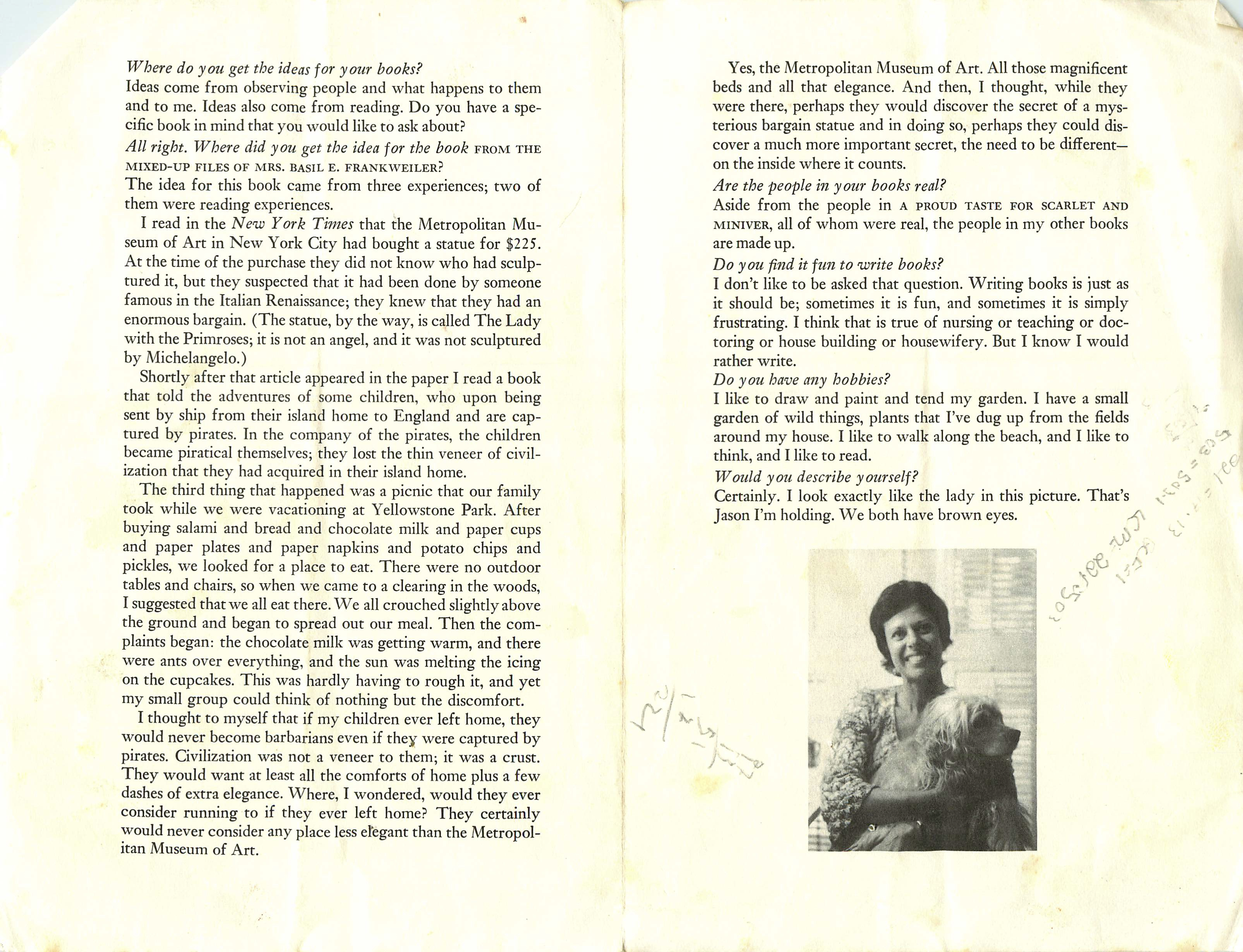
 Sad to hear that EL Konigsburg died a few days ago. She was one of my favorite authors when I was a kid. Here is a note I kept from her that she wrote (when I was very young) after I had written her a letter about loving her books …ElKonigsburg
Eisen Lab Blog

Announcement: Intntl. BioInformatics Workshop on Virus Evolution & Molecular Epidemiology
This looks pretty good:
18th International BioInformatics Workshop on Virus Evolution and Molecular Epidemiology
University of Florida, Emerging Pathogens Institute
Gainesville, Florida, USA.
August 25th – August 30th, 2013
Bioinformatics Methods Applied to Virology and Epidemiology
We are announcing the organization of the international workshop on Virus Evolution and Molecular Epidemiology (VEME) in 2013, hosted by the Emerging Pathogens Institute in the warm city of Gainsville and sponsored by several local partners.
We plan to organize a ‘Phylogenetic Inference’ module that offers the theoretical background and hands-on experience in phylogenetic analysis for those who have little or no prior expertise in sequence analysis. An ‘Evolutionary Hypothesis Testing’ is targeted to participants who are well familiar with alignments and phylogenetic trees, and would like to extend their expertise to likelihood and Bayesian inference in phylogenetics, coalescent and phylogeographic analyses (‘phylodynamics’) and molecular adaptation. A ‘Large Dataset Analysis’ module will cover the more complex analysis of full genomes, huge datasets of pathogens including Next Generation Sequencing data, and combined analyses of pathogen and host. Practical sessions in these modules will involve software like, PHYLIP, PAUP*, PHYML, MEGA, PAML or HYPHY, TREE-PUZZLE, SplitsTree, BEAST, MrBayes Simplot and RDP3.
We recommend participants to buy The Phylogenetic Handbook as a guide during the workshop, and to bring their own data set.
For further information and applications we refer to a dedicated website that will be announced here soon.
Abstract and application deadline is April 30th.
Selections will be made by end of May 2013.
Abstract and application deadline is April 30th.
Selections will be made by end of May 2013.
The registration fee of 1000 USD covers attendance, lunches and coffee breaks.
Participation is limited to 25 scientists in each module and is dependent on a selection procedure based on the submitted abstract and statement of motivation. A limited number of grants are available for scientists who experience difficulties to attend because of financial reasons.
For further information and applications we refer this website: http://conferences.dce.ufl.edu/vemei/http://conferences.dce.ufl.edu/veme/
Share this:

Guest post: Kevin Carpenter on his new microbial photo exhibit at the Exploratorium in SF #SoCool
Special guest post from Kevin Carpenter who has microbe photos featured at the Exploratorium.
One of my colleagues who does research on the microbes that live in the hindguts of lower termites once remarked that interesting organisms can be found in the most unusual of places. And the lower termite hindgut, by almost anyone’s estimation, is certainly an unusual place. It is also a fascinating place for anyone interested in biology, ecology, evolution, biochemistry, or beautiful natural forms and patterns.
Since my undergraduate days in the early 90s, I have had a deep interest in the tree of life, especially eukaryote phylogeny. After a Ph.D. in Plant Biology at U.C. Davis, I headed off to the University of British Columbia to work in Patrick Keeling’s lab to pursue these interests. Anyone who has this peculiar obsession (actually, I think it’s peculiar not to have this obsession!) knows that the eukaryote tree comprises mostly protists, and they arguably encompass greater structural, cell biological, biochemical, (and certainly evolutionary!) diversity than all plants, animals, and fungi combined.
In Patrick’s lab I developed methods for SEM and TEM imaging of these microbes to investigate their phenotypic character evolution, functional morphology, and symbioses with bacteria in the light of molecular phylogenetic data. In addition to a number of publications (with more to come) and talks in Russia, Germany, Norway, etc. my electron micrographs have been featured on numerous journal covers, textbooks, and invited artistic presentations in Canada and Germany.
On 17 April 2013, a collection of 11 of my scanning electron micrographs of lower termite hindgut protists and their bacterial symbionts will go on permanent exhibit at the Exploratorium museum as they open their new $300 million dollar location on Pier 15 in San Francisco. This is a large (12′ x 4′) installation in the East Gallery (overlooking the bay):

The waterfront location, the architecture, the exhibits, and sustainable technology (rooftop solar panels, etc) are all amazing, and I encourage anyone with any interest in science/biology, art, experimentation, tinkering, and beautiful views to come out for a visit. For more information on the exhibit, the organisms, additional images and other resources (including a blog!), please visit my website at: KevinJCarpenter.com
As for the organisms…
The hindgut of wood-feeding lower termites–comprising approximately 1000 species (out of a total of several thousand species of termites)–is densely packed with symbiotic protozoa (protists), many of which engulf and enzymatically degrade wood fragments making their way to the termite hindgut. Far from being parasites, numerous studies have shown this to be a mutualsitic symbiosis, by demonstrating that the termites will starve and die if deprived of their protist symbionts. The symbiosis between lower termites and their hindgut protists is one of the longest-studied and best-known examples of microbial symbiosis, dating back nearly a century and a half to the work by Joseph Leidy and others.
The protists are anaerobic flagellates belonging to Parabasalia or Oxymonadida–members of the Excavate eukaryotic supergroup (also including euglenids, trypanosomes, Giardia, and heterolobosean amoebas). There are numerous odd, interesting, beautiful, and instructive things about these protists.
First, they are endemic to termite hindguts and are found nowhere else. Most of the protist species are found only in association with a single species of termite. The termites pass their hindgut biota from adult to newly hatched nymphs and moulting adult termites (which lose their hindgut contents) via specialized feeding behaviors. It is thought that termites evolved social behavior and caste differentiation from their cockroach ancestors partly to pass hindgut protists between individuals.
Second, many of the protist species and lineages have attained large size (up to 300 microns in length), and enormous structural complexity. Some of the protists are estimated to bear up to 50,000 flagella, each associated with specialized proteinaceous structures (kinetosomes, parabasal fibers) inside the cell. Hence, these are likely among the most structurally complex cells known to science. This is in marked contrast to other symbiotic protist lineages such as microsporidia, apicomplexans, and the coral reef symbiont Cyanidioschyzon, all of which have undergone extreme structural reduction. When looking at these termite gut protists in all of their great structural complexity, dwarfing their numerous bacterial surface symbionts, it is is kind of mind-boggling in a sense to realize that this is a unicellular organism!
Third, the cell biology of these organisms is so different from what is taught in undergraduate cell biology (which is really mammalian, or at best, metazoan cell biology), that it may (hopefully) cause one to reflect on how truly diverse and unknown our biosphere really is. As one example of this, in parabasalid protists, mitochondria have become drastically reduced structurally (loss of cristae), functionally (loss of oxidative metabolism/Krebs cycle), and genomically, and their only known function is the conversion of pyruvate to acetate, with the production of hydrogen gas as a waste product. Hence, these relict mitochondria are called hydrogensomes. The oxymonads are among the least understood group of eukaryotes, and for many species it is unknown what they eat (some of the smaller species apparently do not eat wood), how they reproduce, or how they metabolize their food. Some even have a non-canonical genetic code.
The sitution becomes even more complex when we consider the bacteria in lower termite hindgut systems. In light of their importance in the human and other gut microbiomes, it is no surprise that the termite gut is swarming with innumerable bacteria, many of which are likely found only in one species of termite. What is surprising is that an estimated 90% of all bacterial cells in these systems live either on the surface of, or inside of a protist, and are not free-swimming. One study estimates that the large protist Pseudotrichonympha harbors about 100,000 bacterial cells. Microscopy reveals specialized attachment structures that help the bacteria anchor to the protist surface. Our research shows that the large protist Barbulanympha has not only vast numbers of rod-shaped bacteria on its cell surface and interior, but also bacteria surrounding extruded strands of cytoplasm. This is possibly a mechanism to increase the area available for exchange of nutrients.
Recent research on bacteria symbiotic with termite gut protists suggests that they are important in nitrogen metabolism–both in nitrogen fixation and synthesis of vitamins and amino acids. They are thought to transfer these compounds to their host protist (and to the termite) in return for sugars derived from breakdown of wood.
Just as the protists are generally endemic to a single species of termite, in many cases, bacteria found in symbiotic association with the protists are endemic to a single species of protist. Given this close, three-way association between termite, protist, and bacteria, it is perhaps not surprising that evidence of triplex speciation has been found in these organisms: both the bacteria and their protist hosts speciate in tandem in response to termite speciation events. This is one of only a handful of putative cases of triplex speciation.
The symbiosis between termites and protists is actually also present in a species of wood-feeding cockroach–Cryptocercus punctulatus. C. punctulatus is actually more closely related to termites than to other cockroaches (cockroaches are paraphyletic). It is believed that symbiotic protists were present in the hindgut of the ancestor of C. punctulatus and modern termites, which likely lived over 100 million years ago.
Thus, I consider these termite hindgut systems to be among the most unusual, beautiful, and instructive natural laboratories in evolution and ecology known to science. Nature indeed seems to enjoy tinkering, and in that spirit, I think this is well suited to representation in a place like the Exploratorium!
A few references (copied straight out of one of my manuscripts!) for those interested:
Brune, A. & Ohkuma, M. (2011). Role of the termite gut microbiota in symbiotic digestion. In Biology of Termites: A Modern Synthesis, Bignell, D. E., Roisin, Y. and Lo, N. (Eds.), pp. 439-475. London: Springer.
Carpenter, K.J., Chow, L. & Keeling, P.J. (2009). Morphology, phylogeny, and diversity of Trichonympha (Parabasalia: Hypermastigida) of the wood-feeding cockroach Cryptocercus punctulatus. J Eukaryot Microbiol 56(4), 305-313.
Carpenter, K.J., Horak, A., Chow, L. & Keeling, P.J. (2011). Symbiosis, Morphology, and Phylogeny of Hoplonymphidae (Parabasalia) of the Wood-Feeding Roach Cryptocercus punctulatus. Journal of Eukaryotic Microbiology 58(5), 426-436.
Carpenter, K.J., Horak, A. & Keeling, P.J. (2010). Phylogenetic position and morphology of spirotrichosomidae (parabasalia): new evidence from Leptospironympha of Cryptocercus punctulatus. Protist 161(1), 122-132.
Carpenter, K.J. & Keeling, P.J. (2007). Morphology and phylogenetic position of Eucomonympha imla (Parabasalia: Hypermastigida). J Eukaryot Microbiol 54(4), 325-332.
Carpenter, K.J., Waller, R.F. & Keeling, P.J. (2008). Surface morphology of Saccinobaculus (Oxymonadida): implications for character evolution and function in oxymonads. Protist 159(2), 209-221.
Hongoh, Y., Sharma, V.K., Prakash, T., Noda, S., Taylor, T.D., Kudo, T., Sakaki, Y., Toyoda, A., Hattori, M. & Ohkuma, M. (2008a). Complete genome of the uncultured Termite Group 1 bacteria in a single host protist cell. Proc Natl Acad Sci U S A 105(14), 5555-5560.
Hongoh, Y., Sharma, V.K., Prakash, T., Noda, S., Toh, H., Taylor, T.D., Kudo, T., Sakaki, Y., Toyoda, A., Hattori, M. & Ohkuma, M. (2008b). Genome of an endosymbiont coupling N2 fixation to cellulolysis within protist cells in termite gut. Science 322(5904), 1108-1109.
Ohkuma, M. & Brune, A. (2011). Diversity, structure, and evolution of the termite gut microbial community. In Biology of Termites: A Modern Synthesis, Bignell, D. E., Roisin, Y. and Lo, N. (Eds.), pp. 413-438. London: Springer.
Share this:

YAMMGM: Yet another mostly male genomics meeting

Just got an email from Illumina – key parts are below:
2013 Illumina Scientific Summit
Dear Jonathan,
Illumina’s third annual Scientific Summit will be held June 3rd through 7th in charming New Orleans, Louisiana, at the Loews Hotel. Described by a past attendee as, “an upscale Gordon Conference”, the Scientific Summit is an invitation-only meeting of 120 leading scientists and thought leaders plus the Illumina executive and R&D leadership teams.
Plenary sessions will be focused on the Genetic Etiology of Cancer and Genetic Diseases, The Changing Landscape of Medical Genetics, Microbial Detection, and Epigenetics. The formal presentations will be complemented by attendee-driven discussion sessions on a variety of topics ranging from workflow bottlenecks to future applications of Next Generation Sequencing in single cells and diagnostics.
The following distinguished scientists are scheduled to speak:
Dr. Mark Adams, Scientific Director, J. Craig Venter Institute
Dr. Kenneth J. Bloom, Chief Medical Officer, Clarient
Dr. David Craig, Deputy Director of Bioinformatics, Associate Professor and Director, Neurogenomics Division, Head Neurobehavioral Research Unit, TGen
Dr. Richard Gibbs, Wofford Cain Chair in Molecular and Human Genetics, Professor, Department of Molecular and Human Genetics, Professor, Programs in Translational Biology & Molecular Medicine, Baylor College of Medicine
Dr. David Goldstein, Director, Duke Medical Center for Human Genome Variation, Duke University
Dr. Steven Jones, Head of Bioinformatics and Associate Director, Michael Smith Genome Sciences Centre, BC Cancer Agency
Dr. Michael Katze, Professor, Microbiology, University of Washington
Dr. Jim Knowles, Professor and Associate Chair for Research and Psychiatry and the Behavioral Sciences, USC
Dr. Peter Laird, Director, USC Epigenome Center, Professor of Surgery,Biochemistry and Molecular Biology, Keck School of Medicine, USC
Neil Miller, Director of Informatics and Software Development, Center for Pediatric Genomic Medicine, Children’s Mercy Hospital, Kansas City
Dr. Steven Musser, Director, Office of Regulatory Science, FDA Center for Food Safety and Applied Nutrition
Dr. Charles Perou, Distinguished Professor of Genetics, Professor, Pathology & Lab Medicine, Lineberger Comprehensive Cancer Center, University of North Carolina School of Medicine
Dr. Jonathan Sebat, Chief, Beyster Center for Genomics of Neuropsychiatric Diseases, Associate Professor, Department of Psychiatry & Cellular and Molecular Medicine, University of California, San Diego
Dr. George Weinstock, Professor of Genetics and Molecular Microbiology, Washington University
Dr. Liz Worthey, Director of Genomic Informatics, Medical College of Wisconsin
I love Illumina sequencing toys. I really do. No so impressed with the gender ratio of this meeting however. Would not have gone anyway … but if I COULD have attended I would not have. I wonder -did they even think about whether there might be some bias here? There certainly are plenty of female candidates they could have invited. Maybe they did not invite women? Maybe all the women said no?
Share this:

Fryxell subsampled data and PhyloSift results
Annotation Databases
MG-RAST allows you to view the annotation of your data using several different annotation pipelines/databases. So, we had a discussion about them. Each database/tool was tackled by a different person:
1. GenBank/RefSeq – Joe
2. SEED/Subsystems – Jenna
3. COG/NOG/eggNOG – Tyler
4. KEGG/KO – Megan
5. SwissProt/trEMBL – Kate
6. IMG – Guillaume
7. PATRIC – Sima
8. GO – David
I’m hoping that everyone will be so kind as to post a summary of their database here, as a reply to this blog post.
We kept coming back to the point that which database is right for you depends on what biological question you are hoping to address. As a test dataset, we are currently using samples of a microbial mat from Lake Frxell in Antarctica. Kate, Tyler, and Megan will provide us with a few interesting questions that we might be able to address using their data, and then we will all spend some time playing around with the annotation results from the different databases. How does the biological interpretation of the data change with respect to the annotation database used? Next week, we will discuss this.
Share this:
Metagenomics Working Group – notes from 4/12/13
Guillaume ran us through the MG-RAST interface
Question that came up again (to be asked at the QIIME workshop) – what is the difference between PCA and PCoA
Canonical Correlation Analysis – a way to put vectors on your PCA to explain patterns in terms of metadata.
I suggested that we start putting up little tutorials about how to do different
Next week we will talk about annotation databases – please skim through some papers (and share them!) about the differences between COGS, KEGGS, etc.
Share this:
Metagenomics Working Group
There are a number of people in and around the Eisen lab who are just starting to work with metagenomic (not 16S) data, and most (all?) of us have no idea what we’re doing! So, we’ve decided to meet weekly to walk through it together. The idea is to take an inventory of the currently available tools and pipelines for analyzing metagenomic data.
Here are Holly’s notes from the first meeting:
Spreadsheet of metagenome analysis – keep filling this in. Assign different people to test out different tools?
What type of questions are we going to be asking?
-
How do functional inferences compare across tools?
-
Are specific tools better suited for specific questions (bacteria/archaea vs. eukaryotes)?
Testing out metagenome pipelines for different types of user. 3 prospective levels:
-
Analysis on a laptop or desktop (2-20 GB memory)
-
Analysis on a server (20-50GB memory)
-
Analysis on a cluster (>50GB memory)
Maybe restrict ourselves to testing out “popular” programs (look at citation counts?). Lots of programs out there.
What is the differences between databases? COG vs. KEGG vs. other ontologies
Samples we can use for benchmarking and testing
-
Mock community metagenomes
-
Published data – Yatsunenko et al. metagenome data
Guillaume notes that the Corn samples didn’t have enough sample point to do statistical analysis (~40 samples)
Share this:
GGG seminar today: Dan Rokhsar
Genetics Spring 2013 Seminar
1022 Life Sciences Mondays at 4:10PM
April 22, 2013
“In the Beginning: Genomics of Animal Origins and Diversity”
Dan Rokhsar
Lawrence Berkeley National Laboratory
Share this:
Do we need naming regulations for computer software?
Well, just saw this new paper: BMC Bioinformatics | Full text | Bellerophon: a hybrid method for detecting interchromo-somal rearrangements at base pair resolution using next-generation sequencing data. Seems potentially interesting. But one part of it struck me as very awkward. You see, there already is a Bellerophon software program used by many in my field: Bellerophon: a program to detect chimeric sequences in multiple sequence alignments. Seems like a very bad idea to have a new program with the same name as an existing (and still used) one in a similar general field (DNA sequence analysis).
This leads me to the following question – do we need some sort of naming guidelines or regulations for computer software? We have all sorts of naming regulations and conventions for genes, for species, for other groups of taxa, and more. Why not software tools? But seriously, I don’t think we need such a thing – we just need people to use Google and to do a little searching before they invent / publish a software package in case it’s name is, well, already used.

