http://www.bbc.co.uk/emp/worldwide/player.swf<!– Hat tip to …
Why Professor Larry Smarr (@lsmarr) freezes his own faeces | @BBCNews VIDEO http://t.co/fVZrQNXaYo #DigitalHealth #QuantifiedSelf #QS
— Paul Sonnier (@Paul_Sonnier) August 12, 2013
http://www.bbc.co.uk/emp/worldwide/player.swf<!– Hat tip to …
Why Professor Larry Smarr (@lsmarr) freezes his own faeces | @BBCNews VIDEO http://t.co/fVZrQNXaYo #DigitalHealth #QuantifiedSelf #QS
— Paul Sonnier (@Paul_Sonnier) August 12, 2013
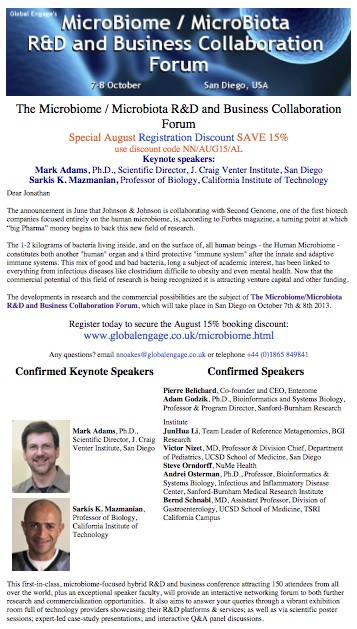
Well, just got an email inviting me to participate in a meeting on microbiomes. The full invite is at the bottom of this posting. Alas, at first glances it seems this meeting, has, well, some gender issues.
Confirmed Keynote Speakers: both male.
Confirmed other speakers: all seven male
I suppose one could say “Well, they are still working on their agenda … maybe they will have some female speakers.” So I decided to dig around a little bit more. They provide a link to the outline agenda here. Alas that is even worse. There we find out who some invited speakers are who have not yet accepted
So that is 9 confirmed speakers and six invited speakers – all of whom are male. Great. Here is a suggestion. DO NOT GO TO THIS MEETING.
![]() |
||
|
The Microbiome / Microbiota R&D and Business Collaboration Forum
Special August Registration Discount SAVE 15%
use discount code NN/AUG15/AL
Keynote speakers: Mark Adams, Ph.D., Scientific Director, J. Craig Venter Institute, San Diego Sarkis K. Mazmanian, Professor of Biology, California Institute of Technology |
||
| Dear Jonathan
The announcement in June that Johnson & Johnson is collaborating with Second Genome, one of the first biotech companies focused entirely on the human microbiome, is, according to Forbes magazine, a turning point at which “big Pharma” money begins to back this new field of research. The 1-2 kilograms of bacteria living inside, and on the surface of, all human beings – the Human Microbiome – constitutes both another “human” organ and a third protective “immune system” after the innate and adaptive immune systems. This mix of good and bad bacteria, long a subject of academic interest, has been linked to everything from infectious diseases like clostridium difficile to obesity and even mental health. Now that the commercial potential of this field of research is being recognized it is attracting venture capital and other funding. The developments in research and the commercial possibilities are the subject of The Microbiome/Microbiota R&D and Business Collaboration Forum, which will take place in San Diego onOctober 7th & 8th 2013. Register today to secure the August 15% booking discount:
www.globalengage.co.uk/microbiome.html Any questions? email nnoakes@globalengage.co.uk or telephone +44 (0)1865 849841 |
||
|
||
| This first-in-class, microbiome-focused hybrid R&D and business conference attracting 150 attendees from all over the world, plus an exceptional speaker faculty, will provide an interactive networking forum to both further research and commercialization opportunities. It also aims to answer your queries through a vibrant exhibition room full of technology providers showcasing their R&D platforms & services; as well as via scientific poster sessions; expert-led case-study presentations; and interactive Q&A panel discussions. | ||
|
The Outline Agenda
Venture Capital + Technology Transfer
The microbiome of the GI tract
Clinical Applications
Connections to the Food World
|
||
| www.globalengage.co.uk/microbiome.html | ||
| Not interested in the Microbiome/Microbiota? Unsubscribe here Nick Noakes: nnoakes@globalengage.co.uk Tel +44 (0) 1865 849841 |
You might think that at some point some of the people organizing meetings
I am sitting on a Southwest Airlines flight heading to Denver for the American Society for Microbiology 2013 meeting. At 3 PM today I am scheduled to co-chair (with David Coil from my lab) a session on “Citizen Microbiology” (well the full title is Citizen Microbiology: Enhancing Microbiology Education and Research with the Help of the Public). The schedule of the session is at the bottom of this post but it promises to be very interesting and exciting (no bias here at all).
As far as I know, this is the first session ever on “Citizen Microbiology” at a large meeting of any kind. We held a small workshop at UC Davis in January of 2012 on Citizen Microbiology but that was quite small. I note – I use a very broad definition for Citizen Microbiology including basically any project that engages the public in some way to participate in a research project relating to microbes. This is the perfect time to have such a session at a large meeting and the ASM General Meeting is an ideal setting. There are a series of converging forces that makes this timing ideal including:
There is a growing appreciation of microbes and the role they play on the planet. Some of this appreciation is broad – covering all microbes – all the time – everywhere. But much of it is due to a growing interest in the microbes closer to us – those that live in and on us (the human microbiome) – those that live in and on plants and animals and other organisms we care about – and those that live in the places where we spend much of our time (the microbes of the built environment). I mean – come on – everyone is talking about fecal transplants now in public – in cover stories of the NY Times Magazine and in Ted talks.
These are but a few of the reasons why I believe the time is right for Citizen Microbiology. But there are also what I would call somewhat negative reasons why the time is right too. These include
So this is both an exciting and a critical time for microbes and microbiology. And I hope that this session will not only help launch the field of Citizen Microbiology, but will help get everyone to think about the bigger issues and how to move the field forward in the right directions. For there is so much we need to do and think about including
And of course – the people at the session are not the only ones engaged in Citizen Microbiology or related activities (see a list we made a while back here). If you are doing a project please post something about it here. And if you are not doing a Citizen Microbiology project – well – why not? Get your act together.
Anyway – got to put away the computer as we land in Denver soon and I will rush off to the conference center, hopefully on time, to chair this exciting session. And I hope to see you there or have you follow online (check out the Twitter hash tag #ASM2013). And keep your eyes open for more excitement in this area.
————————-
Today’s session at ASM 2013:
(Division W Lecture) Authentic Research for Novice Scientists: Phage Discovery and Genomics by Undergraduate Students
Graham Hatfull;
Univ. of Pittsburgh, Pittsburgh, PA.
Understanding Human Influence on Microbial Distribution Patterns in the United States: A Citizen Science Approach
G. Barguil Colares1, J. Marcell1, D. Smith1,2, J. A. Eisen3, J. Gilbert1,2;
1Argonne Natl. Lab., Lemont, IL, 2Univ. of Chicago, IL, 3UC Davis, Davis, CA.
The Home MIcrobiome Project: Learning the Lessons of Citizen Science and Communication
J. A. Gilbert, D. Smith;
Argonne Natl. Lab., Lemont, IL.
The New National Lab: How Citizen Science is Transforming American Research
Darlene Cavalier;
Sci. Starter, Sci. Cheerleader, Philadelphia, PA.
Sequencing the Human Microbiome with Citizen Science
Z. Apte1, J. Richman2, W. Ludington3;
1uBiome, Inc, San Francisco, CA, 2Oxford Univ., Oxford, UNITED KINGDOM, 3Univ. of California, Berkeley, Berkeley, CA.
The American Gut Project: Challenges and opportunities for crowdsourcingmicrobial ecology
Antonio Gonzalez Peña;
Univ Colorado at Boulder, Boulder, CO.
Public Science in Private Places: A Study of the Microbial Ecology of One Thousand Houses in Fifty States and Five Countries
Rob Dunn;
NC State Univ., Raleigh, NC.
UPDATE: Notes from the Session Added 5/23
Here are some notes from the meeting:
Meeting Report: ASM 2013 in Denver, Day 1
ASM 2013, Day 1: From Oceans to Guts
Citizens doing Science, or Science on Citizens? (ASM 2013: Post 1)
Symbionticism: ASM 2013 LINKS
Storify by SPONCH
My storify embedded below
Quick post here. There is a really nice piece on in the New York Times Sunday Magazine by Michael Pollan on the human microbiome: Say Hello to the 100 Trillion Bacteria That Make Up Your Microbiome. In it he discusses how he had his microbiome typed by the American Gut Project and he discusses browsing through the output. He also discusses a diversity of issues in the microbiome and work of various folks. People featured include Justin Sonnenburg, Rob Knight, Burce German, Catherine Lozupone, Stanley Falkow, Jeffrey Gordon, Michael Fischback, Maria Gloria Dominguez-Bello, Martin Blaser, Ruth Ley, Andrew Gewirtz, Patrice Cani, Erica Sonnenburg, and Stephen O’Keefe. The article does a really good job of highlighting why the microbiome is important yet does not oversell what we know at this point.
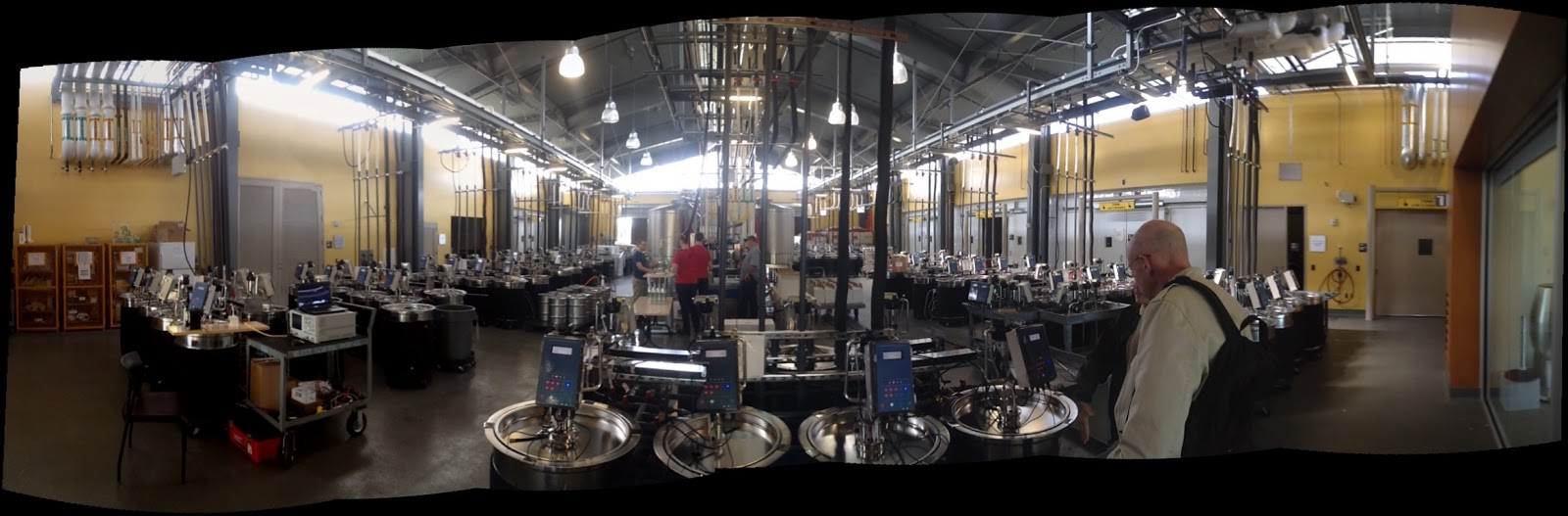
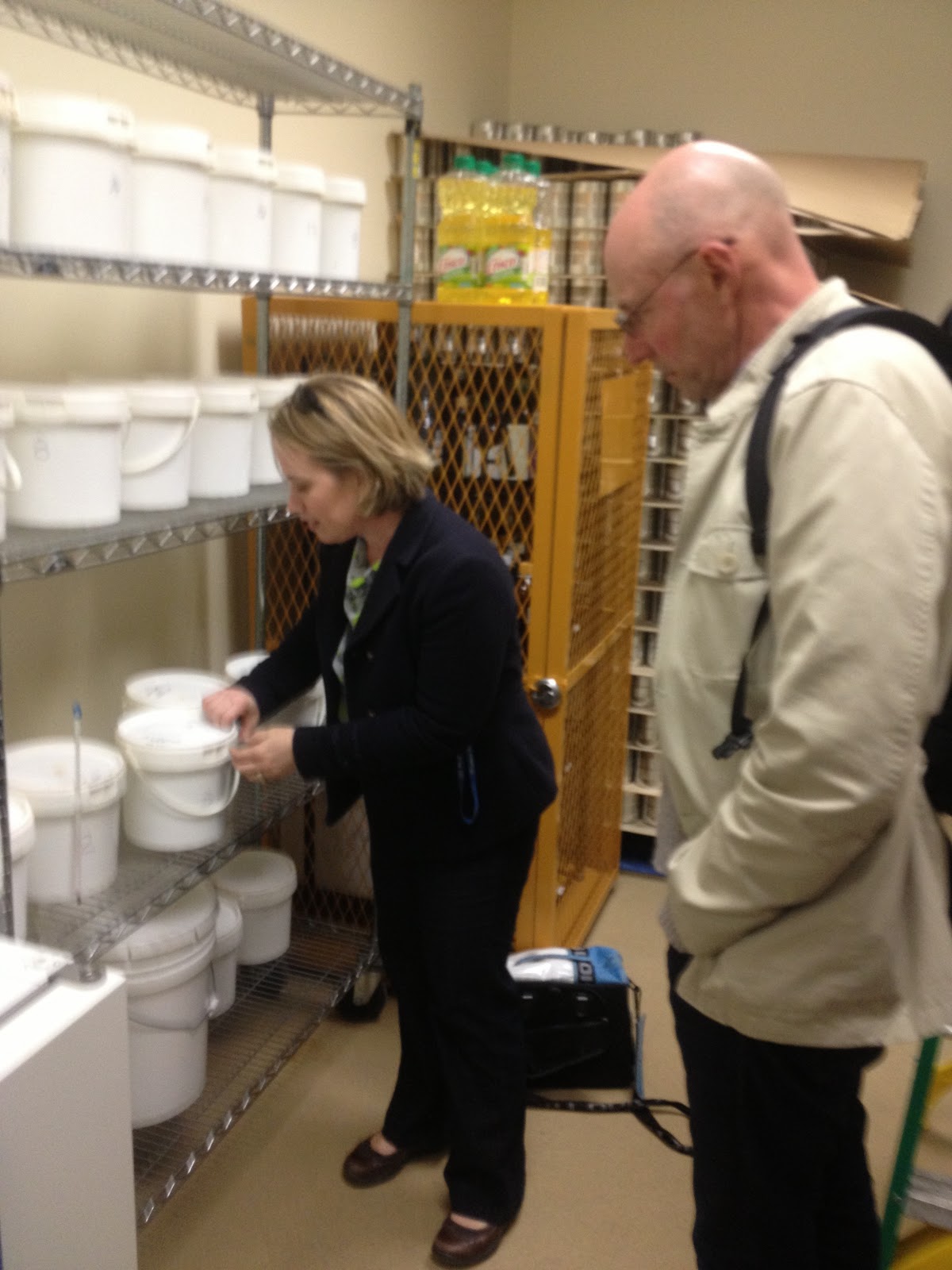
I note – Pollan came to UC Davis as part of his research for the article a little while back. Below are some pics of him getting a tour of the UC Davis LEED Platinum brewing facility. Anyway the article is definitely worth a look. And just in time for the ASM 2013 Meeting which I am about to head to this AM.
Well, I guess this could be good news or bad news or both. The FDA has sniffed the winds of microbiome studies and decided that it wants some more regulation on fecal transplants (aka fecal bacteriotherapy). See for example Fecal Transplant: FDA Wants Regulation. Fecal transplants are spreading like crazy these days and every where I go in real life and online I hear and see more about them. For more on fecal transplants see some of my previous posts such as More (you know you wanted it) on fecal transplants and the microbiome and Fecal transplants in the news and Transfaunation and Fecal Transplants: What Goes Around Comes Around, Literally and Figuratively.
I guess the FDA feels like they have to do something given the spread of FT. Given how many scam artists and oversellers of the microbiome are out there I think some sort of increased protection or regulation is probably a good thing. But I am not sure what the best way to do this is. Clearly some are unhappy with the FDA sticking their noses into fecal transplants (e.g., see here). But given how little we know about FTs other than as treatment for Clostridium dificile infections it seems like one could make a reasonable argument for more regulation or caution. It seems strange though that we can do just about anything and everything we want to kill all the microbes around us with very little regulation and yet attempting to manipulate the microbes in and on us or add a few here and there is being regulated more.
What do others think? Do we need more regulation from the FDA on fecal transplants?
UPDATE – some links to other discussions of this:
I know I complain all the time about news stories and people “overselling the microbiome“. Mind you, I believe microbial communities are likely to be found to have very very important roles in the biology of the plants and animals and other organisms on which they live, but I worry about overhyping the possibilities. But thankfully, there are some good researchers at work out there documenting just what the microbiome can and does do. And the results continue to be promising.
Here is the one that caught my eye most recently: BBC News – ‘Weight loss gut bacterium’ found about this PNAS paper. While the study is in mice and it is what one could call “limited” in some ways, it is really fascinating and has much promise. Basically, they isolated a new bacterium (with the awkward name of Akkermansia muciniphila, and did a series of experiments in mice looking at the role this bacterium can play in many mouse gut properties. But most interesting, treatment of mice with this bacterium (and only when the bacterium was alive) led to a reduction in high fat induced metabolic disorders and obesity. I am still re-reading the paper but the result seems solid. And exciting.
So – there is no need to oversell the microbiome when the results coming in sell themselves …
UPDATE 30 minutes after posting
Of course, I should have checked to see if Ed Yong wrote anything about this. And he did: The Mucus-Lover that Stops Mice from Getting Fat. Read his post. It is excellent. With ALL sorts of links and background and other detail.
So cool. Yesterday on “wait wait … don’t tell me” Kai Penn (actor) was enticed to play the game “Ahhh! Get It Off Me!” in regard to microbes: Not My Job: Kal Penn Takes A Quiz On The Microbiome : NPR
Hat tip to Jenna Lang for pointing me to this.
Via @nprnews: Not My Job: Kal Penn Takes A Quiz On The Microbiome n.pr/10hVj0J @jessicaleegreen @phylogenomics
— Jenna Morgan Lang (@jennomics) April 27, 2013
Just q quick post here. There is an interesting article about the human microbiome worth checking out: Microbes: The Trillions of Creatures Governing Your Health. By Richard Conniff in Smithsonian Magazine. It also comes with some related videos and pictures. See for example http://player.ooyala.com/player.js?height=288&deepLinkEmbedCode=4zdTgwYjrLemfva768KtaJ1Lk_La8Ql1&width=512&embedCode=4zdTgwYjrLemfva768KtaJ1Lk_La8Ql1&video_pcode=VmM2U6ccX_RqI0rIzEgAxHoRsgRL and http://player.ooyala.com/player.js?height=288&deepLinkEmbedCode=41dTgwYjrKdXobNOQAlckTqHsXUsOKFk&width=512&embedCode=41dTgwYjrKdXobNOQAlckTqHsXUsOKFk&video_pcode=VmM2U6ccX_RqI0rIzEgAxHoRsgRL And it references my “Overselling the microbiome” award …
When a scientific team recently suggested that changes in gut bacteria could protect against stroke, Jonathan Eisen of the University of California at Davis lambasted them for “absurd, dangerous, self-serving claims that completely confuse the issue of correlation versus causation.” Eisen, a specialist in microbial genomics, now regularly presents “overselling the microbiome” awards on his blog. He says he doesn’t doubt the ultimate importance of the microbiome: “I believe the community of microbes that live in and on us is going to be shown to have major influences.” But believing that “is different from actually showing it, and showing it doesn’t mean that we have any idea what to do to treat it. There is danger here.”
And it even discusses a fecal transplant-like treatment called RePOOPulate. What could be better? Anyway – definitely worth checking out.
A couple of recent papers on weight-loss surgery and microbes have gotten a lot of attention to the idea that obesity and microbes have a more than just coincidental connection.
Some of the news stories on the topic are below. A few of them are a bit over the top but the new work seems pretty sound so this is definitely worth a look.
At the recent “Future of Genomic Medicine” meeting, George Church gave me some grief over my “Overselling the microbiome award” because he thinks (rightly) that some people also undersell the microbiome.
So I set out today to find an example to give out such an award. And within seconds I bumped into this: Germs: There are bugs that cure infections, protect against stroke and even keep your skin clear | Mail Online in the Daily Mail.
Wow. And not in a good way. Oh well, so much for the underselling award. Just the title made me cringe. And so so so so many of the details are so so bad.
Where to start. I guess from the beginning.
“.The secret lies in the balance of the bugs, which exist in a fragile ecosystem. Knock one out and the system goes haywire.”
Umm. No. Not that I know of. Knock one out? What evidence is there for this? None.
“Imbalances in gut bacteria, for instance, have been linked with diabetes, obesity, autism, eczema, psoriasis, asthma and inflammatory bowel conditions such ulcerative colitis and Crohn’s disease”
“…. may even … cause … multiple sclerosis “
Holy crap. That sounds awesome. Except that there are all correlations so far with no known causative role at least in humans.
Then they list some of the other good things microbes apparently have been proven to do:
“ANXIETY-BUSTING GUT BACTERIA”
“It seems that the type of bugs you have in your body can affect mood.”
Though at least in this section they do refer to a mouse study but clearly imply this is true in humans too. It may be. But I am unaware of any studies proving it.
“BUGS ARE GOOD FOR YOUR SKIN”
“It’s a common misconception that the cleaner the skin, the better — and the bacteria that live on our skin have an important role.”
I am all for not killing all microbes willy nilly but their is certainly one part of the body that you probably do want to wash a lot – your hands. So As long as they don’t say “Don’t wash your hands” this could be OK.
So what do they say next:
‘If you wash your hands repeatedly, they dry out — this is partly because you wash away all the oils but also because you remove a large number of the bacteria that help maintain the skin’s condition,’ says Professor Mark Fielder, a medical microbiologist at Kingston University.
Oh FFS now they are basically telling people to not wash their hands.
“SHARE A KISS… AND BACTERIA”
‘Every time you kiss, for example, you exchange a million bacteria. ‘So your gut microbiology becomes close to that of your loved ones.’
Sounds great. I could not find any references on the topic but sounds great.
“SOME TYPES MAY PREVENT STROKE”
Wherein the tell a story based on a press release which had led me to post the following: “Award: Ridiculous, absurd, offensive overselling of the microbiome from Chalmers & Gothenburg”. Any idea if I think this is an accurate press release?
TRANSFUSION TO BEAT INFECTIONS
Wherein they discuss fecal transplants for C. difficile infections, which seem to work quite well and I have written about a lot (e.g. Transfaunation and Fecal Transplants: What Goes Around Comes Around, Literally and Figuratively). But then they kill their positive mojo on the topic by writing:
Lawrence Brandt, a professor of medicine and surgery at New York’s Albert Einstein College of Medicine, believes the treatment could work for other, non-gastro conditions, such as obesity and Parkinson’s.
Seriously? Fecal transplants for Parkinson’s?
And it goes on and on including:
“SOME BACTERIA KEEP YOU SLIM”
“BUGS THAT HELP MEDICINE WORK”
“COULD THEY WARD OFF CANCER?”
“KEY TO BABIES’ IMMUNITY”
I mean – I really really do think the microbiome plays roles in many many parts of our lives. But those who promote it this much are the snake oil sellers of the modern era. A slight of hand here and soon they will be selling us some specific brand of probiotic or way to protect our microbiomes. So for this article the Daily Mail is getting my first multiple “Overselling the microbiome award.” They could get 3 or 4 just from this article if not more. But I will just give them two. And I will keep searching for an underselling the microbiome recipient.