Soliciting opinions on paper "A congruent phylogenomic signal places eukaryotes within the Archaea"

Been reading this paper which I posted about to Twitter recently: A congruent phylogenomic signal places eukaryotes within the Archaea.  It is very interesting.  Not sure what to make of it though.  So – in contrast to my normal ways of putting my ideas out there first and asking for / hoping for comment I thought – let’s mix things up.  So – I am soliciting comments from people BEFORE I write down my comments.  Any ideas / thoughts / comments would be welcome.

Full citation:

Proc Biol Sci. 2012 Dec 22;279(1749):4870-9. doi: 10.1098/rspb.2012.1795. Epub 2012 Oct 24.
A congruent phylogenomic signal places eukaryotes within the Archaea.
Williams TA, Foster PG, Nye TM, Cox CJ, Embley TM.

My new microbial art for my office: salt evaporation ponds and goethermal spring stamps

Thanks to Russell Neches in my lab I found out about the Earthscapes series stamps from the US Postal Service.  Two of the stamps feature microbial ecosystems and I ordered framed, enlarged versions of the photos for my office.

They are available at the links below:

Go microbes.

PLoSOne paper: Parallel polymorphisms for pepper population phylogenetics, from #UCDavis, not #Pepperspray

Interesting new paper from colleagues at UC Davis: PLOS ONE: Characterization of Capsicum annuum Genetic Diversity and Population Structure Based on Parallel Polymorphism Discovery with a 30K Unigene Pepper GeneChip.

Press release is here: http://www.news.ucdavis.edu/search/news_detail.lasso?id=10497

Good to see something on peppers from UC Davis not about spraying.

Interesting paper on strategy to use PCR to simultaneously characterize eukaryotic, bacterial and archaeal microbes

Interesting new paper in PLOS One: PLOS ONE: Simultaneous Amplicon Sequencing to Explore Co-Occurrence Patterns of Bacterial, Archaeal and Eukaryotic Microorganisms in Rumen Microbial Communities

Full citation:  Kittelmann S, Seedorf H, Walters WA, Clemente JC, Knight R, et al. (2013) Simultaneous Amplicon Sequencing to Explore Co-Occurrence Patterns of Bacterial, Archaeal and Eukaryotic Microorganisms in Rumen Microbial Communities. PLoS ONE 8(2): e47879. doi:10.1371/journal.pone.0047879

Basically, the paper describes the development and use of a PCR strategy to simultaneously characterize eukaryotic, bacterial and archaeal microbes from samples.

Primers used are summarized in Table 2

The strategy they employ attempt to correct for differences in amplification differences between the different amplicons which should therefore allow better normalization of relative abundance estimates.  See results in Figure 2.

Definitely worth a look.

Nice timing: Our paper on the Darwin’s Finch genome is out today on Darwin’s birthday

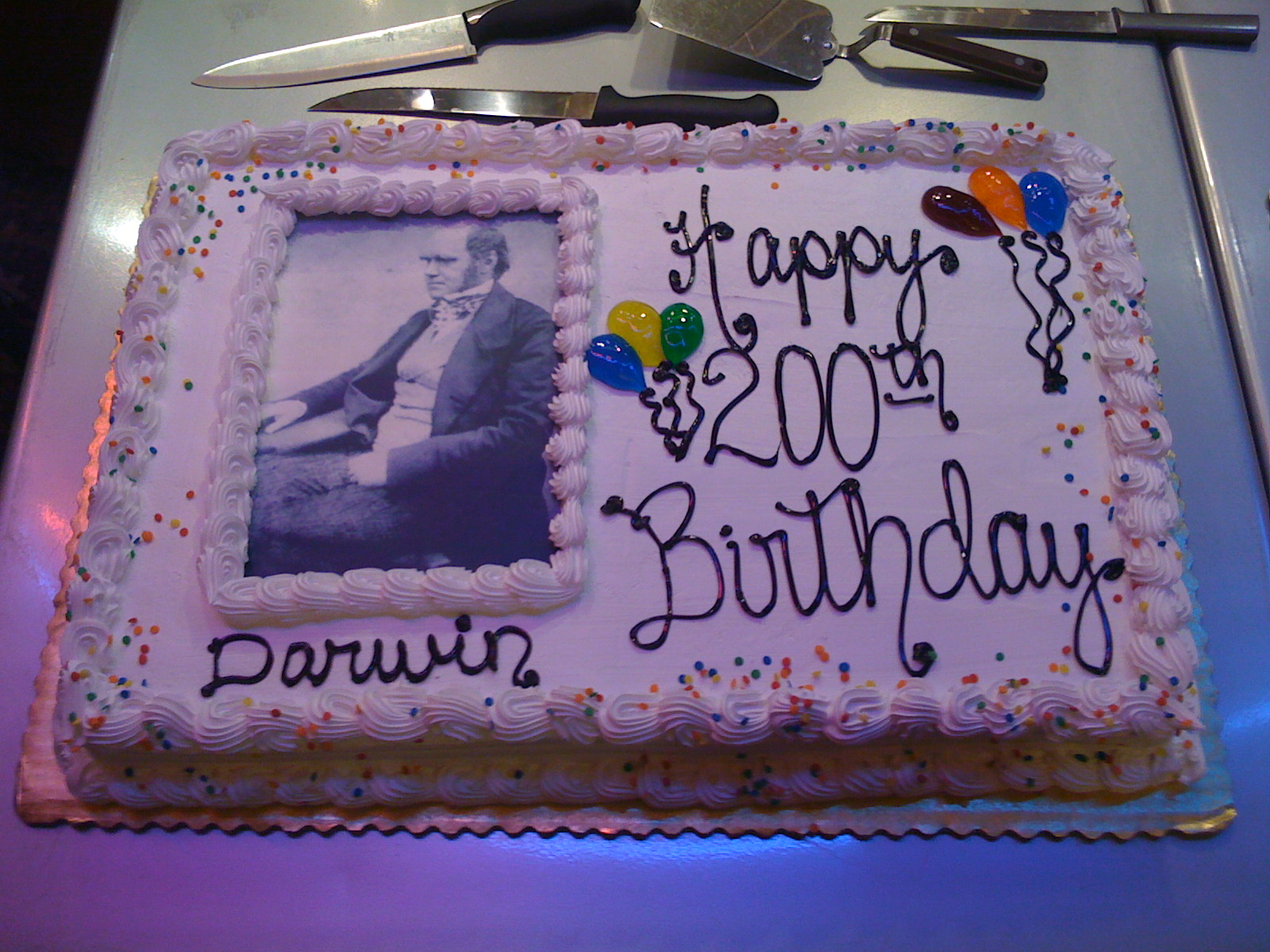
Birthday party for Darwin in 2009

Well, I assume this was on purpose from the folks at Biomed Central but not sure.  Our paper on the genome of one of Darwin’s Finches is out today in BMC Genomics: BMC Genomics | Abstract | Insights into the evolution of Darwin’s finches from comparative analysis of the Geospiza magnirostris genome sequence.

Abstract of the paper:

Background
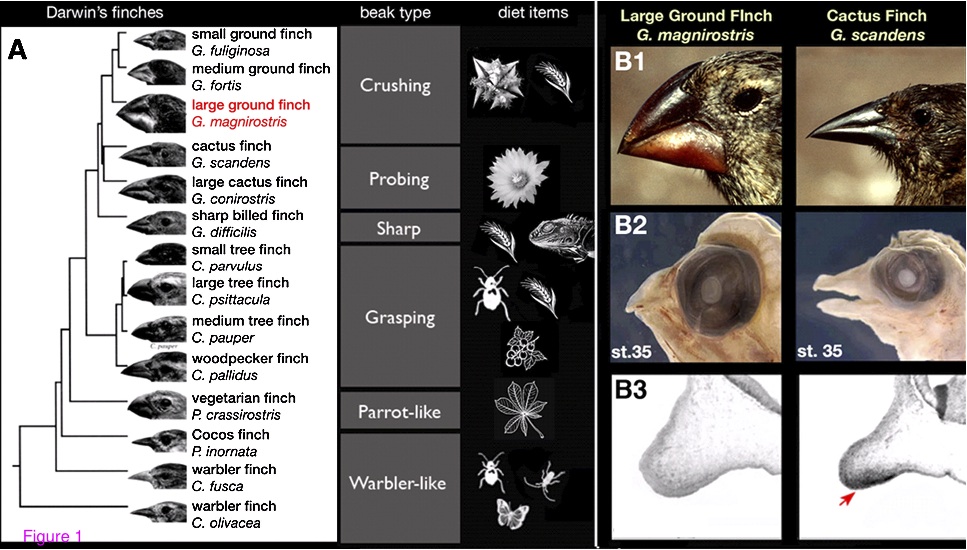
A classical example of repeated speciation coupled with ecological diversification is the evolution of 14 closely related species of Darwin’s (Galápagos) finches (Thraupidae, Passeriformes). Their adaptive radiation in the Galápagos archipelago took place in the last 2–3 million years and some of the molecular mechanisms that led to their diversification are now being elucidated. Here we report evolutionary analyses of genome of the large ground finch, Geospiza magnirostris.
Results
13,291 protein-coding genes were predicted from a 991.0 Mb G. magnirostris genome assembly. We then defined gene orthology relationships and constructed whole genome alignments between the G. magnirostris and other vertebrate genomes. We estimate that 15% of genomic sequence is functionally constrained between G. magnirostris and zebra finch. Genic evolutionary rate comparisons indicate that similar selective pressures acted along the G. magnirostris and zebra finch lineages suggesting that historical effective population size values have been similar in both lineages. 21 otherwise highly conserved genes were identified that each show evidence for positive selection on amino acid changes in the Darwin’s finch lineage. Two of these genes (Igf2r and Pou1f1) have been implicated in beak morphology changes in Darwin’s finches. Five of 47 genes showing evidence of positive selection in early passerine evolution have cilia related functions, and may be examples of adaptively evolving reproductive proteins.
Conclusions
These results provide insights into past evolutionary processes that have shaped G. magnirostris genes and its genome, and provide the necessary foundation upon which to build population genomics resources that will shed light on more contemporaneous adaptive and non-adaptive processes that have contributed to the evolution of the Darwin’s finches.

Figure 1

There is a long long long story behind this paper.  Too long for me to write up right now.  I wrote up some of the story for a Figshare posting of the genome data last year.

“Darwin’s Finches” are a model system for the study of various aspects of evolution and development.  In 2008 we commenced on a project to sequence the genomes of some of these species – inspired by the (then) upcoming celebration of the 200th anniversary of the birth of Charles Darwin (which was in February 2009).  The project started with a brief discussion at the AGBT meeting in 2008 and then via an email conversation between Jonathan Eisen and Jason Affourtit about the possibility of a collaboration involving the 454 company (which was looking for projects to highlight the power of it’s then relatively new 454 sequencing machines).  After further discussions between Jonathan Eisen, his brother Michael Eisen (who separately had become interested in Darwin’s finches) and people from 454 it was decided that this was a potentially good project for a scientific and marketing collaboration.  

In these conversations it was determined that the most likely limiting factor would be access to DNA from the finches.  This was largely an issue due to the fact that the Galapagos Islands (where the finches reside) are a National Park in Ecuador and also a World Heritage site.  Collection of samples there for any type of research is highly regulated.  Thus, Jonathan Eisen made contact with Peter and Rosemary Grant – the most prominent researchers working on the finches – and who Eisen had discussed sequencing the finch genomes in the early 2000s.  In that previous conversation it was determined that the sequencing would be too expensive to carry out without a major fundraising effort.  However, with the advent of “next generation” sequencing methods such as 454 the total costs of such a project would be much lower.   

In the conversations with the Grants, the Grants offered to ask around to see if anyone had sufficient amounts of DNA (or access to samples), which would be needed for genome library construction.  Subsequently they identified Arkhat Abzhanov from Harvard as someone who likely had samples as well as permission to do DNA-based work on them, from many of the finch species. Abzhanov offered to provide samples from three key species (large ground finch Geospiza magnirostris, large cactus finch G. conirostris and sharp-billed finch G. difficilis) and DNA was sent to Roche-454 for sequencing in July of 2008.  In August, the first “test” sequence data was provided from Geospiza magnirostris.  A plan was then made to generate additional data and Roche offered to do the sequencing at their center at a steep discount.  Funds were raised by Jonathan Eisen, Greg Wray, Monica Riley, and others to pay for the sequencing and over the next year or so, three sequencing bursts were conducted at Roche-454. “

That is a decent summary of the background.  The details on the science are in the paper.  What the background does not say is that the project languished for years as we did not have funds to support the actual analysis of the genomes and it was kind of out of my normal area of expertise.  Along the way, I did a poor job of communicating with some of the initial parties in the project (e.g., I did a really bad job of communicating with Greg Wray – who had provide some of the funds – and I will forever be trying to make things up to him).  Anyway, thankfully Arhat eventually pulled together a group of people led by Chris Ponting to help analyze the genome and Chris led the way to the paper that is out today.  Only four years after our original goal.

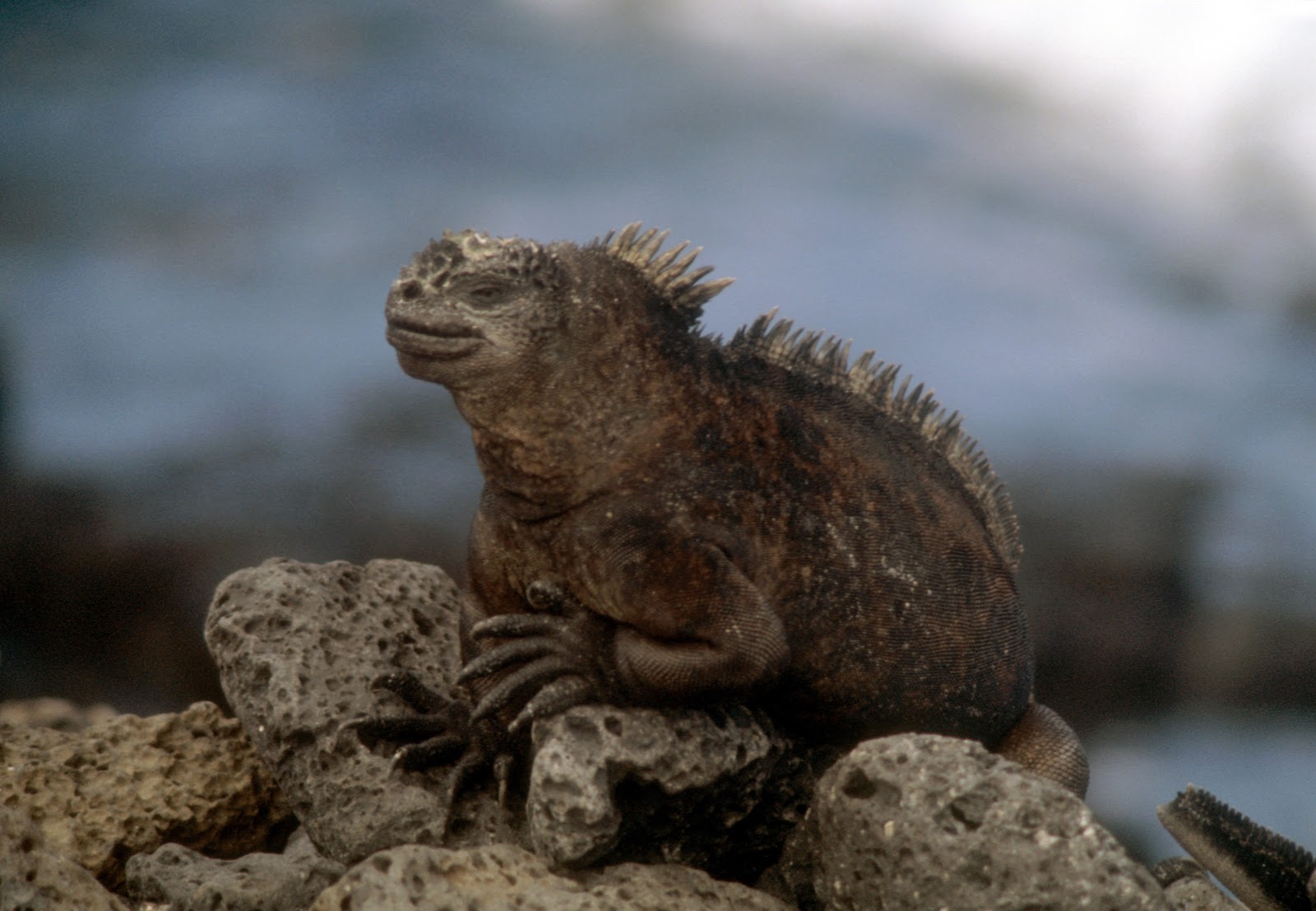
I have been a birder and an evolutionary biologist for many many many years. Thus this is kind of a cool project for me.  When I was in the Galapagos in 2002 I dreamed of doing a project like this – and even started doodling Darwin’s finches all over the place – including on some of the styrofoam cups we sent down to the bottom of the ocean on the outside of the Alvin sub as part of a deep sea research cruise I went on.  See below:

https://picasaweb.google.com/s/c/bin/slideshow.swf

Add caption

Some related posts:
From 2002

From 2002

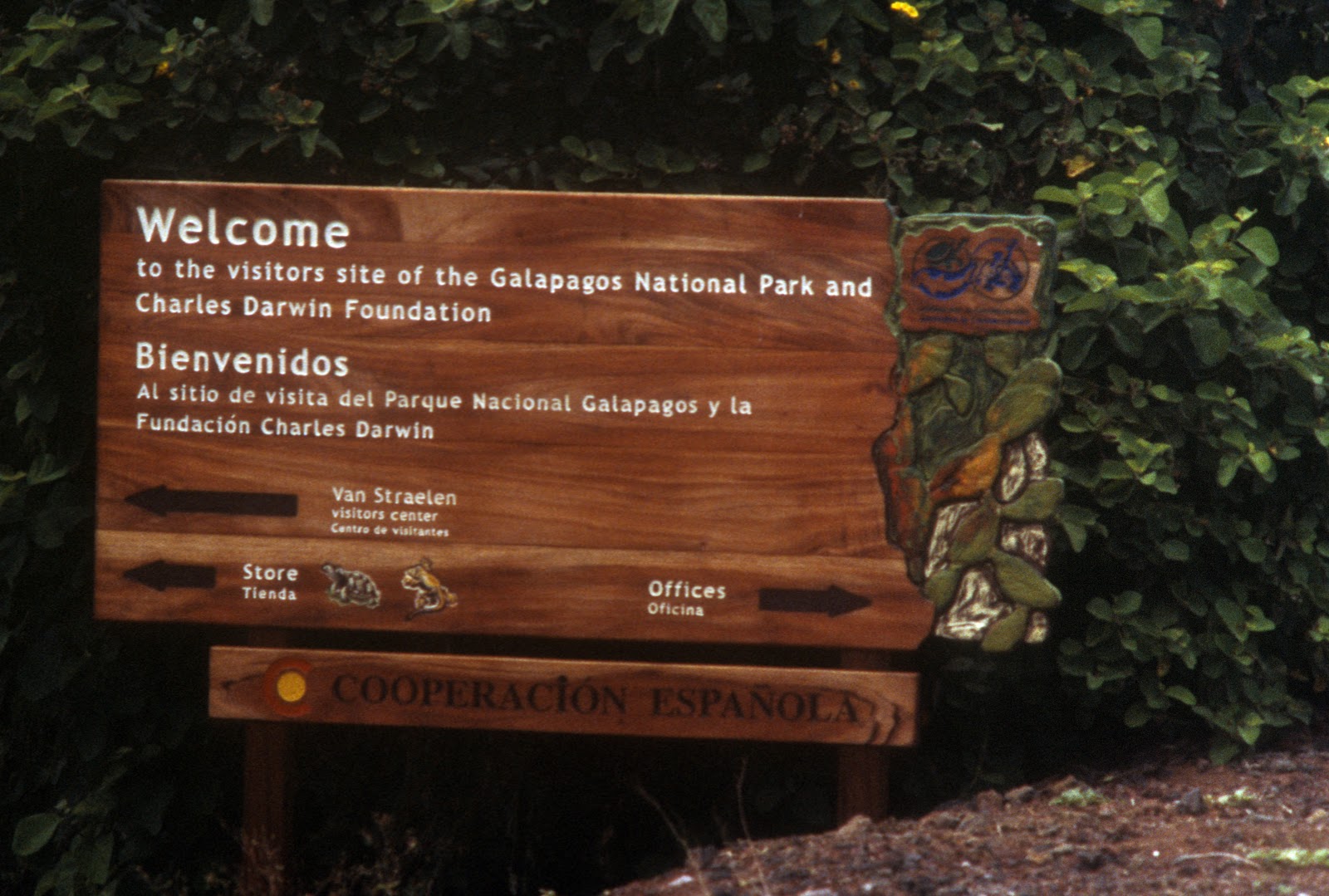
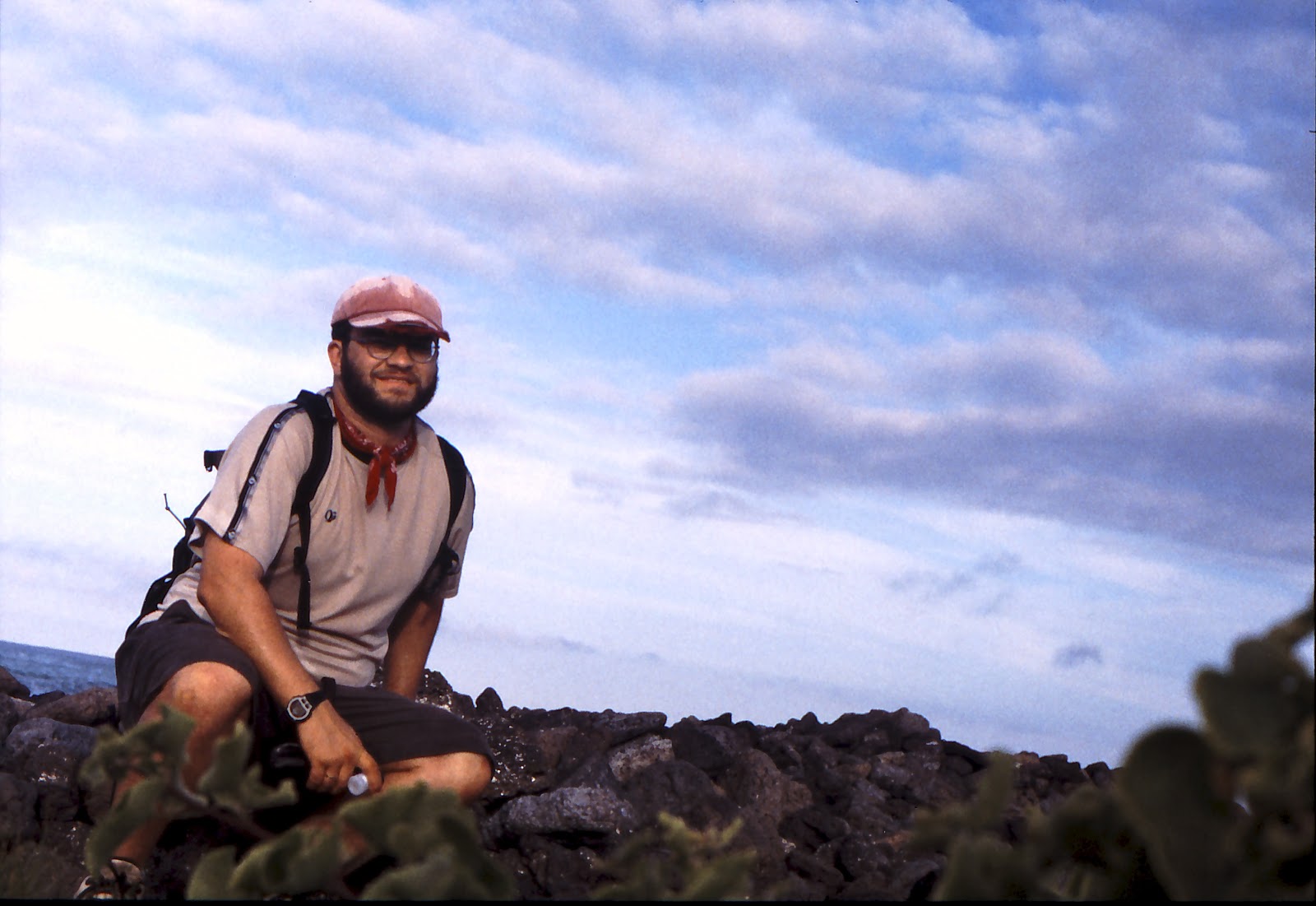
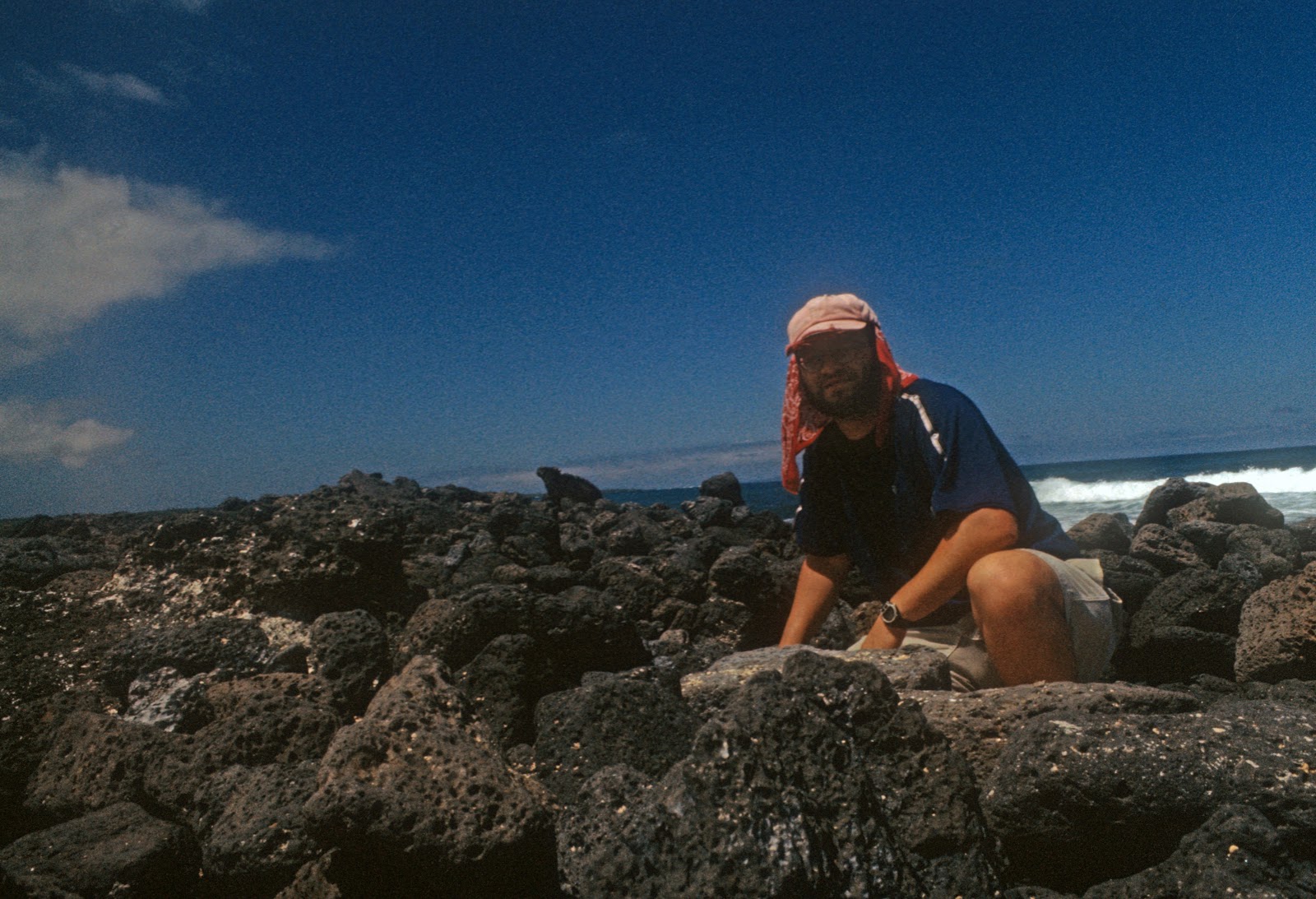
Me, in the Galapagos in 2002

Me in the Galapagos in 2002

CSIS STS co-sponsored talk (Tues, Feb 26, 4:10-6pm): John Muir: the Writer, Scientist and Public Figure

Forwarding this

Hi folks,

The program in STS is co-sponsoring a talk by Kim Stanley Robinson on the life and work of John Muir, with faculty responses from our very own Mario Biagioli, Joe Dumit and Roberta Millstein, along with Mike Ziser (English). Please see attached flyer for details about the talk and the speaker.

Title: John Muir: the Writer, Scientist and Public Figure
When: Tuesday, February 26, 2013 from 4:10-6pm
Where: Buehler Alumni & Visiters Center, Alpha Gamma Rho Hall (Room 138), UC Davis (see map)

Event Description:

In this talk, the noted local science fiction writer Kim Stanley Robinson will discuss John Muir as a writer and public figure, while sharing John Muir’s personal story. Robinson will analyze Muir’s work as a writer and how he managed to translate that career into such astonishing feats of public policy. Following the talk, several campus faculty will respond offering their perspectives on John Muir’s writing and aspects of his career. Audience participation will be invited in the concluding discussion on how we might learn from John Muir’s example to take effective environmental action in the present. The talk is co-sponsored by: the John Muir Institute of the Environment; Science & Technology Studies; and the "Environments & Societies: History, Literature, and Justice" Mellon Research Initiative. Refreshments will be served.

Speaker bio:

Californian science fiction writer and long-time Davis resident, Kim Stanley Robinson’s Mars trilogy is translated into 23 languages. He is a winner of the Hugo, Nebula, and Locus awards and was named a “Hero of the Environment” by Time magazine in 2008. He is associated with the Sequoia Parks Foundation’s Artists in the Back Country program, the Sierra Nevada Research Institute (UC Merced), and the Sierra Press.

Kim Stanley Robinson on John Muir Feb26.pdf

A day to think, to pause, to ponder

Today is not an easy day for me.

I pause today to think about a person in my life.  A person who was dedicated to science and discovery and improving the human condition.  A person who was idealistic and sensitive and also had some mental health issues.  A person who was pushed over the edge by an overly aggressive, misguided investigation.  A person who became lost in some sort of downward spiral triggered by this investigation.  A person who then took their own life and in one moment created a catastrophic ripple in the world around them.

This person was not Aaron Swartz, though I am thinking of him today too. The person I refer to was my father.  On this day, February 7, 1987, my father Howard J. Eisen took his own life.  I was a freshman in college then.  Enjoying life on my own at Harvard.  Exploring the world of new friends, academic pursuits, and the usual college antics.  And then it all exploded.  The details are a bit of a blur and most are not really important for what I write about here.  But suffice it to say I was devastated.

I flew home to Maryland with my brother and slowly the details emerged.  My father was a researcher at the NIH.  A paper was being prepared for publication by a post doc who worked for a colleague / boss of my father and who my father also worked with.  My father was apparently asked to look at the paper and some “discrepancies” were noted and my father helped launch an investigation into the work.  The NIH panel that was brought in to investigate the work of this post doc was very aggressive – very unpleasant – and even though no accusations of wrong doing were made against my father – the style and tone of the investigation pushed him over the edge.  And he could not dig himself out.  Some people knew he was having trouble with the whole incident but others (e.g., myself) were not in the loop at all.  I knew nothing.  Perhaps people thought I had enough going on as a freshman in college or perhaps it just never came up.  But all I knew was discovered after finding out my father had died, by taking his own life, on February 7, 1987.

Losing my father at the age of 18 was devastating.  Still is.  The fact that he killed himself made it even worse of course.  There were even news stories for a while about it – in the Washington Post, and New York Times, and the Associated Press and Nature and such.  Some of the stories helped in a way because they did not accuse my father of any wrong doing.  For example the Washington Post reported

“Dr. Howard J. Eisen, a respected scientist at the National Institutes of Health, committed suicide at his Bethesda home last week while under pressure from an investigation he helped initiate of alleged scientific fraud by a coworker. 

The suicide has shocked the NIH community and outraged some scientists there, who think that the stress of the investigation triggered Eisen’s death. They view it as a case of the system making a responsible scientist suffer even though he acted aggressively to uncover possible dishonesty in his laboratory. Eisen’s friends and family acknowledged that his personality-he was intensely idealistic and unusually sensitive-made him vulnerable.”

And the Nature article, by Joe Palca, reported “NIH made no allegations against Eisen.” Did these make me feel better?  I suppose.  But of course, not really.  Suicide is brutal for those left behind (and I am sure for those who commit it).  I have never recovered.  But I note – the life and death of my father, and the story of the investigation, have shaped my life.  It is why, when I went to graduate school, my #1 criterion for choosing a PhD advisor was that they were a good, kind person.  After struggling with some of the people I worked with I found such a person in Phil Hanawalt and, really, never wanted to leave his lab.  I see so many examples of scientists and MDs and administrators abusing their positions of power and finding someone who does not do any such things can sometimes be a challenge.

The story behind my father’s death is also why, a few years ago, when I realized my father’s publications were not freely and openly available that I got so angry.  My father had, in a way, died over his research.  And for it to not be available pained me to no end.  When David Dobbs wrote a story about my quest to Free my Father’s publications I felt some peace that I had done something in his name.  And when I finally made them all available a week later, I was truly happy.

The story behind my father’s death is also why, when people have pointed out to me that I have been a bit over the top in critiquing others, that I back off.  And I have tried to get others on the web and in my arena to be much more careful about avoiding personal attacks (e.g, see here).

I also note that the story behind my father’s death is why the death of Aaron Swartz hit home so hard to me.  I knew Aaron a tiny bit (having met a SciFoo many years ago) but not in any deep way.  I read the stories about his JStor download and even wrote about it a little bit.  But I was not aware of the demented, aggressive prosecution of him and when I read about his death I was devastated.  The story reminded me a great deal of my father.  I wrote about Swartz and about the follow up PDFTribute movement (here and here) but it felt a bit awkward since I did not know quite how to discuss my own personal feelings about this story.  So I said nothing.  But now, in tribute to my father, I am trying to not ignore the facts around his death.  They are a part of his life and a part of why I am the way I am.  So I write this post.  And I call for others out there to remember – life is fragile.  Be careful with your words and your actions.  No – one cannot blame everyone – or anyone really – for complex things like suicide.  But we can all do a little bit to improve how we treat others.  And on this day, when I am 44, the same age as my father was when he died, that is what I think about.
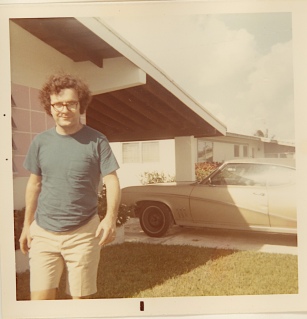
My father, Howard J. Eisen

UPDATE 2/8: See my brother’s nearly simultaneously written post about this topic (which we did not discuss – typical – here).

Storification of responses

Gordon and Betty Moore Foundation hiring fellow for Marine Microbiology program #bioinformatics

Interesting Job Opportunity: Program Fellow, Marine Microbiology Initiative – Gordon and Betty Moore Foundation

See key details of the ad below:

The Bioinformatics Fellow position will be a 1-2 year term. 
The Program Fellow will: 
  • Contribute to developing strategy and implementation plans for the bioinformatics portfolio within the Marine Microbiology Initiative.  The fellow will prepare needs assessment for cyberinfrastruture to support research and discovery by marine microbial ecologists.  The fellow will also coordinate bioinformatics-related activities within MMI. (60% time effort)  
  • Help convene, facilitate and participate in meetings about cyberinfrastructure related to the MMI community to gather and disseminate knowledge, and produce meeting reports or white papers. (30% effort)  
  • Collaborate with MMI Program Officers on grants management related to bioinformatics and data management. (10% effort)  

Key Responsibilities  
The Program Fellow will: 
  • Help develop a strategy and the implementation plans for cyberinfrastructures related to MMI activities. 
  • Communicate with the research community, other funders, commercial vendors, and others to prepare a needs analysis for cyberinfrastructure that includes a description of ongoing or past activities and existing infrastructure. 
  • Convene meetings and workshops in cooperation with grantees and other funders as necessary. 
  • Maintain solid knowledge of the field and key emerging trends.  
  • Contribute effectively on a variety of Program- and Foundation-wide issues beyond the Initiative as required. 
Experience and Education  
The candidate will have: 
  • A Doctorate degree in environmental microbiology, bioinformatics, biology or other relevant field.   
  • Demonstrated knowledge and/or experience with computing environments and sequencing technologies.   
  • Demonstrated experience with using bioinformatics tools.   
Competencies and Attributes  
The ideal candidate also will have:  
  • Good communications skills including demonstrated writing skills.  
  • Demonstrated knowledge of the bioinformatics community and/or existing cyberinfrastructure that supports environmental science.    
  • A desire to promote and work on a complex partnership and multi-stakeholder project to achieve tangible outcomes.  
  • Ability to synthesize diverse points of view to develop solutions. 
  • Demonstrated strong teamwork and interpersonal skills, with ability to develop productive relationships with colleagues, grantees, and stakeholders. Collegial and energetic working style.   
  • Demonstrated comfort with and experience in public speaking and meeting organization/facilitation.    
  • Demonstrated ability and openness to quickly adapt and adjust strategy and approach to changing conditions. 
  • Personal motivation to support the Foundation mission and goals.   
  • Ability and interest in traveling to grantee meetings, site visits, and national/international conferences.   

SimplyThick food thickener, necrotizing enterocolitis, and microbiomes

Wow.  I have not heard anything about this issue until this NY Times article: Warning Too Late for Some Babies – NYTimes.com.  The article summarizes some recent FDA and other medical warnings about a product called SimplyThick.  This product has been connected to cases of necrotizing enterocolitis (NEC) in premature infants.  NEC is a horrible horrible ailment with an incredibly high death rate.  I am familiar with NEC mostly because some colleagues at UC Davis are involved in clinical trials to use probiotics and prebiotics as a preventative therapy for NEC (see more on the project here: Premie NEC — Foods For Health Institute and UC Davis Medicine – Helping Premature Infants Thrive).  NEC seems to have some general connection to “microbiome health” although it is not entirely clear (to me at least) whether the connection is correlative or causal in any way.  The NY Times article simple serves to remind me that we seem to know very very little about the connection between diet and general microbe-related health in infants (or for that matter, adults).  We desperately need to accelerate the pace at which we determine / study how foods, food additives, and diet affect our microbial communities …

Lesson of the week from this article is captured in this quote

“You try not to put anything in a baby’s intestine that’s not natural.” If you do, he added, “you’ve got to have a good reason.”

I am not by any means convinced that everything has to be “natural” (I am not sure I even know what that means) but stuffing preemies full with some food thickener simply because it has been marketed to speech pathologists as something to use seems like a pretty bad idea.

Rhodopsins Rhodopsins everywhere …

Was browsing through this paper (largely due to my interest in sequencing genomes of novel organisms): Genome Biology | Abstract | Genome of Acanthamoeba castellanii highlights extensive lateral gene transfer and early evolution of tyrosine kinase signaling.

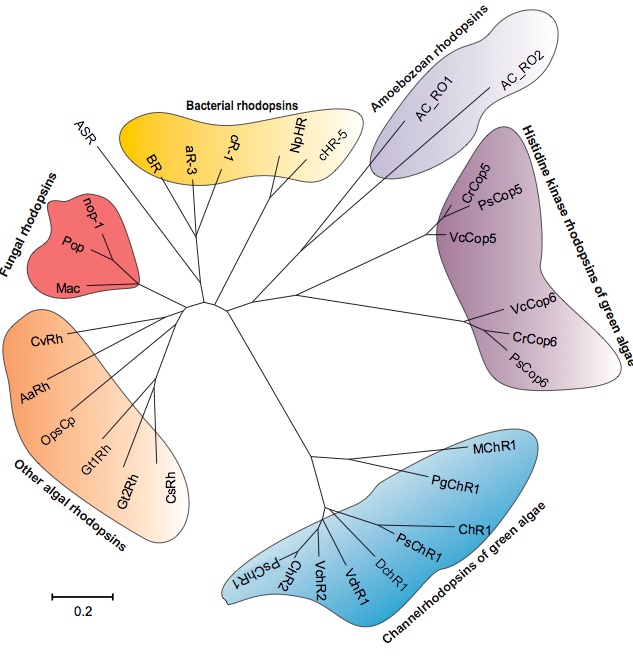
And I found they found something very interesting.  “We identified two rhodopsins both with C-terminal histidine kinase and response regulator domains with homology to the sensory rhodopsins of the green algae that represent candidates for light sensors in Ac (Figure 3).” Seems they found some homologs of the proteorhodopsin / halorhodopsin family of proteins which I have been interested in for years.  Check out Figure 3:

Every couple of months there is a new group of organisms that is found to have a member of this gene family.  See for example: Sequencing of Seven Haloarchaeal Genomes Reveals Patterns of Genomic Flux and Genome sequence of the Antarctic rhodopsins-containing flavobacterium Gillisia limnaea for papers in which I was involved where Rhodopsins were part of the story.  Also see the Venter et al. Sargasso paper: PDF.  Anyway – just a quick post for those out there interested in rhodopsins and the like …