Important read for those interested in gender, family & academia: Do Babies Matter

Just got pointed to this by Julie Huber on Facebook: New book on gender, family and academe shows how kids affect careers in higher education | Inside Higher Ed.  The book is “Do Babies Matter? Gender and Family in the Ivory Tower.”  This looks like a very important book and is especially relevant to me in my role in the UC Davis ADVANCE project where we are working on related issues.  It is from Mary Ann Mason at Berkeley Law School, Nicholas Wolfinger from Utah, and Marc Goulden from the UC Berkeley Office for Faculty Equity and Welfare.  It is definitely worth checking out.

I am ordering it right now …

//ws-na.amazon-adsystem.com/widgets/q?ServiceVersion=20070822&OneJS=1&Operation=GetAdHtml&MarketPlace=US&source=ac&ref=tf_til&ad_type=product_link&tracking_id=thtrofli-20&marketplace=amazon&region=US&placement=0813560802&asins=0813560802&linkId=75TIN64EXB6DWWOT&show_border=true&link_opens_in_new_window=true

Tweets from Nancy Moran’s talk at #UCDavis on "Two sides of symbiosis" storified

I went to a talk yesterday by Nancy Moran at UC Davis.  Nancy is one of my science heroes.  I have worked on a few projects with her and am just a big fan of her body of work on symbioses.  I have written about her work her on this blog many times before including

Anyway – I live tweeted her talk and then tried to “Storify” those tweets but Storify was not working well.  Thankfully  Surya Saha made a storify which I then edited (with his permission).

//platform.twitter.com/widgets.js

#UCDavis Becomes Smoke and Tobacco Free January 1, 2014

Just got this email and thought it would be of interest to some out there:

I am highly skeptical of the CHORUS system proposed by scientific publishers as an end run around PubMed Central

Just read this news story … Scientific Publishers Offer Solution to White House’s Public Access Mandate – ScienceInsider

It reports on an effort by various scientific publishers to create something they call “CHORUS” which stands for “Clearinghouse for the Open Research of the United States.” They claim this will be used to meet the guidelines issued by the White House OSTP for making papers for which the work was supported by federal grants available for free within 12 months of being published.

This appears to be an attempt to kill databases like Pubmed Central which is where such freely available publications now are archived.  I am very skeptical of the claims made by publishers that papers that are supposed to be freely available will in fact be made freely available on their own websites.  Why you may ask am I skeptical of this?  I suggest you read my prior posts on how Nature Publishing Group continuously failed to fulfill their promises to make genome papers freely available on their website.

See for example:

We need to make sure such papers are freely available permanently and the only way to do this is via making them available outside of the publishers own sites.  Pubmed Central seems to be a good solution for this.  I would be happy to hear other possible solutions – but leaving “free” papers under the control of the publishers is a bad idea.

UPDATE 6/27/2013

Saw this Tweet

//platform.twitter.com/widgets.js Seemed potentially really interesting. Read the story and got pointed to a new Nature paper on the ancient horse genome. I guess not so surprisingly, despite the fact that they report a new genome sequence, it is not openly available. We really cannot trust Nature on this can we? They could say “Well, this is a draft genome, and we did not mean to apply our policy to draft genomes.” Well, that would be weird since, well, they have applied this to draft genomes before. And then I decided to search for other examples … and in about ten minutes I found a few. See

//platform.twitter.com/widgets.js

//platform.twitter.com/widgets.js

Learning How to Work Qiime

So we’ve done our data collection, we’ve done more PCR than we could ever imagine, and we finally got our sequences. Now what? We analyze our data using Qiime, a software that will help us see connections between our microbe data. Qiime is useful since it can handle the large amounts of data we’re throwing at it, something most other programs would crash just thinking about. As someone with average knowledge of computers, it’s entirely intimidating learning something based on programming from scratch, but it has also been a great learning experience. Now off to play with terminal and find some meaning in these strings of letters…

Re-reading this on "Why women leave academia and why universities should be worried"

Been reading some somewhat old material out there on women in academia.  I am getting more and more interested in this issue especially as I have become more involved in the UC Davis ADVANCE Program.  The ADVANCE program from the National Science Foundation “aims to increase the participation and advancement of women in academic science and engineering careers.”

I was pointed to this Guardian article from 2012 today based on “The chemistry PhD: the impact on women’s retention”: Why women leave academia and why universities should be worried | Higher Education Network | Guardian Professional.   This Guardian article has a lot of detail and links to other information.  Definitely worth checking out if you had not seen it or forgotten it.

Twisted Tree of Life Award #16: Nature & Authors doing taxonomic alchemy converting an archaeon to a bacterium

Well, this is one of the bigger screw ups in terms of evolution I have seen at a major journal in a while.  See the following paper in Nature: The catalytic mechanism for aerobic formation of methane by bacteria : Nature. The paper discusses some functions of “the ocean-dwelling bacterium Nitrosopumilus maritimus.” Some of what is reported in the paper is perhaps interesting (alas I do not have access).  But painfully, there is one big big big big mistake – you see Nitrosopumilus maritimus is not a bacterium.  It is an archaeon (see for example this paper on its genome).


I got pointed to this by Uri Gophna (in an email and in a comment on my blog)(all see this on Twitter)  Sure – some people debate the structure of the tree of life.  But I am pretty certain the authors here  (Siddhesh S. Kamat, Howard J. Williams, Lawrence J. Dangott, Mrinmoy Chakrabarti & Frank M. Raushel) are not trying to make a statement about monophyly of bacteria or just what archaea are.  They just made what seems to be a colossal screw up.  And Nature not only let them, but added to it with things like their “Editors Summary”:

Novel bacterial biosynthesis of methane
Aerobic marine organisms produce significant quantities of the potent greenhouse gas methane, much of it via the cleavage of the highly unreactive carbon–phosphorus bonds of alkylphosphonates. In this study the authors explore the mechanism of PhnJ, an unusual radical S-adenosyl-L-methionine (SAM) enzyme that appears to use a cysteine-based thiyl radical to help catalyse the conversion of the alkylphosphonate substrate to methane and ribose-1,2-cyclic phosphate-5-phosphate. This reaction, not previously encountered in biological chemistry, establishes a novel mechanism for cleaving carbon–phosphorus bonds to form methane and phosphate via a covalent thiophosphate intermediate.

And for this taxonomic alchemy (converting an archaeon to a bacterium) I am awarding them and Nature my coveted “Twisted Tree of Life Award #16″.

UPDATE 5/28 7AM

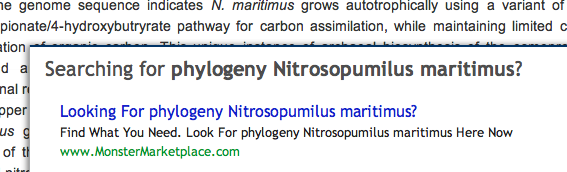
I love the ad that came up while I was writing this post and searching for some information.  I think Nature could use the services from this ad:

I so want a few 1000 of these: Mobile Robotic Laboratory from MBARI

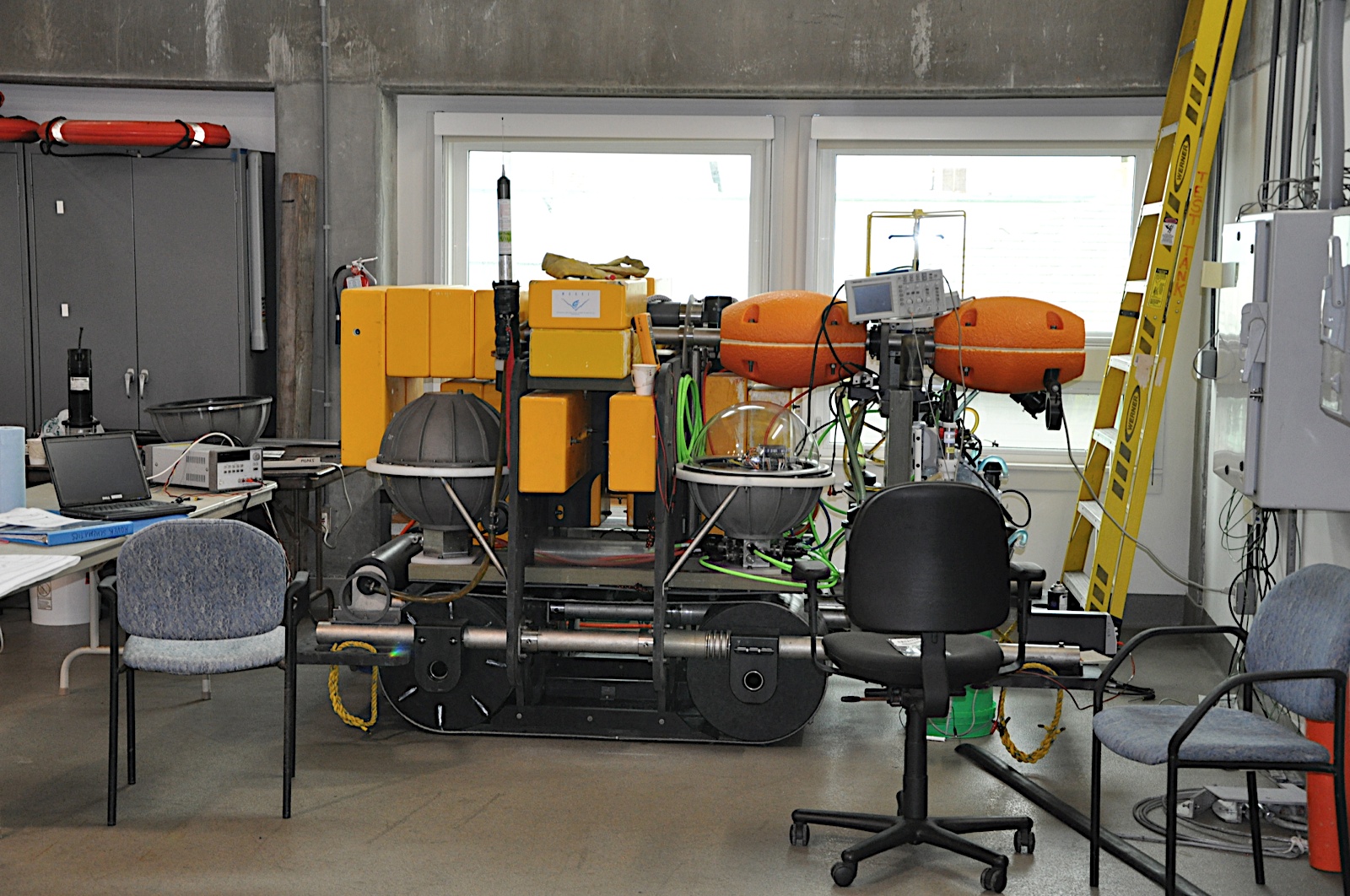
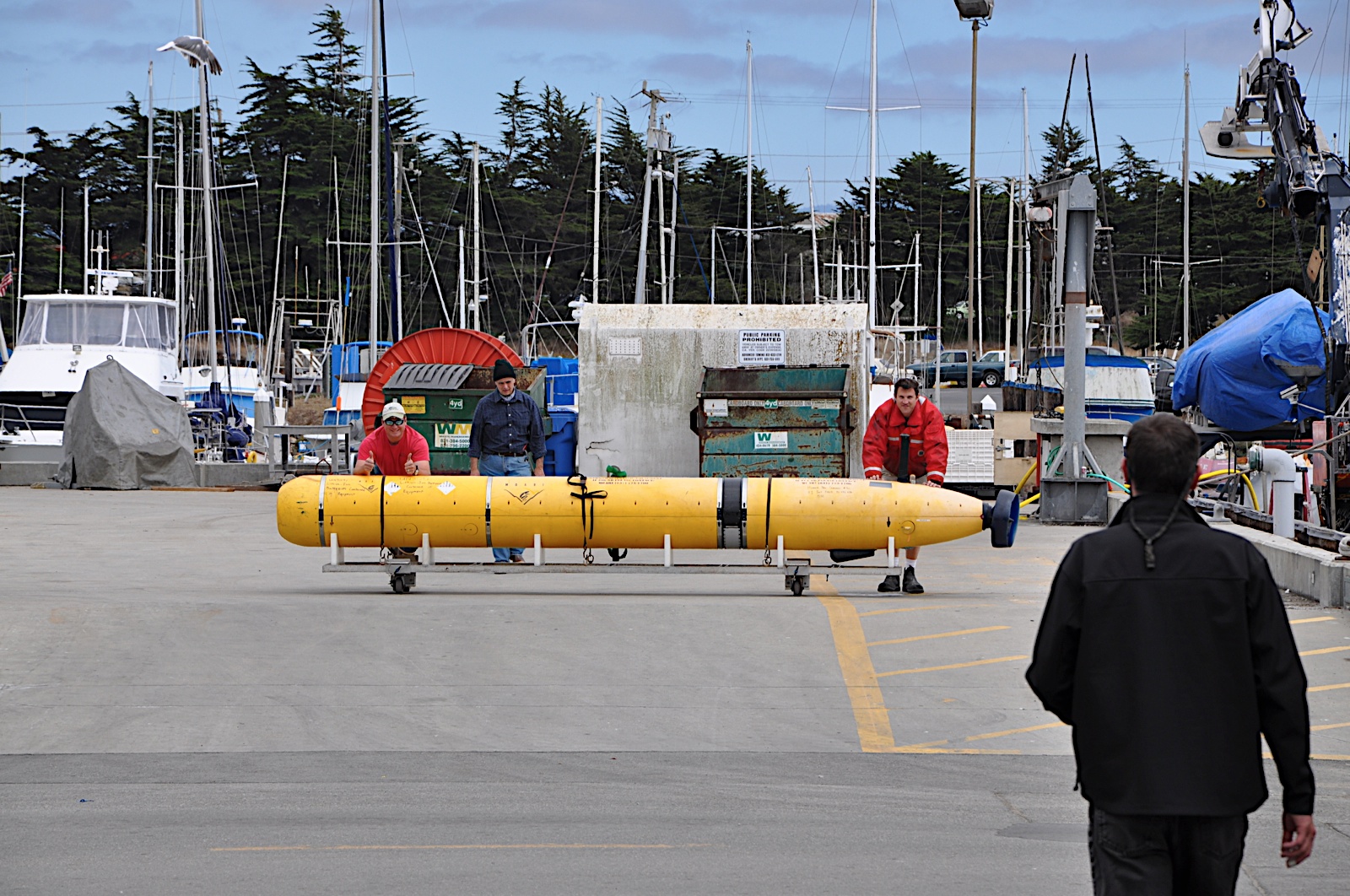
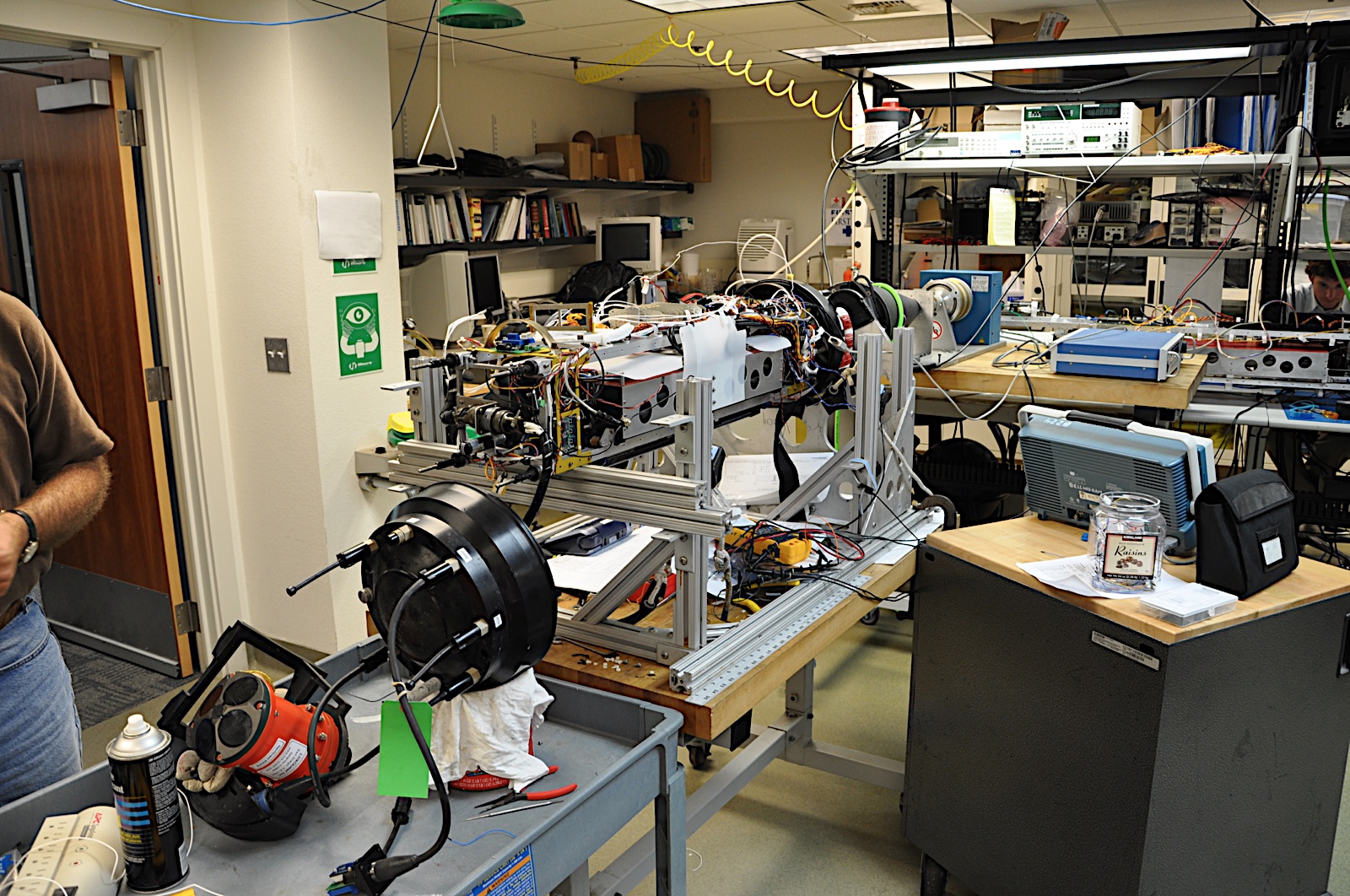
Thanks to Michael Ferrari for pointing me to this:: Mobile Robotic Laboratory Will Track Ocean Toxins – Popular Mechanics.  The article discusses some developments at MBARI for mobile sensor / sampler devices that could be used for various marine microbiology studies.  A few years ago I got a tour of MBARI from Alex Worden (see pics below) and got to see some of their toys but many of the developments in this article are new to me.  I can’t wait until it is possible to deploy a few hundred thousand of these and get massive amounts of data …

ASM2013 – One of the best parts – meeting the "Young Ambassadors"

I attended the American Society for Microbiology (ASM) meeting in Denver last week.  It was a bit overwhelming as usual, with the 1000s of people there.  One surprise for me was an invitation to a after dinner party hosted by Nathan Wolfe and others from Metabiota.  I am not really a big fan of parties (as many who know me know) but this was small and even better it was mostly populated by the recipients of the ASM International Young Ambassador Award winners.  Wolfe was one of the keynote speakers at the ASM Meeting and I think he was hosting this party in part as a reception for the Young Ambassador’s.

For more on the winners see

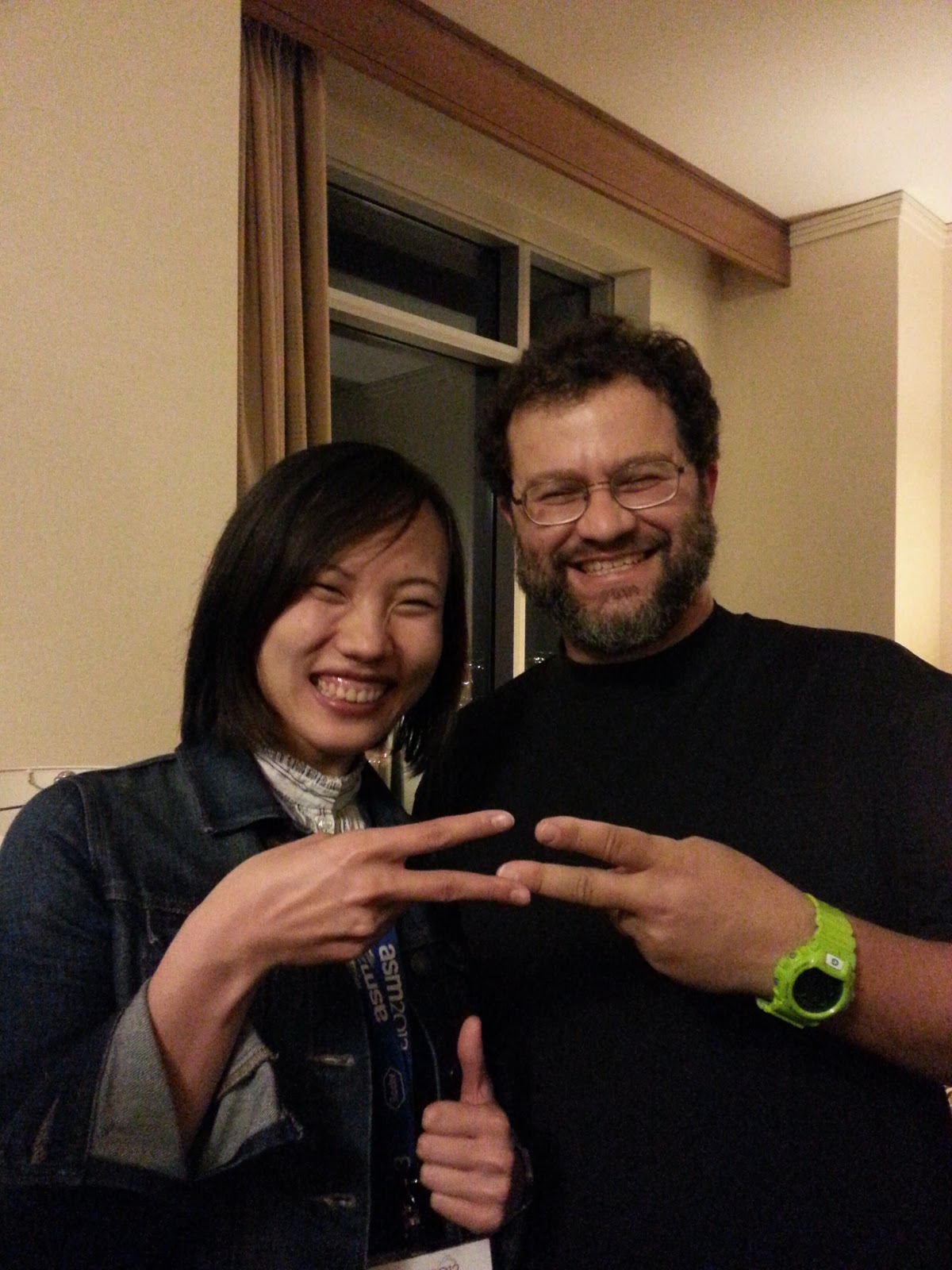
Anyway – it was very interesting to talk to many of them.  And I even got a picture with one of them – Yu Xia from Hong Kong (we were trying to form some sort of Tree of Life with our fingers).
All societies have their good and bad parts.  Sponsoring Young Ambassadors from other countries is definitely one of the very good things ASM does.

Worth a look: PhyloFacts FAT-CAT web server: ortholog identification & function prediction

Quick post.  This seems like a potentially useful resource and tool: The PhyloFacts FAT-CAT web server: ortholog identification and function prediction using fast approximate tree classification

Abstract:
The PhyloFacts ‘Fast Approximate Tree Classification’ (FAT-CAT) web server provides a novel approach to ortholog identification using subtree hidden Markov model-based placement of protein sequences to phylogenomic orthology groups in the PhyloFacts database. Results on a data set of microbial, plant and animal proteins demonstrate FAT-CAT’s high precision at separating orthologs and paralogs and robustness to promiscuous domains. We also present results documenting the precision of ortholog identification based on subtree hidden Markov model scoring. The FAT-CAT phylogenetic placement is used to derive a functional annotation for the query, including confidence scores and drill-down capabilities. PhyloFacts’ broad taxonomic and functional coverage, with >7.3 M proteins from across the Tree of Life, enables FAT-CAT to predict orthologs and assign function for most sequence inputs. Four pipeline parameter presets are provided to handle different sequence types, including partial sequences and proteins containing promiscuous domains; users can also modify individual parameters. PhyloFacts trees matching the query can be viewed interactively online using the PhyloScope Javascript tree viewer and are hyperlinked to various external databases. The FAT-CAT web server is available at http://phylogenomics.berkeley.edu/phylofacts/fatcat/.