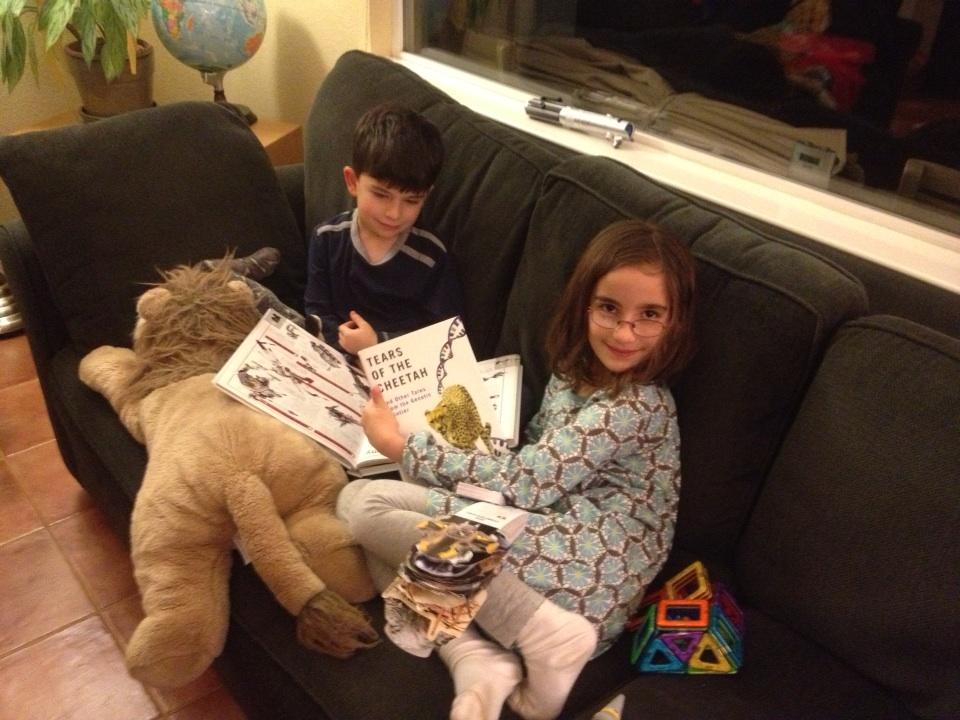
 Stephen O’ Brien talked at UC Davis a few days ago. I met with him in the afternoon before his talk. It was one of the more interesting discussions I have had in a long time. He has done some very interesting and important work (e.g., comparative genomics, HIV, feline evolution) though most of what we talked about was not work per se (e.g., we talked a lot about baseball and big cats since my kids are obsessed with big cats).
Anyway, below is a “Storification” of tweets from his talk. Best part – he signed a copy of his Tears of the Cheetah: The Genetic Secrets of Our Animal Ancestors book with a dedication to my kids.
//storify.com/phylogenomics/steven-j-o-brien-talk-at-ucdavis-on-ccr5-hiv-aids.js?template=slideshow[View the story “Steven J. O’ Brien talk at #UCDavis on CCR5/HIV/AIDS” on Storify]
Steven J. O’ Brien talk at #UCDavis on CCR5/HIV/AIDS
Storified by Jonathan Eisen· Mon, Jan 07 2013 20:12:09
@phylogenomics Wow! Interesting topic. Wish I was attending.Setor Amuzu
As an evolutionary biologist am jealous of name of Obrien’s “Theodosius Dobzhansky Center for Genome Bioinformatics”
http://shar.es/4vIBYJonathan Eisen
SJ Obrien – head of new Dobzhansky Inst – intro by Harris Lewin, discussing how Dobzhansky finished his career here at #UCDavis:Jonathan Eisen
O’Brien at #UCDavis: Giving props to T. Dobzhansky and his pioneering work on population geneticsJonathan Eisen
O’Brien at #UCDavis: discussing how population genetics help lead to many whole fields/areas incl. conservation genetics, DNA forensics, etcJonathan Eisen
Stephen J. O’Brien: is on Plagues and people Contagion Genomics & Beyond. 3 areas: Gene Discovery, Conservation Genetics, DNA forensicsDawei Lin
O’Brien at #UCDavis: began work on AIDS epidemic partly as model for way to connect human genetics and infectious diseaseJonathan Eisen
O’Brien at #UCDavis: close to 30 million people have died of AIDS and close to 30 million more are infected w/ HIV & disease still spreadingJonathan Eisen
@Curosik don’t think soJonathan Eisen
O’Brien at #UCDavis: heterogeneity in progression in HIV led him to try to use advances in human genetics to look for AIDS restrictive genesJonathan Eisen
SJO: Oct. 1996 AIDS quilt is a symbol of the pandemic disease with 40K Tabard Emblems on that day at the Capitol Hill.Dawei Lin
O’Brien at #UCDavis: early in AIDS epidemic got access to samples from different groups of people to test role of human genes in progressionJonathan Eisen
O’Brien at #UCDavis: looked for genetic variation in AIDS resistance, progression rate, outcomes, response to HAART therapyJonathan Eisen
O’Brien at #UCDavis: in 1996 5 groups discovered that CCR5 (a G coupled seven transmembrane receptor) was target of HIV for cell entryJonathan Eisen
O’Brien at #UCDavis: looked for CCR5 mutations in cohorts of patients w/ HIV & found that homozygous mutations were protectiveJonathan Eisen
SJO: CCR5 is the binding target for HIV. People with CCR5 delta with a 32 peptide deletions do not have HIV infections.Dawei Lin
O’Brien at #UCDavis: those people heterozygous for CCR5 deletions showed slower progression of HIV infectionJonathan Eisen
@Lewis_Lab seems to be relatively old data …Jonathan Eisen
Obrien at #UCDavis: many scientists occasionally like to do more than publish in a good journal, some would like to translate to bedsideJonathan Eisen
SJO: People study genes about infectious diseases should not stop at publishing on a good journal, should bring it to the bedside.Dawei Lin
Obrien at #UCDavis: re: delta32 mutation in CCR5 and modifies Dobzhansky “nothing in medicine makes sense except in light of evolution”Jonathan Eisen
Obrien at #UCDavis: discussing how frequency of CCR5 delta32 mutation has increased rapidly over time; suggest this is due to ++ selectionJonathan Eisen
@phylogenomics I’m not seeing any open access/open data reports.Lewis Lab
Obrien at #UCDavis: 20 mutations in CCR5 have been found outside of delta32 mutation; 18/20 are amino acid changing; suggests ++ selectionJonathan Eisen
SJO: 1/5 people now is CCR5 delta 32 carriers. There are 22 variants. 18 of them changes peptides.Dawei Lin
Obrien at #UCDavis: Suggests something influenced CCR5 mutations prior to AIDS epidemic (admits much of his theories on this controversial)Jonathan Eisen
O’Brien at #UCDavis: suggests that bubonic plague may have influenced CCCR5 mutation frequencies over timeJonathan Eisen
O’Brien at #UCDavis: discussing plague epidemic in 1665 and 1666 (reading from his book)Jonathan Eisen
@phylogenomics that got me the statistical test I was looking for–thanks. I don’t find the article very intuitive, thoughLewis Lab
O’Brien at #UCDavis: discussing their estimates of the age of the CCR5 delta 32 mutations by looking at the size of the linkage groupJonathan Eisen
O’Brien at #UCDavis: estimates of the date of the origin of the spread of the CCR5 delta 32 mutation is correlated w/ plague epidemicJonathan Eisen
O’Brien at #UCDavis: many many waves of plague epidemics over time (though he notes many other possible epidemics also at same general time)Jonathan Eisen
@phylogenomics thanks. This is a good case study for the stats class.Lewis Lab
“
@phylogenomics O’Brien suggests that bubonic plague may have influenced CCCR5 mutation frequencies” No doubt a 1-2 insC mutation.Donald Atkinson
SJO: Conspiracy theories of black death cause CCR5 mutation hike, which mostly found in Caucasians.Dawei Lin
O’Brien at #UCDavis: refs a 2004 Nature study of mice w/ CCR5 delta 32 homozygous mutation; -/- have 90+% reduction in Y.pestis uptakeJonathan Eisen
O’Brien at #UCDavis: after 9/11 & anthrax attack collaborated w/ people to look at smallpox infection in CCR5 delta 32 mutant cellJonathan Eisen
“The O’Brien at #UCDavis” stream of tweets by
@phylogenomics is fascinating. Must-read for biology folks.Rob Quarles
@phylogenomics What is his book? I show the PBS vid he was in few years ago to my molec epi class each year to discuss CCR5/plague/HIVTara C. Smith
O’Brien at #UCDavis: many other viruses have been screened for whether they make use of CCR5Jonathan Eisen
@phylogenomics thanks for tweets re O’Brien lecture. Say hi to Steve for me!Kathy Belov
Obrien at #UCDavis: delta 32 mutations in CCR5 may lead to higher risk to West Nile virus …Jonathan Eisen
SJO: people with homozygous CCR5 delta mutations are susceptible to West Nile virus, not HIV.Dawei Lin
Obrien at #UCDavis: looking back to 1996 b/c this is when HAART therapy for HIV was startedJonathan Eisen
Obrien at #UCDavis: showing slide from Tony Fauci of FDA Approved antiretroviral drugs; now many new drugs going after CCR5 interactionJonathan Eisen
OBrien at #UCDavis: 2008 Gero Hitter – the doctor for “The Berlin Patient” shows up at AIDS conference; news finally comes out in WSJ 2008Jonathan Eisen
Obrien at #UCDavis: says the story of the Berlin patient is an anecdote; emphasizes it is one patient; need more information / data / casesJonathan Eisen
@KathyBelov will do …Jonathan Eisen
SJO: Patients with bone marrow transplants with CCR5 negative genotypes remain HIV free without drug treatments. A potential breakthrough.Dawei Lin
Obrien at #UCDavis: OBrien ends his talk by thanking the patients who have provided samples cc: @rebeccasklootJonathan Eisen
Question at Obrien talk at #UCDavis: is CCR5 delta 32 the only restriction mutation? Obrien says yes but not yet translated to bedsideJonathan Eisen
Comment at talk by Obrien at #UCDavis: primate center at UCDavis played a major role in work on HIVJonathan Eisen
Comment at Obrien talk at #UCDavis: says to students in crowd that you have heard a talk about thinking which most people don’t do anymoreJonathan Eisen
@phylogenomics Nice. He definitely saw importance of donor appreciation/respect differently than most in the early days.Rebecca Skloot
@phylogenomics I wanna know what happened to his amazing frozen zoo at NCI! Hope he took it w/him; he worried re who would take care of itRebecca Skloot
@RebeccaSkloot he did not discuss this …Jonathan Eisen
Love
@phylogenomics tweets on O’Brien’s talk at #UCDavis. Everything he said on CCR5/HIV/Berlin pt is right up my alley.Nathalia Holt
@phylogenomics How do the cats get along with all the microbes?Cindy Manson

 Stephen O’ Brien talked at UC Davis a few days ago. I met with him in the afternoon before his talk. It was one of the more interesting discussions I have had in a long time. He has done some very interesting and important work (e.g., comparative genomics, HIV, feline evolution) though most of what we talked about was not work per se (e.g., we talked a lot about baseball and big cats since my kids are obsessed with big cats).