Eisen Lab Blog

Something rotten in the Scholarly Kitchen? (Climate Change Denialism is Everywhere)

I never not previously paid much attention to the “Scholarly Kitchen” site before.  Every once in a while I have noticed their posts and usually have found them off in some way.  But then my brother Michael decided to respond to a recent posting from someone named Kent Anderson there.

I wrote about this briefly here: Trolls and flames discuss #NotSoFunny satire at the Scholarly Kitchen.

And the twitter had quite a bit too.  So, of course, I made a “Storification” of this:

http://storify.com/phylogenomics/scholarly-kitchen-rwa-parody-dissected.js[<a href=”http://storify.com/phylogenomics/scholarly-kitchen-rwa-parody-dissected” target=”_blank”>View the story “Scholarly Kitchen RWA \”Parody\” Dissected” on Storify</a>]

But that is not what I am here to discuss.  What I am here to discuss is something that I discovered from a tweet of my brother’s.

//platform.twitter.com/widgets.js
And I clicked on the link but the details were not there.  So I sniffed around a bit and did some googling (I could have just called my brother I guess …).

And I discovered that one of the contributors to the Scholarly Kitchen David Wojick does indeed appear to be a pretty extreme climate change denialist.  Some information reported to be about him and his anti-climate-change ways can be found at these sites

Apparently Wojick has been affiliated with places like the Heartland Institute (see more on them here) and the Greening Earth Society which are relatively notorious in their “climate change is not happening” points of view.

Sniffing around the web I found some publications which appear to be by him that certainly are, well, extreme:

Not sure what this means exactly about the Scholarly Kitchen site but it smells a bit like their power went out and stuff is rotting in their fridge.

Cool paper from DerisiLab on viruses in unknown tropical febrile illnesses #metagenomics #viroarray

Quick post:

Figure 3. Circovirus-like
NI sequence coverage and phylogeny.

Cool new paper from Joe Derisi’s lab: PLoS Neglected Tropical Diseases: Virus Identification in Unknown Tropical Febrile Illness Cases Using Deep Sequencing

Full citation: Yozwiak NL, Skewes-Cox P, Stenglein MD, Balmaseda A, Harris E, et al. (2012) Virus Identification in Unknown Tropical Febrile Illness Cases Using Deep Sequencing. PLoS Negl Trop Dis 6(2): e1485. doi:10.1371/journal.pntd.0001485

They used a combination of a viral microarray and metagenomic sequencing to characterize viruses in various samples from patients with febrile illness.  And they found some semi-novel viruses in the sample.  Definitely worth a look.

Note – here are some other posts of mine about Derisi:

See some follow up discussion on Google+ here.

Trolls and flames discuss #NotSoFunny satire at the Scholarly Kitchen

Bit of a tiff going on over at the Scholarly Kitchen over a “satire” someone named Ken Anderson wrote related to the Research Works Act. The piece was about the “Restaurant Works Act” — Someone pointed me to the post and I found the satire to be, well, unfunny so I chose to ignore it. My brother alas could not ignore it, nor could some others and there is some discussion going on there now.

I will skip commenting on the discussion itself – go read it. But a few things there annoyed me. One of these is that Anderson has resorted to criticizing the punctuation of some of his critics there. That is pretty lame.  See start of thread below

Alex Merz wrote 

The inappropriateness of the analogy was clear by the end of paragraph 2. For the rest: TL;DR

To which Anderson responded

For those of us not as hip as Alex, TL DR means “too long, didn’t read.” I won’t comment on the inappropriateness of the semicolon in his Urban Dictionaryesque construction. The post is about 850 words, by the way

To which Alex re-responded

It is sad when an overly serious someone attempts a grammar or usage flame, and fails. 

“Too long; didn’t read” is both proper usage and a more effective construction than “too long, didn’t read.” 

Bryan Garner: “Fourth, the semicolon sometimes appears simply to give a weightier pause than a comma would. This use is discretionary. A comma would do, but the writer wants a stronger stop—e.g.: “There is never anything sexy about Lautrec’s art; but there also is never anything deliberately, sarcastically anti-feminist in it.” Aldous Huxley, “Doodles in the Dictionary” (1956), in Aldous Huxley: Selected Essays 198, 206 (1961).” 

Don’t be sad, though. Like you, a lot of smart people don’t know their way around a semicolon. 

If you’re too timid to wade into Fowler, Strunk & White, or Garner, there is help:
http://theoatmeal.com/comics/semicolon


To which Anderson responded

Nice try, but you don’t have any reason to use a semicolon there. In any event, I think you’re just covering up a typo with sophistry, so let’s move on.

To which Merz responded

You attempt a punctuation flame. When your own-goal is pointed out (with reference to authoritative sources) you mumble that your flame was correct (though it wasn’t), and you indicate that we should drop the discussion of punctuation that *you initiated.* 

Do you have *any* idea that makes you look? 

I’m guessing that you don’t: http://en.wikipedia.org/wiki/Dunning–Kruger_effect

and so on …

And before the folks at Scholarly Kitchen accuse me of having no sense of humor about such things – I suggest they look at my history of making fun of EVERYONE in publishing all the time.  The key to me is to be funny first and if you have some political comments you want to make, make them in that context.  I found the cooking / food RWA story to just not be funny so I did not pay any attention to its other messages.  Though clearly those messages bothered some folks, like my brother.

Storification of Fake Science Publishing @fakeelsevier @fakeplos @realelsevier @fakeeisen @closedaccessj

So – I have been enjoying all the Fake Scientific Publishing Posts on Twitter from @fakeelsevier @fakeplos @realelsevier @fakeeisen @closedaccessj and others.  Now I understand why some people think I am behind some of these (e.g., here are some of my Fake Science News posts).  But alas though I WISH I was behind some of these accounts, I am not.  Anyway – I created a storification of the beginning of some of these postings if you want to see some of the origins of the fakery.

http://storify.com/phylogenomics/fake-scientific-publishing.js[<a href=”http://storify.com/phylogenomics/fake-scientific-publishing” target=”_blank”>View the story “Fake Scientific Publishing” on Storify</a>]

Hmm … City of Davis definition of microorganism needs work

From City of Davis Guide to Composting

MICROORGANISM microscopic plants and animals.They exist in soil for the purpose of breaking down organic matter into basic mineral elements.They include bacteria, fungi, actinomycetes, algae, protozoa, yeast, germs, ground pearls, and nematodes.

Gonna have to get them to work on this …

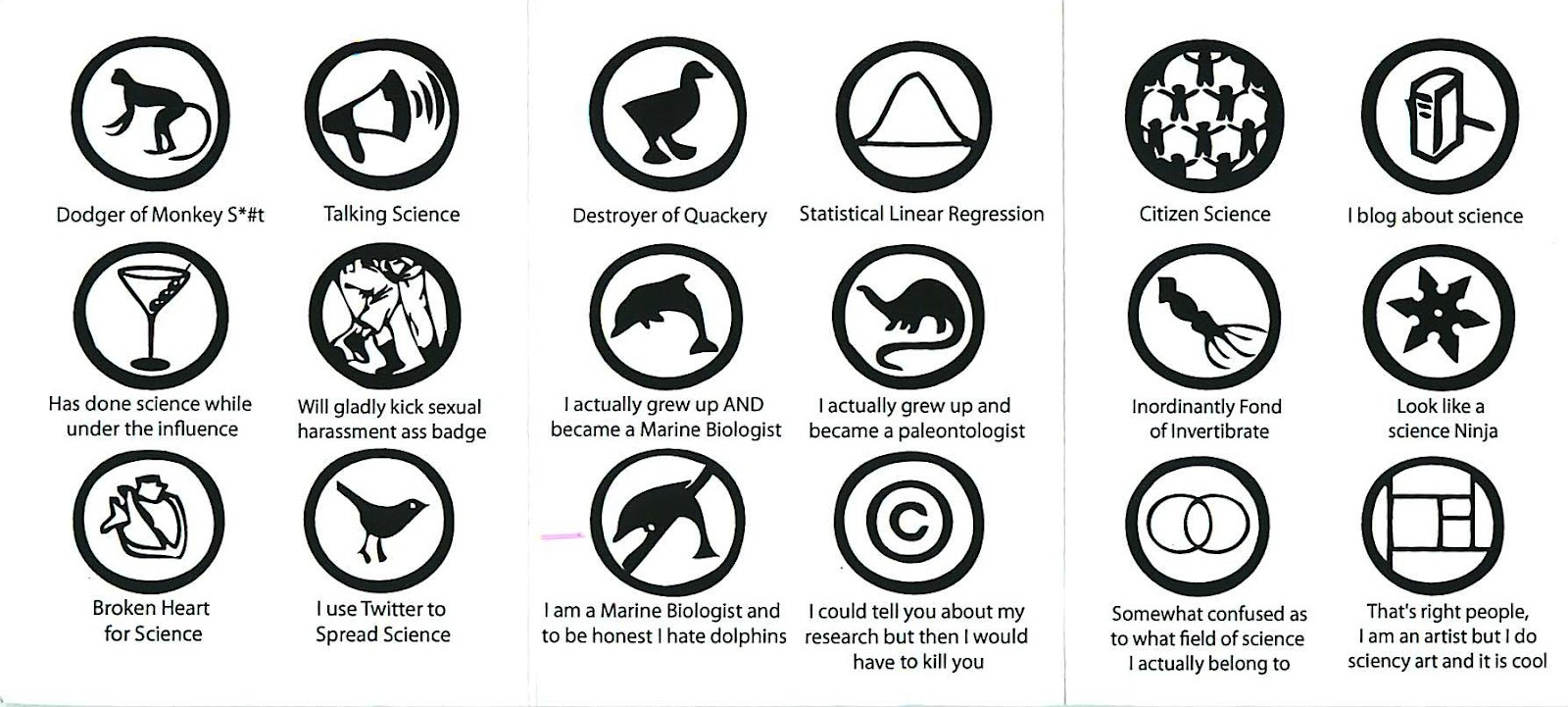
One of the coolest things I discovered at Science Online 2012: Science Scout Stickers #scio12

They were giving some out at Science Online 2012 and I really like them. They had texture and look very cool on my laptop (computer that is). Pondering getting some more. Wondering how I convince them to make some other kinds …
Here are scans of the handout from Science Online 2012

Microbial metaomics discussion group this week: metatranscriptomics and biogeography

A visiting student at my lab Lea Benedicte Skov Hansen will be leading our “metaomics” discussion group this week.  We will be discussing a combination of metatranscriptomics and biogeography and the papers of the week are:

Metatranscriptomics paper:

Microbial community gene expression in ocean surface waters. Frias-Lopez J, Shi Y, Tyson GW, Coleman ML, Schuster SC, Chisholm SW, Delong EF. Proc Natl Acad Sci U S A. 2008 Mar 11;105(10):3805-10. Epub 2008 Mar 3.

Some related papers of potential interest from DeLong

We are also discussing:

Drivers of bacterial beta-diversity depend on spatial scale. Martiny JB, Eisen JA, Penn K, Allison SD, Horner-Devine MC.
Proc Natl Acad Sci U S A. 108(19):7850-4.  (NOTE I am an author on this one – but the meat of the ideas/work was done by Jen Martiny, Claire Horner-Devine and others).

Related papers of possible interest by Jen Martiny and Claire Horner-Divine include:

Will let everyone know how the discussions go.  

Hard to tell if this is a SPAM conference or not "4th Intntl. Science in Society Conference"

Hard to tell if this is email I just got is about a SPAM Conference or not.

Dear Colleague,


On behalf of the Conference Organizing Committee, I would like to inform you of the:


FOURTH INTERNATIONAL CONFERENCE ON SCIENCE IN SOCIETY
University of California, Berkeley, USA
17 – 19 November 2012
http://science-society.com/conference-2012/


This conference addresses the social impacts, values, pedagogies, politics and economics of science. It is an inclusive forum that welcomes a breadth of perspectives on science from practitioners, teachers and researchers representing a wide range of academic disciplines.


The Science in Society Conference is held annually in different locations around the world. The Inaugural Science in Society Conference was held at the University of Cambridge United Kingdom, in 2009. The Conference was held at the Universidad Carlos III de Madrid, Madrid, Spain in 2010; and the Catholic University of America, Washington DC, USA in 2011.


In addition to Plenary Presentations from leading speakers in the field, the Science in Society Conference includes parallel presentations by practitioners, teachers and researchers. We invite you to respond to the conference Call-for-Papers. Presenters submit their written papers for publication in the peer refereed “International Journal of Science in Society”. If you are unable to attend the conference in person, virtual registrations are also available which allow you to submit a paper for refereeing and possible publication in the journal as well as the option of uploading a video presentation to our YouTube channel.


The deadline for the next round in the call for papers (a title and short abstract) is 21 February 2012. Future deadlines will be announced on the conference website after this date. Proposals are reviewed within two weeks of submission. Full details of the conference, including an online proposal submission form, may be found at the conference website: http://science-society.com/conference-2012/ .


We look forward to receiving your proposal and hope you will be able to join us in Berkeley, USA in August.

EVE198 / EVE161 Microbial Phylogenomics Course Spring 2012

Image

EVE 198 – Spring Quarter 2012 – CRN 74485 – 3 units P/NP grading

Microbial Phylogenomics:  The Evolutionary Diversification of Microbes and their Genomes

Professor Jonathan Eisen


TR 1:40-3:00pm

Room 1344 Storer Hall

 Prerequisites for this EVE 198 / Jonathan Eisen course are BIS 2ABC (or its equivalent, for transfer students). (This course is moving through the course approval process, and will eventually be EVE 161!)

New #openaccess paper in G3 from my lab w/ many others on ‘Programmed DNA elimination in Tetrahymena’ #CiliatesRule

A new paper in which the lab was involved has been published recently (just found it though it is not in Pubmed yet): Genome-Scale Analysis of Programmed DNA Elimination Sites in Tetrahymena thermophila.  It was a collaboration between Kathy Collins, multiple Tetrahymena researchers, the Eisen lab, and the UC Davis Genome Center Bioinformatics core (Joseph Fass and Dawei Lin).  The paper is in G3, an open access journal from the Genetics Society. 


This stems from the project I coordinated on the sequencing and analysis of the macronuclear genome of the single-celled ciliate Tetrahymena thermophila.  This organism, like other ciliates, has two nuclei – one called the micronucleus and one called the micronucleus macronucleus.  In essence you can view the micronucleus as the germ line for this single-celled creature and the micronucleus macronucleus is akin to somatic cells.  The micronucleus is reserved mostly for reproduction.  And the micronucleus macronucleus is used for gene expression.  In sexual reproduction, haploid versions of the micronuclear genomes from two lineages merge together just like in sexual reproduction for other eukaryotes.  After sex the offspring then create a macronuclear genome by taking the micronuclear genome and processing it in a variety of ways – going from 5 chromosomes for example to hundreds.  Plus many regions of the micronuclear genome are “spliced” out and never make it into the macronuclear genome.  Our new paper focuses on trying to better characterize which regions of the micronuclear genome get eliminated.


For more on our past work on Tetrhymena genomics see here which includes links to much more information including to my 2006 blog post about our first paper on the project. 


Note – the work in my lab on the sequencing was supported by grants from NSF and NIH-NIGMS.