Well, after breaking the html behind my blog template many times with all sorts of hacked code for widgets and trackers and other things. I have decided to clean up my act. And just revert to a standardized Blogger template for now. If some things are missing, maybe I will revert. The colors I am going to play with – not sure if I want something new or to go back to the old ones. But for now, there will be a bit of a new look here.
Eisen Lab Blog
Open Parkinson’s – need for more progress on Open Access for papers on Parkinson’s
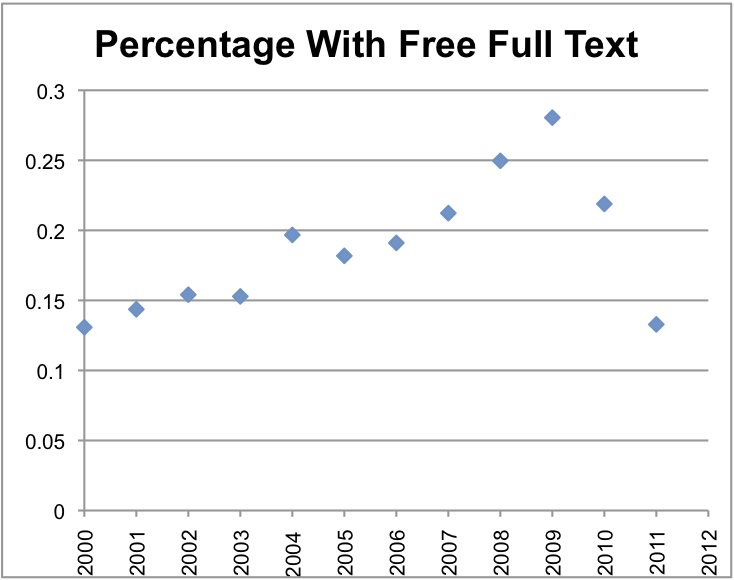
In some ways, there is good news here. The percentage of free text papers goes up over time from 2000-2009. But there is much bad news too. First – even in the best year, more than 70% of papers are not freely available. But perhaps more disconcerting, the percentage of freely available papers drops in 2010 and 2011. Why is this? I think most likely it comes from the delays in deposition to Pubmed Central that happen at many journals. So, it is good that some material gets out there, and apparently a higher fraction is getting out over time. But there is a big delay in the release of much of this material and the max percentage is still low. That is really unfortunate as the best way to catalyze scientific discovery to me is via rapid, open sharing. Imagine, for example, if Twitter posts were only available after 6 months. Useful? I don’t think so. What about weather information? Wait six months for a forecast? Sure, some aspects of scientific research do not need any input from others. But if papers are not important, then, why do we all fuss over them so much? That is because they contain knowledge, techniques, data, ideas, theories, and more. And it would be really better for all if everyone could have access to the full text of all such papers immediately.
Fun with marketing #numerology
Just got an email marketing a new book on numerology. I have a feeling, just a slight one, the marketer does not know much about me. But I thought I would share so everyone can ponder numerology. In order to spare people if they are not interested I have put everything below the “jump break”
Dear Jonathan Eisen:
Glynis McCants has studied Numerology for over 21 years and her accuracy at predicting events has earned her repeat appearances on The Tyra Banks Show, The Today Show, The View and many others. When she does live, quick Numerology readings on air, SHE DOES NOT MISS! In fact, the producers of Jim Carrey’s movie Number 23 hired her as their expert as did the producers of Dancing with the Stars. Upon its release, her latest book Love by the Numbers became the best-selling Numerology book in the country. Love by the Numbers has received rave reviews for its accuracy in helping single people find lasting love, and giving people in a relationship the tools they need to re ignite the passionate love they once had.In a radio interview at the beginning of this year, Glynis said that in the month of August, there would be a lot of political upheaval and serious issues with the economy. The recent downgrade of The United States Credit Rating is a great example of this, and Glynis can give more insights on this subject.
Please read the following press release and let me know if I may book an informative, as well as entertaining interview for you with Glynis McCants. Thank you.
Please view Glynis in television appearances at: http://vids.myspace.com/index.cfm?fuseaction=vids.individual&VideoID=23012149Rick Stevens
Ascot Media Group
Post Office Box 133032
The Woodlands, TX 77393
Office: (281) 333-3507
pr@ascotmediagroup.com
http://www.ascotmedia.comFOR IMMEDIATE RELEASE
Welcome To Glynis McCants’ World – The World Of Accurately Predicting Romantic Love!
San Marino, CA, August 10, 2011 – Glynis McCants is an internationally-known celebrity Numerologist, whose latest book Love by the Numbers (Sourcebooks Publishing), was written for anyone looking for a healthy love relationship, or wanting to improve the one they already have. With a background in comedy, McCants is an in-demand motivational speaker on relationships and in her quick, live on-air readings – she does not miss!
Knowledge is power, and by researching Numerology for over 21 years and using the 2,500 year-old Pythagoras Number System, Glynis tells us that when you have someone’s name and date of birth, you can discover who they really are. Celebrity couples are one of Glynis’ specialties. She predicted that Reese Witherspoon/Ryan Phillippe, Halle Berry/Eric Benet, Ryan Reynolds/Scarlett Johansson’s marriages would not go the distance. Not only did Glynis know Jennifer Lopez was not going to walk down the aisle with Ben Affleck, but she was certain that Jennifer’s marriage with Marc Anthony would be a very difficult one, and that they would not be living “happily ever after.” Glynis makes it clear that Numerology is in everything– people, our home, business, and even the city and state in which we live.
Naming your baby by the Numbers really does make a difference. In the news, Pink, Jewel, Ivanka Trump, Kate Hudson, and Victoria Beckham have all recently given birth, and Glynis teaches that giving the baby the right name can ensure compatibility with child and parents. As your guest, she can explain how that works.
Glynis’ book Love by the Numbers is incredibly accurate, informative and entertaining! For many years, Glynis was a Numerology Counselor who taught others how to find healthy love relationships. One day, after a period of dating disappointments, she realized that she needed to follow her own advice and apply the science to finding her own compatible relationship. She used the power of Numerology to find her husband Charlie. They have been together for nine years, and are still madly in love, and feel as if they are on an extended honeymoon.
While other books make it complicated, the author has defined each number in a simple, understandable process. Its 25 exciting chapters teach readers how to find the Six Numbers that make up their Numerology Blueprint, and how to do a chart comparison. You can also discover what turns your partner on- or- off in love. Love by the Numbers will also show you how to pick the perfect wedding date to avoid a wedding day disaster! There are instances where taking the husband’s surname can actually harm the relationship—this book lets you know if that is the case for you.
Glynis McCants has made repeat TV appearances on The Tyra Banks Show, The Today Show, The Other Half, The Leeza Show, The View and Entertainment Tonight. She was the Numerology expert on Dancing with the Stars and for Jim Carrey’s film, Number 23. Glynis has been featured in top magazines and is a recurring guest on George Noory’s Coast to Coast Radio. She is also heard weekly on The Leeza At Night radio show. Glynis was voted Favorite Guest on PBR for three years running.
Please visit the Glynis McCants website at: http://www.numberslady.com for more information.
###
TIP SHEET:
Olympia Dukakis: “What impresses me most about Glynis is her boundless hope and optimism about the world we live in today. She uses the ancient science of Numerology as her guide, but her insight and wisdom are invaluable. Glynis believes that you can achieve all of your dreams, and by the time you finish reading this book, you will too.”
Leeza Gibbons, Talk Show Host: “I’ve seen Glynis work her Numerology magic dozens of times…always with the same result; empowering people to create the best version of themselves by really knowing and understanding who they are.”
Caroline Rhea: “Glynis knows so much about numbers, she makes the Yellow Pages seem obsolete.”
L.A. Confidential magazine: “To put it simply, if cupid and a clairvoyant were to have an affair, Glynis McCants would very much look like their offspring.”
John Edward, Psychic Medium: “When I think about Numerology I think about two people: Pythagoras and his modern day equivalent, Glynis McCants, The Numbers Lady. Glynis has taken a historic metaphysical science and transformed it into an easy to understand, organized and quite honestly entertaining field of study. To sum it up, she’s GOT your number – now it’s time for you to get it.”
Hydrogen as a fuel? No this is not about cars, this is about animals and their symbionts in the deep sea
As many of you know, I generally avoid writing about non open access publications here. But occasionally I make exceptions. And I am making one today. There is a wicked cool paper out in Nature today. Entitled “Hydrogen is an energy source for hydrothermal vent symbioses” comes from Nicole Dubilier, Jillian Petersen and others. It is about my favorite ecosystem(s) on the planet – hydrothermal vents. I became interested in these vents in 1989 when I met Colleen Cavanaugh who at the time was a Junior Fellow at Harvard. She told me about her work on bacteria that live inside tubeworms, clams and other creatures in the deep sea that are key to the lives of these animals. The bacteria are chemosynthetic (i.e., they use the energy of chemicals to drive carbon fixation). The animals have either no digestive systems or very degenerate ones and the bacteria function much like chloroplasts do for plants. The bacteria basically make everything for their hosts while the hosts collect energy (chemicals in this case) and oxygen and CO2 for the microbes.
After hearing Colleen tell me about her work on these symbioses and how at the time nobody knew much about the symbionts, I joined her new lab at Harvard (she was just appointed as a junior professor) and worked in her lab in my Senior year and after graduating (and ended up publishing my first paper on symbionts of a clam Solemya velum). I have been captivated by symbioses ever since. So much so that many years later I worked with Colleen, Irene Netwon, Tanya Woyke, Dongying Wu and others to sequence and analyze the first genome of any of the chemosynthetic symbiotic bacteria.
Anyway – enough about me. Prior to this new work, all of the symbioses in the deep sea had been found to involve either H2S (or related S compounds) or methane as energy sources. What is completely fascinating about the new work is that they show here that H2 can also serve as an energy source for chemosynthetic symbioses. From the abstract:
The discovery of deep-sea hydrothermal vents in 1977 revolutionized our understanding of the energy sources that fuel primary productivity on Earth. Hydrothermal vent ecosystems are dominated by animals that live in symbiosis with chemosynthetic bacteria. So far, only two energy sources have been shown to power chemosynthetic symbioses: reduced sulphur compounds and methane. Using metagenome sequencing, single-gene fluorescence in situ hybridization, immunohistochemistry, shipboard incubations and in situ mass spectrometry, we show here that the symbionts of the hydrothermal vent mussel Bathymodiolus from the Mid-Atlantic Ridge use hydrogen to power primary production. In addition, we show that the symbionts of Bathymodiolus mussels from Pacific vents have hupL, the key gene for hydrogen oxidation. Furthermore, the symbionts of other vent animals such as the tubeworm Riftia pachyptila and the shrimp Rimicaris exoculata also have hupL. We propose that the ability to use hydrogen as an energy source is widespread in hydrothermal vent symbioses, particularly at sites where hydrogen is abundant.
I am personally hoping that the authors post PDFs of the paper somewhere for everyone to read. I will post a link if they do.
I note – there is also a very accessible News and Views written about this paper. The News and Views is written by Victoria Orphan and Tori Hoehler and is entitled “Hydrogen for dinner.” I particularly like the last paragraph:
Petersen and colleagues’ work exemplifies the technology-driven revolution that is occur- ring in the biological sciences. The continuous development of ever more powerful and spe- cific molecular tools allows taxonomic identity and gene content to be linked to metabolic potential and activity, and to be visualized in context. As these techniques converge with new instrumentation that allows the in situ characterization of physicochemical parameters — even in environments as remote and extreme as hydrothermal vents — biologists are freed from their reliance on model organisms in artificial surroundings. Now, more than ever, our understanding of biology can be placed in the correct environmental and ecological context, enabling the discovery of previously unknown activities that support life.
Petersen JM, Zielinski FU, Pape T, Seifert R, Moraru C, Amann R, Hourdez S, Girguis PR, Wankel SD, Barbe V, Pelletier E, Fink D, Borowski C, Bach W, & Dubilier N (2011). Hydrogen is an energy source for hydrothermal vent symbioses. Nature, 476 (7359), 176-80 PMID: 21833083
Organic farming and antibiotic resistant bacteria:
Uggh: "Barcoding" researchers keep ignoring microbes and history #antimicrobiites #annoying
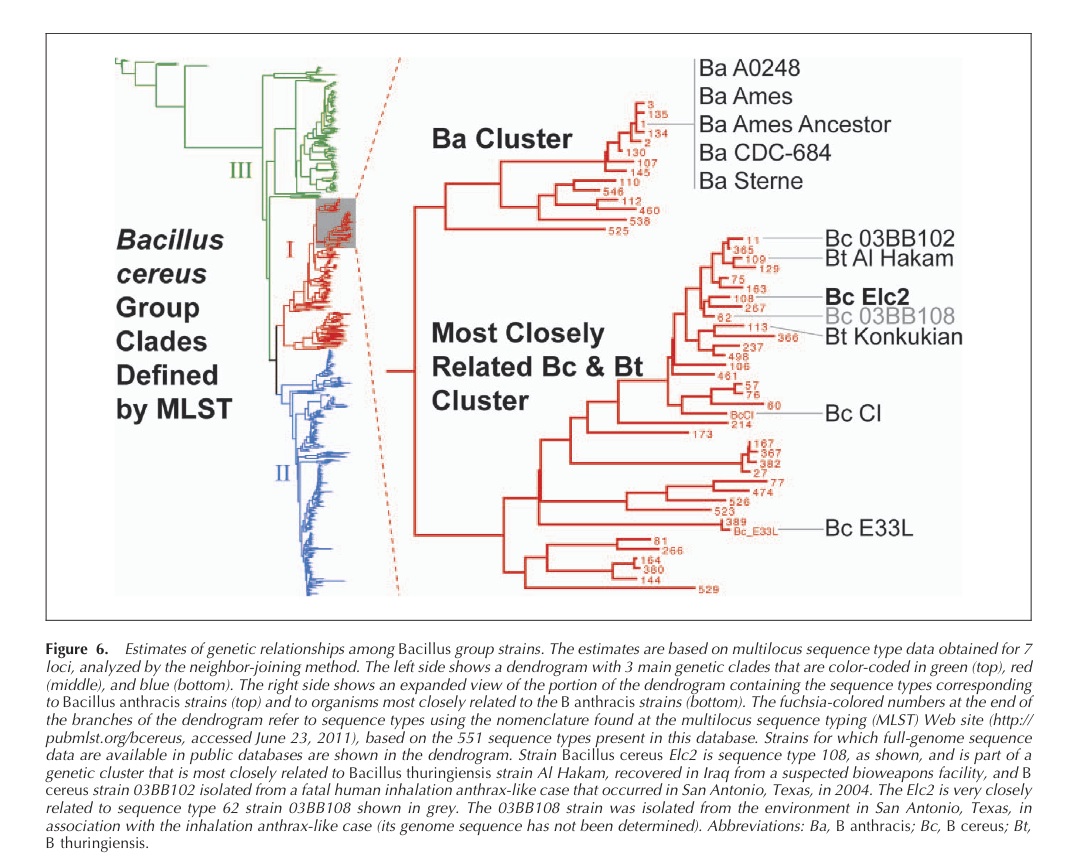
Let’s examine this statement a bit. In the study here the authors did a heroic task – they did barcoding for some 9000 individuals. It is impressive, in many ways. But one can only call it a large molecular survey of biodiversity if one thinks biodiversity = plants and animals. If however you include microbes, as of course you should, then this new study is not even remotely the “largest molecular survey of biodiversity.” In fact, one could argue that 100s if not 1000s of studies of biodiversity of microbes are “larger” in many ways than this study. In microbial studies 9000 “individuals” are characterized routinely in most studies via the use of collecting DNA from environmental samples and sequencing genes from 100s -1000s to even billions of individual cells in a sample. This is done routinely in both metagenomic work (where one collects DNA from the environment and randomly sequences it) or ribosomal RNA PCR surveys where one collects DNA and then sequences rRNA genes from the sample. Overall, hundreds of microbial studies cover more biodiversity than this one – more species – wider phylogenetic diversity – more samples even.
Should these authors here be discussing microbes? I think so. After all, not only would this give their paper historical context. But it would almost certainly give it scientific context and value since there are hundreds of papers on microbes looking at species richness, biodiversity metrics, and such ((a simple pubmed search found 1357 papers using rRNA PCR and diversity as the query, for example). And since the work here is on mitochondrial DNA there may be even more parallels to microbes than one might think at first blush.
Are microbial studies the same as the barcoding studies being done? No. Many barcoding studies have things like individual voucher specimens and museum collections. And microbial studies frequently have mixed samples like soil or water and DNA. So what. The general point of many of these studies is the same – using molecular data to infer information about species richness, beta diversity, phylogenetic patterns, etc. And for this, studies of microbes long preceded the barcoding approach. And there is a lot of useful literature out there as well as tools, methods and concepts. I for one peruse the barcoding papers to see if there is anything useful there for my work. It would almost certainly be good for the barcoding researchers to check out the microbial literature. And if the leaders in the barcoding arena continue to not mention microbes, well that would be unfortunate.
New paper from my lab (& the Facciotti lab): Mauve Assembly Metrics #Halophiles #Genomics
High throughput DNA sequencing technologies have spurred the development of numerous novel methods for genome assembly. With few exceptions, these algorithms are heuristic and require one or more parameters to be manually set by the user. One approach to parameter tuning involves assembling data from an organism with an available high quality reference genome, and measuring assembly accuracy using some metrics. We developed a system to measure assembly quality under several scoring metrics, and to compare assembly quality across a variety of assemblers, sequence data types, and parameter choices. When used in conjunction with training data such as a high quality reference genome and sequence reads from the same organism, our program can be used to manually identify an optimal sequencing and assembly strategy for de novo sequencing of related organisms.
Yet another scammy spammy email from the Beverly Hills Times
I get these types of emails from the “Beverly Hills Times Magazine” every once in a while. They seem spammy or scammy in some way and I thought, rather than suffer alone, maybe I should share. So here goes:
Dear Professor,
The Beverly Hills Times Magazine is considering running an article on experiments proposed at MIT and a few hypotheses. We are seeking background information on the topics related to these experiments and hypotheses. We are asking for your assistance because your extensive expertise has been brought to the attention of the Beverly Hills Times Magazine. The article deals with neuroscience, biophysics, theoretical physics, philosophy, religious studies, ethics, and particle physics.
As background information on the Beverly Hills Times Magazine, my name is Stephen Takowsky, and I am the publisher of Beverly Hills Times Magazine. The Beverly Hills Times is a free magazine that goes to the residences and businesses in Beverly Hills, California. We have several prestigious contributors including: Ralph Nader, Ron Paul, and Dennis Kucinich. We maintain close contacts with other media, and our articles have been featured on several media platforms.
For more information on our magazine, you can view our website at bhtmag.com, or you can Google us by searching for Beverly Hills Times.
Your assistance would be greatly appreciated. Our main goal at this point is to determine whether there is any established scientific evidence that tends either to support or invalidate the hypotheses. We would also consider publishing one of your own articles as trade for your contribution. We are interested in opinions from multiple fields of expertise. If you do not have time please feel free to forward this to a colleague or students that may be interested in providing feedback.
Please let us know. We would greatly appreciate your feedback. If you have any questions, please feel free to contact me.
Here is the url to the hypotheses and experiments: (OfGrandeur.com)
If you are interested, we would appreciate having your comments by September 1, 2011.
Thank you for your time.
Stephen Takowsky
Publisher, Beverly Hills Times Magazine
bhtmag.com
Publisher@bhtmag.com
Others have written about how this seems to be a scam in some way:
Fun with Google Books – Old Books on Bacteria
The Bacteria by Antoine Magnin in 1880
Rare, not rare, rare, not rare (and this is not about burgers, it’s about ocean bacteria)
Nice little press release/story for bacteria and ecology lovers out there: ‘Rare’ bacteria in the ocean ain’t necessarily so, researchers report. This is about work by some colleague of mine including in particular Barbara Campbell at the University of Delaware. I worked with her on a genome project a few years ago (of a bacteria found on the surfaces of some deep sea worms – see Adaptations to submarine hydrothermal environments exemplified ….). Alas, the new paper, in PNAS is not Open Access but the story covers it reasonably well.