Open Parkinson’s – Parkinson’s UK pushing (and funding) openness #brilliant

Just a quick post here on my new theme of Openness in Parkinson’s research in honor of my father in law Carlos Benito who is, unfortunately, dying from this disease.  I did a google search for open access and Parkinson’s to see whether any organizations out there were pushing for more openness.  And the good news is that there are a few.  One I highlight today Parkinson’s UK.  I highlight them because of their position on Open Access publishing: Parkinson’s UK – Open access publishing – (formerly Parkinson’s Disease Society)

From their site:

“We expect authors of research papers to maximise the opportunities to make their results available for free.”

But that is not all – they do offer to help support OA publishing fees on top of the research money they dole out.  Truly putting one’s money where one’s mouth is.


Their full policy can be found here and they summarize the policy in the five following bullet points:

  • We expect authors of research papers to maximise the opportunities to make their results available for free.
  • We require electronic copies of any research papers that have been accepted for publication in a peer-reviewed journal, and are supported in whole or in part by Parkinson’s UK funding, to be made available through PubMed Central (PMC) and UK PubMed Central (UKPMC). This must be as soon as possible and in any event within 6 months of the journal publisher’s official date of final publication.
  • We’ll provide grantholders with additional funding to cover open access charges, where appropriate, (up to 2 years after the end of the grant) in order to meet our requirements.
  • We encourage (and where we pays an open access fee, require) authors and publishers to license research papers such that they may be freely copied and re-used (for example for text and data-mining purposes), provided that such uses are fully attributed.
  • We affirm the principle that it is the intrinsic merit of the work, and not the title of the journal in which an author’s work is published, that should be considered in making funding decisions.

It is really quite awesome actually – they even focus on openness and not just on “no cost” access which many organizations do not seem to understand.  Any and all medical funding organizations that do not have a policy on open access should check out theirs.  Way to go Parkinson’s UK.

Also see:

Single annual cycle for the National Science Foundation’s MCB, DEB and IOS Divisions.

Just received this from NSF and thought it might be of interest to some:

Dear Colleagues:

The Directorate for Biological Sciences (BIO) of the National Science Foundation (NSF) has initiated new procedures for the submission and review of regular research proposals to the core programs within the Division of Molecular and Cellular Biosciences (MCB), Division of Environmental Biology (DEB), and Division of Integrative Organismal Systems (IOS). The changes for MCB were previously announced in a new solicitation (NSF-11-545).

Effective immediately, DEB and IOS will both operate on a single annual cycle of preliminary and full proposals. The initial deadlines for preliminary proposals will be in January, 2012 and the initial deadline for invited full proposals will be in August, 2012. New Solicitations NSF 11-573 (for DEB) and NSF 11-572 (for IOS) provide further details. Also see the Dear Colleague Letter NSF 11-078 and Frequently Asked Questions NSF 11-079 for additional information.

Both DEB and IOS will be hosting webinars to provide further information, please see the Division websites, (DEB) and (IOS), for details and contact information if you have questions or concerns. 

More fun with Mendeley plug ins for reference management #thingsIshouldhaveknownabout

OK – so I am a bit slow. I have been using Mendeley a lot recently. It has all sorts of nice “Social Networking” features for sharing reference lists and publications. I have for example used it as part of my push to free up papers by my father: Freeing my father’s publications part 5: near completion of PDF collection at Mendeley (h/t @David_Dobbs). And I have created some groups on Mendeley for sharing publications relating to various topics in which I am interested including: Microbial Forensics, Microbiology of the Built Environment and Phylogenetic and related analyses of metagenomic data. I have experimented with other online reference management systems like CiteULike, Connotea, Zotero, etc and each have some nice features. I have even written up some more detail on how to use citeulike for one project: Introducing citeulike group on microbiology of the built environment ….

 But it is the more elaborate social networking features that drew me to Mendeley and why I am using it more than the other online system.  And I have focused for example on getting all my personal publication in there to share them with others. And I confess I did not pay attention to many of the other features.

Yesterday however I discovered that Mendeley has plug-ins for generating bibliographies in various word processing programs: Reference Manager | Mendeley. Obviously I probably should have known this. But I have been using EndNote forever and had not experimented with anything new in a while. But I tried out the Mendeley Plugin for MS Word and it is OK. Not perfect. Still needs some work. But it is another factor in why I will likely shift even more to using Mendeley over other system. Still will play with the other ones out there … so if people have comments or suggestions please post.

Plus see below for an example of some of the Mendeley embed widgets one can make

http://www.mendeley.com/profiles/jonathan-eisen/widget/7207/2627036690/e619ef77f9cdf2ab2139da5ecf1c19e9a25e6be7/

http://www.mendeley.com/groups/1147121/_/widget/29/3/

http://www.mendeley.com/groups/844031/_/widget/31/3/

What is in a name? A case study of genomic epidemiology w/ Bacillus cereus and Bacillus anthracis

ResearchBlogging.org There is a very interesting new paper that just came online in the Archives of Pathology: Rapidly Progressive, Fatal, Inhalation Anthrax-Like Infection in a Human: Case Report, Pathogen Genome Sequencing, Pathology, and Coordinated Response

I was alerted to the paper by Eileen Choffnes of the National Academy of Sciences Institute of Medicine Forum on Microbial Threats (which I am a member of).  In the paper, James Musser, Angela Wright and colleagues, the authors discuss the use of genome sequencing in the characterization of a fatal infection with a bacterium that appeared to be a species of Bacillus.  Their summary is below and pretty much sums it up:

Context.—Ten years ago a bioterrorism event involving Bacillus anthracis spores captured the nation’s interest, stimulated extensive new research on this pathogen, and heightened concern about illegitimate release of infectious agents. Sporadic reports have described rare, fulminant, and sometimes fatal cases of pneumonia in humans and nonhuman primates caused by strains of Bacillus cereus, a species closely related to Bacillus anthracis.

Objectives.—To describe and investigate a case of rapidly progressive, fatal, anthrax-like pneumonia and the overwhelming infection caused by a Bacillus species of uncertain provenance in a patient residing in rural Texas.

Design.—We characterized the genome of the causative strain within days of its recovery from antemortem cul- tures using next-generation sequencing and performed immunohistochemistry on tissues obtained at autopsy with antibodies directed against virulence proteins of B. anthracis and B. cereus.

Results.—We discovered that the infection was caused by a previously unknown strain of B. cereus that was closely related to, but genetically distinct from, B. anthracis. The strain contains a plasmid similar to pXO1, a genetic element encoding anthrax toxin and other known virulence factors. Immunohistochemistry demonstrated that several homologs of B. anthracis virulence proteins were made in infected tissues, likely contributing to the patient’s death.

Conclusions.—Rapid genome sequence analysis permit- ted us to genetically define this strain, rule out the like- lihood of bioterrorism, and contribute effectively to the institutional response to this event. Our experience strongly reinforced the critical value of deploying a well- integrated, anatomic, clinical, and genomic strategy to respond rapidly to a potential emerging, infectious threat to public health.

The part in which I am interested, not surprisingly, is the genomic-evolution part.  This is of interest since Bacillus anthracis is in a way a subspecies of a larger clade of bacterial types that includes Bacillus cereus and Bacillus thuringensis.  These two generally do not cause fatal disease in humans, though I believe there are prior cases (see for example, Anthrax, but not Bacillus anthracis?).  Also, I note, B. thuringensis is also known as Bt and is used extensively in agriculture to kill pests.  Anyway, though Bt abd Bc are known to occasionally cause humans trouble, without a doubt, if you say you have found a case of Bacillus anthracis in people, some serious freaking out will occur at some level.  People will want to know things – like is this a natural occurrence or a purposeful attack?  And in the end, there is a lot associated with the name since of course “anthrax” scares people.

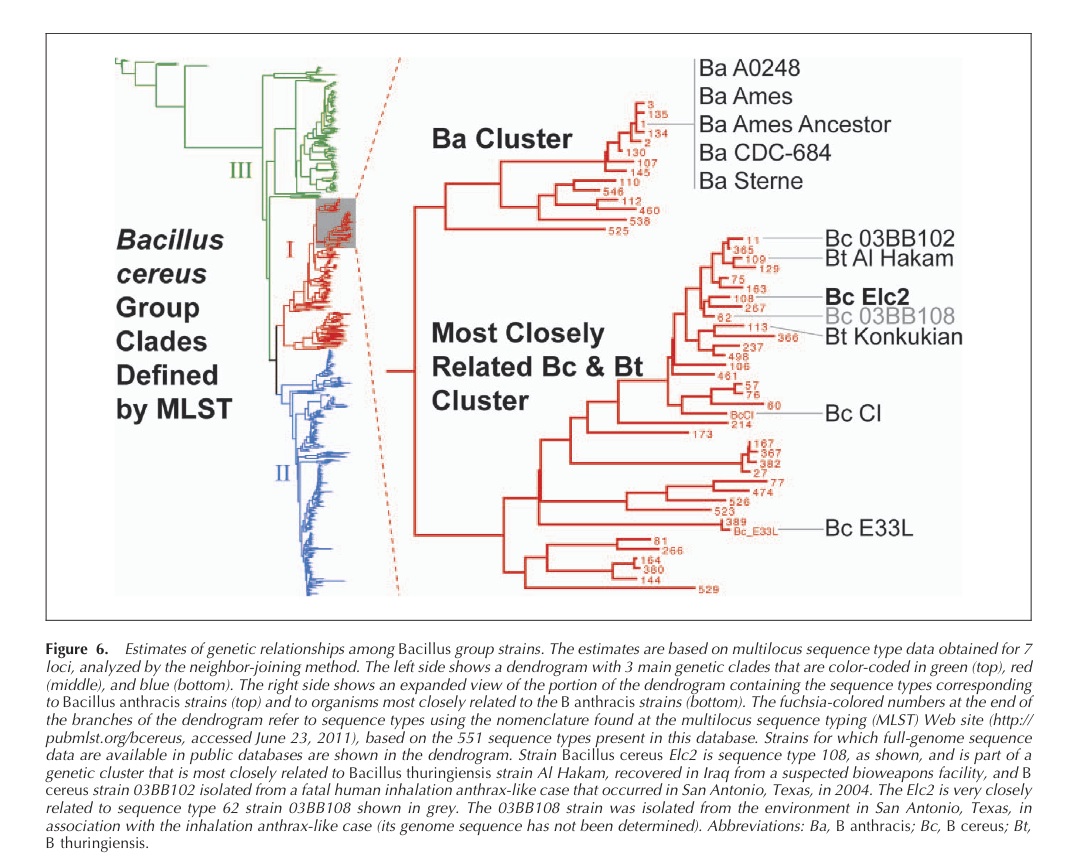
So the authors here basically sequenced the genome of this isolate and then did some detailed phylogenomic analysis to place it in the Bacillus cereus/thuringensis/anthracis group.  See below:

And it turns out, this strain is not in the anthrax portion of the tree.  It is in the Bacillus cereus part.  The key thing here is that this strain is clearly, phylogenetically, in the Bacillus cereus/thuringensis part of this clade.  Not so sure if the genomics was necessary here.  I think some detailed MLST and/or phylogenetics of other variable markers might have done the same trick.  But still, the resolution one gets from the phylogenomics is pretty good.  This is of course nothing really new.  There have been some nice genomic epidemiological studies done in the last year or two such as in the German E. coli and in some other cases (see for example, Prospective Genomic Characterization of the German Enterohemorrhagic Escherichia coli O104:H4 Outbreak by Rapid Next Generation Sequencing Technology and Origins of the E. coli Strain Causing an Outbreak of Hemolytic-Uremic Syndrome in Germany and The 2011 Shiga toxin-producing Escherichia coli O104:H4 German outbreak: a lesson in genomic plasticity and Open-Source Genomic Analysis of Shiga-Toxin-Producing E. coli O104:H4 and Pathogens: Genes and Genomes).
Though this is not per se new, this paper focuses a bit more on the pathology part of the story and even ends by linking to a new paper from one of the authors on how this type of work changes how we should conceive of pathology training: 

One of us recently proposed the inception of a third, training track in pathology termed genomic pathology, designed to complement the traditional anatomic and clinical pathology tracks. As the introgression of genome- scale analyses proceeds rapidly and inexorably into con- temporary patient care and pathology practice, the career opportunities for this new type of trainee will increase considerably, and new patient-care niches will be created. We believe cases such as this highlight the need for, and potential utility of, a cadre of pathologists trained and facile in genomic pathology.

The paper on Genomic Pathology (thank goodness they did not invent a new omics word) can be found here.  There is no doubt we are in a new era.  Genomic sequencing is certainly going to be used in more and more cases like this and we definitely need to change the training paradigm if we want more people to use and understand it.
Some other reading worth checking out:
Some videos of interest

Reference:
Wright AM, Beres SB, Consamus EN, Long SW, Flores AR, Barrios R, Richter GS, Oh SY, Garufi G, Maier H, Drews AL, Stockbauer KE, Cernoch P, Schneewind O, Olsen RJ, & Musser JM (2011). Rapidly Progressive, Fatal, Inhalation Anthraxlike Infection in a Human: Case Report, Pathogen Genome Sequencing, Pathology, and Coordinated Response. Archives of pathology & laboratory medicine PMID: 21827220

Finally updated my blog template after, oh, five years

Well, after breaking the html behind my blog template many times with all sorts of hacked code for widgets and trackers and other things.  I have decided to clean up my act.  And just revert to a standardized Blogger template for now.  If some things are missing, maybe I will revert.  The colors I am going to play with – not sure if I want something new or to go back to the old ones.  But for now, there will be a bit of a new look here.

Hydrogen as a fuel? No this is not about cars, this is about animals and their symbionts in the deep sea

ResearchBlogging.org As many of you know, I generally avoid writing about non open access publications here.  But occasionally I make exceptions.  And I am making one today.  There is a wicked cool paper out in Nature today.  Entitled “Hydrogen is an energy source for hydrothermal vent symbioses” comes from Nicole Dubilier, Jillian Petersen and others.  It is about my favorite ecosystem(s) on the planet – hydrothermal vents.  I became interested in these vents in 1989 when I met Colleen Cavanaugh who at the time was a Junior Fellow at Harvard.  She told me about her work on bacteria that live inside tubeworms, clams and other creatures in the deep sea that are key to the lives of these animals.  The bacteria are chemosynthetic (i.e., they use the energy of chemicals to drive carbon fixation).  The animals have either no digestive systems or very degenerate ones and the bacteria function much like chloroplasts do for plants.  The bacteria basically make everything for their hosts while the hosts collect energy (chemicals in this case) and oxygen and CO2 for the microbes.

After hearing Colleen tell me about her work on these symbioses and how at the time nobody knew much about the symbionts, I joined her new lab at Harvard (she was just appointed as a junior professor) and worked in her lab in my Senior year and after graduating (and ended up publishing my first paper on symbionts of a clam Solemya velum).  I have been captivated by symbioses ever since.  So much so that many years later I worked with Colleen, Irene Netwon, Tanya Woyke, Dongying Wu and others to sequence and analyze the first genome of any of the chemosynthetic symbiotic bacteria.

Anyway – enough about me.  Prior to this new work, all of the symbioses in the deep sea had been found to involve either H2S (or related S compounds) or methane as energy sources.  What is completely fascinating about the new work is that they show here that H2 can also serve as an energy source for chemosynthetic symbioses.  From the abstract:

The discovery of deep-sea hydrothermal vents in 1977 revolutionized our understanding of the energy sources that fuel primary productivity on Earth. Hydrothermal vent ecosystems are dominated by animals that live in symbiosis with chemosynthetic bacteria. So far, only two energy sources have been shown to power chemosynthetic symbioses: reduced sulphur compounds and methane. Using metagenome sequencing, single-gene fluorescence in situ hybridization, immunohistochemistry, shipboard incubations and in situ mass spectrometry, we show here that the symbionts of the hydrothermal vent mussel Bathymodiolus from the Mid-Atlantic Ridge use hydrogen to power primary production. In addition, we show that the symbionts of Bathymodiolus mussels from Pacific vents have hupL, the key gene for hydrogen oxidation. Furthermore, the symbionts of other vent animals such as the tubeworm Riftia pachyptila and the shrimp Rimicaris exoculata also have hupL. We propose that the ability to use hydrogen as an energy source is widespread in hydrothermal vent symbioses, particularly at sites where hydrogen is abundant.

I am personally hoping that the authors post PDFs of the paper somewhere for everyone to read.  I will post a link if they do.

I note – there is also a very accessible News and Views written about this paper.  The News and Views is written by Victoria Orphan and Tori Hoehler and is entitled “Hydrogen for dinner.”  I particularly like the last paragraph:

Petersen and colleagues’ work exemplifies the technology-driven revolution that is occur- ring in the biological sciences. The continuous development of ever more powerful and spe- cific molecular tools allows taxonomic identity and gene content to be linked to metabolic potential and activity, and to be visualized in context. As these techniques converge with new instrumentation that allows the in situ characterization of physicochemical parameters — even in environments as remote and extreme as hydrothermal vents — biologists are freed from their reliance on model organisms in artificial surroundings. Now, more than ever, our understanding of biology can be placed in the correct environmental and ecological context, enabling the discovery of previously unknown activities that support life. 

Petersen JM, Zielinski FU, Pape T, Seifert R, Moraru C, Amann R, Hourdez S, Girguis PR, Wankel SD, Barbe V, Pelletier E, Fink D, Borowski C, Bach W, & Dubilier N (2011). Hydrogen is an energy source for hydrothermal vent symbioses. Nature, 476 (7359), 176-80 PMID: 21833083

New paper from my lab (& the Facciotti lab): Mauve Assembly Metrics #Halophiles #Genomics

Just a quick post here. A new paper from my lab has come out in Bioinformatics. The paper is relatively simple. Titled “Mauve Assembly Metrics” it reports work of Aaron Darling and Andrew Tritt (with some minor contributions from me and Marc Facciotti). Aaron wrote the program Mauve when he was a student in Nicole Perna’s lab at Wisconsin: Mauve: multiple alignment of conserved genomic sequence with rearrangements. Over the years he (and others) have continued to develop the program and written a few papers too including for example, the development of progressiveMauve: multiple genome alignment with gene gain, loss and rearrangement. This new paper reports basically a system/scripts to measure assembly quality. Here is the abstract:

High throughput DNA sequencing technologies have spurred the development of numerous novel methods for genome assembly. With few exceptions, these algorithms are heuristic and require one or more parameters to be manually set by the user. One approach to parameter tuning involves assembling data from an organism with an available high quality reference genome, and measuring assembly accuracy using some metrics. We developed a system to measure assembly quality under several scoring metrics, and to compare assembly quality across a variety of assemblers, sequence data types, and parameter choices. When used in conjunction with training data such as a high quality reference genome and sequence reads from the same organism, our program can be used to manually identify an optimal sequencing and assembly strategy for de novo sequencing of related organisms.

Check out the paper: Mauve Assembly Metrics. Download the scripts/code http://ngopt.googlecode.com and Mauve and play around and let me know what you think.
Note this paper was supported by a grant from the National Science Foundation (ER 0949453). That grant is focused on comparative genomics (sequencing and analysis) of halophlic archaea. Stay tuned for more on that project as we are writing up a series of papers ….
Some related links:

Yet another scammy spammy email from the Beverly Hills Times

I get these types of emails from the “Beverly Hills Times Magazine” every once in a while.  They seem spammy or scammy in some way and I thought, rather than suffer alone, maybe I should share.  So here goes:

Dear Professor,
The Beverly Hills Times Magazine is considering running an article on experiments proposed at MIT and a few hypotheses. We are seeking background information on the topics related to these experiments and hypotheses. We are asking for your assistance because your extensive expertise has been brought to the attention of the Beverly Hills Times Magazine. The article deals with neuroscience, biophysics, theoretical physics, philosophy, religious studies, ethics, and particle physics.
As background information on the Beverly Hills Times Magazine, my name is Stephen Takowsky, and I am the publisher of Beverly Hills Times Magazine. The Beverly Hills Times is a free magazine that goes to the residences and businesses in Beverly Hills, California. We have several prestigious contributors including: Ralph Nader, Ron Paul, and Dennis Kucinich. We maintain close contacts with other media, and our articles have been featured on several media platforms.
For more information on our magazine, you can view our website at bhtmag.com, or you can Google us by searching for Beverly Hills Times.
Your assistance would be greatly appreciated. Our main goal at this point is to determine whether there is any established scientific evidence that tends either to support or invalidate the hypotheses. We would also consider publishing one of your own articles as trade for your contribution. We are interested in opinions from multiple fields of expertise. If you do not have time please feel free to forward this to a colleague or students that may be interested in providing feedback.
Please let us know. We would greatly appreciate your feedback. If you have any questions, please feel free to contact me.
Here is the url to the hypotheses and experiments: (OfGrandeur.com)
If you are interested, we would appreciate having your comments by September 1, 2011.
Thank you for your time.
Stephen Takowsky
Publisher, Beverly Hills Times Magazine
bhtmag.com
Publisher@bhtmag.com

Others have written about how this seems to be a scam in some way:

If anyone knows more detail out there about this “magazine” please post them.  

Fun with Google Books – Old Books on Bacteria

After discovering a copy of this great 100 year old book on “Bacteria in relation to Country Life” on Google Books I decided to snoop around for other old books on bacteria: Microbiology of the Built Environment – as of ~ 100 years ago: Bacteria in relation to country life

The Bacteria by Antoine Magnin in 1880

Lectures on bacteria – Page 1 – by Anton Bary 1887
If you expand the search to “microbes” you get some other interesting ones
I am sure there are many others that are fascinating there. It is always interesting to me to see what people were thinking about in terms of microbes in the past. And Google Books is one heck of a convenient way to do this.

Rare, not rare, rare, not rare (and this is not about burgers, it’s about ocean bacteria)

Nice little press release/story for bacteria and ecology lovers out there: ‘Rare’ bacteria in the ocean ain’t necessarily so, researchers report. This is about work by some colleague of mine including in particular Barbara Campbell at the University of Delaware. I worked with her on a genome project a few years ago (of a bacteria found on the surfaces of some deep sea worms – see Adaptations to submarine hydrothermal environments exemplified ….). Alas, the new paper, in PNAS is not Open Access but the story covers it reasonably well.

Some relevant links: