Important new paper on impact of having women as conveners on gender ratio of speakers

There is an important new paper from Arturo Casadevall and  Jo Handelsman: mBiosphere: Scientific meetings: convening committees with at least one woman boost numbers of women speakers. It was published January 7, 2014 in the open access journal mBio. 

Their abstract

We investigated the hypothesis that the gender of conveners at scientific meetings influenced the gender distribution of invited speakers. Analysis of 460 symposia involving 1,845 speakers in two large meetings sponsored by the American Society for Microbiology revealed that having at least one woman member of the convening team correlated with a significantly higher proportion of invited female speakers and reduced the likelihood of an all-male symposium roster. Our results suggest that inclusion of more women as conveners may increase the proportion of women among invited speakers at scientific meetings. 

IMPORTANCE The proportion of women entering scientific careers has increased substantially, but women remain underrepresented in academic ranks. Participation in meetings as a speaker is a factor of great importance for academic advancement. We found that having a woman as a convener greatly increased women’s participation in symposia, suggesting that one mechanism for achieving gender balance at scientific meetings is to involve more women as conveners.

Basically they conclude that having women serve as conveners for sessions and meetings increases the chance that women will be well represented as speakers.

Much of their key findings are shown in Figure 1

From their paper:  FIG 1  Proportion of women speakers as a function of convener gender composition for the years 2011, 2012, and 2013 at the GM and ICAAC meeting. All comparisons were significant at P < 0.05 by Student’s t test

What to do about this? They have some suggestions at the end of the paper

Whatever the mechanism driving the results, practical actions are suggested by the data. The results suggest that an experiment in which at least one woman is included in every team of conveners might increase the proportional representation of women among the speakers at ASM meetings. An alternative might be to explicitly charge conveners with finding speakers who reflect the diversity of microbiologists. These strategies are worth testing. In the process, we might find that our meetings draw on a fuller arc of talent in microbiology and are enriched by increased gender balance. 

This study suggests a simple mechanism for increasing women’s participation in a critical part of a scientific life. Further research should determine whether discriminatory behaviors contribute to the outcomes and whether the outcomes contribute to the loss of women from academic science.

Some press for this article

Some other things I have written about gender ratio in meetings:

New paper from Eisen lab: Genomic Encyclopedia of Type Strains, Phase I: the one thousand microbial genomes KMG-I project

A new paper of possible interest discussing one of the new phases of the GEBA Genomic Encyclopedia of Bacteria and Archaea project. Genomic Encyclopedia of Type Strains, Phase I: the one thousand microbial genomes KMG-I project | Kyrpides | Standards in Genomic Sciences.


New post on ICIS blog about Google Scholar

I have a new post on the ICIS blog about Google Scholar that may be of interest: ICIS: Innovating Communication in Scholarship – Some additional details of my discussion w/ reporter John Bohannon for his Science story on Google Scholar.  The post gives some detail about the discussions I have with John Bohannon in relation to his story that ran in Science today on Google Scholar.

Some new posts by, well, me, of possible interest

So – I am trying to get some new project specific blogs up and running and have been writing some posts at those sites.  And I thought I would just post a summary here of other posts I have written of possible interest.


Things I don’t understand episode 2000: Why in comparing humans & other animals the null hypothesis people always use (and thus try to disprove) is that humans ≠ animals

Well, this is something I just do not understand.  I am sure others out there have thought about this more than I have.  Just read this article: Considering the Humanity of Nonhumans – NYTimes.com discussing humans vs. non human animals.  And there is this extensive discussion in there about whether animals have self awareness, and whether they deserve legal rights, and such.  All very interesting I think.

But one part I do not understand.  It is very clear that humans and other animals have many homologous features.  It is very clear that humans are more closely related to some animals (e.g., primates) than to others.  For many comparative studies of animals, if one wants to claim that some animal has a feature that is different from it’s close relatives, it is frequently up to the person proposing such a difference to disprove the null hypothesis that the close relatives are the same.  This is the case when studying molecular processes, cell structures, physiology, genome structure, and so on.

Yet, there are a few biological features regarding humans for which it seems the null hypothesis everyone is forced to work with is the reverse.  In these cases the null hypothesis is that we (i.e., humans) are unique and those who wish to claim that humans and other animals are similar / the same have to disprove the null hypothesis.  This seems, well, awkward, at best.  Basically, for some features – especially those that relate to intelligence and behavior  –  if one wants to claim that they are not unique one has to disprove the null.  And yet, for all other features, the null hypothesis is that humans are not unique and those wanting to show uniqueness are forced to disprove this.  On the one hand, I get this.  There are many reasons why one might want to treat “humans are unique” in regards to intelligence and behavior – as the null hypothesis.  But on the other hand – this seems exceptionally anthropocentric and has almost certainly prevented us from discovering and understanding certain behaviors and intelligence-related issues in non human animals.  How do we as a community decided which null hypothesis to use for each phenotype?

Anyway – there it is.  Something I do not understand.

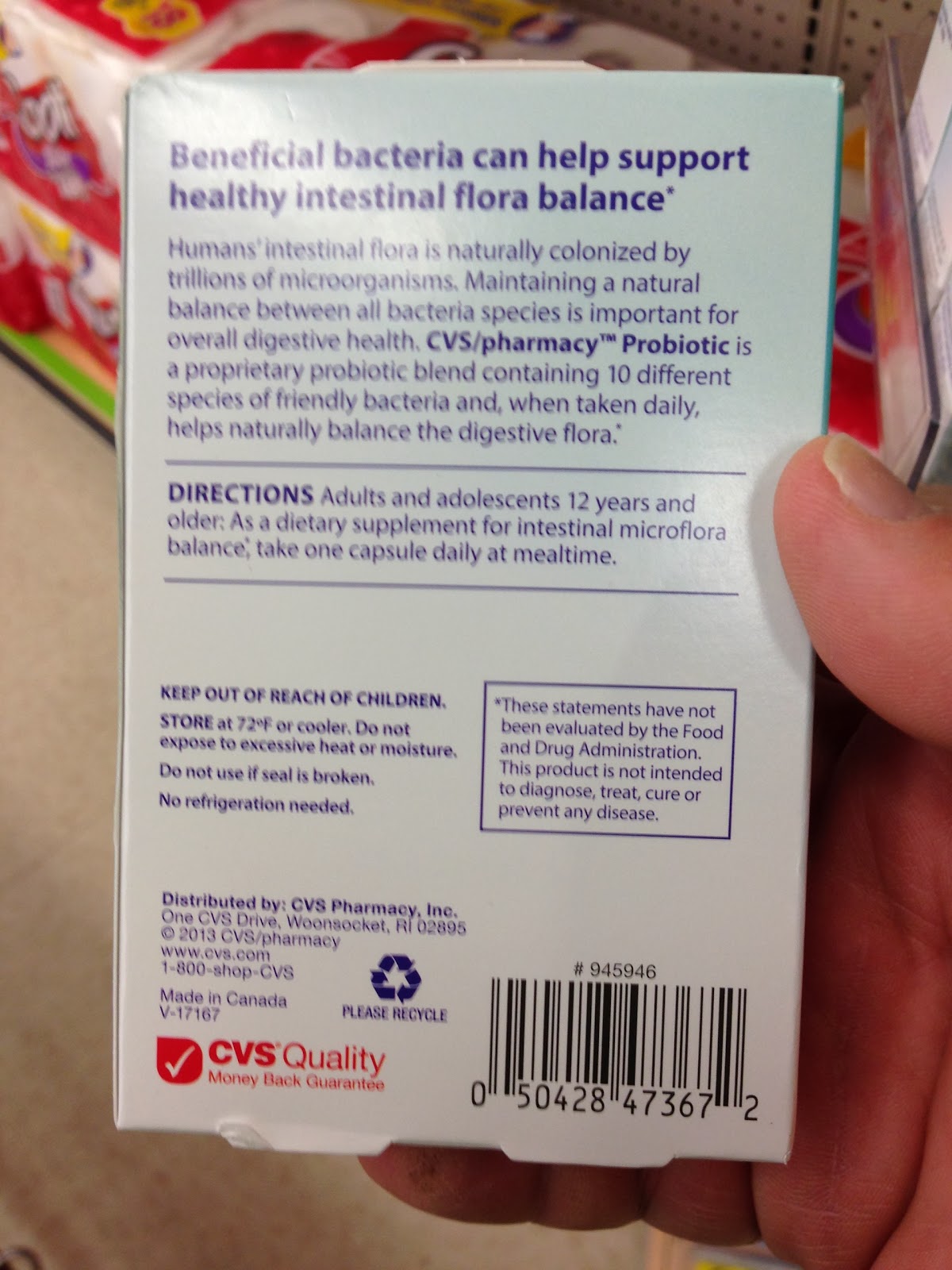
CVS marketing probiotics for everyone – even kids – & the disclaimers are barely visible

Just got back from the CVS drug store in Davis, CA and thought I would share some of the probiotic promotion they are doing.  Not only are the probiotics now right next to the pharmacy counter (moving up in the world I suppose) but the probiotics are being marketed to all sorts of targeted groups.  Alas, the science behind the claims here are dubious.  And – sadly – CVS makes the disclaimer barely visible in many of the signs.

Transitions in the CAMERA metagenomics database —

Just got this email announcement that I thought would be of interest:

Thank you for being a CAMERA user during its first phases of operation as a
resource for environmental genomics. During the past few years, CAMERA has
been able to offer a number of important community resources, including an
exceptionally well curated environmental genomic database, the ability for
researchers to deposit molecular sequence datasets with associated
environmental parameters (metadata), open access to computational resources
to enable metagenomic comparisons, educational resources and helpdesk
services. These efforts have been funded through the Gordon and Betty Moore
Foundation (GBMF) Marine Microbiology Initiative and the National Science
Foundation to serve the needs of the marine microbiology community and
other users.

As we announced earlier this year, CAMERA is undergoing a transition,
shifting from the Testing and Development phase of CAMERA 2.0 into multiple
entities that are supported by federal and foundation-funded projects for
developing and managing databases. Toward this end, we are re-prioritizing
access to the advanced data analysis capabilities of the system (see below)
while maintaining free and open access to CAMERA’s rich collection of
curated data and metadata. This will involve CAMERA being restructured into
a publicly accessible Data Distribution Center consisting of a simplified
website to enable streamlined access for downloading of sequence datasets
and associated metadata. This new interface will serve as an intuitively
accessible central repository, facilitating direct access to genomic,
metagenomic, transcriptomic, and metatransciptomic projects. Further, the
CAMERA 3.0 database will continue to grow and be maintained with the
inclusion of additional marine microbial datasets, such as the ~700 new
marine microbial eukaryote transcriptome datasets as part of the Marine
Microbial Eukaryote Transcriptome Sequencing Project
(marinemicroeukaryotes.org).

In the past, the CAMERA 2.0 compute resources, which include large-scale
BLAST capabilities and other workflow-enabled analysis capabilities, were
generously supported by the GBMF, the San Diego Supercomputer Center, the
NSF XSEDE program, and commercial Cloud computing resource providers,
Amazon and CODONiS. Due to increasing computational costs and the need for
scalability to larger, more complex datasets, it is now necessary for
CAMERA 3.0 to adopt a resource access model wherein projects will need to
identify sources of funding to cover their use of these advanced
capabilities. Starting January 1, 2014, CAMERA 3.0 will no longer offer the
use of computational resources to projects that cannot identify a source of
support for this component of CAMERA 3.0 services. As we shift to this new
usage model, we urge current users to download and save customized data
cart holdings and workflow analysis results before January 1, 2014.

While we are shifting to a restricted resource compute model, we will
continue to improve the capabilities of the system to expand the scientific
breadth of the data managed by CAMERA 3.0. For example, CAMERA 3.0 includes
fully functioning workflows for Illumina datasets, which can be made
available to those users who can identify a source of support for the
associated computational costs. In addition, CAMERA is actively seeking
resources to continue to take community data submissions. If you are now
collecting or have plans to collect data which you wish to deposit in
CAMERA, we urge you to contact us to help you to determine how to obtain
the resources required for these data to be archived and made available
through CAMERA.

Email from #UCDavis on UC #OpenAccess Policy

Just got this email

Just got this email

On behalf of Provost Hexter and Academic Chair Nachtergaele, please find the attached letter regarding the UC Open Access policy. For your convenience and reference, the text of the letter is pasted below.

ACADEMIC SENATE AND ACADEMIC FEDERATION FACULTY

COUNCIL OF DEANS AND VICE CHANCELLORS

DEPARTMENT CHAIRS AND DIRECTORS

Dear Colleagues:

We are pleased to inform you that on July 24, 2013, the Academic Council voted to adopt an Open Access Policy for scholarly articles published by Senate faculty across the University of California system. An article deposit system to support the policy was released, on a pilot basis, at UCLA, UC Irvine and UC San Francisco on November 1, 2013, and will be officially rolled out at the other campuses on November 1, 2014, pending the outcome of the pilot.

The Open Access Policy allows faculty members to maintain legal control over their research articles while making their work much more widely available to the public. The policy does not require faculty to publish in open access journals, or to pay fees or charges to publish; instead it commits faculty to making a version of each article available publicly in an open access repository.

Faculty can take advantage of this right by using UC’s eScholarship digital repository via http://www.escholarship.org/ (or any other open access repository) to make a version of any article publicly and freely available worldwide. While it is expected that faculty at UCLA, UC Irvine and UCSF will make their articles freely available (via eScholarship or another OA Repository) effective immediately, faculty at the other 7 UC campuses are also free to begin depositing their articles now if they wish. Faculty authors may opt out of the policy for any given article, may delay the date of appearance of the article (“embargo” it), and may choose the terms of use that will be applied to each article (for example, whether it is for commercial or non-commercial reuse).

This policy has been under review by the Senate divisions and committees for two years and its implementation is a move of major significance. Policies like this one have been adopted by more than 175 universities but none as large, influential or productive as the University of California. The move signals to publishers that UC faculty want to see open access implemented on their own terms.

The California Digital Library and the campus libraries have developed a streamlined eScholarship deposit system and tools for obtaining waivers and embargoes to assist faculty in complying with the policy. The CDL has also contacted over 600 publishers to alert them to the policy and encourage their cooperation with its terms. Faculty on all campuses may receive questions about compliance from publishers and can consult the resources listed below (including an FAQ) for assistance.

Learn more about your rights and responsibilities under this policy at the UC Open Access Policy website.

http://uc-oa.info

Watch a 90-second video about the policy – and pass it on!

http://osc.universityofcalifornia.edu

Discover how easy it is to deposit your articles in eScholarship.

http://osc.universityofcalifornia.edu/open-access-policy/deposit/

Find out who to contact at your campus library for assistance.

http://osc.universityofcalifornia.edu/open-access-policy/oa-contacts/

Sincerely,

Ralph J. Hexter

Provost and Executive Vice Chancellor

Bruno Nachtergaele

Chair, Davis Division of the Academic Senate

Open Access Policy 11.26.13.pdf

Mini journal club: staged phage attack of a humanizes microbiome of mouse

Doing another mini journal club here.  Just got notified of this paper through some automated Google Scholar searches: Gnotobiotic mouse model of phage–bacterial host dynamics in the human gut

Full citation: Reyes, A., Wu, M., McNulty, N. P., Rohwer, F. L., & Gordon, J. I. (2013). Gnotobiotic mouse model of phage–bacterial host dynamics in the human gut. Proceedings of the National Academy of Sciences, 201319470.

The paper seems pretty fascinating at first glance. Basically they built on the Jeff Gordon germ free mouse model and introduced a defined set of cultured microbes that came from humans.  And then they stages a phage attack on the system and monitored the response of the community to the phage attack.

Figure 1 from Reyes et al.

They (of course) also did a control – in this case with heat killed phage.  And they compared what happened to the live phage.  I love this concept as they are able to control the microbial community and then test dynamics of how specific phage affect that community inside a living host.  Very cool.

Journal club light: skeptical of "Phylo SI: a new genome-wide approach for prokaryotic phylogeny"

Just reading this paper and thought I would start a new “section” here on my blog.  Journal club light.  Just some notes and quick comments.

Today I am selecting this paper: Phylo SI: a new genome-wide approach for prokaryotic phylogeny.  It caught my eye because, well, I am interested in genome-wide phylogeny.

So I glanced at the paper’s abstract:

The evolutionary history of all life forms is usually represented as a vertical tree-like process. In prokaryotes, however, the vertical signal is partly obscured by the massive influence of horizontal gene transfer (HGT). The HGT creates widespread discordance between evolutionary histories of different genes as genomes become mosaics of gene histories. Thus, the Tree of Life (TOL) has been questioned as an appropriate representation of the evolution of prokaryotes. Nevertheless a common hypothesis is that prokaryotic evolution is primarily tree-like, and a routine effort is made to place new isolates in their appropriate location in the TOL. Moreover, it appears desirable to exploit non–tree-like evolutionary processes for the task of microbial classification. In this work, we present a novel technique that builds on the straightforward observation that gene order conservation (‘synteny’) decreases in time as a result of gene mobility. This is particularly true in prokaryotes, mainly due to HGT. Using a ‘synteny index’ (SI) that measures the average synteny between a pair of genomes, we developed the phylogenetic reconstruction tool ‘Phylo SI’. Phylo SI offers several attractive properties such as easy bootstrapping, high sensitivity in cases where phylogenetic signal is weak and computational efficiency. Phylo SI was tested both on simulated data and on two bacterial data sets and compared with two well-established phylogenetic methods. Phylo SI is particularly efficient on short evolutionary distances where synteny footprints remain detectable, whereas the nucleotide substitution signal is too weak for reliable sequence-based phylogenetic reconstruction. The method is publicly available at http://research.haifa.ac.il/ssagi/software/PhyloSI.zip.

And something continued to catch my eye there.  It was the use of “gene order conservation” as the data for the phylogenetic analysis.  Hmm.  I am generally skeptical of most uses of gene order for inferring phylogeny that I have seen.  Why?  Well, because it seems to me that gene order is less likely to be a useful character than sequences in alignments (which is the standard for inferring phylogeny).  Why do I feel this way?  Well, for two main reasons:

1) Sequence alignments are robust.  They have been used and used and used and shown to be quite powerful and useful (even though they are not perfect).  The rich literature on alignments has shown where and when and how they are useful.  And where and when and how they are not.  And we have powerful, tested methods to use such alignments.

2) Gene order seems less likely to be robust.  I am not saying it is not useful.  But the literature I have seen suggests to me that gene order is more prone to convergent evolution than sequence.  And gene order is more prone to enormous variation in rates and patterns of evolution.  And gene order does not actually have a lot of characters to use compared to whole genome alignment based phylogenetics.

I could go on and on.  There are many other reasons I prefer sequence alignments over gene order.  But I am willing to consider that gene order could be more useful than I imagine.  So I read on.  And the first thing I did (which is almost always the first thing I do for new phylogenetic methods papers) was I looked at their phylogenetic results.  And so off to Figure 9. And the results did little to convince me that their method was better than existing alignment based methods.

I am sure people cannot see this that well.  But basically, I looked through the tree and there were just too many things that are inconsistent with trees that are very supported by lots of other data.

For example

which has in one clade species that almost certainly should not group together.  In particular the presence of Neisseria in this group is very strange given that all other analysis put it in the Protebacteria and the Proteobacteria are found in other parts of the tree.

And there is another clade like this

With Francisella (also considered a Proteobacteria) in a clade with things from many other Phyla.

And then there is this one.

Which has gamma Proteobactera, alpha Proteobacteria, Spirochetes, and others all together in one clade.

I could go on.  But this is journal club light.  I just do not have time right now to dig much deeper.  But on first look, I am certainly not overwhelmed with a desire to use gene order instead of sequence alignments to infer phylogenetic trees for bacteria.  Again, I am not saying the method does not have its uses.  It easily could be useful in many ways.  But for inferring trees of all bacteria at once – does not seem to be the right thing.