Month: September 2011
Researchers seeking volunteers who have had HAPE (high altitude pulmonary edema)
Just a mini post here. If you have ever had high altitude pulmonary edema (HAPE, also known as altitude sickness which they refer to as “a devastating form of altitude sickness”) or know someone how has please check out: Altitude.org | Join the International HAPE Database. A group of researchers are seeking people to register in their HAPE database for future scientific studies of HAPE.
Assemblathon 1 paper out, includes many #UCDavis folks, though @vsbuffalo name backwards
New publication from the lab: Assemblathon 1: A competitive assessment of de novo short read assembly methods
Aaron Darling from the lab is an author on a new paper just published: Assemblathon 1: A competitive assessment of de novo short read assembly methods.
Can I just say I love Biomed Central #OpenAccess
Well, I have given Biomed Central a bit of snarky grief the last few days over a few things. First, I posted about to my Posterous site (but not here) a little comment about how their web site looks weird in safari:
Then I posted to this blog a little ditty about how I did not like some parts of a phylogenetic tree they use in marketing:No award to give out but here are some lessons in using Google’s image search to find an image source
My main complaint was the poor treatment of microbes in the tree. In that post I discussed how I used google image search to trace the tree
to a few sites and discovered that they recognized it was a bit of a biased tree. And I noted they had fridge magnets that had the tree and how I wanted one.
And, well, they have responded brilliantly.
Matthew Cockerill posted to my posterous site about how he was looking into the Safari issue and then, they fixed it (it was a font display issue).
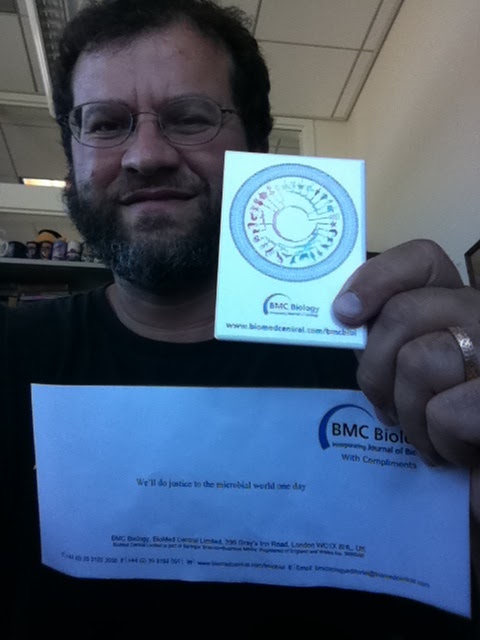
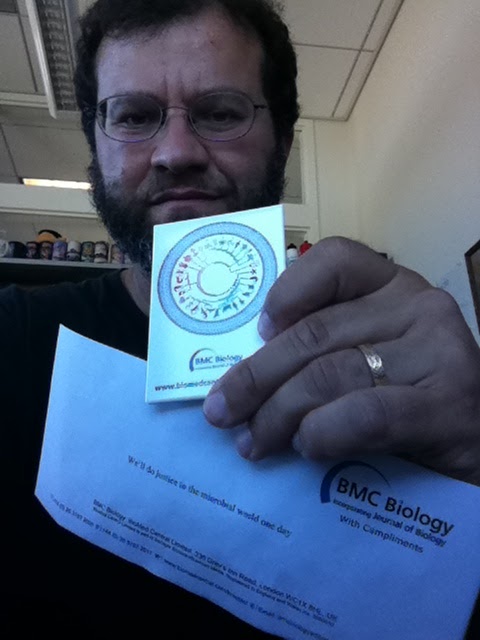
And then today in the mail I received a gift and a note
The note reads “”We’ll do justice to the microbial world one day”.
Indeed.
I note, even without their responses, I truly love Biomed Central. I published my first open access paper was published in a Biomed Central Journal, Genome Biology: http://genomebiology.com/2000/1/6/research/0011 and I have published quite a few articles in their journals including:
- Introducing W.A.T.E.R.S.: a Workflow for the Alignment, Taxonomy, and Ecology of Ribosomal Sequences
- Acidithiobacillus ferrooxidans metabolism: from genome sequence to industrial applications
- Refined annotation and assembly of the Tetrahymena thermophila genome sequence through EST analysis, comparative genomic hybridization, and targeted gap closure
- A genomic analysis of the archaeal system Ignicoccus hospitalis-Nanoarchaeum equitans
- A simple, fast, and accurate method of phylogenomic inference
- New evolutionary frontiers from unusual virus genomes
Biomed Central was THE pioneer for truly open access publications in biology and they are still doing great things. I note in addition, they do a very good job covering microbiology not only in their general journals but also with specific microbiology focused journals including:
- Annals of Clinical Microbiology and Antimicrobials
- Antimicrobial Resistance and Infection Control
- BMC Infectious Diseases
- BMC Microbiology
- Gut Pathogens
- Microbial Cell Factories
- Microbial Informatics and Experimentation
- Virology Journal
So it seems – you are already doing some justice to the microbial world.
Umm – thanks for the invitation but, umm – not going to go to this meeting
Wow. I get a lot of what one could call “Conference SPAM” with invitations to meetings that seem like nothing more than feedlots. But this one really takes the cake:
Dear Dr. Eisen JA.
It is with great pleasure that we invite you to attend the EPS Montreal International Gene Conference to be held November 3-4, 2011 in Montreal, Quebec, Canada. The conference will provide a forum for researchers in Genetics and Genomics to present cutting edge research and learn about the latest breakthroughs and technologies.
We would like to welcome you to our Conference as our valuable speaker and present your recent work and ideas of Environmental shotgun sequencing: its potential and challenges for studying the hidden world of microbes. that were published in PLoS Biol.. Please visit our website at http://www.epsglobal.ca and http://www.epswordlink.com for program details.
Montreal International Gene Conference is organized by EPS Global Medical development Inc. Professor Massaro, the editor-in-chief of the journal Cell Biochemistry and Biophysics (CBB) will be present at this event and call for submission of papers in this field. All of the papers presented in the conference may have a chance to be published in a special issue of Cell Biochemistry and Biophysics (CBB).
EPS Global Medical Development Inc. is a Canada-based biomedical consultant agency that promotes continuing academic education, knowledge transfer and scientific exchange through life sciences-oriented conferences. We are delighted to host the EPS Montreal International Gene Conference in Montreal in order to foster and promote excellence in Genetics and Genomics through education and research, and to provide leadership in promoting development of evidence-based clinical genetics and genomics as well as the basic research that supports these clinical advances.
We look forward to meeting you in Montreal and wish you all an enjoyable time.
Warmest regards,
Yao Lu, MD, PhDExecutive Chair of Montreal International Gene Conference 2011
President of EPS Global Medical Development Inc.
They are inviting me to present about a “recent” commentary paper I published in 2007. Umm – no thanks.
C-DEBI Research Support > Request for Research Proposals
![]() |
| Katrina Edwards on the Atlantis |
I have always been fascinated by life in extreme places on the planet. And somehow I have managed to do projects on microbes from places like Antarctica, boiling hotsprings in Yellowstone and Kamchatka, acid pools, and more. The extremes are fascinating to me because they tell us a lot about the limits of life as well as indirectly about life in “normal” places.
And of course, I am not alone. Many many scientists are fascinated by life’s extremes. But not everyone ends up studying life in extreme environments of course. One reason for this is that many extreme environments that might be of interest are kind of hard to study. Consider the deep sea. Not so easy to do work there and just getting samples can be a massive undertaking.
Just imagine though. What if there were a way to “tag along” on an existing project studying life’s extremes at no cost to you or your grants? Even better what if there were a way to get extra funds to not just tag along on a project but to carry out detailed research at the same time?
Well, amazingly, there is such a chance right now. The C-DEBI “Center for Dark Energy Biosphere” project is calling for proposals. C-DEBI Research Support > Request for Research Proposals
They have money. They have drills. They have been and will continue to be collecting lots of samples from the bottom of the ocean and the crust below. They are doing a bunch of microbiology (as well as other things). And they are calling for people out there to join them in various ways including;
- Research Proposals
- Research and Travel Exchange Program
- Post doc scholar program
- Graduate fellow program
- Education and outreach proposals
- http://www.darkenergybiosphere.org/return-to-northpond/
- http://aam.darkenergybiosphere.org/
- http://www.darkenergybiosphere.org/classroomconnection
- http://joidesresolution.org/node/1983
I note – I was a visiting scientist for a few days at one of the C-DEBI meetings about evolution earlier this year. It was a great meeting – on Catalina Island – and I wrote a VERY long blog post about it: The Tree of Life: A “work” trip to Catalina Island: USC, Wrigley, C-DEBI, dark energy biosphere, Virgin Oceanic, Deep Five, & more. You can learn more about the C-DEBI project by reading that post. And you can look at my pretty pictures below:
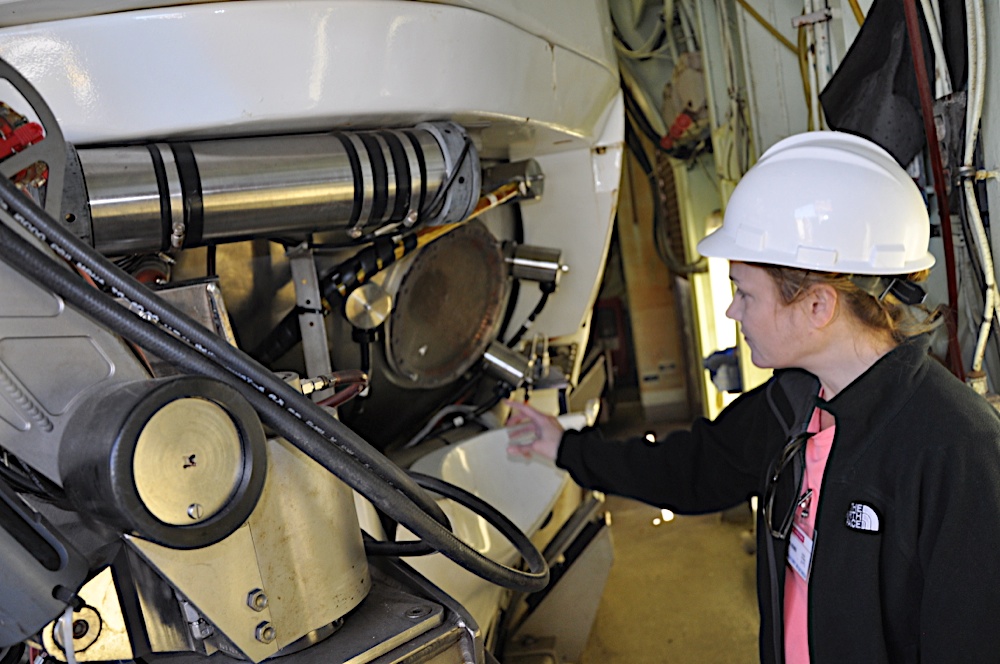
I note in addition, I am forever in debt to Katrina Edwards the PI of the C-DEBI project ever since she gave a frigging awesome tour to my kids of the Atlantis when it was docked in San Francisco
But regardless of the personal connections I have to C-DEBI, the project is very interesting and the fact that they are offering up funds to support “outsiders” who want to participate in the project in some way is great.
John Madden discussing his dog’s surgery at #UCDavis on #KCBS this AM
John Madden on KCBS this AM discussed taking his dog to UC Davis for surgery. Go Ags.
http://player.play.it/PodcastPlayer/Embed.jsplayer.render(‘fileUrl=http://www.podtrac.com/pts/redirect.mp3/nyc.podcast.play.it/media/d0/d0/d0/dY/dP/dB/dK/YPBK_3.MP3?authtok&name=Daily Madden&artist=KCBS&stationID=97&configFile=config.xml&buttonColor=grey&buttonOverColor=blue&backgroundColor=#FFFFFF&guid=6F6EAB5422C3’);
Great paper showing the potential power of comparative and evolutionary genomics in #PLoS Genetics
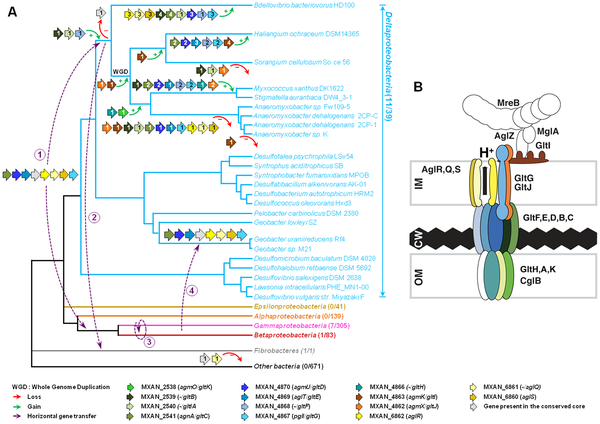
There is a wonderful paper that has just appeared in PLoS Genetics I want to call people’s attention to: PLoS Genetics: Emergence and Modular Evolution of a Novel Motility Machinery in Bacteria
In the paper, researchers from CNRS and Aix-Marseille in France used some nice comparative and evolutionary genomics analyses along with experimental work to characterize the function and evolution of gliding motility in bacteria.
Their summary of their work:
Motility over solid surfaces (gliding) is an important bacterial mechanism that allows complex social behaviours and pathogenesis. Conflicting models have been suggested to explain this locomotion in the deltaproteobacterium Myxococcus xanthus: propulsion by polymer secretion at the rear of the cells as opposed to energized nano-machines distributed along the cell body. However, in absence of characterized molecular machinery, the exact mechanism of gliding could not be resolved despite several decades of research. In this study, using a combination of experimental and computational approaches, we showed for the first time that the motility machinery is composed of large macromolecular assemblies periodically distributed along the cell envelope. Furthermore, the data suggest that the motility machinery derived from an ancient gene cluster also found in several non-gliding bacterial lineages. Intriguingly, we find that most of the components of the gliding machinery are closely related to a sporulation system, suggesting unsuspected links between these two apparently distinct biological processes. Our findings now pave the way for the first molecular studies of a long mysterious motility mechanism.
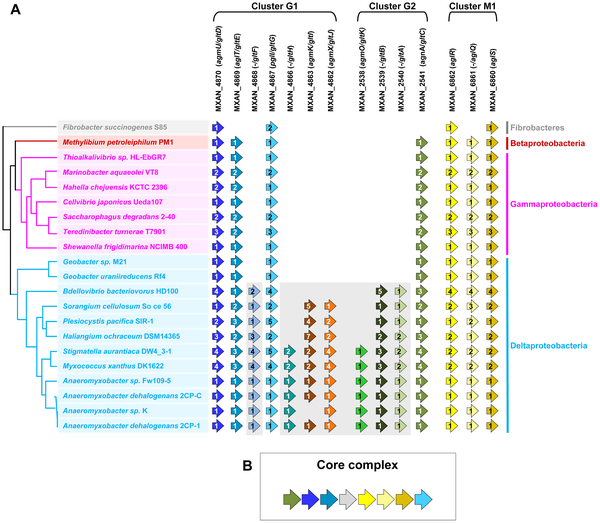
Basically, they started with some genetic and functional studies in Myxococcus xanthus. They analyzed these in the context of the genome sequence (note – I was a co-author on the original genome paper). And then they did some extensive comparative and evolutionary analysis of these genes, producing some wonderful figures along the way such as:
Based on their analysis they then came up with some hypotheses as to which genes were involved in key parts of gliding motility and what their biochemical functions were and they then went and confirmed this with experiments. I am not going to go into detail on the functional work they did but you can read their paper for more details.
They wrapped up their paper by proposing an model for the evolutionary history of gliding motility. I am not sure I buy all components of their model since our sampling of genomes right now is still very poor, but they have a pretty detailed theory captured in part in this figure:
Anyway – I don’t have much time right now to provide more detail on the paper. But it is definitely worth checking out.
Panel from Science Online London (SOLO11): Linking with the Literature – the Arsenic Story
Or see it here:
Fortunately for all I did not do skype video chat – just audio – since I was in my garage in my pajamas: Garage science: why skyping in to a meeting at 2:30 AM can be, well, interesting #SOLO11