Jop de Vrieze has written an article related to the Elsevier boycott for ScienceInsider:
Thousands of Scientists Vow to Boycott Elsevier to Protest Journal Prices
In the article, one of the things he discusses is my blog post (which I then “retracted) suggesting people ignore any papers published in Elsevier Journals: Boycotting Elsevier is not enough – time to make them invisible (UPDATED/RETRACTED).
In his article he wrote:
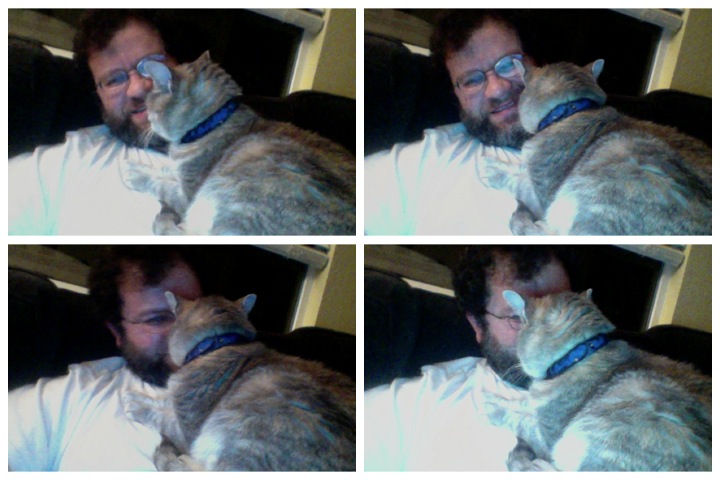
One scientist who strongly supports the boycott is Jonathan Eisen, a microbial genomicist at the University of California, Davis, and the Academic Editor-in-Chief of PLoS Biology, an open access journal. On Tuesday, Eisen urged readers of his blog to go one step further, by no longer paying attention to research published by Elsevier. “In essence, ignore them – consider them dead – make them invisible,” he wrote. But after readers protested that no paper should be ignored just because of where it’s published, Eisen quickly retracted the entire post, which he said had been written “at midnight, with a cat on my lap.” “The response to my post helped make me realize that the semi-sarcastic attempted tone was not coming through correctly,” Eisen writes in an e-mail to ScienceInsider.
de Vrieze did a good job of representing my point of view. But I thought it might be useful to all of the Q&A in the email with him. Fortunately, he said this was OK to do so … here are my full answers to his questions:
If you would have adjusted your blog, what would have been the main points your would have reconsidered?
Oh – my blog post was really just a thought question written in anger in the middle of the night. I could have written it better but in the end, the idea behind the post was wrong-headed. Any scientific publication or presentation, no matter where it is made, should be considered a contribution to science. The name of the journal or the
publisher does not matter (nor from my point of view does it matter if something is in a journal per se). Thus even though I was being a bit tongue in cheek in the post suggesting we ignore publications in Elsevier journals – clearly my tone was not coming through and I decided to retract the post.
I note – following the recommendation of Ivan Oransky who runs the Retraction Watch site I left up the original post (though I changed it
to strikethrough font) and posted an explanation for the retraction.
I also tried to chase down twitter and blog and Google+ discussions of my post to say I was “retracting” the post and to explain why and what I had been trying to say.
I also note – I had sense knocked into my head on this by people on twitter like @drugmonkey -so the response to my post helped make me realize that the semi-sarcastic attempted tone was not coming through correctly
For your article you might want to check out the discussions happening on Google+ and on Drug Monkey’s blog.
https://plus.google.com/u/0/103101121348859087349/posts/B8f1XyuY7Gk
https://plus.google.com/u/0/106772544387169323774/posts/TszquaTKeoA
What do you think is the value of this petition?
I support the petition. I think scientist’s and others (humanities too …) need to take a stand against some of the publishing policies and political actions (e.g., support of the RWA) of Elsevier. I note – I already do not review for or publish in or edit for any of their journals. And I think if 1000s of scientists really followed through on this Elsevier might be forced to change their policies.
What do you think needs to change in the system?
I should note – I am personally not against for profit companies and not agains the notion that people can make a profit off of publishing.
The problem I have is really two fold.
- I think that research and publications that are supported by taxpayer money should be made available broadly to the public.
- I think there is abundant evidence that more openness in science is beneficial to the progress of science – open data (e.g., Genbank) has revolutionized certain fields. True open access publishing frees up the literature so that not only can anyone access it but also allows anyone to remix and utilize the literature in creative ways (and potentially make a profit from doing so). Open release of software is critical for cases where software is used in scientific publications. And so on. Openness aids in the progress of science.
Thus with #1 and #2 above, I think it is imperative that we move towards more openness. The challenge is – how do we get there? And how do we pay for it? (Note – I am not saying above that being open has no cost – I am saying it is beneficial and politically wise). The problem with Elsevier in my mind is they take government subsidies that pay for journal charges, salaries of their reviewers and editors, and subscription fees for libraries – and in return – amazingly – they generally take ownership of the literature. This seems to be an unsound trade.
So – the question is – can we become more open and afford it? Yes, I think it is pretty clear that there is more than enough money being spent currently on publishing broadly that could be reallocated to open publishing. The success of PLoS and Biomed Central and the move of some societies to release publications rapidly (e.g., ASM) indicates that this is possible (though I note – Science still lags in this area).
I think we are still figuring out exactly how to set up a new system – but the old system of signing over the ownership and / or publishing rights for papers is no longer needed and it is not helpful to scientific progress.
Who should take the first, or most important steps? Scientists? Publishers? Libraries? Institutions?
Everyone. We all need to work together to come up with a system that retains the good things in the old system (e.g., scientific societies, good peer review, paper editing, etc) while being more open. We need to change hiring policies, library subscription systems, peer review, journal search algorithms, and so on.
What, if publishers like Elsevier would disappear, would give scientists a mark of quality or relevance of scientific publications?
Well – the name of a publisher and the name of a journal is a crude mark of quality at best. What should be measured is the ACTUAL quality of publications not a surrogate for quality. Certainly, everyone is busy and surrogates of quality end up being used a lot. But we need to develop systems that measure article quality better and also help people find the right articles for them. There are many examples of things in the works to help do this. The PLoS commenting system was/is an attempt at this. So is Faculty of 1000. I think post-publication peer review is going to be critical. The cream should rise to the top and the more we can do to make sure this happens quickly the better.