Eisen Lab Blog

Teaching kept me from SF Giants playoff games; StubHub glitches are keeping me from my money ..

Well, as if not going to the game wasn’t bad enough …

A few weeks ago, I managed to buy some tickets to some San Francisco Giants playoff games (for the League Championship Series and the World Series). Alas, due to teaching activities for Intro Bio at UC Davis, I was unable to go (when I bought them the dates were not yet determined). I gave some to a neighbor (a belated thank you for them allowing construction workers to use their driveway and yard for months when we had a pool built last summer). And then I sold the others on StubHub. Generally I have always loved Stubhub. Great way to get tickets. Had never sold any there before but it was pretty smooth and painless (except for the relatively large commission but that is another story) and the tickets sold fast (I listed them at ticket price).

And then I waited to payment to go to my Paypal account. And waited. And waited. I finally wrote to StubHub

“Just trying to find out why it is taking so long to get payment from something from a few weeks ago”

The response was surprising:

Dear Jonathan,

Thank you for contacting StubHub.

I understand your concern regarding your payment. I’m sorry it has been delayed. We recently experienced a technical error where MLB payments were diverted to ‘Credit My Team Account’. We are in the process of correcting these orders and issuing payments to the default payment method in the sellers account. Due to the widespread nature of this issue, it is taking longer than normal to change the payment method, as each one needs to be done manually. Unfortunately at this point, I am unable to give you a timeframe for receiving your PayPal payment. Rest assured we are working as quickly as possible on this issue.

I apologize for the inconvenience, but appreciate your business with StubHub. Please feel free to contact us if you have any further questions.

Sincerely,

Kim
StubHub Customer Service
Weekdays: 5:00AM — 9:00PM (PST)
Weekends: 6:00AM — 7:00PM (PST)
customerservice@stubhub.com
www.StubHub.com

Wow.  Glad they are trying to explain what was going on.  But just how hard can it be to correct such an error?

So I waited again.  And waited.  And then I got an email with the subject line “Payments Returned to StubHub – 11/06/2012.”   Sounded good.  Until I looked at the email.

That is right.  I got a payment of $0.  How does that even work?  A few days later I did get a notice of an ACTUAL payment for some of the money I am owed.  But some is still missing.  Clearly some sort of major IT / DB malfunctions going on at StubHub.  Anyone else have this problem?

Important & neglected aspect of lab studies of animals : effect of habitat change on microbiome

By Aaron Logan via Wikipedia 

Very very interesting paper came out recent from some colleagues at UC Davis: PLOS ONE: Routine Habitat Change: A Source of Unrecognized Transient Alteration of Intestinal Microbiota in Laboratory Mice

Abstract: The mammalian intestine harbors a vast, complex and dynamic microbial population, which has profound effects on host nutrition, intestinal function and immune response, as well as influence on physiology outside of the alimentary tract. Imbalance in the composition of the dense colonizing bacterial population can increase susceptibility to various acute and chronic diseases. Valuable insights on the association of the microbiota with disease critically depend on investigation of mouse models. Like in humans, the microbial community in the mouse intestine is relatively stable and resilient, yet can be influenced by environmental factors. An often-overlooked variable in research is basic animal husbandry, which can potentially alter mouse physiology and experimental outcomes. This study examined the effects of common husbandry practices, including food and bedding alterations, as well as facility and cage changes, on the gut microbiota over a short time course of five days using three culture-independent techniques, quantitative PCR, terminal restriction fragment length polymorphism (TRFLP) and next generation sequencing (NGS). This study detected a substantial transient alteration in microbiota after the common practice of a short cross-campus facility transfer, but found no comparable alterations in microbiota within 5 days of switches in common laboratory food or bedding, or following an isolated cage change in mice acclimated to their housing facility. Our results highlight the importance of an acclimation period following even simple transfer of mice between campus facilities, and highlights that occult changes in microbiota should be considered when imposing husbandry variables on laboratory animals.

I personally think that we as a community are going to have to come to grips with the fact that the microbial communities in / on research organisms (of all kinds) may have a profound effect on experimental results.  This may explain many of the differences seen in experiments between facilities or over time within a facility.  In general, I think either controlling the microbes more carefully in lab experiments (e.g., using defined flora) or at least monitoring them is going to be very important to best interpret studies of plants and animals in the lab (or for that matter – in the field too).  Anyway -this paper is a tiny window into one of the ways that controlling for microbiomes may be important in lab studies.

Citation: Ma BW, Bokulich NA, Castillo PA, Kananurak A, Underwood MA, et al. (2012) Routine Habitat Change: A Source of Unrecognized Transient Alteration of Intestinal Microbiota in Laboratory Mice. PLoS ONE 7(10): e47416. doi:10.1371/journal.pone.0047416

Guest post on "CHANCE" ChIP-seq QC and validation software

Guest post by Aaron Diaz from UCSF on a software package called CHANCE which is for ChIP-seq analyses.  Aaron wrote to me telling me about the software and asking if I would consider writing about it on my blog.  Not really the normal topic of my blog but it is open source and published in an open access journal and is genomicy and bioinformaticy in nature.   So I wrote back inviting him to write about it.  Here is his post:


CHANCE: A comprehensive and easy-to-use graphical software for ChIP-seq quality control and validation


Our recent paper presents CHANCE a user-friendly software for ChIP-seq QC and protocol optimization. Our user-friendly graphical software quickly estimates the strength and quality of immunoprecipitations, identifies biases, compares the user’s data with ENCODE’s large collection of published datasets, performs multi-sample normalization, checks against qPCR-validated control regions, and produces publication ready graphical reports. CHANCE can be downloaded here.

An overview of ChIP-seq: cross-
linked chromatin is sheared,
enriched for a transcription factor
or epigenetic mark of interest
using an antibody, purified and
sequenced.

Chromatin immunoprecipitation followed by high throughput sequencing (ChIP-seq) is a powerful tool for constructing genome wide maps of epigenetic modifications and transcription factor binding sites. Although this technology enables the study of transcriptional regulation with unprecedented scale and throughput interpreting the resulting data and knowing when to trust the data can be difficult. Also, when things go wrong it is hard to know where to start when troubleshooting. CHANCE provides a variety of tests to help debug library preparation protocols.

One of the primary uses of CHANCE is to check the strength of the IP. CHANCE produces a summary statement which will give you an estimate of the percentage of the IP reads which map DNA fragments pulled down by the antibody used for the ChIP. In addition to the size of this signal component within the IP CHANCE reports the fraction of the genome these signal reads cover, as well as the statistical significance of the genome wide percentage enrichment relative to control in the form of a q-value (positive false discovery rate). CHANCE has been trained on CHIP-seq experiments from the ENCODE repository by making over 10,000 Input to IP and Input to replicate Input comparisons. The q-value reported gives then the fraction of comparisons between Input sample techinical replicates that report an enrichment for signal in one sample compared to another equal to the user provided sample or greater. CHANCE identifies insufficient sequencing depth, PCR amplification bias in library preparation, and batch effects.

CHANCE identifies biases in sequence content and quality, as well as cell-type and laboratory-dependent biases in read density. Read-density bias reduces the statistical power to distinguish subtle but real enrichment from background noise. CHANCE visualizes base-call quality and nucleotide frequency with heat maps. Furthermore, efficient techniques borrowed from signal processing uncover biases in read density caused by sonication, chemical digestion, and library preparation.

A typical IP enrichment report.

CHANCE cross-validates enrichment with previous ChIP-qPCR results. Experimentalists frequently use ChIP-qPCR to check the enrichment of positive control regions and the background level of negative control regions in their IP DNA relative to Input DNA. It is thus important to verify whether those select regions originally checked with PCR are captured correctly in the sequencing data. CHANCE’s spot-validation tool provides a fast way to perform this verification. CHANCE also compares enrichment in the user’s experiment with enrichment in a large collection of experiments from public ChIP-seq databases.

CHANCE has a user friendly graphical interface.
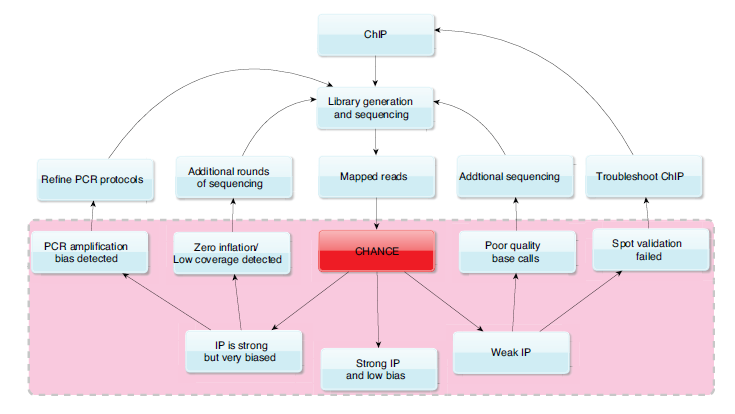
How CHANCE might be used to provide feedback on protocol optimization.

SMBE Satellite Meeting on Mechanisms of Protein Evolution II

This meeting might be of interest for people in the lab:

We are pleased to announce the SMBE Satellite Meeting on Mechanisms of
Protein Evolution II: Thermodynamics, Phylogenetics, and Structure
(MPEII 2013), to take place at the University of Colorado Denver’s
Anschutz Medical Campus, February 7-9, 2013.

The meeting aims to broadly cover the interface of protein evolutionary
mechanisms, models of amino acid substitution, genomics/systems biology
and phylogenetics. Topics also include adaptation, coevolution,
convergence, neutral processes including mutation, prediction of
folding, prediction of mutational effects, the influence of
protein-protein interactions on protein evolution, and the interaction
of next-gen sequencing and model development. This is a small meeting,
with plenty of opportunity for interaction. Talks by students as well as
more senior scientists are encouraged, and there will be a poster
session this year in addition to talks. This meeting is also partially
sponsored by BMC Evolutionary Biology and the UC Denver Department of
Biochemistry & Molecular Genetics, Program in Computational Bioscience,
and Consortium for Comparative Genomics.

Confirmed invited speakers include:
Belinda Chang, University of Toronto
Andy Clark, Cornell University
Richard Goldstein, National Institute of Medical Research (UK)
Nicolas Lartillot, University of Montreal
David Liberles University of Wyoming
Michael Lynch, Indiana University
James McInerney, National University of Ireland, Maynooth
Mary O’Connell, Dublin City University
David Pollock, University of Colorado School of Medicine
Jeff Thorne, North Carolina State University
Naomi Ward, University of Wyoming

More information and registration can be found at
http://www.proteinevolution.org. The early registration deadline is
December 15, 2012. A ski trip at Copper Mountain (CO) is being planned
for attendees in the day(s) that follow the meeting. We hope you can
join us in Denver for this event.

David Pollock, James McInerney, and David Liberles

David Liberles <liberles@uwyo.edu>

ASM Exchange Program for Early Career Scientists

Just got this e-mail – if anyone’s interested in an overseas jaunt!

Dear ASM Member,

Are you interested in traveling to the U.K. to expand your scientific network? Apply for ASM’s Heatley-Payne Exchange Program for Early Career Scientists before November 15, 2012!

This program, offered jointly with the Society for General Microbiology (SGM), provides up to $4,000 in funding for U.S. members, who have received their PhD within the past 5 years, to travel abroad to present their research at the SGM’s Annual Spring Meeting in Manchester, UK, March 25-28, 2013 and spend up to three weeks at a nearby research laboratory in the UK or Ireland.

The grant is designed to benefit young scientists by giving them the opportunity to present their work overseas and experience the best of microbiology in the partner countries.

For more information, please visit www.asm.org/international/heatley-payne.

ASM is pleased to offer these exciting opportunities; if you have any questions please contactinternational@asmusa.org. Good luck!

Best Regards,

May Chu
Chair, International Board (IB)

Gotta love those DNA extractions :)

Because I was so late to introduce myself, I can also talk about what we’ve been doing for the last few weeks. We’ve gone to the aquariums and collected samples, done some DNA extractions, and done PCR on our samples. Our samples came from salt water and fresh water tanks and include water, sediment, and gunk from the walls of the tanks. Our latest issue has come after PCR, while running the Gel. It seems like our issue might be all the way back in PCR A. I am very excited for the new aquatic systems that we will start sampling in the next couple weeks. We are hoping to start sampling the minute they load the tubs. Our hope is to sample very frequently in the first couple days because we know much of the microbial community will develop in this time. So what’s the point of that, you ask? Well we would love to study the succession of microbial communities in these new aquatic systems.  That’s all for now!

Aquarium Project

So the project is finally in full swing! After a couple of weeks of practice sampling and getting used to different protocols for extracting, purifying and amplifying the DNA, we have now moved on to working with our real samples. We have extracted DNA from 18 samples (includes replicates of 3) from the tropical tank and the cold water tank. Funnily, the hardest part of the project so far has been running gels. We initially hit a couple of problems such as thickness of the gel, a loose wire in a gel box and differences in loading buffers and dyes. However, now that Akshay is going to be coming in, hopefully he can give us a couple of hints from his experience from IGEM, cause god knows how many gels he had to make this summer 😛

Aquarium Blog Post 1 (#longoverdue)

So after a long and intense summer and first half of fall quarter, the iGEM international competition came and concluded. So now I get the chance to walk down the lab (towards the gel room!) a few more feet and start work on the aquarium project I am helping with in the Eisen Lab. I can now devote more time to the processes of the project, and not just be involved with going to retrive samples from the aquarium, and trying to figure out where we keep our Taq Polymerase. I will try and come in the lab in the next few days, and figure out the workflow and how to get this project going. I am very excited for the project as well as hoping for some actual success in our process. This is the first of many blog posts as well, so stay tuned for the next segment of our project!

Lab meeting. Tuesday Nov. 6th 2012

Lizzy Willbanks will be presenting for this week’s lab meeting. We will be meeting from 1:30 to 3:30pm in room 5206 of the genome center.

Marine Microbial Ecology Summer Course in Sydney during February 2013

See attachment for details.

SIMS-CMB summer course 2013_OCT2012.pdf