Ten simple ways to share PDFs of your papers #PDFtribute

There is a spreading surge of PDF sharing going on in relation to a tribute to Aaron Swartz who died a few days ago.  For more on Aaron and tributes to him see the collection I am making here: The Tree of Life: RIP: Aaron Swartz.  For more on the PDF sharing see this CNET story for example: Researchers honor Swartz’s memory with PDF protest and http://pdftribute.net.

I should say, sharing your PDFs is not necessarily clearly not enough (the license on the PDF may affect what people can do with them if they feel constrained to follow the law).  It is also critical to think about the level of openness of a paper, but I will save most of the comments on that for another time. What I wanted to do here is point out various ways to share PDFs for people who don’t know how …

UPDATE 1/14: See follow up post 10 things you can do to REALLY support #OpenAccess #PDFTribute

Ten simple ways to share PDFs of your papers.

1. Publish your paper in a fully #openaccess journal (so called GOLD OpenAccess).

Such journals immediately post your paper online for all to see and frequently also post your paper in various formats to repositories like Pubmed Central.  For a list of such journals see the “Directory of Open Access Journals“.  In my opinion, this is the best, and, well, really only viable long term option.  This is what I do for papers from my lab.

2. Publish your paper in a non #openaccess journal that has the option of selecting / paying for #openaccess on a case by case basis. 

Many journals that are not fully #openaccess have the option of paying extra to have your paper be published in an #openaccess manner and then the journal handles not only posting the paper on their site but also frequently depositing in a repository of their or your choosing.  UPDATE: Note – in many cases the licenses used by journals for such one-off “open” publishing are not fully open, despite what some of the journals claim so proceed with caution (see PLOS Biology: Why Full Open Access Matters for example).

3. Publish in a non #openaccess journal that releases papers to a repository after a delay.

Many journals put papers behind a paywall initially but then “free”them up in some way after a set period of delay.  For example a large number in biomedicine will deposit papers to Pubmed Central and also make them freely available on their website after 6 months.  Frequently as with #2 above, the licenses associated with such release of papers are not fully open, but this is a way to have your papers be at least accessible to others after a period of time.

4. Deposit your paper in a preprint server before you submit it for publication.  

For more on preprint servers see

Examples of commonly used preprint servers include

5. Self-archive your PDF in a repository (so called GREEEN OpenAccess).

Various repositories out there exist for posting ones papers.  They work in essence like a preprint server though some people use them more for posting papers after they have been published so I am listing them separately here.  More detail on self-archiving can be found here.  A good source of information about repositories is the Registry of Open Access repositories.  Also the Directory of Open Access repositories.  Another good source is SPARC. Also see here.

One repository commonly used in biomedicine in Pubmed Central.  Alas one is only allowed to post papers there by oneself if the work in the paper was funded by an NIH grant.

Another approach is to use arXiv as a repository where you can post things even after they are published.

Another growing venue for self-archiving is an institutional repository.  As many universities expand their commitment to open access or access university repositories are becoming a source of more and more publications.  Check to see if your institution has a repository and use it.

UPDATE: Note, just depositing your paper in a repository or preprint server does not necessarily mean your paper is open access.  Look in detail at the license and copyright policies of the archives you are considering before using them.

6. Self post your PDFs to a website you control.

If you do not have a personal website and/or do not know how to post a paper to your website, well, you should learn more about this.  A few simple ways to quickly post a PDF for others to get access to include

Create a new blog / website with a system that allows posting PDFs.  There are many many options for this.  One is Posterous.  Another is WordPress.Com.  There are certainly a million other ways.  Upload a PDF to Google Docs and then share the Google Doc link.  Post to Dropbox and share the link there.  Etc. etc. etc.  I ended up using WordPress.Com to create my lab page and to post all my PDFs.

7. Post your PDFs to an online reference collection.

Many systems now exist for collecting and collating and sharing reference collections online.  They include CiteULike, Zotero, and Mendeley.  I particularly like Mendeley right now in part because it makes it very easy to share PDFs privately or publicly.  I for example have posted all my own papers on Mendeley as well as papers of my father’s (for more on this see The Tree of Life: Freeing My Father’s Publications and Free Science, One Paper at a Time | Wired Science | Wired.com).

8. Create an academic profile page and post PDFs there.

Many systems now exist for creating a personal Academic profile of sorts.  One example is Academia.Edu. I have created a page here  Jonathan Eisen | University of California, Davis – Academia.edu although I confess I have not been updating it much.

9. Post to Slideshare.

Though many people end up only posting slideshows to Slideshare, and I use it for that purpose, I have posted many of my papers there as well. See for example:

10. Post to “Data” archives.

There is a large growing collection of places to post “Data” to share it with others.  Some of these sites also allow posting of papers.  For example, I have posted multiple papers to Figshare, a great data sharing site that can be used to post and share just about anything. I have also used Figshare for this (for example – here is my PhD thesis there).

11. Ask a Librarian. (Yes it goes to 11)

Probably the best way to figure out how to better share your PDFs if the options above don’t work for you (or even if they do) is to talk to a librarian.  They are the most knowledgable people in regard to methods and systems and other issues for sharing academic work.


Some related posts from The Tree of Life


Other ideas? Please post in comments …


RIP: Aaron Swartz (collection of news stories, articles, etc)

Aaron Swartz from the AWL

Compiling links to stories, posts, information about Aaron Swartz and his untimely death. RIP Aaron.

About Aaron

News and Posts about his death
More from 1/14
More from 1/17-22

Storifies about Aaron Swartz

PDF upload tribute

The kitten microbiome – new related paper and Mendeley collection

Saw this new paper today: Dietary format alters fecal bacterial populations in the domestic cat (Felis catus) – Bermingham – 2013 – MicrobiologyOpen – Wiley Online Library

And was reminded on the Kitten Microbiome project. It was conceived as a (sort of) joke but studying the microbes in our domestic companion animals is a good thing and could be very interesting in many ways.

So I created a Mendeley group on cat / kitten microbiome studies:
http://www.mendeley.com/groups/2960631/kitten-microbiome-oh-and-other-cats-too/widget/21/3/

Oh, and while I was at it I created a group for the Dog Microbiome.

http://www.mendeley.com/groups/2960691/dog-microbiome/widget/29/3/

Not sure these should really be completely separate (i.e., there could be a collection on the domestic animal microbiome) but am keeping them separate for now.

Interesting new #PLOS One paper on study design in rRNA surveys

Interesting new paper in PLoS One:  PLOS ONE: Taxonomic Classification of Bacterial 16S rRNA Genes Using Short Sequencing Reads: Evaluation of Effective Study Designs

Abstract: Massively parallel high throughput sequencing technologies allow us to interrogate the microbial composition of biological samples at unprecedented resolution. The typical approach is to perform high-throughout sequencing of 16S rRNA genes, which are then taxonomically classified based on similarity to known sequences in existing databases. Current technologies cause a predicament though, because although they enable deep coverage of samples, they are limited in the length of sequence they can produce. As a result, high-throughout studies of microbial communities often do not sequence the entire 16S rRNA gene. The challenge is to obtain reliable representation of bacterial communities through taxonomic classification of short 16S rRNA gene sequences. In this study we explored properties of different study designs and developed specific recommendations for effective use of short-read sequencing technologies for the purpose of interrogating bacterial communities, with a focus on classification using naïve Bayesian classifiers. To assess precision and coverage of each design, we used a collection of ~8,500 manually curated 16S rRNA gene sequences from cultured bacteria and a set of over one million bacterial 16S rRNA gene sequences retrieved from environmental samples, respectively. We also tested different configurations of taxonomic classification approaches using short read sequencing data, and provide recommendations for optimal choice of the relevant parameters. We conclude that with a judicious selection of the sequenced region and the corresponding choice of a suitable training set for taxonomic classification, it is possible to explore bacterial communities at great depth using current technologies, with only a minimal loss of taxonomic resolution.

Not sure I like everything in the paper.  For example, they focus on naive Bayesian classification methods … when (of course) I prefer phylogenetic methods.  But that is a small issue.  Overall there is a lot of useful detail in here about rRNA based taxonomic studies.  I note – some of this probably applies to metagenomic studies as well … perhaps this group will do a comparable analysis of metagenomics next?

Mizrahi-Man O, Davenport ER, Gilad Y (2013) Taxonomic Classification of Bacterial 16S rRNA Genes Using Short Sequencing Reads: Evaluation of Effective Study Designs. PLoS ONE 8(1): e53608. doi:10.1371/journal.pone.0053608

I note – if you want to catch up / learn / research metagenomics and phylogeny or classification check out the Mendeley group I started on the topic:

http://www.mendeley.com/groups/1152921/phylogenetic-and-related-analyses-of-metagenomic-data/widget/29/3/

Come all ye Citizen Microbiologists – to Denver 5/19 for ASM Meeting – abstracts due 1/15

This is going to rock.  Citizen microbiology – highlighted at the American Society for Microbiology Annual Meeting in Denver in May.  The details on the session are below.  Sunday May 19 at the American Society for Microbiology General Meeting in Denver.  If you are interested in attending Register here.  If you work on some aspect of Citizen Microbiology please consider submitting an abstract for a talk or poster. The deadline is January 15.  We will highlight ALL accepted abstracts in some way both during the session and in blogs, tweets, interviews, etc.  So please consider participating.
Citizen Microbiology: Enhancing Microbiology Education and Research with the Help of the Public OralAbstract Image
3:00 p.m.- 5:30 p.m.
Conveners:
JONATHAN EISEN; Univ. of California-Davis, Davis, CA
DAVID COIL; Univ. of California-Davis, Davis, CA
Invited Speakers:
GRAHAM HATFULL; Univ. of Pittsburgh, Pittsburgh, PA
   Carski Foundation Distinguished Undergraduate Teaching Award and Division W Lecturer
DARLENE CAVALIER; Sci. Starter, Sci. Cheerleader, Philadelphia, PA
ROB DUNN; North Carolina State Univ., Raleigh, NC
Description:
Citizen Science is a valuable way to both generate scientific data and to engage and educate a broad audience. Some areas of biology such as astronomy and ornithology have conducted multiple successful citizen science projects over the years. Surprisingly, there are not many citizen science projects in microbiology even though microbes are of interest to the majority of the public, as well as being tractable for these kinds of studies. This session will focus on citizen science in microbiology. This session will examine the diversity of Citizen Science projects, outline what makes a successful project, and highlight examples of past, current and future Citizen Microbiology projects. Speakers will also provide details on overcoming challenges in Citizen Science (e.g., visualization, permissions, privacy, standardization, informed consent). Our belief is that more projects, throughout the different domains of microbiology, could benefit from incorporating a citizen science component. Having this session at the General Meeting will help bring together people interested in this topic, as well as fostering collaboration on existing and future citizen science projects.
Sunday May 19 at the American Society for Microbiology General Meeting in Denver.  Register here.

Storify/Tweet Notes from Noah Fierer’s talk at UC Davis

//storify.com/phylogenomics/noah-fierer-talk-at-ucdavis-on-biogeography-of-soi.js?template=slideshow[View the story “Noah Fierer talk at #UCDavis on biogeography of soil microbes” on Storify]

Noah Fierer talk at #UCDavis on biogeography of soil microbes

Storified by Jonathan Eisen· Thu, Jan 10 2013 22:44:52

At #UCDavis tomorrow: Noah Fierer @NoahFierer on “Exploring Terra Incognita: the biogeography of soil microorganisms” http://shar.es/44O44Jonathan Eisen
Reminder – today 4 PM #UCDavis Seminar by Noah Fierer #microbes #microbiomes #biogeography #evolution #soil http://wp.me/ph9ob-RvJonathan Eisen
Awaiting talk at #UCDavis by @NoahFierer- starting in a few minutes “Exploring terra incognita – the biogeography of soil microorganisms”Jonathan Eisen
Introduction for @NoahFierer talk at #ucdavis refers to him as a self described expert on cooties .. this has to be goodJonathan Eisen
@phylogenomics @noahfierer Did you ever play the Cooties game? I did, now I’m an entomologist. Trapped.Jack C. Schultz
For more on work of @noahfierer (whose talk at #UCDavis I am live tweeting) see http://www.colorado.edu/eeb/EEBprojects/FiererLab/Jonathan Eisen
Now tweeting from @NoahFierer ‘s #UCDavis seminar “Exploring terra incognita: the biogeography of soil microorganisms” No eukaryotes tho :(Holly Bik
Fierer at #UCDavis defends referring to plants and animals as “macrobes” as better than calling small things microbesJonathan Eisen
Fierer at #UCDavis: 4000-2000 kg microbial biomass per hectare (from Fierer et al. 2009 Ecology letters)Jonathan Eisen
Fierer at #UCDavis: vast majority of soil microbial diversity undescribed, quotes Donald Rumsfeld as “patron saint of microbial ecology”Jonathan Eisen
Fierer at #UCDavis: example of Acidobacteria – up to 30% of bacteria in soil from this phylum yet only 5 described generalJonathan Eisen
Fierer at #UCDavis: using microbes to test principles of biogeography/ecology; using biogeography to learn about poorly understood microbesJonathan Eisen
Fierer at #UCDavis: in 2006 $10K = 400 bacteria IDd in each of 5 samples; 2012 $10K = > 10K bacteria IDd in each of 500 samplesJonathan Eisen
Fierer at #UCDavis: reduction in sequencing cost / increase in capacity allows 1st time biogeography studies of microbes on large scaleJonathan Eisen
Fierer: You can’t do ecology with 5 samples (old methods) – now costs have dropped, we can sequence 100s of samples to look at ecologyHolly Bik
Fierer at #UCDavis: dealing with this: “There is no biogeography of anything smaller than 1 millimeter” Bland Finlay Science 2005 vol 310Jonathan Eisen
Fierer at #UCDavis: collected soil samples from diverse biomes (tundra, desert, prairie, forest) & asked what calls “19th century” eco ??sJonathan Eisen
If the bacterial/archaeal people are doing 19th century ecology (as says @NoahFierer), then us eukaryote people are stuck in the dark ages..Holly Bik
Fierer at #UCDavis discussing Lauber et al. 2009 http://www.ncbi.nlm.nih.gov/pubmed/19502440 – ~1000 sequences per sample x 80 + samplesJonathan Eisen
Fierer at #UCDavis discussing this figure http://aem.asm.org/content/75/15/5111/F4.large.jpg from 2009 paper – where simple ordination did not distinguish samples wellJonathan Eisen
Fierer at #UCDavis now discussing Figure B from http://aem.asm.org/content/75/15/5111/F4.large.jpg saying that soil pH shows strong association w/ microbe Beta diversityJonathan Eisen
“@Dr_Bik: Fierer: You can’t do ecology with 5 samples costs have dropped, we can sequence 100s of samples 4 ecology” SORT OF. Whoo R U? $$$Jack C. Schultz
Fierer et al. refs http://aem.asm.org/content/75/15/5111/F3.large.jpg from 2009 paper that shows good relationship between soil pH and alpha diversityJonathan Eisen
Fierer at #UCDavis: their soil data did not show any obvious relationship to latitude, mean annual temp, or other variables looked atJonathan Eisen
Fierer at #UCDavis: their data showing relationship between pH and microbial diversity could have been due to some feature related to pHJonathan Eisen
Fierer at #UCDavis: looked at soil microbes in one biome in arctic and still had correlation with pH and diversityJonathan Eisen
Fiere at #UCDavis: refs. http://www.nature.com/ismej/journal/v4/n10/full/ismej201058a.html where even in controlled system (Rothamsted Research) pH & microbial diversity correlatedJonathan Eisen
Does pH itself drive soil microbial assemblages, or aluminum toxicity (Al and pH closely linked)? We don’t know yet says @NoahFiererHolly Bik
At #UCDavis @NoahFierer: discussing PNAS 2012 Soil paper http://www.pnas.org/content/early/2012/12/05/1215210110.full.pdf – metagenomics of VERY different soil samplesJonathan Eisen
At #UCDavis @NoahFierer: in soil metagenomic data only ~ 20% of reads could be annotated (i.e., function predicted)Jonathan Eisen
At #UCDavis @NoahFierer: in soil metagenomic data there is a weak ++ correlation between 16S PD and functional diversityJonathan Eisen
At #UCDavis @NoahFierer: desert soils VERY different from other soils in beta diversity of taxa & functionsJonathan Eisen
At #UCDavis @NoahFierer: looked are which genes were driving the major differences beta. soils in deserts & other locationsJonathan Eisen
At #UCDavis @NoahFierer quotes Willa Cather “elsewhere the sky is the roof of the world but here the earth was the floor of the sky”Jonathan Eisen
. @NoahFierer heads to 19th century graveyards to sample native prairie grass habitats for soil microbes. One of least disturbed sites..Holly Bik
At #UCDavis @NoahFierer refs paper that modelled distributions of Sasquatch http://onlinelibrary.wiley.com/doi/10.1111/j.1365-2699.2009.02152.x/abstractJonathan Eisen
At #UCDavis @NoahFierer discussing collaborative work w/ Josh Ladau from UCSF http://docpollard.com/jladau/index.html (who I collaborate w/ too)Jonathan Eisen
At #UCDavis @NoahFierer says “Microbial ecology needs more Ecologists” (emphasizes the capital EJonathan Eisen
At #UCDavis @NoahFierer: Ecology needs more microbial ecologyJonathan Eisen
Pleas frm @NoahFierer: Microbial ecology needs more Ecologists–lots of data out there, not being fully used, & lots of reinvention of wheelHolly Bik
At #UCDavis @NoahFierer: ecological restoration projects need to consider microbes as part of the storyJonathan Eisen
@phylogenomics: @NoahFierer: ecological restoration projects need to consider microbes as part of the story” or quit stupid reconstructionJack C. Schultz
@phylogenomics: At #UCDavis @NoahFierer says “Microbial ecology needs more Ecologists” (emphasizes the capital E” ) Brilliant!Jack C. Schultz
@phylogenomics Lots of reasons reconstruction is purely subjective, starting with “which era do we reconstruct?”. Not “science”Jack C. Schultz
@phylogenomics For a different take (e.g., why is YOUR reconstruction THE reconstruction?) see http://www.amazon.com/Invasion-Biology-Oxford-Mark-Davis/dp/0199218765Jack C. Schultz
Both true! – MTs: “@phylogenomics: At #UCDavis @NoahFierer: Ecology needs more MICROBIAL ecology” &”Microbial ecology needs more Ecologists”Gavin Collins
@jackcschultz sure some restoration projects have issues but the “not science” accusation makes you sound sillyJonathan Eisen

Notes from talk by Stephen J. O’Brien at #UCDavis

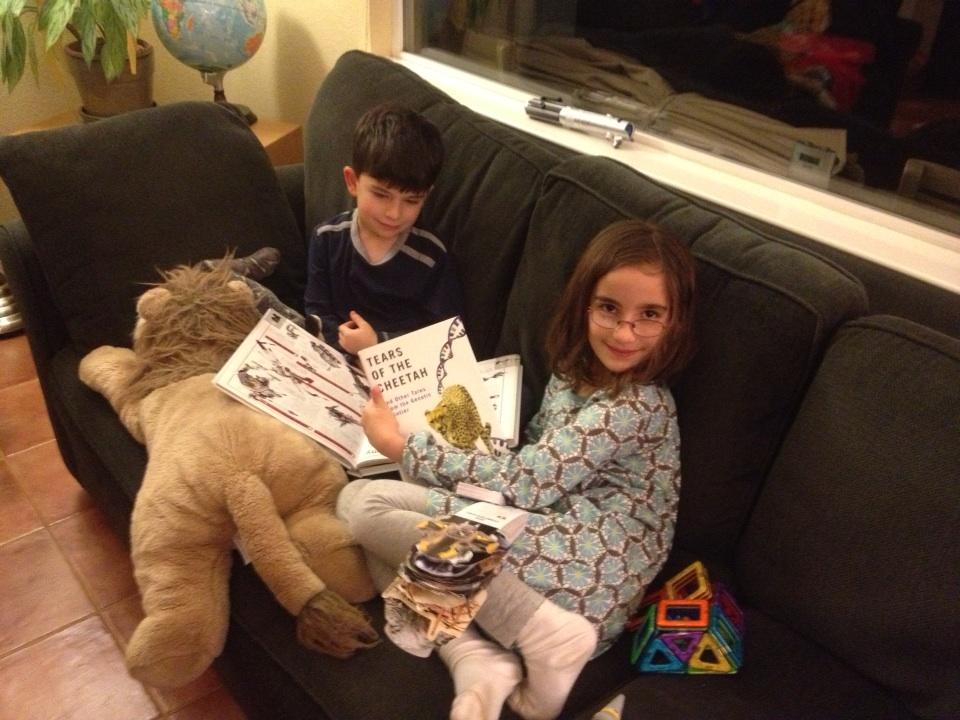
Stephen O’ Brien talked at UC Davis a few days ago. I met with him in the afternoon before his talk. It was one of the more interesting discussions I have had in a long time. He has done some very interesting and important work (e.g., comparative genomics, HIV, feline evolution) though most of what we talked about was not work per se (e.g., we talked a lot about baseball and big cats since my kids are obsessed with big cats).

Anyway, below is a “Storification” of tweets from his talk. Best part – he signed a copy of his Tears of the Cheetah: The Genetic Secrets of Our Animal Ancestors book with a dedication to my kids.
//storify.com/phylogenomics/steven-j-o-brien-talk-at-ucdavis-on-ccr5-hiv-aids.js?template=slideshow[View the story “Steven J. O’ Brien talk at #UCDavis on CCR5/HIV/AIDS” on Storify]

Steven J. O’ Brien talk at #UCDavis on CCR5/HIV/AIDS

Storified by Jonathan Eisen· Mon, Jan 07 2013 20:12:09

Today at #UCDavis Stephen O Brien on “Three Decades of Genomics and AIDS” http://pic.twitter.com/dQG4tBsoJonathan Eisen
Can’t wait for talk at 4 PM today at #UCDavis Genome Ctr by Stephen O’Brien on “Three Decades of Genomics and AIDS” http://pic.twitter.com/dQG4tBsoJonathan Eisen
@phylogenomics Wow! Interesting topic. Wish I was attending.Setor Amuzu
As an evolutionary biologist am jealous of name of Obrien’s “Theodosius Dobzhansky Center for Genome Bioinformatics” http://shar.es/4vIBYJonathan Eisen
@phylogenomics any podcasts available?Cuquis R
SJ Obrien – head of new Dobzhansky Inst – intro by Harris Lewin, discussing how Dobzhansky finished his career here at #UCDavis:Jonathan Eisen
Lewin point out that Steven O Brien has been called the Indiana Jones of Genomes (e.g.., http://www.genomenewsnetwork.org/articles/2004/03/19/tears.php ) #ucdavisJonathan Eisen
Lewin: Steven O’ Brien is also one of the coordinators of the genome 10K project http://genome10k.soe.ucsc.edu/participants #UCDavisJonathan Eisen
Steven O Brien launching into his talk at #ucdavis http://pic.twitter.com/RTadoUJmJonathan Eisen
O’Brien at #UCDavis: Giving props to T. Dobzhansky and his pioneering work on population geneticsJonathan Eisen
O’Brien at #UCDavis: discussing how population genetics help lead to many whole fields/areas incl. conservation genetics, DNA forensics, etcJonathan Eisen
Stephen J. O’Brien: is on Plagues and people Contagion Genomics & Beyond. 3 areas: Gene Discovery, Conservation Genetics, DNA forensicsDawei Lin
O’Brien at #UCDavis: began work on AIDS epidemic partly as model for way to connect human genetics and infectious diseaseJonathan Eisen
O’Brien at #UCDavis: close to 30 million people have died of AIDS and close to 30 million more are infected w/ HIV & disease still spreadingJonathan Eisen
@Curosik don’t think soJonathan Eisen
O’Brien at #UCDavis: heterogeneity in progression in HIV led him to try to use advances in human genetics to look for AIDS restrictive genesJonathan Eisen
SJO: Oct. 1996 AIDS quilt is a symbol of the pandemic disease with 40K Tabard Emblems on that day at the Capitol Hill.Dawei Lin
O’Brien at #UCDavis: early in AIDS epidemic got access to samples from different groups of people to test role of human genes in progressionJonathan Eisen
O’Brien at #UCDavis: looked for genetic variation in AIDS resistance, progression rate, outcomes, response to HAART therapyJonathan Eisen
O’Brien at #UCDavis: in 1996 5 groups discovered that CCR5 (a G coupled seven transmembrane receptor) was target of HIV for cell entryJonathan Eisen
O’Brien at #UCDavis: looked for CCR5 mutations in cohorts of patients w/ HIV & found that homozygous mutations were protectiveJonathan Eisen
SJO: CCR5 is the binding target for HIV. People with CCR5 delta with a 32 peptide deletions do not have HIV infections.Dawei Lin
O’Brien at #UCDavis: those people heterozygous for CCR5 deletions showed slower progression of HIV infectionJonathan Eisen
@phylogenomics would love to see the stats methods on thatLewis Lab
@Lewis_Lab seems to be relatively old data …Jonathan Eisen
Obrien at #UCDavis: many scientists occasionally like to do more than publish in a good journal, some would like to translate to bedsideJonathan Eisen
SJO: People study genes about infectious diseases should not stop at publishing on a good journal, should bring it to the bedside.Dawei Lin
Obrien at #UCDavis: re: delta32 mutation in CCR5 and modifies Dobzhansky “nothing in medicine makes sense except in light of evolution”Jonathan Eisen
Obrien at #UCDavis: discussing how frequency of CCR5 delta32 mutation has increased rapidly over time; suggest this is due to ++ selectionJonathan Eisen
@phylogenomics I’m not seeing any open access/open data reports.Lewis Lab
Obrien at #UCDavis: 20 mutations in CCR5 have been found outside of delta32 mutation; 18/20 are amino acid changing; suggests ++ selectionJonathan Eisen
SJO: 1/5 people now is CCR5 delta 32 carriers. There are 22 variants. 18 of them changes peptides.Dawei Lin
Obrien at #UCDavis: Suggests something influenced CCR5 mutations prior to AIDS epidemic (admits much of his theories on this controversial)Jonathan Eisen
OBrien at #UCDavis now reading from Tears of the Cheetah http://www.amazon.com/Tears-Cheetah-Genetic-Secrets-Ancestors/dp/0312339003 his book on genetics / genomicsJonathan Eisen
O’Brien at #UCDavis: suggests that bubonic plague may have influenced CCCR5 mutation frequencies over timeJonathan Eisen
O’Brien at #UCDavis: discussing plague epidemic in 1665 and 1666 (reading from his book)Jonathan Eisen
@phylogenomics that got me the statistical test I was looking for–thanks. I don’t find the article very intuitive, thoughLewis Lab
O’Brien at #UCDavis: discussing their estimates of the age of the CCR5 delta 32 mutations by looking at the size of the linkage groupJonathan Eisen
O’Brien at #UCDavis: estimates of the date of the origin of the spread of the CCR5 delta 32 mutation is correlated w/ plague epidemicJonathan Eisen
O’Brien at #UCDavis: many many waves of plague epidemics over time (though he notes many other possible epidemics also at same general time)Jonathan Eisen
@phylogenomics thanks. This is a good case study for the stats class.Lewis Lab
@phylogenomics O’Brien suggests that bubonic plague may have influenced CCCR5 mutation frequencies” No doubt a 1-2 insC mutation.Donald Atkinson
SJO: Conspiracy theories of black death cause CCR5 mutation hike, which mostly found in Caucasians.Dawei Lin
O’Brien at #UCDavis: refs a 2004 Nature study of mice w/ CCR5 delta 32 homozygous mutation; -/- have 90+% reduction in Y.pestis uptakeJonathan Eisen
O’Brien at #UCDavis: after 9/11 & anthrax attack collaborated w/ people to look at smallpox infection in CCR5 delta 32 mutant cellJonathan Eisen
“The O’Brien at #UCDavis” stream of tweets by @phylogenomics is fascinating. Must-read for biology folks.Rob Quarles
@phylogenomics What is his book? I show the PBS vid he was in few years ago to my molec epi class each year to discuss CCR5/plague/HIVTara C. Smith
O’Brien at #UCDavis: many other viruses have been screened for whether they make use of CCR5Jonathan Eisen
@phylogenomics thanks for tweets re O’Brien lecture. Say hi to Steve for me!Kathy Belov
Obrien at #UCDavis: delta 32 mutations in CCR5 may lead to higher risk to West Nile virus …Jonathan Eisen
SJO: people with homozygous CCR5 delta mutations are susceptible to West Nile virus, not HIV.Dawei Lin
Obrien at #UCDavis: looking back to 1996 b/c this is when HAART therapy for HIV was startedJonathan Eisen
Obrien at #UCDavis: showing slide from Tony Fauci of FDA Approved antiretroviral drugs; now many new drugs going after CCR5 interactionJonathan Eisen
@phylogenomics cool! I will order it.. Thanks for the link!Cuquis R
@phylogenomics thanks!Tara C. Smith
Obrien at #UCDavis: discussing “The Berlin Patient” (see http://articles.latimes.com/2012/jul/27/news/la-heb-hiv-cure-aids-meeting-20120727); had AML; prognosis bad; bone marrow tplant from CCR5delta32Jonathan Eisen
OBrien at #UCDavis: 2008 Gero Hitter – the doctor for “The Berlin Patient” shows up at AIDS conference; news finally comes out in WSJ 2008Jonathan Eisen
Obrien at #UCDavis: here is the WSJ news story about The Berlin Patient http://online.wsj.com/article/SB122602394113507555.htmlJonathan Eisen
Obrien at #UCDavis: says the story of the Berlin patient is an anecdote; emphasizes it is one patient; need more information / data / casesJonathan Eisen
Obrien at #UCDavis: refs SciAm article http://www.scientificamerican.com/article.cfm?id=blocking-hivs-attack where gene therapy for HIV patients reported; he’s skeptical about peer reviewJonathan Eisen
Obrien at #UCDavis: some researchers have been looking at how CCR5 might influence Graft Versus Host Disease (see http://www.nejm.org/doi/full/10.1056/NEJMc1209665)Jonathan Eisen
Obrien at #UCDavis refs new Nature paper showing CCR5 is a receptor for MRSA leukotoxin (see http://www.sciencedaily.com/releases/2012/12/121214191518.htm)Jonathan Eisen
@KathyBelov will do …Jonathan Eisen
SJO: Patients with bone marrow transplants with CCR5 negative genotypes remain HIV free without drug treatments. A potential breakthrough.Dawei Lin
Obrien at #UCDavis giving props to George W. Bush for PEPFAR program http://www.pepfar.gov http://www.avert.org/pepfar.htmJonathan Eisen
Obrien at #UCDavis: OBrien ends his talk by thanking the patients who have provided samples cc: @rebeccasklootJonathan Eisen
Question at Obrien talk at #UCDavis: is CCR5 delta 32 the only restriction mutation? Obrien says yes but not yet translated to bedsideJonathan Eisen
Comment at talk by Obrien at #UCDavis: primate center at UCDavis played a major role in work on HIVJonathan Eisen
Comment at Obrien talk at #UCDavis: says to students in crowd that you have heard a talk about thinking which most people don’t do anymoreJonathan Eisen
@phylogenomics Nice. He definitely saw importance of donor appreciation/respect differently than most in the early days.Rebecca Skloot
@phylogenomics I wanna know what happened to his amazing frozen zoo at NCI! Hope he took it w/him; he worried re who would take care of itRebecca Skloot
@RebeccaSkloot he did not discuss this …Jonathan Eisen
Love @phylogenomics tweets on O’Brien’s talk at #UCDavis. Everything he said on CCR5/HIV/Berlin pt is right up my alley.Nathalia Holt
My kids are very happy w/ autographed copy of “Tears of the Cheetah” Steven O Brien gave me after his talk at #ucdavis http://pic.twitter.com/SCEh5AXkJonathan Eisen
As follow up to post about “Tears of a cheetah” – my kids are a bit obsessed w/ big cats … http://pic.twitter.com/M82V4fiHJonathan Eisen
@phylogenomics How do the cats get along with all the microbes?Cindy Manson
@CynthiaManson1 extremely well http://pic.twitter.com/joOoehUWJonathan Eisen

Reading in detail Carl Woese’s 1998 "Manifesto on Microbial Genomics" for the first time …

I am a bit stunned by this paper from Carl Woese in 1998 which I was aware of but have not read in detail until now: ScienceDirect.com – Current Biology – A manifesto for microbial genomics

I re-discovered it because I am making a compilation of papers by Woese in relation to the tribute page I have set up.  And the title (a manifesto about microbial genomics) combined with the date (1998 – early in the genome sequencing era) struck me as something worth looking at.  Plus I knew others (e.g., Phil Hugenholtz, Nikos Kyrpides, …) had mentioned this paper to me so I figured – hey – how about actually reading it in detail.  And fortunately it is freely available at the Current Biology web site (not sure why that is actually).  Anyway – what I found in the paper is basically an argument for much of my career from 1998-2008.

Some choice lines in here but the crux is as follows

The first order of business in microbial genomics should be a phylogenetically representative genomic screen of the microbial world. In other words, all the major microbial taxa and their subdivisions — which are the major source of biological diversity on Earth — should be represented by several genome sequences. There are now more than 30 recognized major eubacterial taxa — each the phylogenetic equivalent of a eukaryotic kingdom — and at least half that number in the (far less well characterized) Archaea; not to mention the yet-to-be-discovered kingdoms among the unicellular eukaryotes.

This basically lays out the Tree of Life project I co-ran at TIGR and the Genomic Encyclopedia of Bacteria and Archaea project I co-ran / run at the DOE JGI.

The ending is perfect

This is not the place to go into the specifies of which microbial genomes would be most useful. I would suggest, however, that a phylogenetic tree hang on the wall of every laboratory in which microbial genomes are being sequenced — for inspiration.

Somehow I had missed the crux of this paper until now.  I think it is worth reading by everyone out there working on microbes and/or their genomes.

Oh – and here is the compilation of Woese’s papers I am making in Mendeley.

http://www.mendeley.com/groups/2940711/papers-by-carl-woese/widget/21/3/

Water Chemistry 10 Commandments

So for this aquarium project we have been doing a ton of water chemistry (over 50 hours so far).  Along the way we’ve learned a number of lessons the hard way and so have written up a set of “Water Chemistry 10 Commandments”.  I’m posting them here for both the current students or for anyone else doing water chemistry analysis.

1. Wear gloves! (seriously… reagents include mercury, corrosives, and carcinogens)

2. Double-check all reagents!!! For example “sulfuric acid” ≠ “sulfamic acid”.  Likewise “phosphorus” ≠ “phosphate”.

3. Be sure your measurement is within the range of the test.

4. Be sure to keep track of “ppm” versus “ppb”!

5. Replace the cap of each solution immediately! Spills are expensive, hazardous, and annoying.

6. Rinse all glassware with the sample to be measured before conducting an assay

7. Always rinse everything between measurements and assays.   The pH meter should be rinsed in tapwater, everything else should be rinsed in DI water.

8. Dilutions should be performed with DI water.  Be sure to measure the concentration of whatever you’re testing in the DI water first so that you can subtract the background.  The blank needs to be of the diluted solution as well!

9. Keep cuvettes clean!  Clean before each use… wipe with a Kimwipe immediately before placing in detector.

10. If you get an anomalous measurement: do it again twice more.  Sometimes things really do change but if you’ve been getting ammonia measurements between .5ppm and 1ppm for days and then all of a sudden you see 25ppm… it’s worth making absolutely sure!

RIP Carl Woese: Collecting posts / notes / other information about my main science hero here

My tribute to Carl Woese 12/30/12

Sadly, Carl Woese has passed away.  I am collecting some links and posts about him here in his memory.  He was without a doubt the person who most influenced my career as a scientist.

News stories about Woese’s passing

Some of my posts about Woese

Woese Tree of Life pumpkin (by J. Eisen)

Storification of Tweets and other posts about his passing //storify.com/phylogenomics/rip-carl-woese.js?template=slideshow[View the story “RIP Carl Woese” on Storify]

Other posts worth reading about Woese’s passing

Some videos with Woese 


Miscellaneous

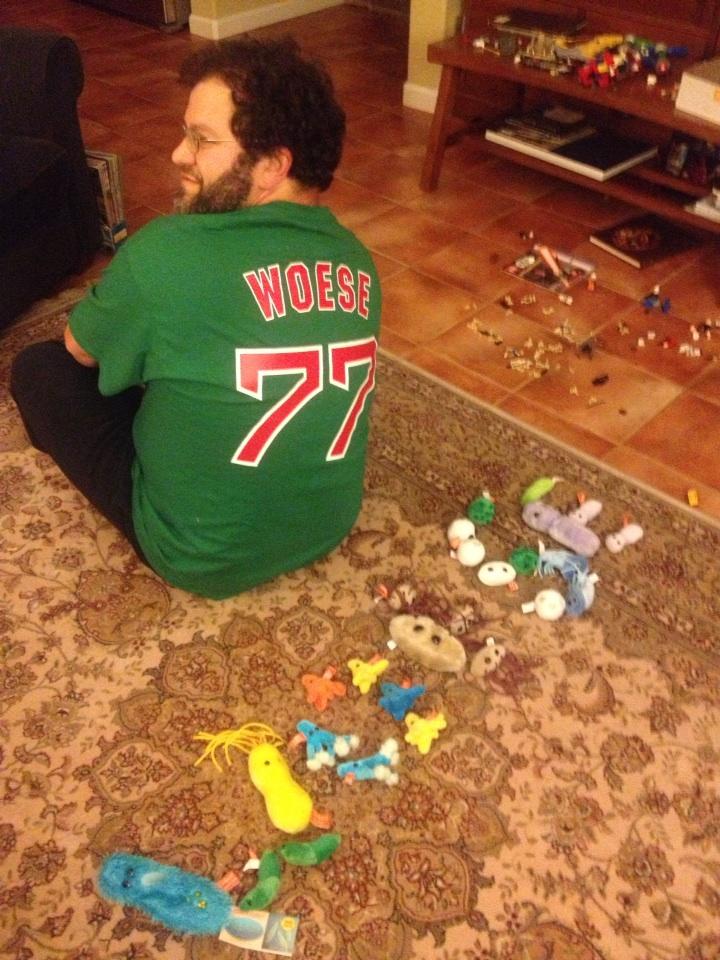
My graduate student Russell Neches used a laser to etch a picture of Carl Woese on a piece of toast.

http://www.mendeley.com/groups/2940711/papers-by-carl-woese/widget/21/3/